
Most advice on how to get into house flipping starts in the wrong place. It starts with paint colors, distressed properties, or the thrill of finding a bargain. The starting point is capital structure.
A flip is a short-term business project secured by real estate. If your financing is too slow, too rigid, or too thin, even a good property can turn into a bad outcome. New flippers usually don't fail because they couldn't spot outdated cabinets. They fail because they underbought their time, underfunded the rehab, or ran out of liquidity halfway through the job.
The operators who last tend to do four things well. They buy right, finance smart, manage tightly, and exit without drama. Everything else is secondary.
The Reality of Real Estate Flipping Today
TV still sells flipping like a fast payday. Buy ugly house. Renovate. List. Collect check. Real projects don't work that cleanly, and current market conditions punish sloppy underwriting.
Recent ATTOM-based reporting found that in 2025 the average gross profit per flip fell to $65,981, down from $77,000 the year before, while average ROI slipped to 25.5%, the lowest level since 2008. The same reporting said returns were down year over year in 70% of the metros studied, according to Realtor.com's coverage of ATTOM data.
That doesn't mean flipping is dead. It means the easy margin is gone.
What that changes for beginners
A thinner margin changes how you should approach your first deal. You can't count on a rising market to cover bad math, a weak contractor, or a delayed resale. You need a deal that still makes sense if the project takes longer than planned or the buyer pool is slower than expected.
Practical rule: Treat every flip like a business with a narrow operating window, not like a windfall.
That mindset changes your behavior fast. You stop chasing dramatic before-and-after projects and start asking harder questions. Is the scope clear? Can the property sell to the actual buyers in that neighborhood? Can your financing keep up with the pace the project requires?
The four parts that matter
For a first-time flipper, the job is simple to describe and hard to execute:
- Buy with margin: The purchase has to leave room for rehab, carrying costs, selling costs, and mistakes.
- Use the right loan structure: Speed matters, but so does preserving cash for draws, surprises, and extensions.
- Control the rehab: Scope drift destroys profit faster than almost anything else.
- Choose the exit early: If you don't know whether you're planning to sell or hold, your decisions get worse from day one.
A lot of beginner content focuses almost entirely on finding deals. That's incomplete. A deal isn't real until it's financeable, executable, and sellable.
If you're serious about learning how to get into house flipping, stop thinking like a shopper and start thinking like an operator.
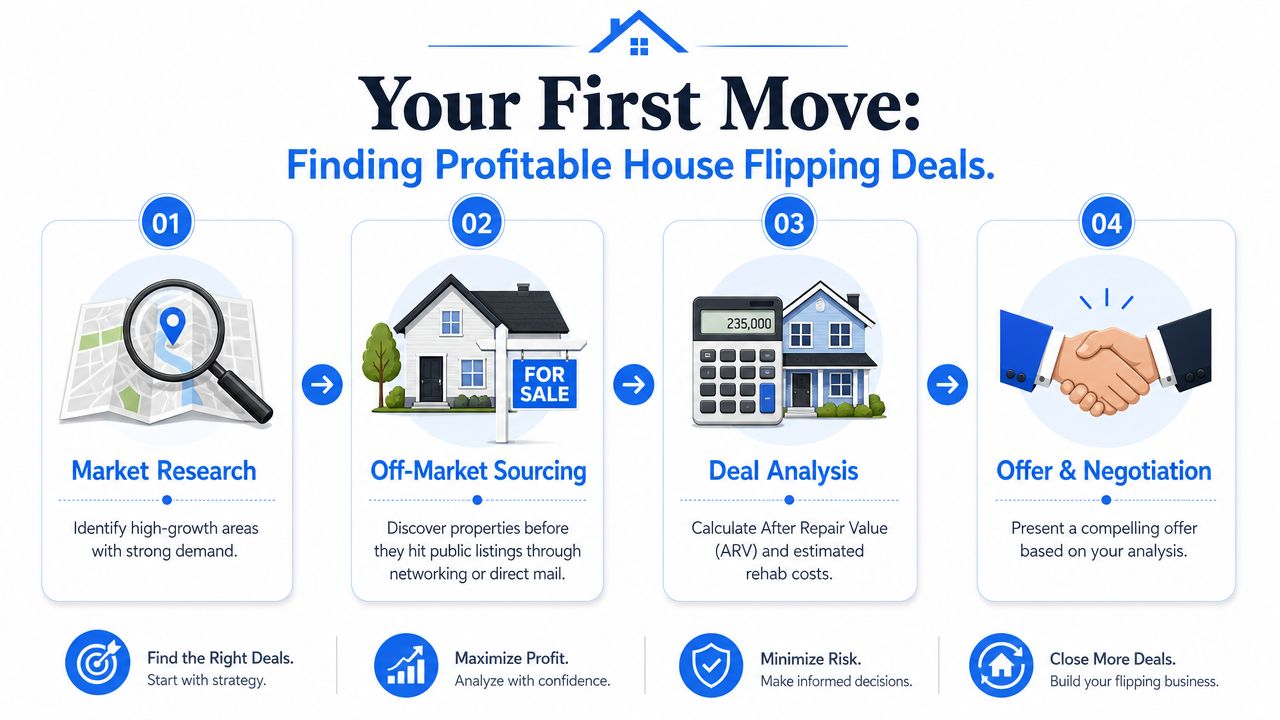
Your First Move Finding and Analyzing Profitable Deals
The first property you flip shouldn't be the most dramatic one you can find. It should be the one you can underwrite with confidence.
That usually means a house with a resale story you can understand. Good neighborhood. Clear comparable sales. A renovation scope that improves the property without changing its identity. For beginners, cosmetic and light-rehab projects are usually easier to estimate and easier to exit than full structural jobs.
Start with the resale, not the purchase
New investors often fall in love with the discount. Professionals start with the likely resale value.
That resale estimate is your after-repair value, or ARV. To estimate it, look for recently sold renovated homes that match the subject property as closely as possible in location, size, layout, and buyer appeal. If the best renovated homes in that pocket sell quickly and at predictable prices, you have a cleaner target. If the comps are scattered or inconsistent, your risk goes up.
Once you have a believable ARV, work backward.
Use the 70% rule as a filter
A common shortcut is the 70% rule, which says an investor should pay no more than 70% of the after-repair value minus repair costs, as explained in Rocket Mortgage's overview of the 70% rule.
Rocket Mortgage gives a simple example with a property expected to be worth $500,000 after renovation. Using the rule, the maximum total purchase price would be $350,000 before accounting for repair costs. The same source also gives a worked example of $220,000 ARV x 0.70 – $40,000 repairs = $114,000 as the maximum buying price.
That matters because the formula forces discipline before emotion enters the deal.
Here's how to apply it in practice:
- Estimate ARV from real sold comps: Don't use active listings as your anchor.
- Build a repair budget from contractor input: Seller guesses aren't underwriting.
- Apply the rule: ARV x 0.70, then subtract repair costs.
- Check the all-in business case: If the number doesn't leave room for fees and carrying costs, pass.
A first pass isn't a green light. It's a filter that helps you avoid overpaying before you spend more time and money on diligence.
What works and what doesn't
The best beginner deals usually share a few traits:
- Simple value-add: Paint, flooring, kitchens, baths, fixtures, curb appeal.
- Clear buyer profile: You know who will likely buy it when finished.
- Predictable comps: Renovated sales nearby support your ARV.
- Clean scope: Fewer unknowns hidden behind walls and under slabs.
What usually doesn't work for a first project:
- Complicated layouts: Reconfigurations introduce cost and permit risk.
- Unclear resale ceiling: If the neighborhood doesn't support your finish level, you're overspending.
- Contractor-light budgeting: If you haven't walked it with trades, your numbers are soft.
- Offer-first analysis: Speed matters, but blind speed is expensive.
If you want to pressure-test the math before you offer, a fix and flip loan calculator can help you see how financing, rehab costs, and exit assumptions affect the deal.
The Engine of Your Flip Securing Smart Financing
Most beginner guides assume you already have enough cash to buy, renovate, carry, and sell a property. That assumption knocks a lot of capable investors out before they start.
Mainstream beginner content often explains the purchase formula but stops short of showing how to combine cash, short-term financing, and staged rehab draws in a way that preserves liquidity through the project lifecycle, a gap noted in The Home Depot's beginner guide to flipping houses. That's where financing stops being a background detail and becomes the operating system of the flip.
Why traditional bank financing often isn't the right fit
A bank loan can work well for stabilized, owner-occupied property. A flip is different. You're moving on a short timeline, buying an investment property, and often taking on a house that isn't in condition for conventional financing.
Banks tend to struggle with that combination. Their process is built for standard documentation, clean property condition, and timelines that don't always match competitive acquisitions. In a flip, speed matters twice. It matters when you buy, and it matters when you need rehab money released without friction.
What private and hard money actually do
Private and hard money loans aren't magic. They're tools.
A bridge loan is short-term financing used to acquire or refinance a property quickly while you execute a near-term plan. A fix-and-flip loan is a short-term investment property loan designed around acquisition plus renovation, usually with rehab funds released in stages as work is completed.
That staged structure matters. Instead of tying up all your cash in the rehab on day one, you can preserve liquidity and draw funds as milestones are met. That gives you more flexibility if a project runs into permit delays, change orders, or a slower-than-expected resale.
Borrowers usually focus on rate first. On a flip, the bigger question is whether the loan structure helps you finish the project without starving the project.
Compare the financing options
| Feature | Traditional Bank Loan | Private / Hard Money Loan |
|---|---|---|
| Speed to close | Often slower and more process-heavy | Built for faster closings on investment property |
| Property condition tolerance | Usually prefers cleaner, financeable condition | More flexible on distressed or rehab-ready assets |
| Rehab funding | Often limited or handled outside a simple flip structure | Commonly structured with staged rehab draws |
| Underwriting focus | Heavy emphasis on borrower profile and conventional guidelines | Strong focus on asset, exit plan, and project viability |
| Fit for first-time flippers | Can be difficult if the deal needs speed or construction coordination | Often more practical when timing and flexibility matter |
This isn't an argument that private money is always better. It's an argument that it often fits the job better.
How to structure your capital without overleveraging
The most practical way to think about your first flip is to separate the project into buckets:
- Acquisition funds: What gets the property closed fast.
- Rehab funds: What pays contractors and materials in phases.
- Cash reserve: What protects you when the project doesn't move perfectly.
- Carrying and selling costs: What keeps the project alive until exit.
Beginners often make one of two mistakes. They put too much cash into the down payment and have too little left for the rehab. Or they overextend their financing and have no reserve when the timeline slips.
The healthier approach is to keep your own liquidity available for the parts of the deal that don't ask permission before showing up. Utility bills, insurance, permit issues, extra labor, cleanup, extension time, staging, price reductions. Those costs don't care that your spreadsheet looked clean at closing.
For investors looking at short-term funding built around acquisition and renovation, fix and flip loans are one option to evaluate, including structures that pair bridge-style speed with rehab draws. The key is not the brand name of the loan. It's whether the terms match the way the project will unfold.
What to ask any lender before you commit
Don't just ask whether you're approved. Ask how the loan behaves after closing.
- How are rehab draws handled? You want a clear process, not vague promises.
- What does the lender need from your scope of work? Detailed paperwork upfront prevents disputes later.
- How does the lender view first-time operators? Some are comfortable if the deal and team are strong.
- What happens if the project needs more time? You need to know before you sign.
- Can the lender move at acquisition speed? A good deal can die while financing drifts.
A fast closing helps you win the property. A workable draw process helps you finish it. For new flippers, both matter.
Execution is Everything Building Your Team and Managing the Rehab
Buying right gets the project started. Execution decides whether the margin survives.
The easiest way to ruin a decent flip is to treat the rehab like a side task. It isn't. Every day the property sits unfinished, you carry more cost and more exposure. That doesn't mean you need to swing a hammer yourself. It means you need a team, a scope, and a system for decisions.

Build the right team before demo starts
Your first flip doesn't require a huge bench. It requires dependable people in the right roles.
At minimum, line up:
- A general contractor or lead tradesperson: Someone who can price work clearly and communicate consistently.
- A real estate agent who understands investor resale: Retail listing skill matters at the back end.
- A lender contact who understands draw requests: Smooth funding depends on documentation and timing.
- A title and escrow team familiar with investment transactions: Delays often come from paperwork, not construction.
If a contractor can't explain the sequence of work, doesn't document changes, or disappears during estimating, that's a warning. Beginners often shop for the cheapest bid. A better test is whether the contractor can finish on time, invoice cleanly, and flag problems early.
Write a real scope of work
A vague rehab budget creates vague results. Your scope of work should break the job into rooms, trades, and deliverables. It should show what gets repaired, replaced, painted, cleaned, or left alone.
A workable scope usually includes these categories:
- Exterior items: Roof, paint, landscaping, fencing, doors, windows, drainage.
- Interior finishes: Flooring, cabinets, countertops, tile, fixtures, appliances, paint.
- Mechanical items: Electrical, plumbing, HVAC, water damage remediation.
- Punch list items: Final touch-ups, debris haul-away, deep cleaning, staging prep.
If a line item can't be inspected, billed, or verified, it probably isn't defined well enough.
Material selection belongs in the scope too. That's especially important for finishes buyers notice immediately. Flooring is a good example. You don't need premium choices in every neighborhood, but you do need durable, resale-appropriate ones. If you're weighing finish levels, it helps to compare profitable flooring options before ordering materials.
Manage draws, permits, and change orders
Construction draws sound simple until the paperwork starts. In practice, you complete a defined portion of the work, document it, submit the request, and wait for release according to the lender's process. That means your scope and budget need to align with how the draws will be reviewed.
A clean draw process usually depends on three habits:
- Document completed work with photos and invoices.
- Keep the original scope and approved changes organized.
- Submit requests promptly instead of batching chaos at the end.
Permits are another place beginners lose time. If the job requires permits, handle that early and build the timing into your schedule. Trying to shortcut compliance often creates larger delays later, especially when a buyer, appraiser, or inspector flags work that wasn't handled properly.
This short walkthrough is useful if you're trying to visualize how experienced investors think about the rehab process and timeline:
The rehab phase is active management. Walk the property. Compare progress to the scope. Approve changes carefully. A flip doesn't need perfection. It needs controlled decisions.
Cashing Out Planning Your Exit Strategy
The exit should shape the deal before you buy it. If you only start thinking about the end after the rehab is done, you're late.
Most flippers have two practical paths. Sell the property and take the profit, or refinance and keep it as a rental if the numbers and market support that move. Both can work. They solve different problems.
Selling for a faster turn
If your plan is to sell, price discipline matters as much as rehab discipline. A finished property that sits too long starts draining profit through carrying costs and often invites price cuts.
PropertyRadar reports that the average hold time for a flip is about 166 days, which is a useful reminder that speed and cost control drive results because any delay increases carrying costs and exposes the investor to market price swings, as noted in PropertyRadar's discussion of flipping homes in an uncertain market.

A clean resale usually comes from doing ordinary things well:
- Price to the local buyer pool: Don't price from pride.
- Finish for the neighborhood: Over-improving can trap your equity.
- List with sharp presentation: Good photos, clean staging, and a ready property reduce friction.
- Respond fast during escrow: Repairs, disclosures, and buyer questions can stall a closing if no one is driving them.
Refinancing and holding
Sometimes the better move is not to sell. If the property would perform well as a rental and the refinance proceeds allow you to recover capital, holding can make sense.
This path works best when you bought well, kept the rehab practical, and ended with a property tenants will want without constant maintenance drama. The appeal is different from a flip sale. Instead of one lump-sum outcome, you're moving into a longer operating cycle that depends on leasing, reserves, management, and debt service.
A hold strategy only works when you actually want to own the asset after the dust settles. It isn't a rescue plan for a project you mispriced.
How to choose between the two
Ask these questions before the rehab is done:
| Decision point | Sell | Refinance and hold |
|---|---|---|
| Primary goal | Recover cash and redeploy quickly | Keep the asset for long-term income potential |
| Best fit | Strong resale demand and clean retail exit | Property also works as a durable rental |
| Main benefit | Faster capital turnover | Ability to retain the property instead of liquidating |
| Main risk | Price reductions if the home sits | Ongoing ownership responsibilities |
The important part isn't picking the fashionable strategy. It's choosing the one your deal supports. Good operators decide that early, then renovate and finance accordingly.
Your Next Steps to Becoming a House Flipper
If you want to know how to get into house flipping, strip the idea down to its working parts.
Buy a property with margin. Use financing that matches the pace and messiness of a real rehab. Control the project with a defined scope and a reliable team. Decide your exit before you need one. That's the business.
What doesn't work is jumping straight to the exciting part. New counters, demo day, the listing photos. Those are outcomes. Actual work happens in underwriting, reserves, draw management, and everyday decisions that keep a project moving.
For most first-time flippers, the biggest obstacle isn't motivation. It's figuring out how to structure the deal without draining every dollar of available cash. That's why financing matters so much. The right loan doesn't replace discipline, but it can give you the speed and flexibility that traditional financing often can't.
If you're evaluating your first project, don't start by asking whether the house looks flippable. Ask whether the deal can survive the ordinary problems that flips tend to face. If the answer is yes, you're looking at something real.
If you're working through a potential investment property deal and need a practical read on financing options, LendingXpress can be a useful next conversation. A quick discussion around purchase price, rehab scope, timeline, and exit plan can help you see whether the deal is structured well before you commit.