
You've got a deal under contract, the numbers look workable, and then the key question shows up fast. How much down payment for investment property do you need to close without scrambling for cash at the last minute?
Most investors hear some version of “plan on 20% down” and stop there. That shortcut causes problems. A more accurate answer depends less on the property itself and more on the financing path, how the lender views risk, and whether you're buying a stabilized rental, a value-add project, or something a bank won't touch.
For non-owner-occupied properties, cash planning needs to be tighter than most first-time investors expect. Serious buyers don't just ask about the down payment. They ask how the whole capital stack fits the deal, how quickly the loan can close, and whether the lender can handle a property that doesn't fit clean bank guidelines.
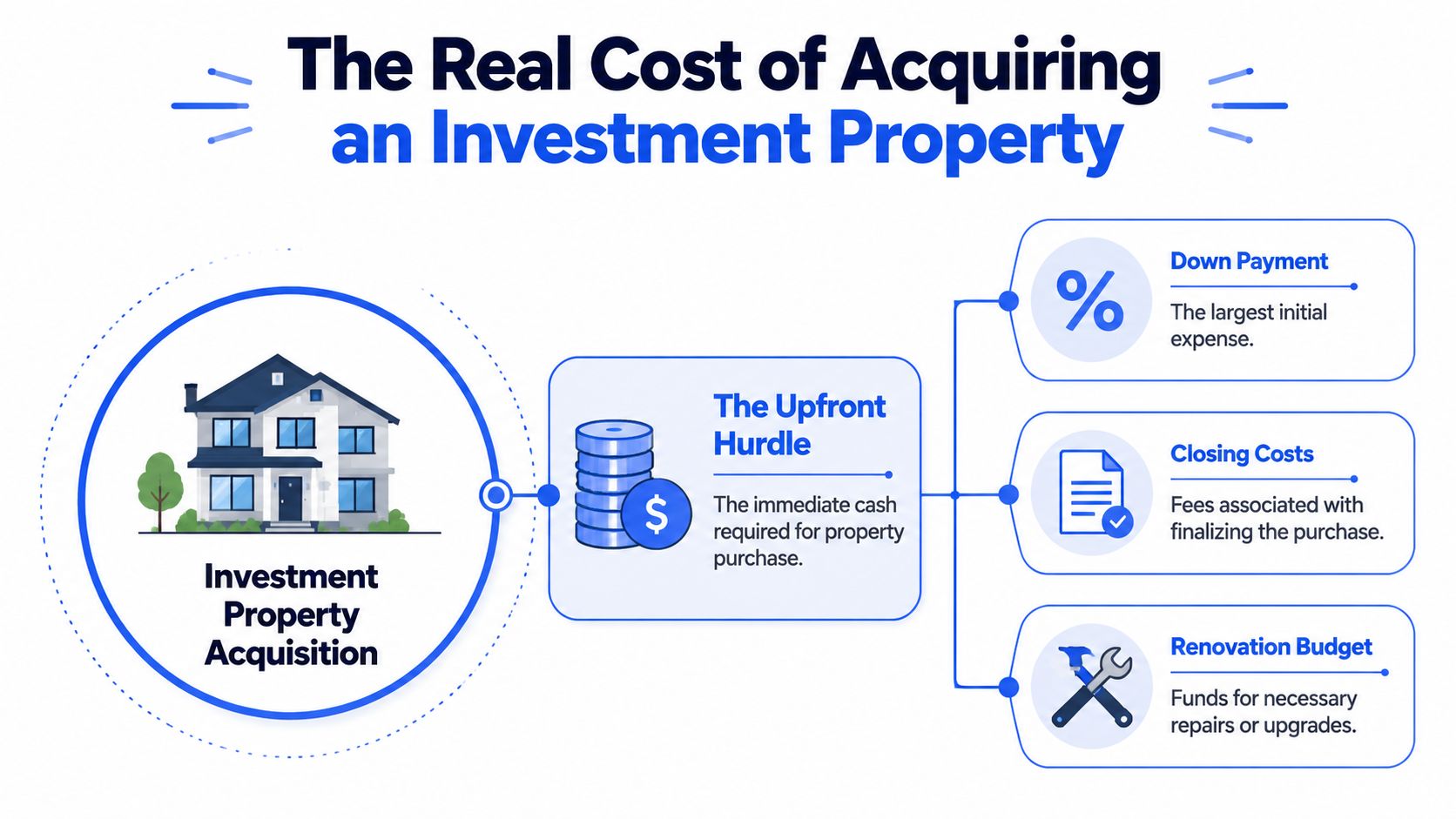
The Real Cost of Acquiring an Investment Property
You can have a property under contract, a lender quote in hand, and still come up short at closing. That usually happens because investors budget for the headline down payment and miss the rest of the cash required to get the deal across the finish line.
Down payment is only part of the acquisition cost. Closing costs, lender fees, appraisal, reserves, insurance, and any immediate repair money can all hit before the property produces a dollar. On a straightforward rental, that may be manageable. On a distressed asset or a rushed closing, the cash requirement can shift quickly based on who is lending and how the deal is structured.
Why the 20 percent rule is too simplistic
The 20 percent rule gets repeated because it is easy, not because it fits every deal. Cash to close changes based on the financing path, the property's condition, the unit count, the borrower profile, and whether the lender is underwriting the asset, the income, or both.
That distinction matters in the field. A bank may offer lower-cost money on a clean, stabilized property if the borrower checks every box. A private or hard money lender may ask for more equity up front, but that structure can still be the better business decision if it helps you close fast, buy a property with problems, or preserve bank financing for longer-term holds. Investors who understand how to finance investment property with different loan structures usually make better acquisition decisions because they size the full cash need before they commit earnest money.
A duplex with strong rents, a vacant fixer, and a non-warrantable condo can all require different amounts of cash, even if the purchase prices are similar.
Practical rule: Choose the lending strategy first. Then calculate total cash to close, including fees, reserves, and any money the property needs in the first 30 days.
Investors who close consistently budget for flexibility
Experienced investors do not underwrite to one perfect financing outcome. They leave room for a backup option if appraisal issues, title problems, property condition, or timing push the deal outside a bank's box.
That is one reason private capital should not be treated like a last-minute rescue tool. In many deals, it is the strategy from the start. Speed, lighter documentation, and asset-based underwriting can be worth more than a lower rate if they let you buy the right property at the right time.
If you are buying in active regional markets, local operations matter too. AIM's Inland Empire investment guide is a useful reference because it connects acquisition decisions with rent performance, maintenance realities, and day-to-day management.
Investment Property Down Payments by Loan Type
A seller accepts your offer on Tuesday and wants to close next week. The property has strong upside, but it needs work and a bank appraisal timeline will kill the deal. In that situation, down payment is not just a percentage. It is part of the strategy.
Loan type changes how much cash you need, how fast you can close, and what kind of property you can realistically buy. Conventional financing, DSCR loans, and private or hard money all solve different problems. Serious investors use each one for a reason.
The baseline ranges that matter
Conventional investment loans usually ask for more borrower documentation and a cleaner property profile. For many investors, that means lower pricing but tighter rules on occupancy, condition, reserves, and timing. Single-unit rentals can start with a lower equity requirement than small multifamily, but bank financing gets restrictive fast once the deal falls outside standard guidelines.
Private and hard money loans usually come with a larger cash requirement up front. That is the cost of speed, asset-based underwriting, and flexibility around condition, title issues, or business-plan risk. For investors buying distressed property or racing a closing deadline, that trade is often rational.
The key point is simple. A higher down payment does not automatically mean worse financing. It can mean the lender is giving you a structure a bank would decline.
Investment Loan Down Payment Comparison
| Loan Type | Typical Down Payment | Best For | Closing Speed |
|---|---|---|---|
| Conventional investment loan | Often lower than private capital on clean, bankable deals, but depends on unit count, borrower profile, and reserves | Stabilized rentals, strong borrower profile, deals that fit bank guidelines | Usually slower than private options |
| DSCR loan | Varies by lender, property cash flow, and requested leverage | Rental investors focused on property income rather than traditional full-income qualification | Often faster than conventional, but varies by lender |
| Hard money or private loan | Often higher equity in exchange for speed and flexibility | Fix and flip, bridge deals, distressed assets, fast closings, non-bankable scenarios | Typically faster than conventional |
Where DSCR fits
DSCR loans sit in the middle for many investors. They are often a strong fit when the property income supports the payment, but the borrower does not want a conventional full-doc process or has tax returns that do not reflect actual investing capacity.
That does not mean DSCR is a low-cash option by default. If rents are soft, the property is in rough shape, or the requested loan-to-value ratio is high, the lender may still ask for more money down. I tell investors to treat DSCR as a cash-flow-driven product, not a shortcut.
If you want a side-by-side view of structures, this guide on investment property financing options breaks out where each loan type fits.
Why hard money is often the right tool
Hard money works best when the deal has a clear business plan and a short decision window. Vacant properties, heavy rehab, auction purchases, title cleanup, and bridge scenarios all fit that profile. The investor brings more equity, but gets certainty, speed, and a lender focused on the asset and exit.
That is why experienced investors often choose private capital first, not last. If the goal is to secure the property, stabilize it, then refinance or sell, the right question is not "How do I get the lowest rate?" The right question is "What structure gives me the highest chance of closing this deal on time and hitting the exit?"
It also helps to separate pure investment lending from business-use real estate. If the borrower will occupy the property through an operating company, financing owner-occupied commercial property follows a different rule set than non-owner-occupied investment property.
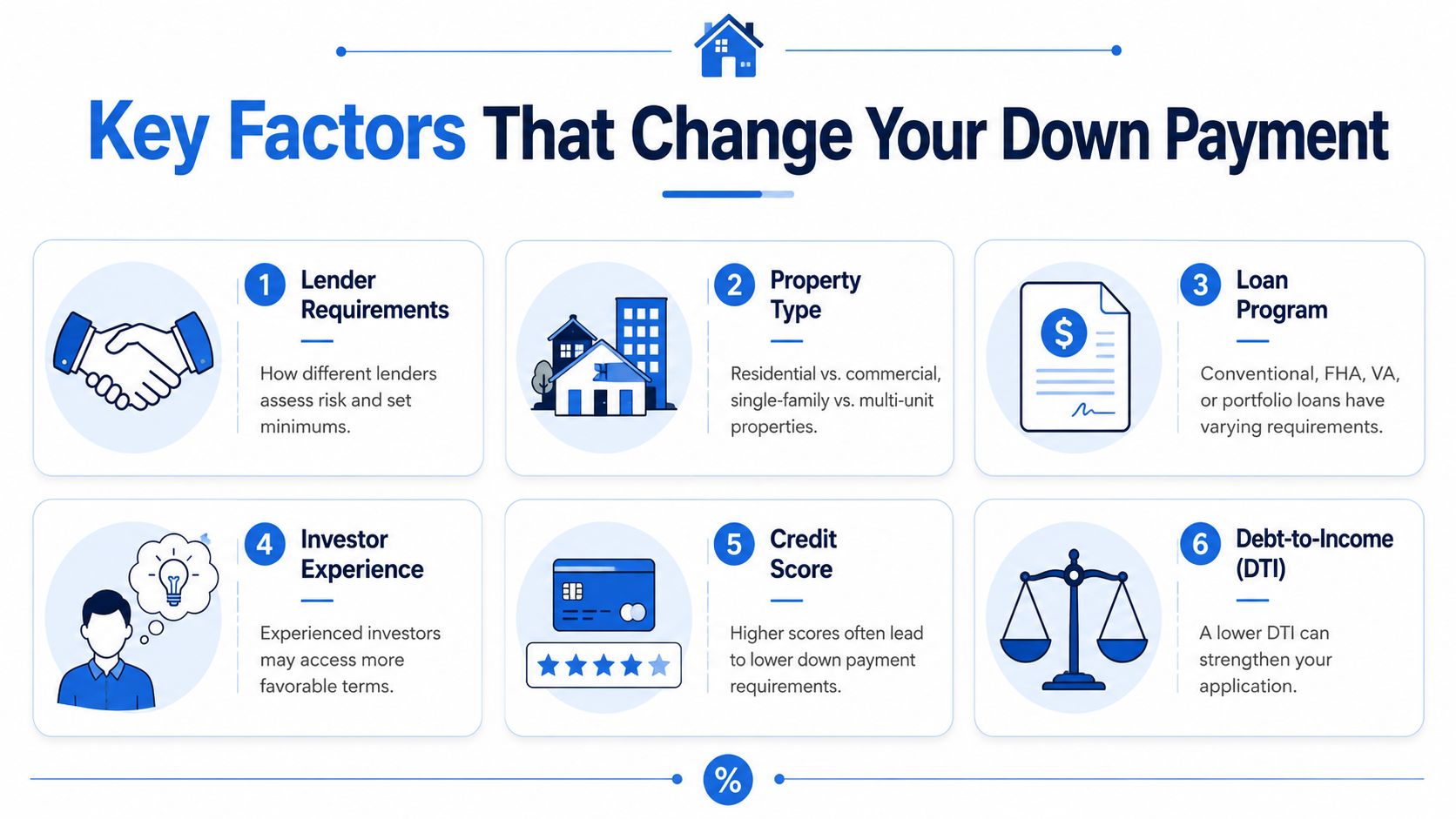
Key Factors That Change Your Down Payment
Two investors can look at the same property and get very different terms. That happens because lenders don't price or size loans from one variable. They look at the whole file.
The down payment usually moves based on the lender's confidence in the deal, the asset, and the borrower's ability to carry the project if something takes longer than expected.
Property type changes the risk profile
A clean single-family rental is easier to finance than a mixed-condition small multifamily, and that's before you factor in occupancy issues, deferred maintenance, or a short lease roll.
Lenders usually get more conservative as the asset gets harder to underwrite. More moving parts often means more equity required. That's especially true when the property needs work before it qualifies for long-term rental financing.
Borrower strength still matters
Even when the lender is asset-focused, borrower quality still affects the structure. Credit profile, liquidity, investor experience, entity setup, and prior project history all influence how comfortable a lender feels.
A seasoned investor with reserves and a clear exit plan usually has more options than a new investor trying to stretch into a thin deal. That's one reason borrowers should review lender expectations early. This overview of rental property loan requirements gives a useful picture of the documents and strengths lenders tend to look for.
Total cash to close matters more than the headline number
Many buyers fixate on the percentage down and miss the broader cash requirement. Closing costs can add roughly 3% to 6% on top of the purchase price, and lenders may also require reserves, as noted by The Mortgage Reports' explanation of investment property loan requirements.
That's where deals fall apart. A buyer might have enough for the stated down payment but still come up short before closing because title, lender fees, escrows, or reserve requirements weren't included in the original estimate.
If you only budget for the down payment, you're not fully capitalized for the acquisition.
What usually pushes the number up or down
- Asset condition: Properties with deferred maintenance, vacancy, or rehab needs usually need a more conservative structure.
- Income visibility: Stabilized rent rolls and cleaner lease documentation usually help.
- Exit clarity: A short, realistic refinance or sale plan makes lenders more comfortable.
- Liquidity: Borrowers who can show post-closing strength tend to look less risky.
- Timeline pressure: If the deal needs to close quickly, private capital may solve the timing issue, but often with a different capital structure.
Down Payment Calculations in Action
A listing hits the market at 9:00 a.m. By lunch, the seller already has multiple offers and wants a short close. In that situation, the down payment is not just a math exercise. It affects which loan options are realistic, how fast you can move, and whether you can keep enough cash available for the rest of the project.
Stabilized rental purchase
Take a rental purchase at $500,000.
At 15% down, the equity contribution is $75,000. At 25% down, it becomes $125,000.
That $50,000 gap changes the deal.
On paper, the lower-down-payment option preserves cash. In practice, it often comes with tighter underwriting, more documentation, and a slower approval process. For a clean, stabilized property with strong borrower income, that trade-off can make sense. For a time-sensitive purchase, many investors decide the extra cash in a private or hard money structure is worth it because it improves execution and reduces the chance of losing the deal.
I see that choice often. Investors are not always trying to minimize the check they bring to closing. They are trying to match capital to the opportunity.
Smaller acquisition with investor rules applied
Now use a $400,000 purchase and apply common investor down payment levels.
At 15% down, the required equity is $60,000. At 25% down, it is $100,000.
That difference matters, especially for newer investors who have enough cash to get into the deal but not much room for mistakes. It also clears up a common misunderstanding. Low-down-payment programs people read about are usually tied to owner-occupied financing. Once the property is strictly non-owner-occupied, the structure changes and the borrower is usually expected to bring in more capital.
The first conversation with a lender should cover property use, timeline, and exit. The down payment number comes after that.
Fix and flip reality
A flip is a different underwriting conversation.
The investor usually cares less about squeezing the down payment to the lowest possible level and more about whether the lender can close fast, fund the renovation plan, and underwrite the exit based on a realistic resale or refinance strategy. A bank may quote a lower-cost structure, but if the property needs work or the seller wants a fast close, that approval path may not fit the deal.
Serious flippers often use private capital on purpose. They accept a larger equity contribution or a higher rate in exchange for speed, fewer property-condition issues, and terms built around the business plan instead of a conventional box. If the project pencils and the timeline is tight, that can be the stronger move.
How to Fund Your Investment Property Down Payment
A deal gets accepted on Friday. The seller wants a short closing window, the property needs work, and your bank wants tax returns, property-condition exceptions, and more time than the contract gives you. At that point, the down payment is only one part of the problem. The central question is how to bring in cash without leaving yourself short on closing costs, rehab money, and reserves.

Investors usually fund the equity piece from one or more of five places: equity pulled from another property, cash from a partner, seller financing, retained business liquidity, or private capital layered into the structure. The right answer depends on the deal, your timeline, and how much cash you need to keep available after closing.
A HELOC can work if you have strong equity in another property and enough income to carry that payment. Equity partners can reduce your out-of-pocket cash, but you give up part of the upside and need a clear operating agreement. Seller financing can reduce immediate cash pressure if the seller is motivated and the title, lien, and documentation issues are handled correctly. Business liquidity is clean and simple, but draining operating cash to win a deal can create problems a month later.
Private and hard money belong in this conversation early, not after every bank option fails. Serious investors use them because they close faster, work around property-condition issues, and can be structured around the actual business plan. That matters on bridge deals, distressed purchases, and flips where execution speed is often worth more than chasing the lowest rate on paper.
LendingXpress provides private and hard money financing for non-owner-occupied residential and commercial real estate, including bridge, fix-and-flip, and rental property scenarios where speed or property condition can make bank financing less practical.
Keep owner-occupied strategies separate from true investment financing. A buyer living in the property may qualify for low-down-payment programs. An investor buying a non-owner-occupied asset should build the plan around investor terms, as noted earlier, and make sure the cash-to-close estimate includes the full picture.
Here's a useful explainer on the topic:
The strongest down payment strategy is usually the one that leaves margin for mistakes. If you have to patch together funds from too many places, close with almost no reserves, or depend on perfect timing to refinance, the deal is tighter than it looks.
If seller financing is part of your plan, legal details matter. For readers looking at that path in Texas, this Texas home owner finance guide is a useful legal overview.
Choosing the Right Financing Partner for Your Next Deal
The right down payment isn't a single number. It's the result of the property type, the loan structure, the lender's risk tolerance, and your ability to close with enough cash left over to operate the asset properly.
That's why experienced investors don't choose financing after they find a property. They line up capital sources first, understand which deals fit each source, and move with the lender that matches the business plan. A conventional loan may fit a clean stabilized rental. A DSCR or private loan may fit better when documentation, speed, condition, or execution matters more.
If your next deal needs flexibility, fast underwriting, or a structure built around the asset instead of a rigid bank box, it helps to talk with a lender early and size the deal correctly before you write the offer.
If you're evaluating a purchase, refinance, bridge loan, or fix-and-flip, talk with LendingXpress to review the property, expected cash to close, and the financing options that fit your deal.