
A deal hits your inbox on Tuesday. The seller wants certainty, the property needs work, and the listing agent says cash or a very fast close will win it. That's where most investors stop talking about “cheap money” and start thinking about executable money.
If you're buying a non-owner-occupied property, secured financing is usually the tool that keeps the deal alive. The property itself becomes the collateral. That lowers lender risk, changes how the loan is priced, and often makes room for structures that a traditional bank won't touch on a tight timeline.
For investors, secured loan rates aren't just a number on a term sheet. They're part of a bigger decision about funding structure, timing, rehab scope, exit strategy, and whether the lender can close when the clock is running. If you also work in ground-up or redevelopment planning, some of the same timing and funding logic shows up in expert advice on financing a new home, especially when the deal doesn't fit a plain-vanilla bank box.
Your Guide to Secured Loan Rates
In real estate investing, secured loan rates matter most when the property opportunity won't wait. A clean rental in good condition gives you one set of options. A heavy fixer with title issues, deferred maintenance, or a short escrow gives you another.
Private and hard money loans sit in that second category more often than not. They're secured by the asset, so the lender underwrites the property, the equity position, and your plan to repay. That's why these loans are common for bridge loans, fix-and-flip projects, rental acquisitions, cash-out refinances, and time-sensitive purchases.
Practical rule: The cheapest quote on paper doesn't help if the lender can't close before your contract expires.
What makes this topic confusing is that investors often compare the wrong things. They compare a long-term bank loan meant for stabilized property against a short-term private loan meant to win a deal, fund a rehab, or solve a timing problem. Those are different products built for different jobs.
Here's the better lens:
- Use rate as one filter, not the only filter. Closing speed, loan amount, draw structure, extension terms, and prepay flexibility often matter just as much.
- Match the loan to the business plan. A bridge loan should help you acquire or refinance fast. A flip loan should support the rehab timeline. A rental loan should fit the hold strategy.
- Price risk accurately. If the property is distressed, the title is messy, or the borrower story is complex, the rate will reflect that.
When you understand how secured loan rates are built, you stop shopping blindly and start structuring smarter deals.
What Actually Is a Secured Loan Rate
A secured loan rate is the interest charged on a loan backed by collateral. In investment real estate, that collateral is usually the property itself. The lender records a lien against the asset, which gives the lender a legal claim if the loan isn't repaid.
Think of it this way. If a lender has a claim on a real asset, the lender isn't relying only on your promise to pay. That changes the risk calculation. Equifax explains that secured loan pricing is driven by collateral because the lender can recover value through repossession or sale if the borrower defaults, which reduces expected loss and typically leads to lower rates than unsecured credit. It also makes secured loans easier to qualify for and capable of supporting higher loan amounts than unsecured loans, as outlined by Equifax's explanation of secured loans.

Secured versus unsecured in plain English
With an unsecured loan, the lender has no direct claim on a specific asset at closing. That usually means the lender leans harder on income, credit profile, and conservative underwriting. With a secured loan, the lender still cares about you, but the asset becomes central to the decision.
That distinction matters a lot in investor lending because many deals don't look clean enough for a bank file. A property may be vacant, mid-rehab, non-stabilized, or acquired through an unusual timeline. Secured financing can still work because the structure is based on collateral first.
Why investors care
For non-owner-occupied properties, the key benefit isn't just that a secured loan may price better than unsecured credit. It's that the structure often fits real transactions better.
A few situations where this matters:
- Distressed assets: Banks may hesitate when condition is poor. Asset-based lenders may still proceed.
- Short escrows: Investors need lenders who can move on appraisal alternatives, efficient document review, or practical underwriting.
- Transitional business plans: If your plan is buy, rehab, lease, then refinance, the initial secured loan is a bridge to the permanent outcome.
If you want a broader consumer-facing comparison outside the U.S. private lending context, EHF Mortgages has a helpful overview for borrowers looking to find secured loan options.
The 5 Key Factors That Drive Your Rate
The rate on a secured real estate loan doesn't come out of thin air. Lenders price the deal based on risk, collateral quality, and current market conditions. In practice, five inputs usually matter most.
To frame the market backdrop, secured loan pricing tends to move with broader benchmarks. Historical mortgage data shows the 30-year fixed mortgage averaged 16.64% in 1981, fell to 2.96% in 2021, and rose to 6.81% in 2023, according to Rocket Mortgage's historical mortgage rate summary. That's the macro layer. Your file determines the spread above it.
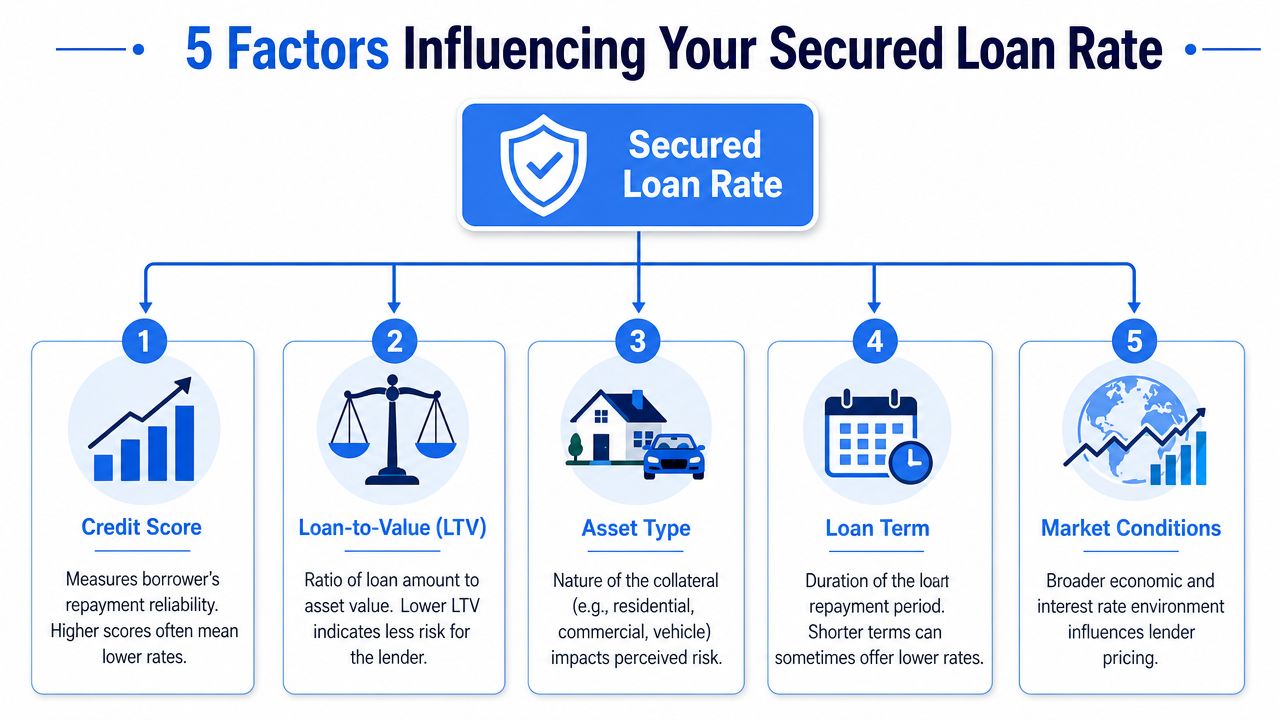
Loan-to-value matters first in private lending
For private and hard money, loan-to-value, or LTV, often carries more weight than people expect. The lower the LTV, the more room the lender has if the exit takes longer or the market softens.
If you bring in more equity, you usually improve the risk profile immediately. That can help your pricing, but it can also help you get approved at all. On a shaky deal, strong collateral coverage does more work than a polished borrower summary.
The property doesn't need to be perfect. The leverage does need to make sense.
Credit score still matters, but not always the same way
Credit affects pricing, but private lenders typically view it differently than banks do. A lower score doesn't automatically kill the deal if the property is strong, the equity position is conservative, and your exit strategy is believable.
What credit often changes is the margin for error. A borrower with a clean repayment history may get more flexibility on structure. A borrower with recent issues may still close, but the lender will likely tighten other terms.
Asset type changes lender appetite
A stabilized single-family rental, a small multifamily property, a mixed-use building, and a heavy commercial asset don't price the same. The more specialized the property, the more carefully the lender looks at resale risk, liquidity, and how easy the collateral would be to recover and reposition.
That's why an investor should never assume all real estate collateral is treated equally. Residential investment property usually has a broader lender audience than a niche property type.
A quick way to benchmark where broader non-owner-occupied pricing sits is to review current non-owner-occupied mortgage rates, then compare that baseline against the speed and flexibility your specific deal requires.
The video below gives useful context on how lenders think about real estate loan pricing and structure.
Loan purpose can push rate up or down
A bridge loan for a clean property with a clear refinance path is one thing. A fix-and-flip with construction risk is another. A cash-out loan on a partially stabilized asset can be another category entirely.
Purpose matters because it changes the lender's exposure. Rehab execution, carry costs, tenant stability, permit risk, and exit timing all affect how the lender prices the file.
Term and market conditions work together
Shorter terms can reduce exposure in some cases, but short-term loans also serve higher-urgency situations, so they don't automatically come with the lowest rate. What matters is how the term matches the plan.
Current market conditions also shape every quote you receive. When benchmark borrowing costs are high, even well-secured loans can stay expensive. That's why investors need to judge the full business outcome, not just the note rate.
Private Money vs Bank Rates A Realistic Look
Investors ask this all the time. Why would I take private money if a bank rate is lower?
The short answer is because rate and usefulness aren't the same thing. Bank loans are designed for predictable files, stabilized properties, and borrowers who can wait through a longer process. Private money is built for deals that need speed, flexibility, asset-based underwriting, or all three.

Where secured pricing helps and where it doesn't
Collateral usually lowers borrowing cost versus unsecured credit. LendingTree's June 2026 overview noted that some secured personal loans started at 3.00%, while average unsecured personal loan APRs for fair-credit borrowers were around 22.87% on the same date, showing the value of pledged collateral in pricing, as summarized in LendingTree's secured loan guide.
But that doesn't mean every secured real estate loan will beat every bank quote. A private loan and a bank loan solve different problems. If your property is stabilized, your tax returns are clean, and you have time, a bank may be the right fit. If the property needs work, the seller wants a fast close, or the deal doesn't fit conventional underwriting, private money often becomes the practical option.
What private money is really buying you
Private money usually earns its place in three ways:
- Speed to close: Useful when the contract timeline is tight or the seller wants certainty.
- Flexible underwriting: Helpful when the property is vacant, distressed, or mid-transition.
- Execution confidence: Critical when missing the close costs you the deal, deposit, or renovation schedule.
That's why experienced investors often compare private lenders by more than rate alone. They look at responsiveness, certainty, draw administration, extension terms, and whether the lender understands investment property risk. For borrowers evaluating that route, this overview of private money lenders is a practical starting point.
A lower rate loses its value fast when the lender asks for a condition your deal can't satisfy before closing.
A better way to compare offers
Use a side-by-side lens:
| Loan type | Usually strongest for | Common trade-off |
|---|---|---|
| Bank financing | Stabilized holds, long-term debt, lower-cost capital | Slower process, tighter guidelines |
| Private money | Fast closings, distressed assets, bridge and rehab execution | Higher cost, shorter term |
If the asset is clean and the timeline is loose, banks often win. If the asset is transitional and the deal is fragile, private money often keeps the transaction alive.
Beyond the Headline Rate APR Fees and Points
A lot of investors focus on the note rate and stop there. That's a mistake. The full borrowing cost includes APR, points, lender fees, third-party closing costs, draw-related charges, and any prepayment restrictions.
Federal consumer guidance makes the bigger issue clear. The cost of a secured loan includes more than APR, and fees, closing costs, and prepayment penalties can materially change the economics. That matters even more in fast-turn real estate deals, where holding costs can outweigh a small rate difference, as noted in the CFPB guide on secured and unsecured loans.
What to review on every term sheet
When you review a private or hard money quote, check these items before you compare it to another offer:
- Origination points: These hit your cost on day one and directly affect net proceeds.
- Interest structure: Ask whether payments are monthly, interest-only, accrued, or collected in another format.
- Draw fees: On rehab loans, every draw process affects your timeline and actual project cost.
- Prepayment terms: A slightly lower rate can lose its appeal if the loan penalizes a quick refinance or sale.
- Extension terms: If your project runs long, the extension language matters more than you think.
A practical investor test
Don't ask only, “What's the rate?”
Ask:
- How much cash do I need to close?
- What does the loan cost if I exit early?
- What does it cost if the project runs longer than planned?
- How fast can I access rehab funds?
Those questions usually expose the true winner.
The lowest headline rate can still be the more expensive loan if it slows your project or traps you with fees when you pay off early.
What works in real deals
For flips and bridge deals, the best structure is often the one that protects your timeline. A slightly higher rate with straightforward draws, clean documents, and no ugly surprises can outperform a lower-rate loan that delays contractors, pushes closing, or complicates payoff.
That's especially true when your profit depends on speed. Every extra week of ownership can mean more interest carry, more taxes, more insurance, and more operational friction.
Secured Rate Scenarios for Investors
Real estate investors don't borrow in theory. They borrow against a plan. Here's how secured loan rates tend to behave in common non-owner-occupied scenarios, without pretending every file prices the same.
Bridge acquisition with a short escrow
You find a property with upside, but the seller wants a fast close and the building isn't positioned for conventional financing yet. Maybe it has vacancy, deferred maintenance, or a lease rollover issue.
In that case, the secured rate is often driven by three things more than anything else: the equity in the deal, the clarity of your exit, and how liquid the property type is. If the LTV is conservative and the exit is straightforward, lenders may look past details that would slow down a bank file.
What tends to work:
- Clear exit strategy: Refinance, sale, or stabilization path that makes practical sense.
- Solid collateral position: Enough equity to give the lender comfort.
- Simple deal story: Fewer unresolved issues at closing.
What usually hurts pricing:
- Murky payoff plan
- Title or legal complications
- A property type with limited resale demand
Fix-and-flip with rehab financing
Many investors get tripped up by focusing on rate and ignoring the rehab structure. For a flip, the better question is whether the lender understands construction pacing, release schedules, and the way delays affect profitability.
A flip loan may price differently from a clean bridge loan because the lender is taking both property risk and execution risk. The rate reflects the fact that your payoff depends on renovation, marketability, and timing.
A lender will usually look closely at:
- Scope of work: Light cosmetic rehab is different from a full gut.
- Borrower track record: Repeat flippers usually present less execution uncertainty.
- After-repair strategy: Sale timeline and resale logic need to be credible.
On rehab deals, speed of draws can matter more than a modest difference in the stated rate.
Rental property loan with a hold strategy
A rental investor usually wants a loan that supports cash flow and a clean path to long-term financing. Here, the secured rate often depends on whether the property is already stabilized or still in transition.
If the property has strong fundamentals, marketable units, and a believable long-term hold plan, lenders may view the risk profile more favorably than a speculative flip. If the asset still needs lease-up, repairs, or operational cleanup, the rate may reflect that transitional risk.
For rental borrowers, the right structure often comes down to these questions:
| Scenario | What lenders look at most | Borrower focus |
|---|---|---|
| Stabilized rental | Property quality, equity, payoff certainty | Keeping flexibility for refinance |
| Transitional rental | Lease-up plan, condition, reserves | Time needed to stabilize |
| Cash-out on rental | Existing equity and repayment path | Using proceeds without overleveraging |
The common thread in all three scenarios is simple. The lender prices the deal you have, not the one you wish you had.
How LendingXpress Structures Competitive Offers
In volatile markets, a lien on real estate doesn't automatically produce a dramatically better rate. Wells Fargo's consumer loan guidance makes the broader point that when benchmark rates are high, the borrower's credit tier, loan purpose, and speed of execution can matter as much as the security interest itself, which is why structuring matters as much as pricing in practice, as reflected in Wells Fargo's loan rate overview.
That's exactly how experienced private lenders tend to approach investor deals. They don't just ask whether the loan is secured. They ask whether the collateral is solid, whether the debt level is workable, whether the exit is believable, and whether the timeline is realistic.
What a useful offer looks like
A competitive offer for an investor usually has a few traits:
- The financing fits the property. Aggressive structures can look attractive early and create problems later.
- The term matches the plan. Bridge debt should bridge. Rehab money should account for construction timing. Rental financing should leave room for the hold.
- The process is executable. The best term sheet is the one that can fund on schedule.
For borrowers who need bridge, fix-and-flip, or rental property financing secured by residential or commercial real estate, LendingXpress offers private loan structures built around non-owner-occupied investment property, including fast closings and rehab funding on qualifying deals.

What investors should do next
Bring the complete deal story to the conversation. Property type, purchase price, current condition, timeline, rehab plan, payoff strategy, and where the friction points are. That gives a lender enough context to structure terms that fit the transaction instead of forcing the transaction into a template.
If you're comparing offers, compare the whole package. Rate matters. So do points, reserves, draw mechanics, prepay flexibility, extension language, and whether the lender can move at the speed your contract demands.
If you're financing a flip, bridge, or rental property and need a loan structure that fits a real investment timeline, talk with LendingXpress about your next non-owner-occupied deal. A quick review of the property, borrowed funds, and exit strategy can tell you fast whether the numbers work.