
You can buy a rental property with a bank and still lose the deal before you ever get to closing. That's what happens when the seller wants certainty, the appraisal drags, and your lender treats a simple income property like a full documentary audit. The smarter move is to underwrite fast, choose capital that matches the timeline, and stop pretending every deal deserves a slow bank process.
If you want to know how to invest in a rental property the right way, start there. The property has to work on paper, the financing has to close on time, and the numbers have to survive vacancy, repairs, and insurance shocks. If any one of those breaks, you don't have a deal, you have a story.
When Speed Beats the Bank
A three-bed rental looks clean on paper, the price is strong, and the seller already has a backup buyer waiting. The bank appraisal is two weeks out, the file gets kicked back for two more tax returns, and the closing date starts slipping. By the time the lender finishes its round of questions, the seller has a reason to move on.

That's the core problem with relying on slow money. The property might still be good, but the timing isn't. A faster lender, especially one that underwrites the deal instead of just the borrower's paperwork, keeps the seller engaged and keeps the investor in the game.
What happens when the file stalls
The first thing to understand is that a rental purchase isn't saved by a verbal estimate or a friendly handshake. You need a real offer sheet, a real purchase contract, and a financing path that matches the seller's clock. If the deal only works when everyone is patient, it's fragile.
Pull the offer first, then decide which loan fits. Too many investors shop financing before they know whether the property is even worth fighting for.
If you're looking for a current market screen while you sort through targets, it helps to compare neighborhoods against rent potential and turnover risk, not just asking price. A resource like discover top 2026 property markets can help frame that search, but the final decision still comes down to local rent, local demand, and how quickly you can close.
Your first move is simple. Get the offer in writing, lock the property up fast, and only then match the capital to the deal.
Sourcing and Winning the Right Deal
Start with neighborhoods where the rent can support the purchase. Don't drive around hoping a nice street turns into a good investment. Build a list, pull your own comparables, and decide what rent the property has to hit before you ever walk through the front door.
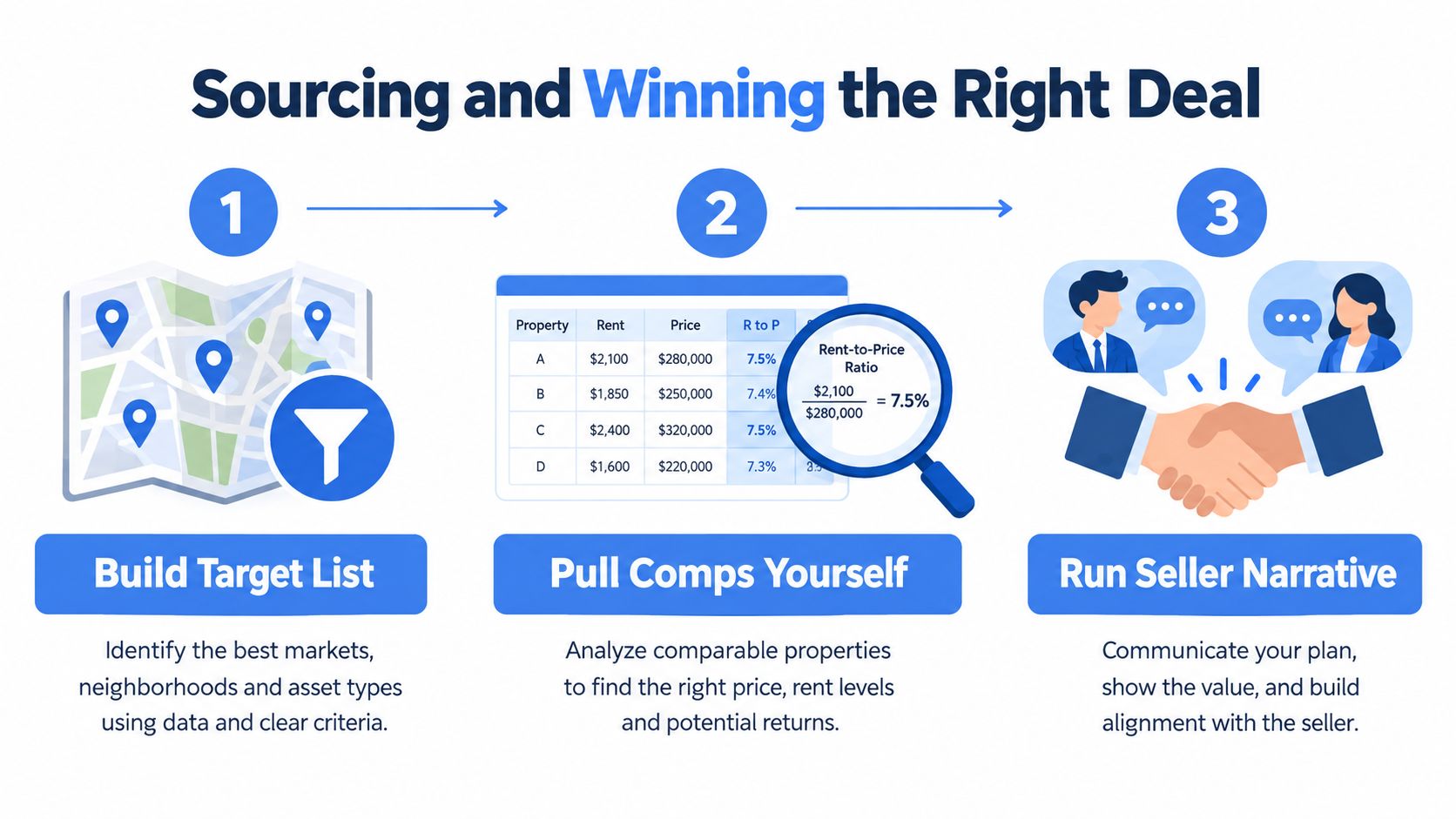
Win the deal before you overpay for the story
The cheap mistake is buying a property you didn't fully underwrite. The smarter move is to verify title status, lien searches, recent permits, and the actual rent roll before money moves. If the current rent looks aspirational, treat it as fiction until you see leases, deposits, and bank records.
Use the inspection window to renegotiate, not to panic. If the roof is tired, the plumbing is old, or the numbers stop working once the true costs show up, that's your negotiating edge. The worst habit in this business is falling in love with a property after the seller already priced in your optimism.
For investors who want more practical market context, a source like commercial property access control is useful when evaluating risk at the building level, especially if you're moving beyond a simple single-family hold. That matters because good rental investing isn't just about a house, it's about controllable risk.
Lock the property under contract with a tight inspection period before you call any lender. If the seller sees discipline, you get respect. If they see hesitation, you get replaced.
Financing Options Worth Comparing
The right loan depends on one thing, speed versus cost. A conventional rental loan can be excellent for a long hold, but it usually asks for more paperwork and moves slower. A bridge or hard-money loan costs more, but it can save a deal when the seller needs certainty this week.
| Product | Speed to Close | Docs Required | Rate Range | Best Use Case |
|---|---|---|---|---|
| Conventional DSCR | Slower | Tax returns, reserves, rent proof | Lower | Stable long-term hold |
| Portfolio Loan | Moderate | Property and borrower documentation | Middle | Borrowers with multiple rentals |
| Bridge Loan | Fast | Deal-focused, lighter underwriting | Higher | Acquisition, rehab, refi later |
| Hard Money | Fastest | Asset-first, limited income focus | Highest | Time-sensitive purchase or heavy rehab |
Use the capital that fits the deal, not your ego
A 30-year DSCR rental loan wins on long-term hold economics. It's the cleaner answer when the property is already stabilized and the borrower's story is straightforward. But if the seller wants a hard close date and the bank is still asking for more paper, speed-priced capital earns its keep.
That's where a flexible private lender comes in. How to finance investment property is one place to start if you want to compare a faster route against the traditional path. For some investors, that kind of capital is the operating system, not the emergency exit.
A practical benchmark is blunt. If the deal dies without a 14-day close, the speed premium is probably worth paying. If time isn't the issue, don't overpay for convenience.
If you're weighing a rental acquisition against a refinance or rehab plan, a lender like LendingXpress can fit into that faster, asset-first lane with rental property loans, bridge structures, and rehab funding. That doesn't make it the only answer, but it does make it a serious one when the bank can't move.
Underwriting the Numbers That Actually Matter
Take a single-family rental priced at $245,000 that brings in $2,150 a month in rent. Don't start with the mortgage payment. Start with effective gross income, then strip out vacancy, expenses, and anything else the property owner has to pay.
Build NOI before you touch debt
Here's the clean version. Monthly rent of $2,150 gives you $25,800 a year in scheduled rent. If you assume 7% vacancy and collection loss, that's $1,806 off the top, leaving $23,994 in effective gross income.
Now subtract real operating costs. Property taxes, insurance, management, maintenance reserves, and other recurring expenses have to come out before you call anything profit. If those annual expenses total $8,910, the property produces $15,084 in NOI.
That matters because NOI is what supports the loan.
| Line Item | Base Case | Stress Case | Hard-Money Accept |
|---|---|---|---|
| Gross scheduled rent | $25,800 | $25,800 | $25,800 |
| Vacancy and collection loss | $1,806 | Higher under stress | Higher under stress |
| Operating expenses | $8,910 | Higher under stress | Higher under stress |
| NOI | $15,084 | Compresses sharply | Can be looser |
| Debt service on 75% LTV interest-only loan | $11,790 | Same payment, weaker coverage | Often underwritten more on asset than coverage |
| DSCR | 1.28 | About 0.98 | More flexible, higher cost |
At 75% LTV and 7.25% interest-only, the annual debt service is about $11,790, which produces a 1.28 DSCR in the base case. If vacancy worsens and insurance jumps 25%, that same property can compress to roughly 0.98 DSCR. That's the difference between a file a conventional lender can defend and a file that gets pushed to a more flexible capital source.
Most conventional underwriters don't want a sub-1.0 deal because the property isn't fully carrying the debt. Bridge and hard-money lenders will sometimes live with tighter coverage, but you pay for that latitude. Before you make an offer, lock down four numbers, in-place rent, true taxes, a bindable insurance quote, and rehab cost.
The Insurance Line Most Investors Miss
Insurance is the line item most investors hand-wave, and it's the one that can wreck a clean model fast. Federal Reserve research found average multifamily property-insurance costs rose from $39 per unit per month in 2019 to $68 in 2024, and estimated that each extra dollar of insurance expense reduced net income by roughly 72 cents. That's not a rounding error, it's a margin problem. Federal Reserve research on rising property insurance costs and pass-through to rents
Stop underwriting with guesses
If a renewal comes back ugly, the deal doesn't care what your spreadsheet said last month. A policy that looked fine at closing can erode cash flow, reduce DSCR, and make a refinance harder. That's why you get a bindable quote before you sign, not a ballpark number after you're already committed.
The pass-through risk is real because landlords often eat the first hit before rent resets. For a hold in a wind, flood, or wildfire zone, you need to treat insurance like a moving expense, not a fixed one. If the quote isn't stable, the deal isn't stable.
A plain example makes the point. If annual insurance rises from $1,400 to $2,100, that extra cost strips $58 a month out of cash flow. That kind of swing can erase the return you thought was there. On a long hold, I'd rather see a conservative model and a real quote than a rosy model built on hope.
Insurance requirements for investment properties should be part of the underwriting conversation before closing, not after the first renewal. That's especially true when financing depends on the deal continuing to cash flow.
Don't let insurance be the surprise that turns a good purchase into a bad hold.
Renovating, Leasing, and Scaling Up
The moment you close, the job changes. Now you're running a scope, not a search. Start with the rehab budget, break it into stages, and don't release full payment upfront because contractors promise speed.

Control the rehab and protect the draw schedule
Use staged draws tied to actual progress. Framing, rough-in, and finish inspections are the checkpoints that keep a project honest. If you release the final payment before the work passes inspection, you've turned financial control into a donation.
Leasing comes next, and it's where optimism gets expensive. Price to comps, not to what you need the property to do. Run credit and background checks through a standard screening process, and only use a property manager when the fee is justified by the workload or the geography.
Hold reserves for capex, vacancy, and insurance from day one. That cash is what keeps one bad month from becoming a default problem. A stable investor is usually a liquid investor.
The cleanest way to scale is to buy, stabilize, refinance, and repeat. Leave enough room in the numbers so the takeout actually works.
Once the tenant is in place and seasoning is met, move from bridge or hard money into a DSCR or portfolio rental loan. That's how you recycle capital into the next acquisition instead of trapping it in one asset. Every stabilized rental should be a candidate for a takeout loan within 6 to 12 months.
For investors who want more structure around property income strategies, the right sequence is simple, buy with speed, stabilize with discipline, then refinance on purpose. If the property can't survive that cycle, it wasn't a strong rental to begin with.
Your Rental-Property Game Plan
The right order is simple. Confirm the deal can be financed, stress-test NOI and DSCR, price insurance separately, and then choose the capital stack that matches the timeline. If the property only works with perfect conditions, it doesn't work.
What to do in the next 48 hours
Pull comps on your first target property and write down the rent that can be defended. Model NOI with a 15% vacancy assumption, not the best-case number the listing agent wants you to believe. Then request a term sheet from a private lender so you know whether speed, flexibility, or long-term pricing should win.
The investor who wins isn't the one who tours the most houses. It's the one who underwrites fast, closes cleanly, and keeps enough liquidity to survive the boring parts. That's the difference between owning a rental and owning a problem.
If you want a lender that can move when the bank can't, LendingXpress structures rental-property, bridge, and rehab financing for non-owner-occupied deals. Visit LendingXpress if you want to compare a faster capital path against your next acquisition.