
You're looking at a deal that looks clean on the surface, then the lender starts trimming the budget and the numbers stop feeling as friendly. The purchase price made sense, the rehab looked manageable, and the term sheet was supposed to tell you how much cash you'd need. Then the underwriting team reworks the cost side, and your loan to cost ratio drops before you've even closed.
That's the part investors need to understand. Loan to cost, or LTC, measures how much of a project's total cost is financed by debt, using loan amount ÷ total project cost. In a simple example, a $1,000,000 project funded with a $700,000 loan has a 70% LTC as defined in industry guidance. For non-owner-occupied deals, especially bridge loans and fix-and-flip financing, lenders care about LTC because it tells them how much equity the borrower is putting in and how much risk they're carrying.
The practical point is simple. LTC focuses on the deal's actual cost, not just what the property might be worth later. That makes it a strong underwriting tool when the property is distressed, under-repaired, or in transition, because future value can be harder to defend than the current budget. It also gives private lenders a consistent way to compare requests across different markets, projects, and exit strategies.
What Loan to Cost Means for Investment Properties
A real estate investor usually feels LTC pressure the moment a term sheet lands in the inbox. The property looks promising, the rehab budget seems workable, and the numbers still need to survive a lender's review. That's where loan to cost becomes the gatekeeper for non-owner-occupied financing.
The lender is sizing the deal, not just the asset
Loan to cost is the share of the project's total cost that the lender is willing to finance using the standard formula. For investment properties, that matters more than many borrowers expect, because the lender isn't only looking at the house or the building, they're looking at the full budget behind the project. That includes the acquisition and the work required to turn the property into something rentable or saleable.
This is why private and hard money lenders lean on LTC for non-owner-occupied properties. A bank making a long-term consumer mortgage can put more weight on the borrower's income and the appraised value of a finished home. A private lender funding a bridge loan or fix-and-flip deal is usually trying to judge whether the project is sized correctly, whether the equity cushion is real, and whether the borrower has enough capital to finish.
Practical rule: if the deal only works when every line item comes in perfectly, the LTC approval is already fragile.
The biggest advantage of LTC is consistency. Because it ties debt to project cost, not projected value, it gives lenders a cleaner way to compare a renovation in one neighborhood against a development in another. That's especially useful when the current condition of the property makes a future appraisal less reliable than the actual budget.
Borrowers often think in terms of purchase price and rehab only. Lenders think in terms of whether the entire capital need is covered without creating a thin equity position that leaves no room for mistakes.
The LTC Formula and a Worked Example
The formula is straightforward, but the mistake usually starts in the budget, not the math. Loan to cost = loan amount divided by total project cost. If the project cost is bigger than you first assumed, the ratio changes immediately, and so does the amount of equity you need to bring.
Here's the clean example lenders use all the time. A project with $1,000,000 in total cost and a $700,000 loan produces a 70% LTC as shown in common industry examples. That means the borrower is covering the remaining cost with equity or outside capital, and the lender is financing most of the project but not all of it.

What total project cost really includes
For investment properties, total project cost is broader than the purchase price. Industry references include items such as closing costs, legal fees, and capital improvements in the cost base used to calculate LTC. In development and renovation lending, project cost can also include land or purchase price, hard costs, soft costs, financing costs, and even an interest reserve depending on the structure.
That matters because the ratio can look strong until the lender reviews the budget line by line. A borrower may assume the rehab budget is the whole story, then learn that permits, professional fees, and financing carry all need to be captured too. Once those items are added, the effective financing dynamic changes.
A project can look conservatively financed on paper and still be undercapitalized if the cost base leaves out real expenses.
The cleanest way to think about LTC is this. It measures how much debt sits on the actual project, not on the fantasy version of the project. That's why a precise budget is more valuable than a rough estimate, and why borrowers who bring a lender a well-documented cost stack usually get a faster answer.
How LTC Compares to LTV and ARV
Borrowers mix up these three ratios because they all sound like borrowing power, but they're not measuring the same thing. LTC looks at cost, LTV looks at current value, and ARV looks at projected value after repairs. If you use the wrong one in your loan request, you can ask for more debt than the deal will support.
| Metric | What It Measures | When Lenders Use It | Typical Range |
|---|---|---|---|
| LTC | Debt compared with total project cost | Acquisition, construction, and renovation lending | Varied by product and risk profile |
| LTV | Debt compared with current appraised value | Stabilized or less transitional assets | Varied by product and risk profile |
| ARV | Debt compared with value after repairs | Fix-and-flip exits and renovation loans | Varied by lender and deal structure |
LTC is usually the first filter in bridge and rehab lending because it tells the lender whether the borrower has enough capital in the deal. LTV becomes more important when the lender wants to know how much the property supports the loan today. ARV matters when the business plan depends on a completed renovation and a resale exit.
A deal can satisfy one metric and still fail another. A borrower may have a budget that fits LTC, but the current appraised value is too low for the lender's comfort. Or the projected after-repair value may look strong while the cost stack still leaves too little borrower equity in the file.
That's why experienced lenders don't stop at one ratio. They review the capital stack, the sponsor's experience, and the exit plan together. For a deeper look at how lenders frame loan-to-value, see the internal guide on what loan to value ratio means in private lending.
Typical LTC Thresholds by Loan Type
Different loan types carry different levels of risk, so the LTC ceiling moves with the product. A short-term bridge loan can support a different level of financing than a rental loan that depends on long-term cash flow. That's not a theory point, it's how lenders protect themselves when the exit path changes.
Product structure drives the tolerance
Bridge loans often tolerate a higher LTC because the lender expects a clear exit, such as refinance or sale. Fix-and-flip loans are usually more conservative, because the borrower still has to complete the work, control costs, and sell into a market that can move before closing day. Rental property loans tend to be the tightest, since the lender is underwriting a stabilized asset, not just a transaction.
There's also a difference between what a lender is willing to finance and what a borrower thinks is included. Some private lenders may finance a large share of rehab work, even up to 100% of rehab costs with staged draws according to the publisher's lending profile, but that doesn't mean every budget item will count the same way in underwriting. The structure matters as much as the headline financing structure.

Bottom line: the more the lender has to rely on the future, the more carefully they'll pressure-test the cost side.
Private lenders usually bring more flexibility than banks because they focus on the asset and the business plan, not just the borrower's tax returns. Traditional banks often want more documentation and more conservative sizing, which can slow down a time-sensitive acquisition. For investors who need speed, the question isn't just what rate they can get, it's whether the lender understands the project enough to size it quickly and fairly.
Why Your LTC Might Drop After Budget Review
This is the part that frustrates borrowers the most. You submit a budget, the lender reviews it, and the final LTC comes back lower than you expected. The property didn't change, but the cost base did.
Lenders scrutinize which items belong in total project cost and which ones need to be treated separately. Some budgets include soft costs too loosely, some pad contingency too aggressively, and some fold holding costs into the construction number when the lender won't. When that happens, the lender revises the denominator in the formula, and your loan-to-cost ratio falls.
The line items lenders often challenge
Borrowers usually run into trouble with items like contingency reserves, carry costs, interest reserves, and change orders. A lender may accept some of those items, cap some of them, or exclude them from the initial LTC calculation altogether. That's why a deal can feel fully funded in a borrower's spreadsheet and still come back short in underwriting.
The cleanest budgets are itemized, supported by contractor bids, and easy to defend. If the lender has to guess whether a line item is real or padded, that line item is more likely to get trimmed. If the budget is vague, the negotiating power is usually the first thing to suffer.
- Unexpected Contingencies: Keep them realistic and clearly separated from base construction costs.
- Lender's Independent Appraisal: Treat it as a check on the deal, not a confirmation of your full budget.
- Higher Material or Labor Costs: Back them with contractor pricing, not rough estimates.
- Scope Creep or Upgrades: Leave cosmetic upgrades out unless they support the exit strategy.
Borrowers sometimes ask why the lender “changed the deal.” The lender usually sees it differently. They're not changing the deal, they're deciding what cost categories they'll recognize as financeable. That's why a clean budget, strong contractor support, and a disciplined scope are so important if you want the LTC number you originally expected.
Strategies to Strengthen Your LTC Position
The borrower who gets the best terms usually doesn't ask for the most aggressive structure, they present the cleanest file. Lenders like projects that are easy to underwrite, easy to monitor, and easy to exit. If you want a stronger LTC position, the first move is to reduce uncertainty.
Make the lender comfortable with the downside
Additional collateral can help when the main project is tight. Cross-collateralizing another property may reduce the lender's perceived risk, especially if the deal itself is aggressive. Strong cash reserves help too, because they show the borrower can absorb a budget miss without stalling the project.
Experience matters as well. A sponsor with a history of completed projects usually gets more credibility than a first-time borrower with a polished spreadsheet. The same goes for the budget itself, contractor-verified numbers get more respect than estimates built from generic assumptions.
If you're still comparing ways to fund renovation work, financing help for home projects can be a useful starting point for understanding how project-based funding differs from ordinary consumer borrowing.
Practical move: bring the lender a scope, budget, and exit plan that all tell the same story.
A partner can also make sense if the deal needs more equity or a stronger balance sheet. In some cases, bringing in another borrower or more cash is the simplest way to make the financing acceptable. If the project works only with wishful budgeting, it probably needs a more conservative structure before it gets approved.
LendingXpress is one option for investors who need a private lender that can look at bridge, fix-and-flip, and rental requests with common-sense underwriting and staged rehab funding.
A Fix and Flip Scenario with Staged Draws
A borrower finds a distressed property, lines up the purchase, and uses a fix-and-flip loan to cover acquisition and renovation. At closing, the lender funds the deal based on the initial LTC, then releases rehab money in stages as the work gets completed. That staged structure keeps the project moving without flooding the borrower with cash on day one.
The draw schedule matters because it controls when money gets released. The borrower doesn't pay interest on funds that haven't been disbursed yet, and the lender gets a built-in check that the work is progressing. That balance is why staged draws are common in renovation lending.
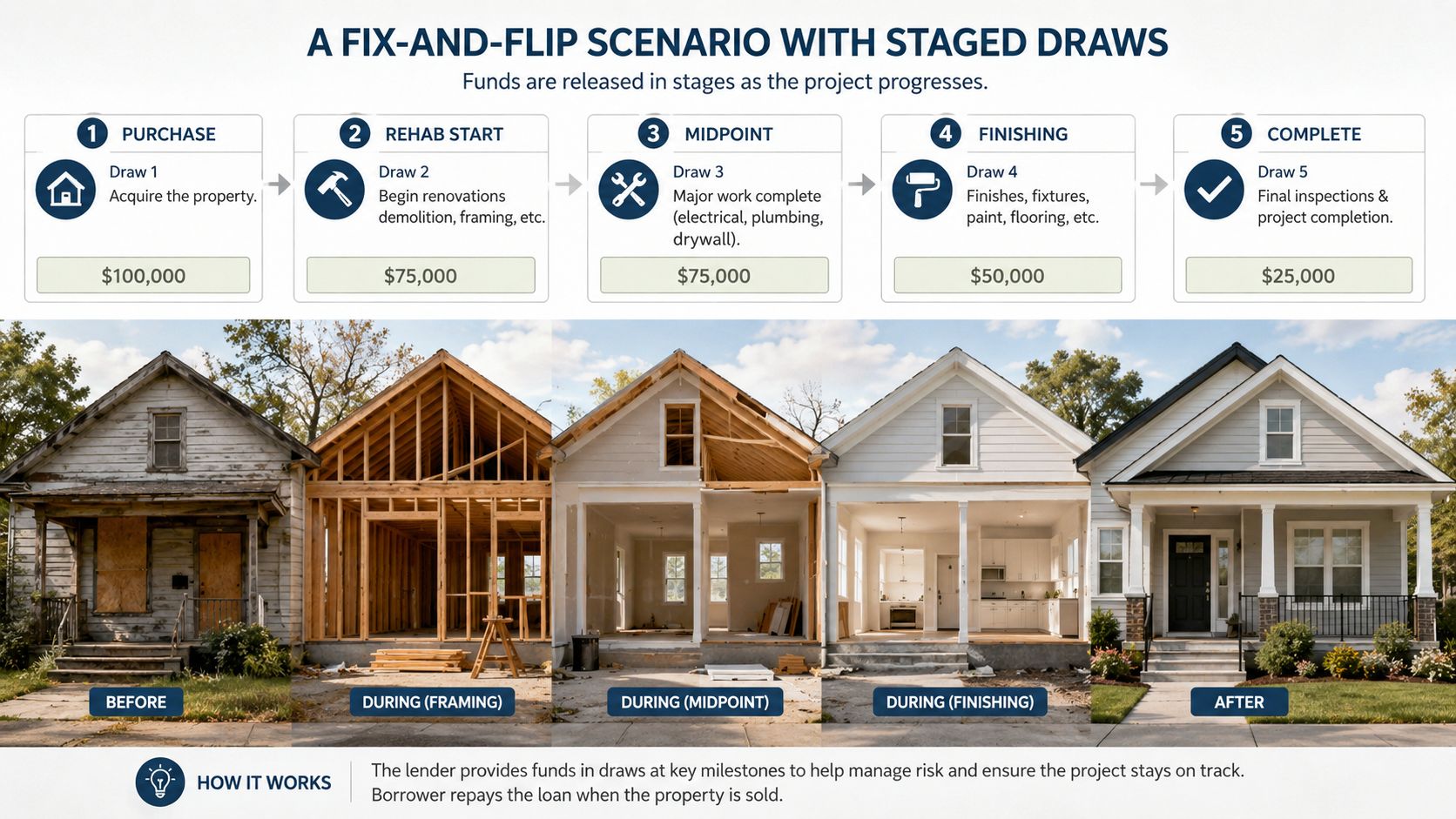
A borrower who understands LTC from the start plans the project around the lender's milestones instead of arguing with them later. Once the property is sold, the investor's gain comes from the spread between all-in cost and the sale proceeds, not from the loan itself. That's the core reason LTC matters throughout the project, not just on the initial application.
If you're evaluating a non-owner-occupied deal and the numbers need a lender who can size the project quickly, reach out to LendingXpress. They work with bridge, fix-and-flip, and rental financing, and they're set up for investors who need a practical answer on deal math, not a slow bank process.