
You're under contract, the clock is moving, and the lender conversation is already shaping the deal. If the property needs work, the seller wants a fast close, or your bank file is getting buried in paperwork, the key question isn't “Which lender is cheaper?” It's which lender can fund this specific deal on time.
| Criterion | Private Lender (e.g., LendingXpress) | Traditional Bank |
|---|---|---|
| Speed | Fast funding, often built for deals that need quick execution | Slower process, more committee review |
| Underwriting | Asset-based and flexible | Borrower-based and documentation-heavy |
| Best use | Fix-and-flip, bridge, transitional rentals | Stabilized, long-term financing |
| Pricing | Higher cost for speed and flexibility | Lower cost for stronger, cleaner files |
| Loan structure | More customizable terms | More standardized products |
If you're trying to choose between a private lender vs bank for a non-owner-occupied property, the right answer usually comes down to the deal's timeline, condition, and exit plan, not a generic rate quote. The lender that helps you win the property can be the cheaper option in the end, even if the nominal rate looks worse on paper. That's especially true when a delayed closing erodes your bargaining power or costs you the asset altogether.
Private Lenders and Banks A Fundamental Divide
The source of money changes everything
Banks and private lenders don't just behave differently, they're built differently. Banks are depository institutions that lend depositor money under strict federal and state oversight, while private lenders lend their own capital or funds raised from private investors and are usually regulated at the state level with fewer restrictions. That funding model is the root of almost every practical difference you feel as a borrower.
A bank has to protect deposits, satisfy internal committees, and stay inside a conservative underwriting box. That pushes the process toward standardized files, predictable income, and clean documentation. A private lender can focus more on the property, the business plan, and whether the exit makes sense, which is why it can move faster on transitional deals.
For investors, that means the right question is not “Which is better?” It's “Which capital source matches this asset and this timeline?” If you need a clean, long-term mortgage on a stabilized rental, a bank may fit well. If you need speed for a value-add purchase or a refinance before a renovation is complete, a private lender is often the more practical path.
Practical rule: choose the capital source that matches the deal's stage. Stable asset, bank. Transitional asset, private money.
One more thing matters here. A modern private lending platform, such as LendingXpress private money lenders, fits into this nonbank side of the market by offering a more flexible route for investment properties that don't fit standard bank rules. That doesn't make it a universal answer, but it does make it a relevant option when the file needs judgment instead of a rigid checklist.
Private Lender Vs Bank A Head to Head Comparison
Speed, Cost, and Structure: The Key Separators

A real estate investor usually feels the difference between a private lender vs bank in three places first, how fast the file moves, how much the loan costs, and how much structure the lender will allow around the deal. Those differences show up quickly on fix-and-flip purchases, bridge loans, and value-add rentals, where the timeline and the exit matter as much as the price.
The timing gap is hard to ignore. Conventional bank closings are often reported in the 45 to 60 days range, while private lenders have been reported to close in 7 to 21 days. In practice, that means a private lender can help an investor compete on a property that will not wait for a long underwriting cycle.
Price is the other obvious tradeoff. In CRE lending data for Q2 2026, private debt averaged 9.76%, while banks, credit unions, and life insurers averaged 6.47%, a spread of 329 basis points. Banks are cheaper on rate, but the lower cost only helps if the deal can survive the longer process and the stricter documentation.
| Criterion | Private Lender (e.g., LendingXpress) | Traditional Bank |
|---|---|---|
| Speed | Faster closings, often measured in days or a few weeks | Often measured in weeks or longer |
| Cost | Higher rate, priced for speed and flexibility | Lower rate, priced for standardized risk |
| Underwriting | More flexible, more property and exit focused | More document-heavy, more borrower focused |
| LTV Limits | Can be structured around deal specifics | Usually more standardized and conservative |
| Use case | Fix-and-flip, bridge, value-add, transitional rentals | Stabilized, long-term financing |
That table is the practical test. If the property is still being improved, needs a quick close, or depends on a refinance after stabilization, private money usually fits better. If the asset is already stabilized and the borrower has time to gather a full package, a bank can make more sense.
For an investor, the right choice comes down to deal economics and exit strategy. A fast close can protect a margin on a short hold. A lower rate can improve cash flow on a stabilized rental. The wrong match is easy to spot, a bank timeline on a deal that needs speed, or private money used on a property that clearly qualifies for standard long-term financing.
The Underwriting Process What Lenders Actually Look For
Banks judge the borrower, private lenders judge the deal first
Bank underwriting usually starts with the borrower's financial profile. That means income, debt, credit, reserves, and a long list of supporting documents. The process is designed to answer one question, can this borrower safely repay under standard assumptions? If the answer isn't clean enough, the file often stops there.
Private lenders are typically non-bank lenders and are often more flexible than banks because they can consider the borrower's history and ability to repay, making them a common option for applicants who have already been turned down by a bank. That flexibility matters for investors who own multiple properties, have uneven income documentation, or need to move on a property before it qualifies for conventional financing. The conversation shifts from “Can you fit our box?” to “Does this deal make sense?”
A useful way to think about it is this. Banks want the paperwork to tell a calm story. Private lenders want the asset and the exit strategy to tell a credible story.
Private lenders still care about repayment, but they're usually less obsessed with standard bank formulas when the deal itself supports the loan.
For investors, that changes how you prepare the file. A bank deal needs tidy tax returns, pay stubs, and a clean borrower picture. A private money file needs a clear plan for purchase, rehab, lease-up, refinance, or resale. If the exit strategy is weak, private lenders won't ignore that. They just evaluate it differently.
If you want a more detailed qualification checklist, the practical standards for a short-term investment loan are laid out in how to qualify for a hard money loan. That's the right frame for transitional real estate, because the lender is looking at whether the asset and the plan can support repayment, not just whether you look perfect on paper.
Choosing Your Lender by Investment Strategy
Match the lender to the exit strategy, not the dream rate
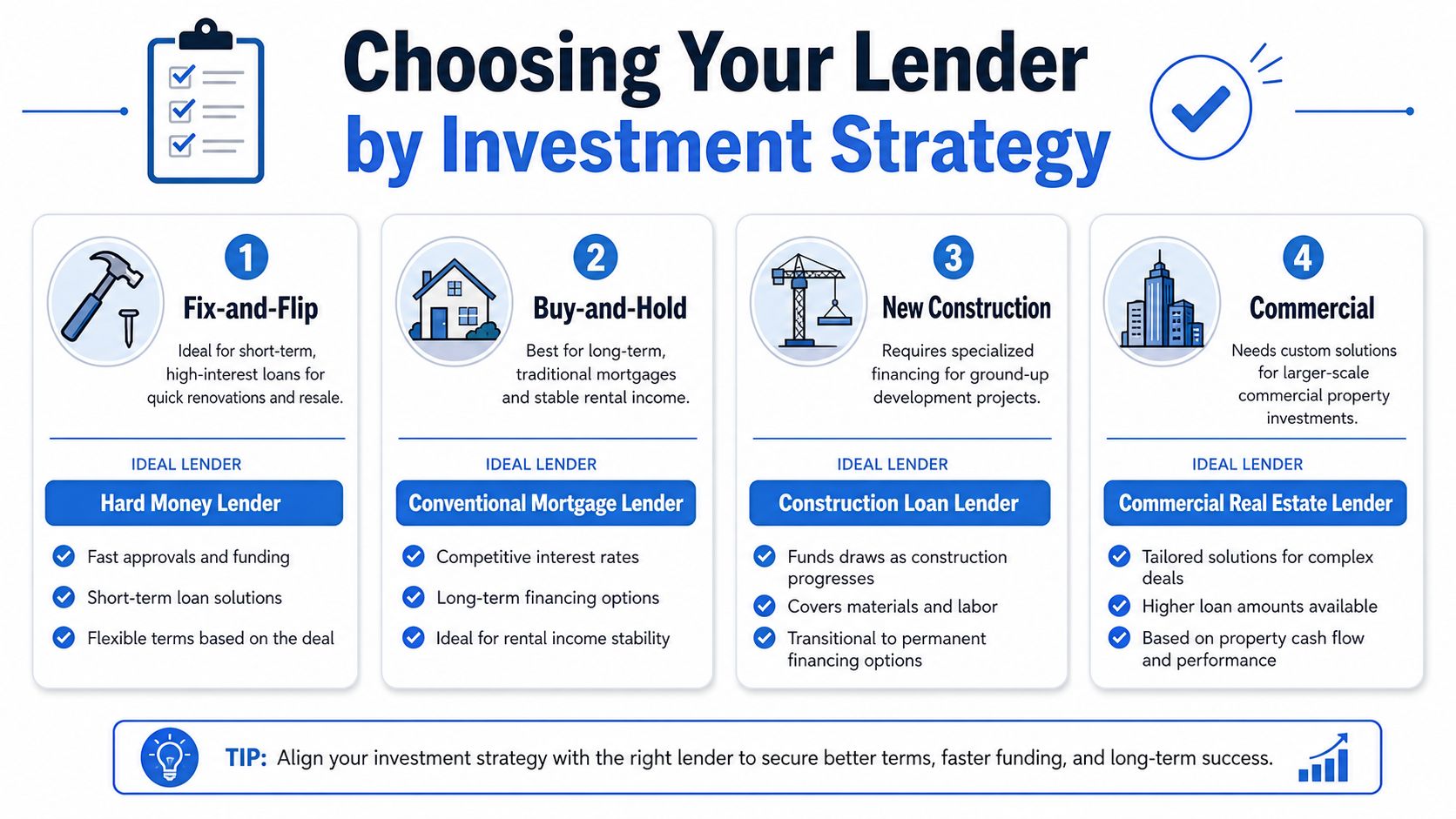
Fix-and-flip deals usually point straight toward private lending. The reason is simple, you need speed at acquisition and flexibility during rehab. A seller won't wait on a slow bank file, and a property in poor condition often won't meet a bank's standards anyway. Private money is built for that kind of short-term, transitional work.
Buy-and-hold rentals are different. If the property is already stabilized or close to stable, a bank can make more sense because the cost of capital is lower and the timeline is less urgent. That's the cleaner fit for investors who want long-term cash flow and don't need to solve a timing problem.
Bridge loans sit in the middle. They work when the property is not ready for long-term financing yet, but the investor has a clear path to refinance or sell later. In that scenario, a private lender can help the deal get from “not bankable today” to “bankable later.” That's a common move in non-owner-occupied real estate because the asset is being repositioned, not only purchased and held.
Commercial and larger value-add projects often need a custom structure. Banks can do those deals, but they tend to prefer cleaner profiles and more certainty. Private lenders are often more willing to evaluate the business plan, not just the current snapshot.
A Federal Reserve Bank of Philadelphia study found that nonbank lenders are more likely than banks to extend credit to borrowers with lower incomes, lower credit scores, and recent denials (Philadelphia Fed study). That doesn't mean every borrower should go nonbank. It does mean the channel matters, because lenders are already serving different borrower profiles in different ways.
If the deal is short-term, transitional, or hard to document, a private lender deserves a close look. If the property is stable and the clock isn't tight, a bank may be the simpler path. The best choice comes from the business plan, not from the headline rate alone.
Making the Right Call A Decision Checklist
Use the deal itself to decide

Start with the timeline. If the seller needs a fast close, the property is competitive, or a refinance deadline is near, the private route usually deserves first look. If the deal can wait and you're optimizing for rate, a bank may be a better fit.
Then look at the property's condition. If the asset needs work, lease-up, or some other transition before it can qualify for conventional debt, bank underwriting gets harder. Private lenders are often more comfortable lending against the plan and the collateral, especially when the exit is clear.
Next, check your documentation. If your personal income picture is clean and easy to verify, banks become more realistic. If the file has complexity, recent credit issues, or nonstandard income, a private lender may be more practical because it can weigh the deal differently.
Decision point: if the deal only works when the loan closes fast, don't force it through a slower bank process.
Finally, define the exit. If your plan is to sell after rehab, refinance into a bank loan, or stabilize the property and then move to long-term debt, private financing can be the bridge that gets you there. If you already have a stabilized asset and just want the lowest cost capital, the bank route is usually cleaner.
The private credit market is no longer niche. The U.S. private credit asset class reached $1.34 trillion and was nearly $2 trillion globally by Q2 2024, about 5x larger than in 2009 (Federal Reserve). That scale matters because it shows private lending is now a major financing channel, not a fallback option.
Frequently Asked Questions About Real Estate Financing
The questions investors ask most often
Why does private money cost more?
Because you're paying for speed, flexibility, and a lender that can move on deals banks may pass on. In recent CRE data, the pricing gap between private debt and bank-type lenders was measurable, and that premium reflects the different risk profile and the faster execution window. The borrower is buying certainty as much as capital.
Can I use a private loan and then refinance into a bank loan later?
Yes, that's a common path for transitional properties. A borrower often uses private money for acquisition and rehab, then refinances after the property is stabilized and easier for a bank to underwrite. That structure is especially useful when the current condition would block conventional financing.
What should I look for in a private lending partner?
Look for direct decision-makers, clear terms, and a process that doesn't hide the actual costs. Transparency matters because private money is only useful when you can model the exit cleanly. You also want a lender that understands investment property timelines instead of treating every file like an owner-occupied mortgage.
Does bank financing always beat private lending?
No. Bank financing is usually cheaper, but it can lose the deal if it can't close fast enough or can't handle the property's current condition. The cheaper loan is not the better loan if it kills the transaction or forces you to miss the opportunity.
When does a private lender make the most sense?
Private money fits best when the property needs work, the timeline is tight, or the borrower's file doesn't fit standard bank rules. It's a practical tool for non-owner-occupied properties where the plan matters more than the current snapshot.
If you're weighing a fix-and-flip, bridge, or rental deal right now, take a hard look at the timeline and the exit before you chase the lowest headline rate. LendingXpress structures private and hard money loans for investment properties when traditional financing falls short, so it's worth comparing the deal against a faster, more flexible option. Visit LendingXpress to review your next property and see whether the numbers work better with private capital.