
You've probably got the deal in hand already. The house is picked, the market looks promising, and the question now is whether the financing can keep up with the timeline, the condition of the property, and the income the lender is willing to believe.
That's where short term rental financing gets practical fast. The property is not being judged like a primary residence, and it's not always treated like a standard long-term rental either. Lenders care about projected nightly revenue, occupancy, reserves, and how clean the story looks on paper, because STR cash flow can swing with seasons, rules, and platform demand.
Why Short Term Rental Financing Is Different
A conventional mortgage assumes stable income, stable occupancy, and a borrower whose personal tax return matters more than the asset's operating story. A short-term rental doesn't fit that box. It behaves more like a small operating business, where the lender wants to know whether the property can cover its own debt from rental cash flow.
The market is large enough that lenders have a reason to care. The Congressional Research Service said the U.S. short-term rental market was estimated at 2.4 million STRs generating $64 billion in annual revenue as of 2023, and only about 1.5 million properties were actively available at any one time. It also placed STRs at roughly 1.6% of U.S. housing stock based on the Census Bureau's estimate of 147 million housing units in 2024 Q3. That makes this a relatively small slice of housing, but an economically meaningful one, which is exactly why financing standards stay tighter than borrowers expect. Congressional Research Service primer
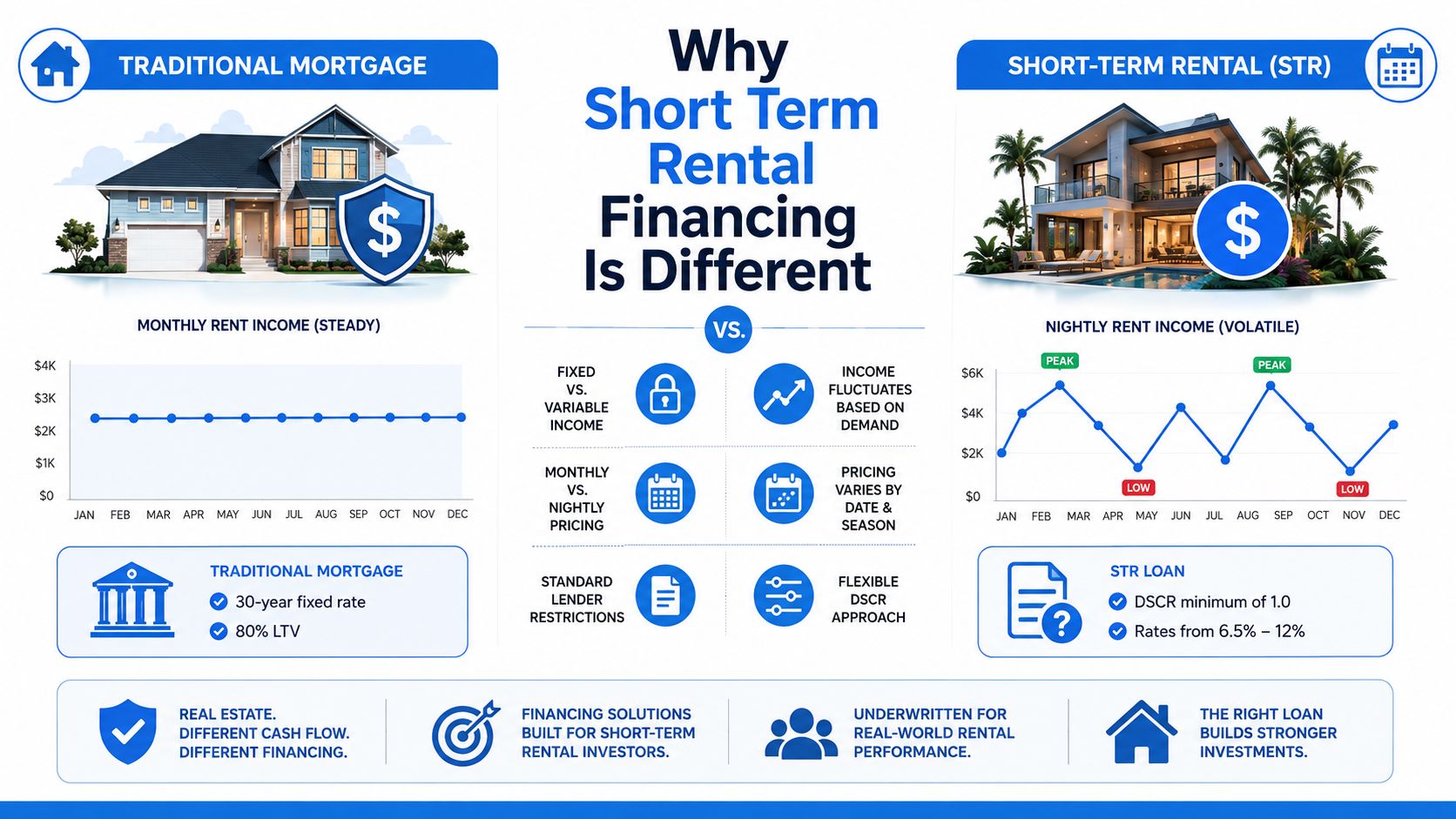
What lenders are really underwriting
The lender is usually looking past your W-2 and into the property's revenue story. That story often includes projected occupancy, average daily rate, cleaning and management costs, taxes, insurance, and debt service. In other words, the loan is tied to whether the asset can carry itself, not just whether the borrower has a good salary.
A good starting point for a borrower is a plain-language breakdown of the asset type, like the short-term rental guide from AgentPulse. It helps frame the property as a business asset, which is closer to how lenders view it.
Practical rule: if the income picture needs a lot of hand-waving, the lender will usually ask for more cash down, more reserves, or both.
That's why bank-style underwriting often slows down. The income isn't a fixed lease, it's a forecast, and the lender has to decide whether that forecast is believable enough to secure debt.
How DSCR Underwriting Works
Most STR loans come back to DSCR, Debt Service Coverage Ratio. The formula is straightforward, NOI divided by debt service, where NOI is net operating income. In plain English, the property's income after operating expenses has to cover the monthly loan payment.
For STRs, the lender usually models monthly rental revenue, then subtracts operating expenses such as property management, taxes, insurance, and repairs to estimate NOI. Some lenders work from historical operating data, while others rely on projected income from similar properties and market comps. For a new listing, that projection package matters as much as the borrower's credit.
The threshold is where the deal gets real. Industry guidance says many lenders want DSCR at or above about 1.2, some use stricter thresholds such as 1.5, and some programs can accept lower ratios depending on compensating factors. A separate industry guide says some DSCR lenders require 1.00 or more for Airbnb or short-term rental properties, which means the income must at least cover debt service. Capital Arm DSCR guidance Griffin Funding DSCR guide
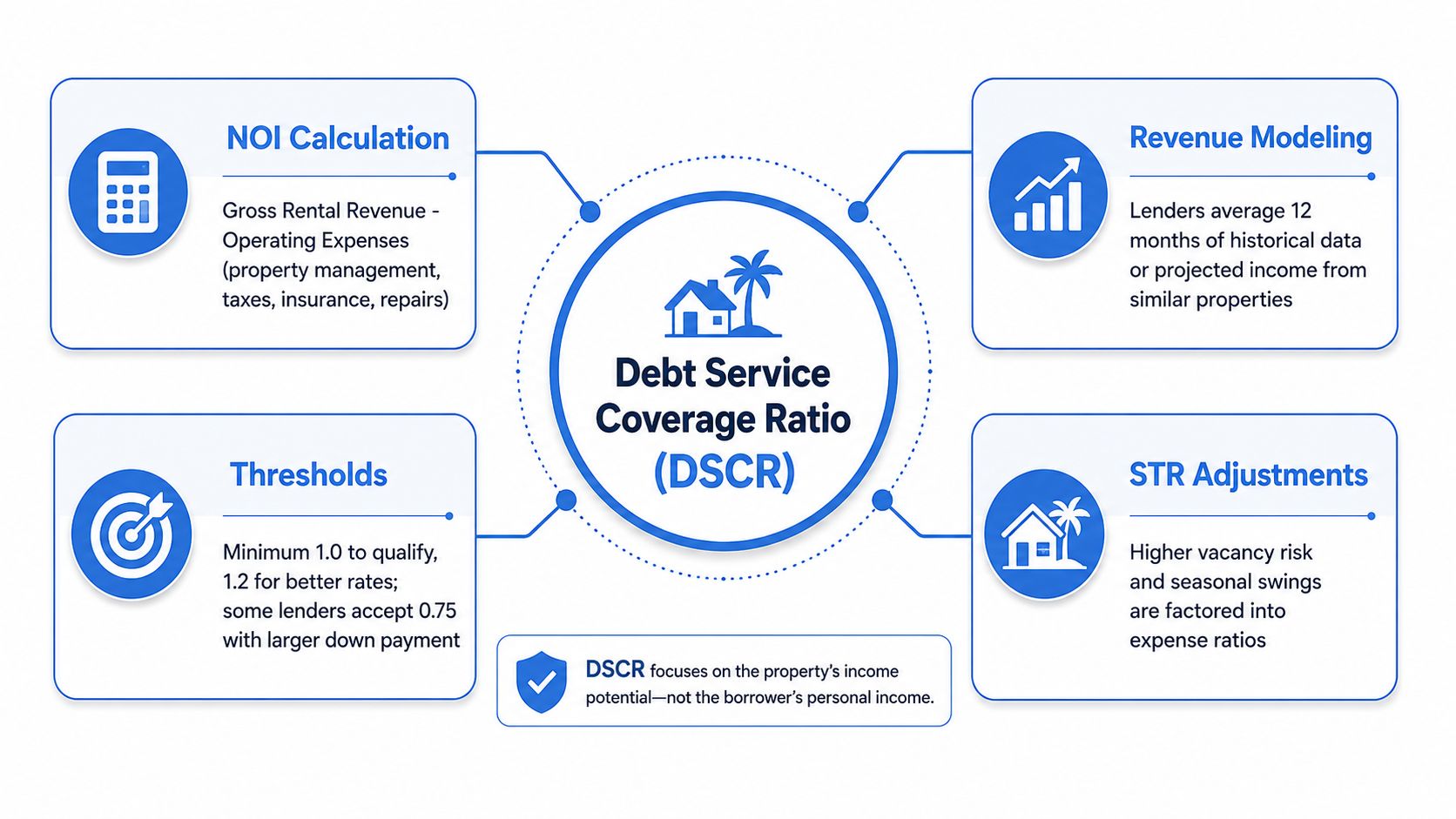
A simple underwriting example
Say projected gross monthly revenue is $6,000. If operating expenses come to $2,000, NOI is $4,000. If the monthly debt service is $3,200, the DSCR is 1.25 because $4,000 divided by $3,200 equals 1.25. That usually reads better than a deal at 1.00, because the cushion is stronger.
Plain English: the higher the DSCR, the more breathing room the property has if bookings dip or expenses rise.
Borrowers with thin ratios often get asked for larger down payments or stronger reserves. The lender is offsetting a smaller cash-flow cushion with less borrowed capital and more liquidity. A useful starting point for borrowers who want to see how this gets packaged in practice is the DSCR loans page.
Why STRs need their own math
Short-term rentals carry seasonal swings, so the lender often normalizes the numbers instead of accepting best-month performance. That is the main difference from a long-term lease property, where rent tends to be steadier and easier to verify. The more the deal depends on clean projections, the more the underwriter wants documentation that supports those projections.
Comparing STR Loan Products and Lender Types
The right loan depends on the property, but also on your clock. A bank DSCR loan can be fine when the property is stable and the file is clean. A bridge loan works better when the asset needs time, repairs, or repositioning before the long-term cash flow is believable. Hard money is the blunt instrument for speed and condition issues, especially when the property would fail a conservative bank review today.
| Product | Typical speed | Rate range | LTV range | Best-fit deal |
|---|---|---|---|---|
| Bank DSCR loan | Slower | Usually lower than private options | Often tighter | Clean, stabilized STRs with solid projected income |
| Portfolio lender | Moderate | Mid-range | Moderate | Borrowers with unusual file strengths or nonstandard income |
| Bridge loan | Fast | Higher than long-term debt | Conservative | Value-add STRs that need rehab or seasoning |
| Hard money | Fastest | Highest among the four | Lowest to moderate | Heavy rehab, distressed condition, urgent close |
The gap between bank and private money shows up in the details. Industry guides note STR loans are often priced about 0.5% to 1% above comparable conventional residential loans, with down payments commonly around 15% to 30%, and some programs asking for 20% to 25% down or more plus 3 to 6 months of cash reserves. That lower loan-to-value ratio is part of the trade-off for financing a property whose income can move around with demand and regulation. GetChalet STR loan guide
Where banks win and where they usually lose the investor
Banks can win on cost if the file is spotless and the property is already behaving like a stable rental. They usually lose on speed, flexibility, and willingness to deal with properties that need work, seasoning, or a sharper underwriter. If the property is turnkey and the borrower can tolerate the process, bank debt may make sense.
If the investor needs to move fast, the bridge or hard money lane tends to make more sense. For a broader comparison of financing paths on non-owner-occupied property, this investment property financing guide is a useful reference point.
Practical rule: if the deal only works when everything goes perfectly, the lender is probably going to price that risk into the loan.
Matching product to purpose
The right product isn't the cheapest one on paper. It's the one that fits the condition, the timeline, and the amount of documentation the deal can support today. If those three things don't line up, the lowest rate in the market won't close the transaction.
The Document Checklist Investors Should Prepare
Lenders move faster when the file is complete before the first call. The basic package for STR financing is more property-driven than a conventional mortgage file, and that changes what you should gather first. A clean submission gives the underwriter less room to stall on missing items.
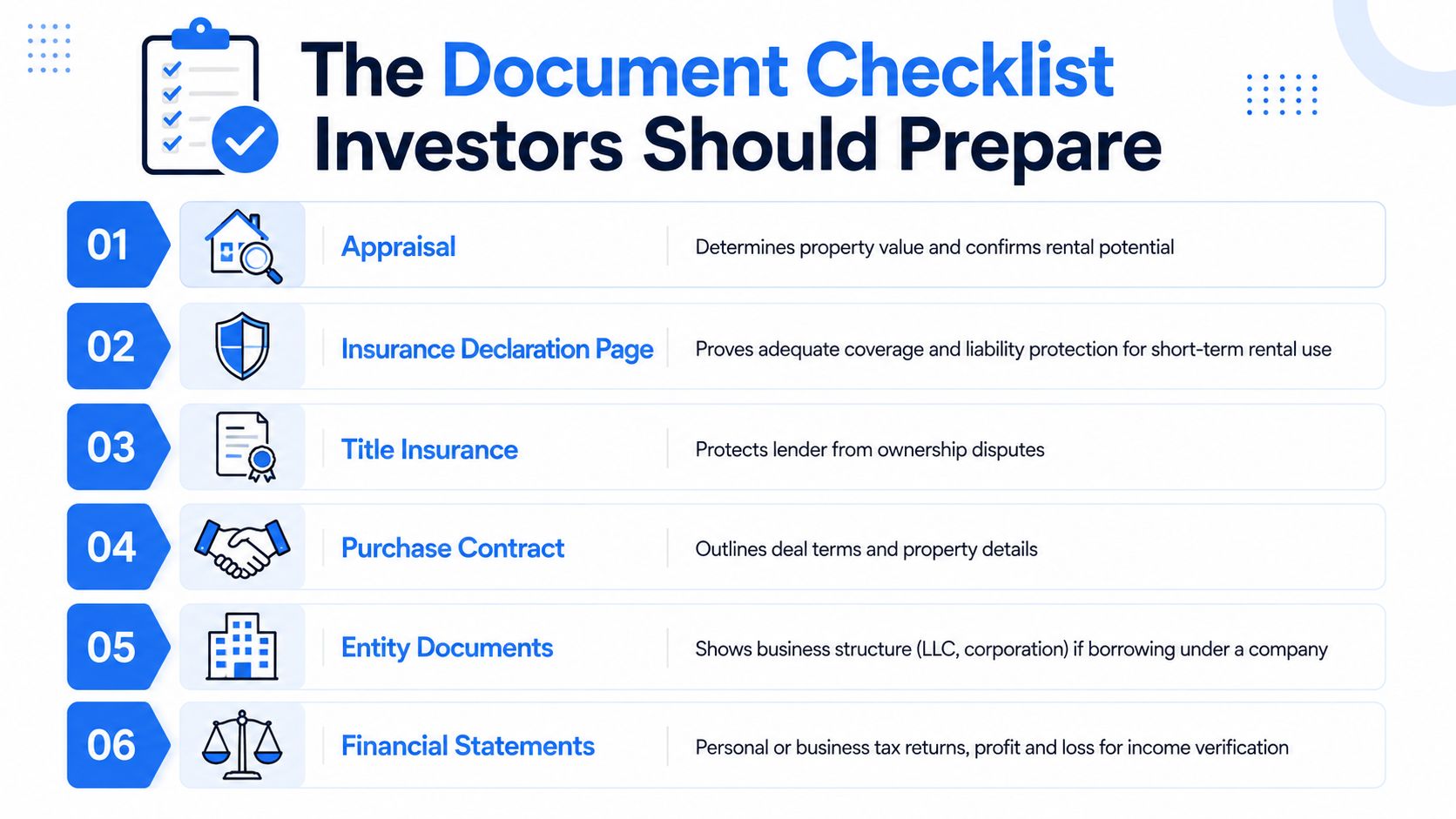
What usually belongs in the file
The most common items are straightforward:
- Appraisal: confirms property value and supports rental market value and DSCR thresholds.
- Insurance declaration page: shows adequate coverage and liability protection for short-term rental use.
- Title insurance policy: helps protect the lender from ownership disputes.
- Purchase contract: sets the deal terms and property details.
- Business entity documents: needed when the loan is being made to an LLC or other company.
- Projected income package: includes market comps, occupancy assumptions, and supporting rental evidence.
Some lenders also do not require tax returns or pay stubs for these loans, because the asset itself is doing most of the qualifying work. A property appraisal, insurance declaration page, purchase contract, and entity paperwork are commonly part of the review. Visio Lending STR guide
What investors forget most often
The missing piece is usually the projected income file, not the deed or the contract. Borrowers often bring a listing idea and assume the lender will fill in the rest, but underwriters want the logic behind the forecast. That means comparable properties, realistic occupancy assumptions, and a path from gross revenue to NOI.
Practical rule: if the lender can't trace the number back to market evidence, the number won't help you much.
Another common miss is entity documentation. If the borrower plans to hold title in an LLC, the lender wants the company structure to be clean and ready, not assembled the night before underwriting. A complete file saves time because the lender can focus on credit, collateral, and cash flow instead of chasing basic paper.
Fast way to get organized
A simple folder structure works better than a pile of PDFs. Put the contract, title item, insurance, appraisal order, entity docs, and income package in separate folders so your lender or broker can move through the file without digging. That's how deals stop stalling over avoidable admin.
Three Example Loan Scenarios With Real Numbers
A clean STR deal can still land in very different financing buckets depending on condition and timing. The numbers below are illustrative examples using the kind of structure lenders commonly apply, not promises of approval. The point is to show how the monthly math changes from one deal type to another.
Scenario one, turnkey condo with bank DSCR
A borrower buys a turnkey condo for $450,000 and puts 20% down, or $90,000. The loan amount is $360,000. If the monthly debt service comes in at $2,400 and projected monthly NOI is $3,000, the DSCR is 1.25.
That deal is the kind of file a bank DSCR lender may like, because the property is already stable and the income projection has some cushion. The borrower may still need reserves and clean documentation, but the property is doing a lot of the work. Stronger projected NOI usually helps more than trying to maximize borrowing power.
Scenario two, value-add property with bridge financing
A buyer picks up a coastal property for $700,000, plans light renovations, and needs to close before the season changes. They put 25% down, or $175,000, and finance $525,000 with a bridge loan. If monthly debt service is $4,900 while stabilized projected NOI is expected to reach $6,000, the DSCR is about 1.22 once the property is operating as planned.
Bridge debt makes sense here. The file isn't being judged as if the property is already stabilized, because the borrower still needs time to finish work and season the asset. A short term rental business plan from hostAI can be useful because it forces the borrower to map operating assumptions before the lender asks for them.
Scenario three, heavy rehab with hard money
A distressed asset is purchased for $500,000 with a heavy rehab budget and little chance of bank approval in its current state. The borrower uses hard money, puts down 30%, or $150,000, and borrows $350,000, with rehab funds staged separately. If the debt service is $4,200 and projected NOI after stabilization is $5,100, the DSCR lands around 1.21 after the project is complete.
Hard money is expensive relative to long-term debt, but it buys speed and control when the property is not ready for bank review. The staged draw structure matters because it lets the borrower fund improvements without waiting for every cost to be front-loaded. In these deals, the exit plan matters as much as the first closing.
Risks That Can Break a STR Loan Deal
The most common mistake is treating the property as if the rental income will always be there. Lenders don't make that mistake. They price in local rules, platform dependence, and demand swings, because any of those can weaken debt service after closing.
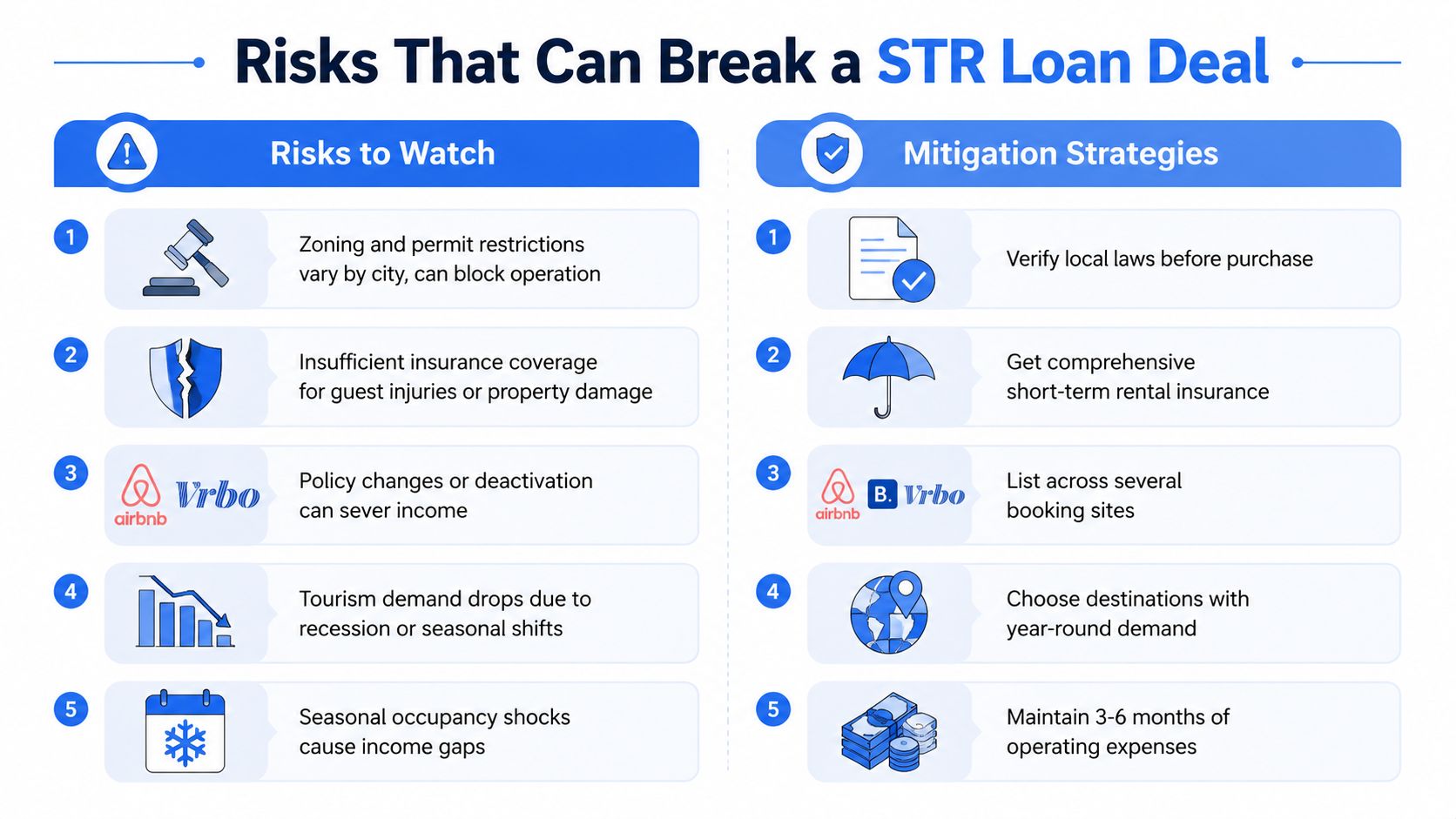
The main risk buckets
Zoning and permit restrictions can block operation entirely, so the first check should always be local law. Insurance gaps matter too, because guest injuries or property damage can wipe out cash flow fast if coverage is thin. Platform policy changes or deactivation can also cut off the income stream without touching the building itself.
Demand is another pressure point. A UK parliamentary briefing reported an average 36% occupancy rate and 10.4-day average stay in February 2024, which is a reminder that STR performance is measured in operating metrics, not just asking rent. The same kind of volatility is why underwriters care about occupancy swings and not just sticker revenue. UK parliamentary briefing on STR metrics
How to stress-test the deal
Borrowers should test the property under lower occupancy and tighter regulation. If the asset can't survive a softer market, the loan is vulnerable even if the initial approval looks fine. That's why many borrowers keep backup plans such as a midterm rental strategy when rules or demand shift.
A practical local example is the property service side of the business. If you're evaluating an operating market and want to understand how turnover support works, a local provider like residential clean services San Antonio is a reminder that the business depends on reliable operations, not just acquisition math. Cleaning, turnovers, and occupancy management all affect whether projected NOI is believable.
Practical rule: if the property only works at peak occupancy, the debt is carrying too much optimism.
The better question is whether the asset can still service debt if bookings soften or local enforcement tightens. That's the question serious lenders ask, and it's the one investors should ask themselves before they sign.
Choosing the Right Lender for Your Deal
The lender choice should follow three questions. How fast do you need to close, what condition is the property in, and how much documentation can you produce today? If those answers point in different directions, the cheapest loan probably isn't the right loan.
A bank DSCR loan makes sense when the property is already stable, the file is clean, and the borrower can wait for a more traditional review. A bridge loan fits when the asset needs time, repairs, or market repositioning before the income story is strong enough. Hard money is the practical answer when speed, condition, or both make the bank lane unrealistic.
That's where a California private lender can be useful. LendingXpress structures bridge, fix-and-flip, and rental property loans for non-owner-occupied assets, which gives investors a way to close when a bank file would stall on documentation or condition. For brokers and borrowers dealing with a tight closing window, that kind of responsiveness is often the difference between winning the deal and losing it.
If the property is strong but the paperwork is light, start with the product that can close. If the property needs rehab, use a loan that gives you room to finish the work. And if the exit depends on proving future cash flow, line up the lender with the clearest path to that story.
If you've got a short-term rental acquisition, refinance, or rehab deal that needs a faster answer, reach out to LendingXpress and compare the fit before you miss your window. Their team works on bridge, hard money, and rental financing for non-owner-occupied properties, and you can start the conversation at LendingXpress.