
You're staring at a deal that should've been simple. The offer is signed, the seller's waiting, and your bank still wants another round of underwriting, another doc, another week. That's usually the moment people start asking what investment companies are, because the word sounds academic until your closing date is on the line.
In plain English, an investment company is a pooled-capital vehicle that takes money from many investors and puts it to work in assets the group couldn't easily access alone. In real estate, that can mean a public fund, a private debt fund, a trust deed pool, or a REIT structure tied to income-producing property. The U.S. market is enormous, with 16,829 investment companies and $45.1 trillion in total net assets by year-end 2025; nearly 130 million U.S. retail investors sit behind that capital base (ICI Fact Book).
For a borrower, that matters because speed and certainty often matter more than a glossy term sheet. For an accredited investor, it matters because the same pooled-capital logic that powers mutual funds also powers a lot of private lending and trust deed activity. If you've ever wondered why one capital source closes while another stalls, this topic is usually where the answer starts.
A Real Estate Investor's Quick Answer
A borrower comes in with a non-owner-occupied single-family fix-and-flip, a hard closing deadline, and a bank that's still “reviewing conditions.” I've seen that story enough times to know the issue usually is not the deal itself. It's the gap between the borrower's timeline and the lender's structure.
Investment companies are the broader umbrella behind pooled capital. Some are public and familiar, like mutual funds and ETFs. Others sit closer to the world of real estate, like trust deed funds and debt funds that finance mortgages instead of stocks. The legal backbone for the modern U.S. structure was the Investment Company Act of 1940, which established the framework that later supported mutual funds, closed-end funds, unit investment trusts, and the ETF model (ICI Fact Book).
Practical rule: if money is being pooled professionally and deployed under a consistent set of rules, you're probably looking at some form of investment company, even if the storefront looks like a private lending shop.
A close look at what investment debt means in practice helps here. The label can cover very different funding sources, but the basic mechanics are the same, pooled capital, defined rules, and a sponsor or manager deciding where the money goes.
The scale is not niche. At year-end 2024, U.S.-registered investment companies managed $39.2 trillion for more than 125 million U.S. retail investors, and households were the largest investor group (ICI 2025 Fact Book Chapter 2). By year-end 2025, the total had grown to 16,829 investment companies with $45.1 trillion in net assets, while the SEC reported 13,702 registered funds and $41.5 trillion in aggregate net assets in 2024 (ICI 2026 Fact Book). That puts this squarely in the main stream of finance, not on the fringes.
For real estate people, the practical takeaway is simple. Banks lend from deposit funding and move at bank speed. Investment companies and private funds can be structured around property debt, rehab timelines, and investor cash flow in a way that fits real deals better. If your deal is about execution, not theory, this is the lane worth understanding.
Defining Investment Companies the Simple Way
A borrower or investor usually runs into an investment company when money is pooled first and decisions are made by a manager or sponsor, not by each individual participant. That structure works like a capital pool. It gives access to assets or loans that would be awkward, slow, or impossible to buy one by one.
The U.S. legal framework starts with the Investment Company Act of 1940. That law set the ground rules for pooled capital, including disclosure, governance, and investor protection, and it helped formalize the classic categories described in the ICI Fact Book: mutual funds, closed-end funds, unit investment trusts, and the structure that later developed into exchange-traded funds. The point was practical, not academic. Pooled money needed a repeatable framework that investors could understand and regulators could oversee.
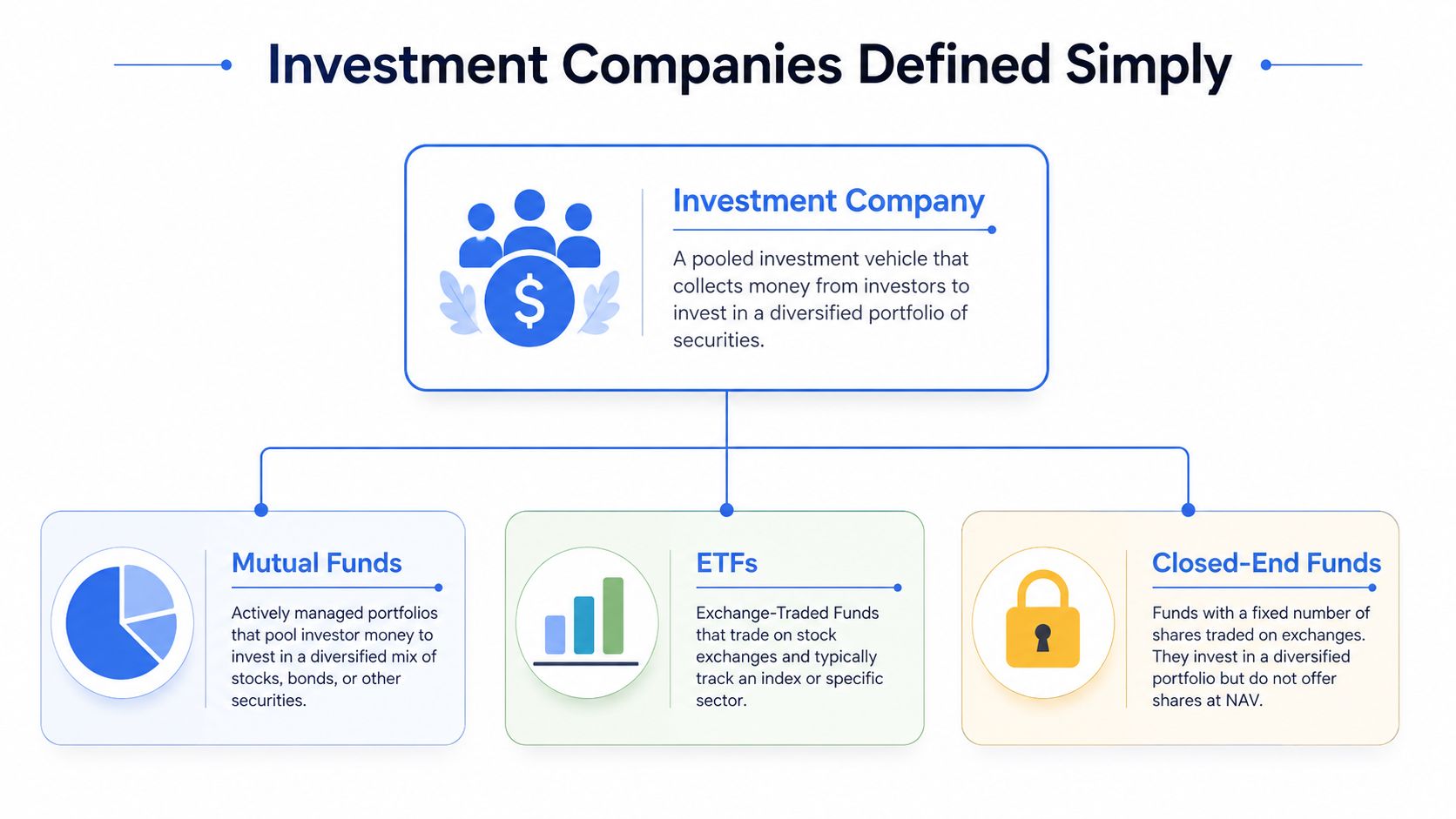
Real estate investors see the term in several wrappers. Public REITs own or finance property. Private debt funds may lend on first-position liens. Trust deed funds often buy secured real estate notes. Some closed-end or mutual fund strategies also reach into property debt or equity. The wrapper changes, but the capital-pooling logic stays the same.
A public mutual fund is built for broad market access and daily liquidity. A private trust deed fund is usually built for a narrower investor base and a more specific lending strategy. If you are reading a private placement memorandum, you are usually looking at a capital pool designed to finance real estate debt in a tighter lane, not a street-level stock fund.
For a direct read on how that debt side works, this overview of investment debt fits the private lending world well.
Simple test: if the money is pooled, professionally managed, and allocated across many positions, you are in investment company territory even when the underlying assets are real estate loans.
The Four Types Real Estate Investors Use
Real estate investors commonly see four structures, and mixing them up leads to bad decisions. Some are public, some are private, and some combine fund mechanics with lending activity. The right fit depends on whether you're borrowing, investing, or trying to understand who is funding the deal.
The structures in plain English
REITs are the public face many investors recognize. They can hold equity in properties or, in some cases, focus on real estate debt. Public REITs trade like stocks, which makes them easier to enter and exit than private funds. Private REITs are less liquid and usually more selective about who can invest.
Trust deed funds and debt investment funds sit closer to private lending. A manager pools investor money, then funds loans secured by real property, often with a first-position lien. Investors usually receive periodic distributions, while the capital stays tied to the loan term.
Mutual funds and closed-end funds can also allocate to real estate debt or equity, though they are often used for broader strategies rather than a single-market lending niche. These are usually run by registered managers with more standardized reporting and wider portfolio mandates. For a broader look at pooled capital structures, the ICI Fact Book is a useful reference point.
Direct private lenders are the last group. Sometimes they are a small shop funding one loan at a time. Sometimes they are a more formal platform with pooled capital behind the loans. The borrower experiences them as fast, practical, and documentation-heavy where it counts, but not as bureaucratic as a bank.
A LendingXpress-style debt fund is easy to understand. Capital is pooled, loans are made against short-term real estate collateral, the loan sits in first position, and the investor sees disclosure documents that spell out the strategy, target return, and risks. That is much closer to a mortgage business with a fund wrapper than to a stock fund with a real estate sleeve.
| Investment Company Types Used by Real Estate Investors | |||
|---|---|---|---|
| Type | Typical Structure | Who Invests | Liquidity |
| REIT | Public or private real estate vehicle | Public market investors or private placement buyers | Public REITs are more liquid, private REITs are less liquid |
| Trust deed fund | Pooled real estate debt fund | Accredited investors | Usually limited |
| Mutual or closed-end fund | Registered pooled fund with real estate allocation | Broad investor base or qualified buyers | Varies by structure |
| Direct private lender with pooled capital | Lending platform or fund-backed lender | Accredited investors or capital partners | Usually limited |
The core difference is control and exit. Public REITs are more market-facing. Private trust deed and debt funds are more deal-facing. If you're borrowing, that distinction affects speed and underwriting. If you're investing, it affects liquidity and how much loan-level risk you're taking.
How Investment Companies Differ from Banks and Private Lenders
A lot of people use “lender,” “fund,” and “bank” like they mean the same thing. They don't. A bank takes deposits, lives under a heavy safety-and-soundness regime, and usually prefers borrowers who fit cleanly into standardized boxes. A private lender may be one person funding one deal. An investment company sits in the middle, pooling capital and applying a portfolio approach.
That middle ground matters on real estate deals. Banks often win on cost if the file is clean and the timeline is forgiving. Private lenders win on flexibility when the borrower needs a fast answer and the asset itself is strong. Investment-company-backed lenders can do both at scale, because the capital pool and the underwriting model are designed for repeatable real estate decisions.
If you want a practical comparison, this private lender versus bank breakdown is a useful way to think about the trade space. For broader capital planning, Stewart Accounting Services' funding options for asset acquisition is also a decent outside reference on how buyers think through funding sources.

What changes in practice
- Speed: banks move through layers of approval, while private capital can move much faster when the collateral and exit make sense.
- Flexibility: banks prefer standard credit boxes, while private lenders and fund-backed lenders can underwrite to the property and the plan.
- Documentation: banks usually ask for more consumer-style and deposit-style paperwork, while real estate funds focus on asset quality, lien position, and exit.
- Loan purpose: banks are often better for patient borrowers, while private and fund-backed lenders are better for acquisitions, rehabs, bridge needs, and cash-out timing.
- Portfolio mindset: an investment company thinks across many loans or positions, not just one file, so pricing and risk controls are designed with the whole pool in mind.
A borrower who needs two weeks to close, but can't get a bank file through underwriting, usually does better with a fund-backed private lender than with another round of bank paperwork.
What to Look for Before You Invest or Borrow
A deal can look fine on paper and still fail at the finish line. The borrower may be focused on closing fast, while the investor is watching whether the manager can protect collateral, collect payments, and keep the file clean.

Borrower checklist
A credible private lender or investment-company-backed fund should answer the basics without dragging you through a maze. Ask about loan-to-value discipline, the draw process, upfront fees, and who can clear the file. If you're financing a $750K fix-and-flip on a non-owner-occupied single family, you need a lender that can spell out the path from application to closing in plain English.
Timeline matters, but so does rehab funding. Ask how staged draws work, what gets financed, and what happens if the project runs longer than expected. A good loan officer should understand the market, the property type, and the borrower profile well enough to spot trouble before documents go out.
Investor checklist
If you're looking at a debt fund or trust deed opportunity, don't stop at the target return. Ask how often loans sit in first lien position, what the borrower base looks like, where the loans are concentrated geographically, and how the manager handles origination volume. A fund targeting a 9% annual return secured by first-position liens can sound simple, but the key questions are underwriting depth, servicing quality, and how the sponsor handles a delayed exit.
The admin side matters too. A solid bookkeeping guide from Book Tech helps show why loan-level tracking, draw reconciliation, and reporting discipline matter in lending operations. Good credit work usually sits on top of careful recordkeeping, not just a polished pitch deck.
Borrower rule: if the lender can't explain fees, draws, and closing steps in plain language, keep shopping.
A private fund should also show how it treats realized results versus stated targets. If the sponsor can't speak clearly about loan sizing, collateral, or concentration, the return number does not tell you much. That applies whether you're buying into a trust deed pool or reviewing a more formal debt investment fund.
The Honest Trade-offs Nobody Mentions
Non-bank capital is not magic, and it's not automatically dangerous either. It's built for a different job. The borrower gets speed and flexibility, but usually gives up low rates and long amortization. The investor gets access to income-producing loan exposure, but accepts illiquidity and manager risk.
The biggest mistake I see is treating a target return like a promise. A stated return is a business goal, not a guarantee, and the deal still depends on underwriting quality, lien priority, borrower discipline, and exit execution. If any of those weaken, the paper return starts to matter a lot less than the actual loan book.
Real-world trade-off: the faster capital moves, the more the lender has to know what it's doing before money leaves the door.
There's also a quieter issue that gets missed in marketing copy. Capital often bypasses good deals not because the deals are bad, but because of network bias, thin local relationships, and market design. That means mainstream sources can miss opportunities that a better sourced private lender or investor would understand. In practice, the best non-bank outcomes usually come from sharper underwriting, not from looser standards.
For borrowers, that means higher rates can still be a fair trade if the closing window is real and the exit is credible. For investors, it means the question is not whether private debt exists, but whether the sponsor is disciplined enough to protect principal while the loans are outstanding. The upside is real. So are the constraints.
Putting It Together and Choosing Your Next Move
If you're a borrower, start with the deal timeline. If the property is clean, the file is simple, and you can wait, a bank may still make sense. If the deal is non-owner-occupied, the clock is tight, or the bank keeps slowing the file, a private lender or investment-company-backed fund is often the more practical lane.
Ask three questions before you apply. Can the lender close on your timeline, can it explain the draw and fee structure in plain English, and does it understand the exit on this specific property? If the answer is fuzzy, keep looking. Good capital partners sound organized before you sign, not after you run into trouble.
If you're an investor, sort the opportunity by wrapper and by control. Public REITs fit investors who want market access and easier liquidity. Private debt funds and trust deed opportunities fit investors who want real estate credit exposure and can live with less liquidity. The manager should be able to explain lien position, origination discipline, and how the portfolio is monitored, not just what the headline yield is.
For portfolio review, a tool like real estate ROI software from TruTec can help investors and operators keep track of properties, returns, and decision points without relying on memory alone. That kind of visibility matters when you're comparing several deals or trying to see which holdings are carrying their weight.
LendingXpress fits into this conversation as a relationship-driven private lending option for borrowers who need speed, flexibility, and common-sense underwriting, and as one of the places accredited investors may look when they're studying trust deed or debt investment opportunities. The right next move is usually a conversation, not a guess, especially if the deal is time-sensitive or the capital stack needs to be cleaner.
If you're weighing a non-owner-occupied purchase, refinance, or fix-and-flip and need a lender that can move quickly without losing sight of the collateral, reach out to LendingXpress. If you're an accredited investor evaluating trust deeds or debt funds, visit the site and review how the structure fits your goals before you put capital to work.