
You find a property that makes sense on paper. The seller wants a fast close. The house needs work. The rent story is strong after cleanup, or the resale margin is there if you move quickly. Then your bank asks for more time, more documents, and a cleaner property than the deal is.
That's where many new investors get stuck. The deal isn't bad. It just doesn't fit a conventional lender's box.
A private mortgage for non-owner occupied residential property solves a different problem than a bank loan. It isn't built to be the cheapest money in the market. It's built to help you close when timing, property condition, borrower structure, or documentation make bank financing too slow or unrealistic. For investors and brokers, that difference matters.
When Banks Say No (or Too Slow), Private Mortgages Say Yes
A common investor situation looks like this. You get a purchase contract accepted on a rental or fix-and-flip. The price is right because the property needs repairs, the seller wants certainty, or the listing has been sitting because retail buyers can't finance it easily. You call your bank and hear the usual response: maybe, but not on that timeline.
Private lending exists for that gap.
The mistake many first-time investors make is treating private money like an emergency option. In practice, serious investors often use it as a timing tool. If the property is right and the exit is clear, paying more for faster execution can be the better decision.
Where conventional financing breaks down
Banks usually want a straightforward file. Clean income. Clean property. Predictable occupancy. Time for committee review, appraisal, and follow-up conditions. That works well when the property is turnkey and the transaction is simple.
It works poorly when you're dealing with:
- A short escrow: The seller wants a close that feels close to cash.
- A distressed property: Deferred maintenance can stop a conventional approval.
- An investor-owned entity: LLC ownership often adds more review.
- Income that doesn't fit neatly on tax returns: Many borrowers are strong operators with complicated paperwork.
- A bridge need: You need to buy now and refinance or sell later.
Private money makes sense when the cost of missing the deal is higher than the cost of the loan.
That's the core framework. Don't ask only, “What rate can I get?” Ask, “What happens if I wait?”
In competitive California markets, speed changes outcomes. A private lender can often make a practical yes-or-no decision faster because the file is judged more on the property, the equity, and the exit plan than on a long list of consumer-style underwriting conditions.
What Is a Private Mortgage for an Investment Property
A private mortgage for an investment property is a loan made by a private lender rather than a traditional bank. For non-owner occupied residential real estate, that usually means financing for a rental, flip, bridge acquisition, or refinance where the borrower does not live in the property.
A bank loan is like a scheduled commercial flight. It's efficient when your trip matches the route and timetable. A private mortgage is closer to a charter. It costs more, but it's built around getting a specific deal done.
Asset first, borrower second
Private lenders still care about the borrower, but they underwrite differently. The first question is usually whether the property and loan structure make sense. If the collateral is solid, the debt is not excessive, and the exit is credible, the deal may work even when a bank won't touch it.
That's why these loans are often called asset-based. The lender focuses heavily on:
- Property value and condition
- Your cash contribution
- The business plan for the property
- How the loan gets paid off
A conventional lender usually starts with tax returns, W-2s, debt ratios, and internal overlays. A private lender often starts with the property.
What non-owner occupied really means
This part matters more than many borrowers realize. A property is non-owner occupied when you, the borrower, are not using it as your residence. It's being held for investment, rental income, resale, or another business purpose.
Occupancy isn't a casual checkbox. Independent guidance on non-owner-occupied property lending and occupancy fraud risk notes that lenders treat misrepresentation as occupancy fraud. That's a serious issue, and it's one reason underwriting for investment property is different from owner-occupied housing.
Why the rules are stricter
Non-owner-occupied lending carries different risk because repayment depends more on the property's performance and your investment plan than on your day-to-day use of the home. Mainstream mortgage comparisons commonly note that non-owner-occupied loans are typically priced and underwritten more conservatively, with rates about 1 percentage point higher and down payments that can rise from as little as 5% on a primary residence to 25% or more on a non-owner-occupied property, according to this owner-occupied vs. non-owner-occupied mortgage comparison.
If you plan to live in the property, say so upfront. If you don't, structure the loan correctly from day one.
That honesty protects you, your broker, and the lender. It also keeps the deal on the right product instead of trying to force an investment scenario into a consumer mortgage program.
How Private Lenders Evaluate Your Deal
Private lending feels faster when you understand what drives the approval. It isn't random. A lender is trying to answer a practical question: if this deal goes forward, is there enough value, enough borrower capability, and a clear enough payoff path to justify the risk?
Here's the underwriting lens most investors should expect.

Property assessment
This is usually the anchor. The lender wants to know what the property is worth today, what it may be worth after improvements if rehab is part of the plan, and how much cushion exists if the project takes longer than expected.
That review often includes current condition, neighborhood support, comparable sales, rent potential for rental deals, and whether the scope of work is realistic. A good asset can carry a file a long way. A weak asset usually can't be saved by a strong personal story.
Borrower experience
Experience matters, but not always in the way new investors think. You don't need a massive portfolio to get considered. What helps is showing that you understand the project in front of you.
A lender will usually look for signs that you can execute:
- Prior projects: Even smaller rehabs or landlord experience can help.
- Team quality: A reliable contractor, property manager, or broker strengthens the file.
- Financial capacity: Reserves matter because projects rarely run exactly as planned.
If you're new, the file has to be cleaner elsewhere. More cash in, conservative debt limits, and a simpler business plan often make the difference.
Exit strategy
This is one of the most important parts of the file. Private loans are often short-term or transitional. The lender needs to know how the loan gets repaid.
Common exits include:
- Sale after renovation
- Refinance into long-term rental debt
- Sale of another asset
- Stabilization followed by a conventional or DSCR refinance
Practical rule: If your exit plan only works in a perfect market, the lender will treat it as fragile.
A strong exit is specific. “I'll probably sell for more later” is weak. “I'll finish this scope, lease the property, then refinance once it's stabilized” is much more credible.
Loan purpose
Why are you borrowing? Acquisition, bridge financing, cash-out for a business purpose, rehab, or payoff of an existing loan all carry different risk. A lender wants the story to line up. If the purpose is blurry, the file feels risky.
A clean submission usually answers four questions fast:
| Question | What the lender wants to see |
|---|---|
| What is the property? | Type, location, condition, value story |
| Why this loan? | Purchase, rehab, bridge, refinance |
| How strong is the borrower? | Experience, liquidity, entity structure |
| How does it get paid off? | Sale, refinance, or another defined exit |
Common Types of Private Mortgages for Investors
The loan type should match the business plan, not the other way around. A private mortgage can solve very different problems for an investor buying a distressed rental, a broker trying to save a delayed closing, or an experienced flipper bidding in a competitive California market. The question is not just what the loan is called. The question is whether paying more for speed and flexibility helps you make or protect the deal.
Bridge loans
Bridge loans work for properties and situations that are in transition.
A property may have vacancy, deferred maintenance, unfinished leases, title issues, or a seller timeline that does not leave room for a conventional approval. In those cases, the investor is often choosing between two costs: a higher short-term borrowing cost now, or losing the asset while waiting on cheaper money that may not arrive in time.
A common example is a small non-owner occupied residential property that has good long-term potential but is not ready for bank financing today. The borrower closes quickly with private money, fixes the issue that is blocking conventional financing, then exits into a refinance or sale once the property is financeable.
That is a strategic use of private capital. It is not a fallback if the numbers support the move.
Fix-and-flip loans
Fix-and-flip loans are built for execution. The lender is looking at the purchase basis, the rehab plan, the timeline, and whether the borrower has enough cash and experience to finish the job without getting squeezed mid-project.
For many investors, the right structure is a loan that covers both the acquisition and the rehab budget. That is why some borrowers use purchase and renovation loans for non-owner-occupied properties instead of trying to patch together separate financing sources.
This loan type makes sense when speed affects profit. If a worn property is priced right, a slow approval can cost more than the rate spread you would have saved with a bank. On the other hand, if the property is already financeable, the rehab is light, and the seller is flexible, conventional money may be the better answer. Serious investors make that decision before they write the offer, not after.
Some borrowers compare private rehab financing with HELOCs and government programs, but those options often fit owner-occupied properties better than time-sensitive investor deals.
Rental property loans through private channels
Private mortgages also fit rental investors who are buying or refinancing properties that need a transition period before long-term debt makes sense. The issue is often not the asset itself. The issue is timing, documentation, or current property condition.
An investor might buy a building with below-market rents, complete unit turns, improve occupancy, and refinance after the rent roll is stronger. Another borrower may need to close in an LLC, use business-purpose cash-out proceeds, or move on a property that a bank underwriter will spend weeks reviewing. In those cases, private money gives the investor control over the timeline.
The right structure usually follows a simple sequence: acquire the property, improve it, stabilize it, and exit the short-term loan. If that sequence is clear and the deal still works after financing costs, private money can be the right tool, even when cheaper capital exists somewhere else.
Understanding the Costs and Timeline
Cost matters. So does timing. In private lending, the smart way to evaluate both is through opportunity cost, not rate alone.
Recent market commentary noted that the average 30-year fixed rate was 6.85% in mid-May 2025, after peaking around 7.04% in January 2025, and pointed out that investors with non-owner-occupied properties may decide that waiting for conventional pricing is less important than avoiding execution risk, vacancy, or renovation delays, as discussed in this non-owner-occupied loan market overview.

How to think about the premium
Private loans generally cost more than bank loans. That's not a flaw in the product. It reflects faster underwriting, more flexible structures, and higher-risk property or borrower profiles.
What matters is whether the premium buys you something valuable:
- A fast close that wins the deal
- A loan on a property a bank would reject
- A bridge through rehab or vacancy
- A simpler process for an LLC or investor borrower
If the answer is yes, the higher cost may be justified. If the property is turnkey, the seller is flexible, and you qualify cleanly with a bank, private money may not be the right first choice.
Timeline is part of the economics
Time has a carrying cost. Every extra week can mean more holding expense, a lost seller, delayed rehab, or a missed refinance window. Investors often focus on note rate and ignore how expensive delay can become.
A typical private process often looks like this:
- Initial review: You send the property details, loan request, and business plan.
- Underwriting and due diligence: The lender reviews the asset, borrower, and exit.
- Terms issued: You decide whether the structure works.
- Closing and funding: Documents are signed and funds are released.
- Execution: Rehab, lease-up, sale, or refinance.
If you're comparing options for renovation funding, it also helps to understand alternatives outside investor lending. Homeowners sometimes use HELOCs and government programs, but those solutions fit owner-occupied scenarios far better than business-purpose financing for investment property.
Rehab draws and project control
For renovation deals, lenders often disburse rehab funds in stages rather than all at once. That protects both sides. You complete part of the work, document progress, and then request the next draw.
This system works well when the budget is detailed and the scope is realistic. It breaks down when the borrower underestimates labor, materials, permit timing, or contingency needs.
Borrowers get into trouble when they treat private lending as expensive cash instead of structured project capital. The better the plan, the smoother the draw process.
Private vs Conventional Loans A Head-to-Head Comparison
The right financing choice depends on what you need the loan to do. If your goal is the lowest long-term cost on a clean, stable property, conventional financing is usually hard to beat. If your goal is certainty, speed, or flexibility on a deal that doesn't fit bank credit, private money often wins.
Private mortgage vs. conventional loan at a glance
| Factor | Private Mortgage (Hard Money) | Conventional Bank Loan |
|---|---|---|
| Speed | Built for faster decision-making and shorter closings | Usually slower, with more layered approvals |
| Property condition | Can work for distressed or transitional properties | Usually prefers move-in ready or stabilized assets |
| Underwriting focus | Asset, equity, deal structure, exit plan | Income, credit, documentation, guidelines |
| Borrower structure | Often more workable for investors using entities | Often more rigid |
| Flexibility | More room for case-by-case judgment | Less room outside program rules |
| Best use case | Time-sensitive purchase, bridge, rehab, transitional rental | Long-term hold with clean qualifications |
Where conventional loans still shine
Conventional loans are often the better fit when:
- The property is stable and financeable
- The borrower has straightforward income and documentation
- The closing timeline is not aggressive
- The strategy is long-term hold from day one
If you can qualify and the deal allows time, conventional debt can be the cheaper capital.
Where private loans earn their place
Private loans are often stronger when:
- The seller cares about speed and certainty
- The property needs repairs before bank financing is possible
- The borrower is using an LLC or has complex income
- The transaction needs a bridge before permanent debt
Historically, non-occupant borrowers have mattered more to mortgage activity than many people assume. A Federal Reserve Bank of Richmond study found they accounted for 26% of the increase in home-purchase mortgage borrowing between 2003 and 2005, and originations to non-occupants rose 84% over that period, compared with 36% growth for owner-occupant home-purchase originations. The same study found investor FICO scores averaged around 720–730 versus about 700 for owner-occupants, with generally comparable or lower levels of borrowing and debt burdens, according to the Richmond Fed working paper on non-occupant mortgage borrowing.
That's a useful reminder. Investor borrowers are not automatically weak borrowers. They're a distinct category with different needs, timelines, and risk factors.
Your California Investor Checklist to Get Funded Fast
You get a property under contract on Tuesday. The seller wants a short close, the listing agent wants proof that your lender can perform, and the asset still needs work before a bank will touch it. At that point, speed is not about rushing. It is about showing a lender a file that makes sense on first review.
That is the actual checklist.
For California investors, the difference between a fast approval and a stalled file usually comes down to preparation. A lender should be able to see the asset, the business plan, your cash position, and the exit without chasing five follow-up emails. If any of those pieces are vague, the deal slows down.
A practical legal and market primer can help if you're entering or expanding in the state. This 2026 guide to California real estate is useful for understanding the broader investing environment around ownership, compliance, and transaction planning.
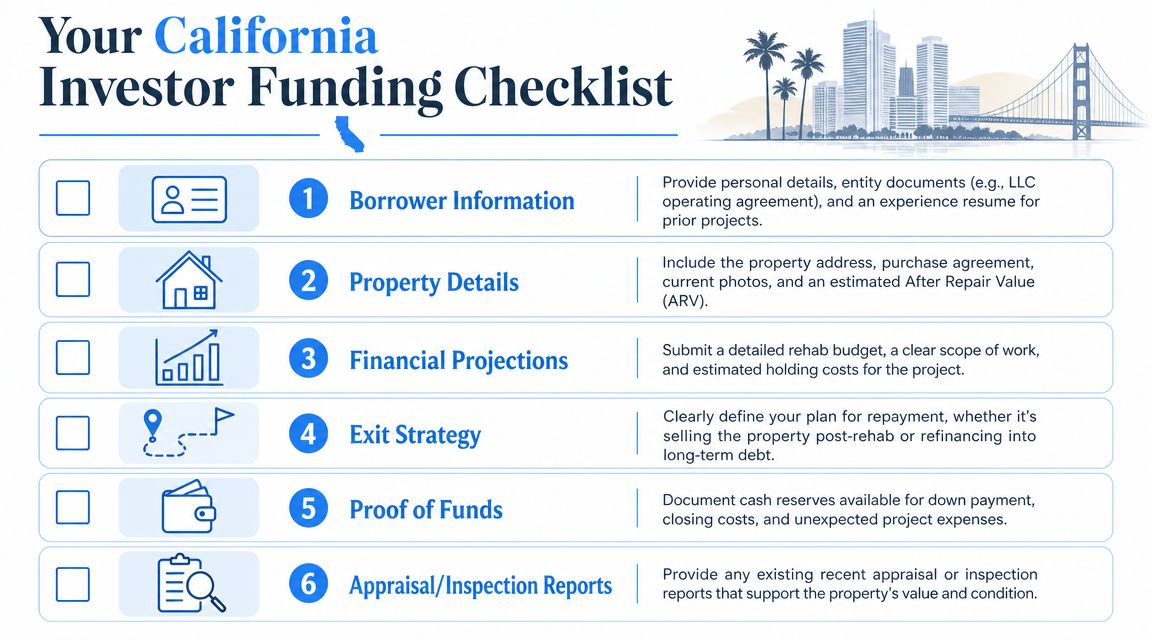
What to have ready
Bring a lender a decision file, not a pile of documents.
- Borrower package: Include a short background on you or your principals, entity documents if the borrower is an LLC or corporation, and a concise summary of prior projects or landlord experience.
- Property package: Include the address, purchase contract or payoff statement, current photos, rent roll if occupied, and any facts that affect value or marketability.
- Project numbers: Show the purchase price, rehab budget, carry costs, timeline, and your expected after-repair value or stabilized value.
- Exit plan: State whether the payoff comes from sale, refinance, or improved cash flow after stabilization.
- Liquidity proof: Show available funds for down payment, reserves, closing costs, and overruns.
What California lenders watch closely
California deals often look good on a spreadsheet and still fail in execution. Permit timing, insurance availability, tenant relocation issues, local rent rules, wildfire exposure, and neighborhood resale pace can all change a lender's view of risk.
That is why experienced investors pay for private money in specific situations. If the asset needs to be controlled now and cleaned up later, short-term California bridge loan options can make sense even if the rate is higher than bank debt. The premium can be justified when speed protects the purchase, preserves earnest money, or creates time to improve the property and refinance into cheaper capital.
This short video gives a useful overview of how investors think about project funding and execution:
What a strong submission looks like
A strong file is clear about the weak points.
If the property has deferred maintenance, say exactly what needs to be fixed and who will do it. If rents are below market, show current leases and your repositioning plan. If title has an issue, disclose it early. Private lenders can work with imperfect deals. They do not like surprises.
Investor borrowers are a real lending category, not a side case. A Federal Reserve Bank of Richmond study found that non-occupant borrowers accounted for 26% of the increase in home-purchase mortgage borrowing between 2003 and 2005, and originations to non-occupants rose 84% over that period, compared with 36% growth for owner-occupant home-purchase originations. The same study found investor FICO scores averaged around 720–730 versus about 700 for owner-occupants, with generally comparable or lower levels of borrowing and debt burdens, according to the Richmond Fed working paper on non-occupant mortgage borrowing.
That matches what good lenders already know. An investor file should be judged on execution, equity, and exit, not on the assumption that non-owner occupied means weak.
If you want terms quickly, send four things first. The property summary, the loan request, proof of cash, and the exit strategy. That gives a lender enough to price the risk and tell you whether private money is the right tool for this deal.
Frequently Asked Questions About Private Mortgages
Can I get a private mortgage with credit issues
Possibly, yes. Private lenders often place more weight on the property, the equity in the deal, and your exit strategy than a bank would. Credit still matters, but it usually isn't the only filter. A weak credit profile can sometimes be offset by a stronger asset, more cash in the deal, or a cleaner payoff plan.
Is hard money different from private money
People often use the terms interchangeably. In practice, both usually refer to non-bank real estate loans that focus more on the asset and the transaction than on full conventional underwriting. The exact terms depend on the lender and the deal.
Can I live in a non-owner occupied property for a while
You need to be very careful here. If the loan is made as non-owner occupied, your occupancy representation matters. Misstating occupancy can create fraud problems. If there's any chance you'll live there, disclose that before the loan is structured.
Is private money only for distressed borrowers
No. Many investors use it because the deal is time-sensitive, the property needs work, or the financing needs to match a short-term business plan. It's often a strategic choice, not a last resort.
What makes a file easier to approve
Clarity. A lender wants to understand the property, your cash contribution, the project plan, and the exit. The cleaner those four pieces are, the easier it is to get to a real answer.
If you're weighing whether a private mortgage is the right tool for your next non-owner-occupied residential deal, LendingXpress is one California-based option for bridge, rehab, and investor property financing. The best first step is to send the basic deal summary, property details, and exit plan so a loan officer can tell you quickly whether the structure makes sense.