
A property condition assessment is an independent, walk-through-based evaluation of a non-owner-occupied building's observable systems and components that identifies material deficiencies, estimates likely repair costs, and helps lenders and investors decide how to structure acquisition, renovation, or bridge financing before committing funds. ASTM International formalized the baseline process with ASTM E2018-99 in 1999, creating a repeatable framework for commercial property due diligence.
You're buying an apartment building, arranging a bridge loan, or preparing a value-add rental for refinancing. The property looks acceptable during a quick tour. Then the lender reviews the roof notes, asks about an aging electrical panel, spots missing life-safety documentation, and wants a reserve or repair plan before issuing a final approval. The problem isn't always that the property is unfinanceable. The problem is that the capital stack wasn't built around the building's actual condition.
Why a Property Condition Assessment Changes the Loan Conversation
A borrower can walk through a non-owner-occupied property and see clean hallways, occupied units, and working lights. A lender sees a different question: what physical conditions could require cash before the property stabilizes or the loan exits?
Consider a small multifamily acquisition. The buyer's initial tour shows no obvious interior damage, so the purchase budget focuses on cosmetic upgrades. A lender-grade property condition assessment then identifies roof deterioration, signs of recurring water entry, and deficiencies involving fire or life-safety equipment. The borrower hasn't lost the deal, but the original financing plan no longer works. Part of the capital must address closing-critical work, and renovation proceeds may need to move into controlled reserves with release conditions.

The underwriting distinction that matters
Underwriters don't treat every defect equally. A stained ceiling with no evidence of active intrusion may belong in planned maintenance. An actively leaking roof above occupied space can affect habitability, collateral protection, and the timing of the lender's first advance. A loose handrail may be routine correction, while a broader life-safety failure can become a condition to funding.
ASTM E2018 established a process built around a site walk-through, available records, owner or operator interviews, identification of physical deficiencies, and communication of recommended actions in a property condition report. The framework became increasingly routine after 2000 as lenders and transaction participants sought independent evidence about building systems, remaining useful life, and likely repair obligations. ASTM's historical description of E2018-99 explains why PCA moved from an informal inspection exercise toward a recognized risk-control process.
For a bridge or renovation loan, the report should answer practical questions:
- What must be fixed before funding: Life-safety threats, active water intrusion, or conditions that threaten the building's immediate operation may delay closing or require a cure plan.
- What belongs in a controlled reserve: Deferred roof work, paving, mechanical repairs, or other near-term needs can be funded through reserves and verified draws.
- What changes the exit plan: Major system replacements may affect stabilization timing, operating expenses, valuation assumptions, and refinance readiness.
- What can remain ordinary maintenance: Minor repairs and de minimis conditions shouldn't consume underwriting attention that belongs on material risks.
Practical rule: A PCA isn't valuable because it produces a long defect list. It's valuable because it tells the lender which defects change the money, timing, and conditions of the loan.
A property condition assessment therefore isn't an optional add-on for serious investment financing. It gives the broker, borrower, and lender a shared record before anyone commits the full purchase price, renovation budget, or construction draw schedule.
What a Property Condition Assessment Actually Covers
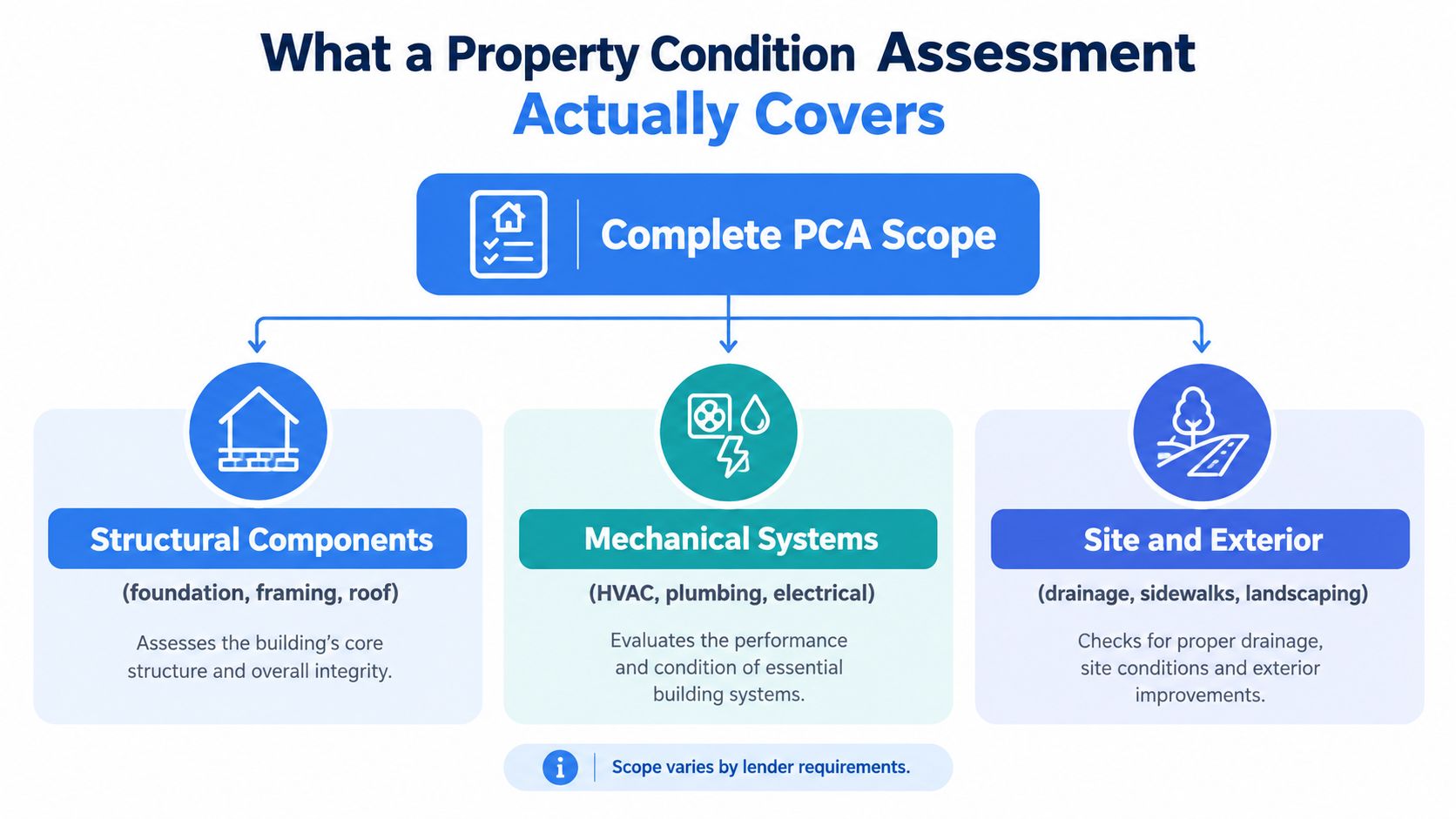
A lender-grade property condition assessment isn't a general home inspection, appraisal, structural certification, or environmental investigation. ASTM E2018 defines it as a baseline process that combines a visual walk-through with document review, research, and interviews. The assessor works from observable conditions and available evidence, then records findings in a property condition report.
The core scope
A reliable assessment should address the systems most likely to create capital demands or collateral risk:
- Structural elements: Foundation, framing, visible settlement, and other accessible structural conditions.
- Roof and exterior envelope: Roof coverings, drainage, exterior walls, windows, doors, sealants, and visible water-entry points.
- Interior areas: Representative tenant or common areas, finishes, evidence of leaks, and conditions affecting safe operation.
- Plumbing: Distribution systems, fixtures, visible leaks, water heaters, and signs of recurring failures.
- HVAC: Heating and cooling equipment, distribution, apparent condition, and probable replacement needs.
- Electrical systems: Service equipment, distribution, visible hazards, and conditions requiring specialty review.
- Fire and life-safety equipment: Observable alarms, extinguishing systems, egress conditions, and related deficiencies.
- Conveyance systems: Elevators or other conveyance equipment where present, with specialist review when the scope requires it.
- Site improvements: Drainage, paving, sidewalks, parking areas, retaining features, and other site components.
The report should separate material deficiencies, significant deferred maintenance, routine maintenance, minor repairs, and de minimis conditions. That classification matters because combining a failed roof with a damaged cabinet hinge makes the property appear riskier than it is, while burying an active leak among minor repairs can hide a real funding problem.
Readers who want a plain-language overview of what the assessment actually covers can use it as a helpful companion when reviewing vendor proposals or comparing report scopes.
What the report should deliver
The deliverable isn't merely an opinion that the building is acceptable. It should connect observed evidence to likely causes, recommended action, and probable cost.
A property condition report should document what the assessor observed, why the condition may matter, what corrective action is recommended, and the opinion of probable repair cost.
A baseline PCA also has limits. It generally doesn't replace environmental, code, structural, destructive, or specialty investigations. If the assessor observes a possible structural concern or a complex fire-system issue, the report should identify the need for a qualified specialist rather than imply that a visual review resolved it.
That limitation protects the borrower as well as the lender. A private lender can move quickly when the report clearly identifies its boundaries, separates facts from assumptions, and shows which items need contractor pricing or additional engineering before funds are released.
How PCA Findings Influence Lending and Underwriting Decisions
At the underwriting desk, a PCA becomes useful when each finding is translated into a financing action. The lender isn't asking whether the building has defects. The lender is asking whether the borrower has enough liquidity, reserves, time, and execution control to address those defects while protecting the loan.
A life-safety issue or active water intrusion usually receives the highest attention because the condition can worsen quickly or affect occupancy and collateral protection. The lender may require completion before closing, a funded repair escrow, evidence of a qualified contractor, or a draw that follows verified progress. Deferred maintenance that doesn't threaten immediate operation may instead increase replacement reserves or reduce proceeds available for discretionary improvements.
Longer-life replacements require a different judgment. An aging roof, HVAC plant, paving system, or electrical component may still function during the inspection, but its remaining useful life can influence reserve sizing, projected operating cash flow, and the borrower's exit valuation. A bridge lender may accept the condition if the renovation budget and draw schedule address it. A lender expecting a refinance may want more documentation showing that the replacement won't undermine debt-service capacity later.
Finding to loan action
| Finding Type | Typical Underwriting Impact | Common Loan Action |
|---|---|---|
| Active water intrusion | Raises concern about ongoing damage and collateral protection | Cure before closing, escrow funds, or require verified repair |
| Life-safety deficiency | May affect occupancy, compliance, and immediate risk | Closing condition, controlled reserve, or specialist sign-off |
| Deferred roof or mechanical work | Creates near-term capital demand | Increase reserves and include a defined repair budget |
| Aging but functioning system | Affects remaining useful life and exit planning | Add replacement allowance or adjust proceeds |
| Routine maintenance | Usually doesn't change core collateral risk | Track in operating budget rather than loan reserve |
| De minimis condition | Limited effect on value or execution | Note without a material loan adjustment |
For multifamily financing, the connection between physical condition and reserves is explicit. Fannie Mae's Multifamily Guide requires the minimum replacement-reserve amount to equal the greater of the guide's calculated amount or $250 per unit per year. On a 40-unit non-owner-occupied apartment property, that stated minimum benchmark equals $10,000 annually, before any higher amount indicated by physical condition or capital-needs analysis, as shown in Fannie Mae's replacement-reserve requirements.
The guide also identifies a property condition assessment and historical operating information as inputs to the reserve determination, using Form 4099. Fannie Mae's multifamily process therefore connects the report to cash-flow underwriting rather than treating it as a descriptive attachment.
Capital stack and draw schedule
A borrower may need to fund immediate repairs with equity, place future work in a lender-controlled reserve, and release renovation proceeds in stages after inspections or invoices. That structure can maintain financial advantage while preventing repair money from being diverted to unrelated uses.
The most effective loan package presents a line-item schedule that ties each material deficiency to a cost allowance, responsible contractor, target completion point, and source of funds. Brokers who want a clearer view of how those inputs fit into approval should review the loan underwriting process before submitting a deal with unresolved PCA findings.
How Borrowers and Brokers Should Order and Use a Property Condition Assessment
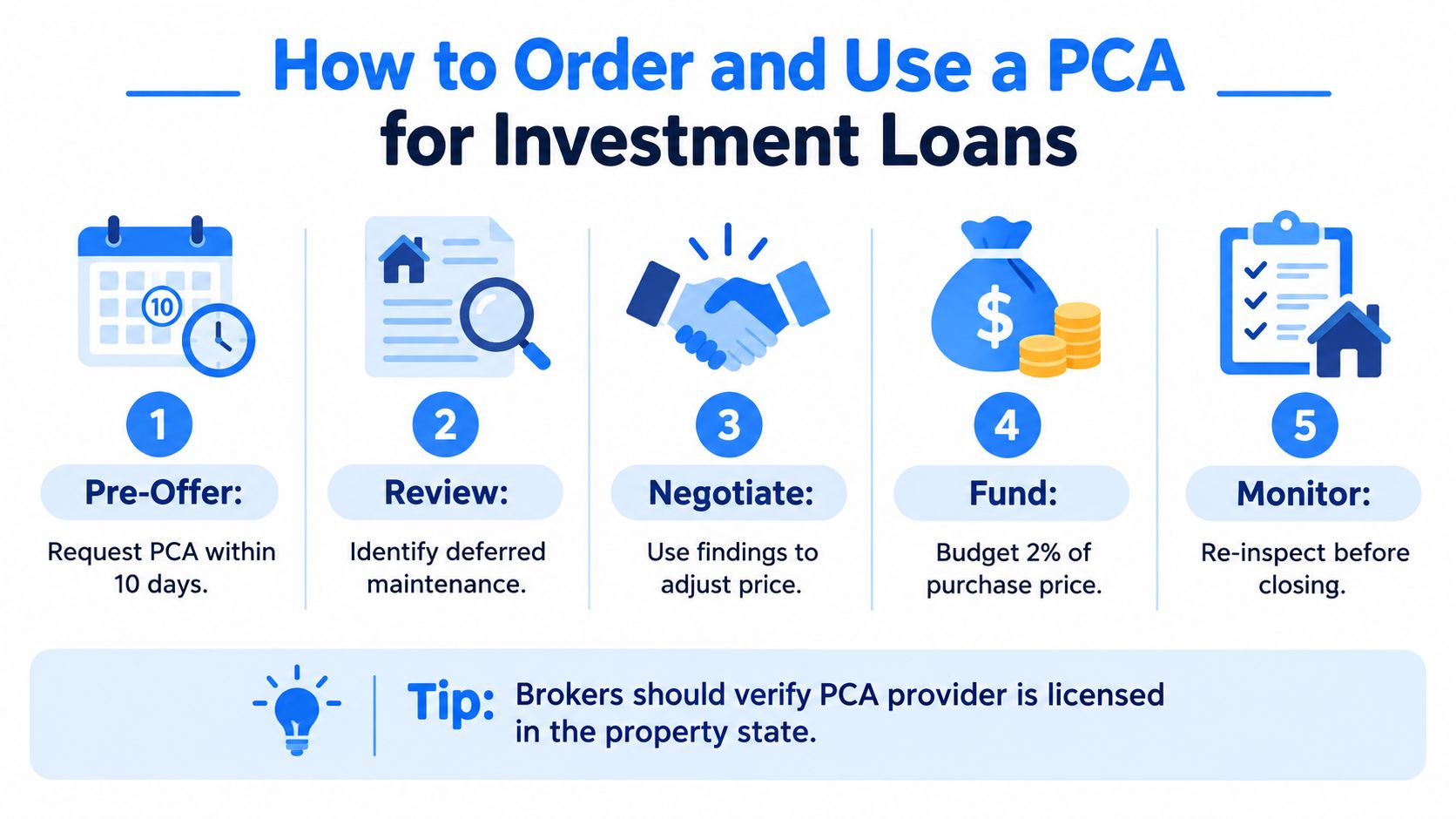
Order the property condition assessment early enough for the findings to affect the purchase contract and loan structure. Waiting until the lender's final checklist can turn a manageable repair plan into a closing delay, especially when the report leads to contractor bids, specialist inspections, revised insurance terms, or a new reserve calculation.
Request a lender-grade PCA aligned with ASTM E2018, but confirm the intended lender will accept the provider and scope. A report prepared for a limited owner review may not satisfy a private lender underwriting a commercial acquisition. The engagement should identify the property type, accessible areas, representative units or spaces, roof access, mechanical rooms, site improvements, available records, and interview contacts.
A practical ordering checklist
Confirm scope before the site visit. Ask whether the assessment covers structural components, roof, envelope, interiors, plumbing, HVAC, electrical, fire and life-safety equipment, conveyance systems, and site work. Clarify exclusions so you know when to order a separate specialist review.
Request useful documentation. Provide maintenance records, prior reports, repair invoices, capital plans, service contracts, certificates, and known issue logs. Missing records don't automatically stop a deal, but they can increase uncertainty and make the lender more conservative.
Require categories that support underwriting. Ask the assessor to separate material deficiencies from routine maintenance and de minimis conditions. Request probable repair costs and remaining useful-life opinions for major systems, while recognizing that the figures aren't contractor bids or guaranteed prices.
Share the draft findings quickly. Send material observations to the lender, broker, contractor, and relevant advisers as soon as they're available. Early review lets the team decide whether a finding requires a price adjustment, seller cure, reserve, or revised renovation scope.
Turn the report into a funding schedule. Place immediate work, near-term deferred maintenance, and planned capital replacements into separate budget lines. Tie each line to equity, closing proceeds, a controlled reserve, or staged construction draws.
For private and hard-money transactions, speed comes from organized information, not from skipping diligence. A borrower who supplies the report, repair logic, and funding source in one package gives the lender fewer open questions. The guidance on hard-money loan due diligence is useful when assembling that package for a fast investment loan.
Broker checkpoint: Verify that the PCA provider is licensed or otherwise properly qualified for the property's state and the lender's requirements. A cheap report that the lender rejects costs more than a compliant report ordered at the start.
Use the report during negotiations, too. A documented roof, drainage, or mechanical issue gives the buyer a basis to request a price adjustment, repair credit, seller completion, or a financing structure that reflects the actual work. The objective isn't to make every property look perfect. It's to make the loan match the property's real condition.
Real PCA Examples and Common Red Flags for Investment Loans
Three report outcomes illustrate how the same assessment can produce very different loan structures.
Example one, a clean multifamily acquisition. The assessor finds functioning major systems, no material active water intrusion, manageable routine maintenance, and capital needs that fit the borrower's operating plan. The lender can underwrite standard reserves, keep the renovation budget focused on improvements, and avoid a large closing holdback. The report doesn't eliminate risk, but it gives the lender a documented basis for a straightforward bridge structure.
Example two, a value-add rental with deferred work. The property is operational, but the roof is approaching replacement, several HVAC components are aging, and site drainage needs correction. Those findings don't necessarily block closing. The lender may divide the capital into acquisition proceeds, a controlled renovation reserve, and staged draws tied to completed work. The borrower must preserve enough liquidity for ordinary operations while the property moves through stabilization.
Example three, a property with closing-critical red flags. The report identifies active roof failure, recurring water intrusion, and unresolved life-safety concerns. A casual walk-through might have missed the pattern, particularly if damage was concealed by recent finishes. The lender may require a repair scope, contractor pricing, insurance confirmation, and completion evidence before funding, or may increase the borrower's equity contribution to protect the transaction.
Red flags that deserve immediate escalation
- Active water entry: Look beyond the visible stain. Ask whether the source is identified, whether damage is ongoing, and whether the repair scope includes the roof, envelope, drainage, or plumbing.
- Life-safety uncertainty: Missing documentation, impaired alarms, blocked egress, or unresolved fire-system concerns can become funding conditions.
- Structural movement: Cracking, settlement indicators, or deflection may require an engineer rather than a lender relying on a baseline visual assessment.
- Systemic maintenance failure: Repeated repairs, inconsistent service records, or multiple failing components can signal a larger capital requirement.
- Unclear repair pricing: A vague allowance creates draw disputes. Obtain contractor input when the work could materially change proceeds or timing.
A water-related finding can also justify a specialist review. For properties with suspected slab or subsurface plumbing problems, borrowers may need San Antonio leak detection experts or an equivalent local specialist, depending on location and the suspected failure.
The public sector shows why standardized assessments matter beyond individual transactions. HUD's Real Estate Assessment Center conducts approximately 20,000 physical inspections annually on properties owned, insured, or subsidized by HUD. HUD's historical national data reported that in fiscal year 1999, about 84% of combined HUD-assisted properties were rated standard or excellent, while 16% were classified as substandard, demonstrating how consistent inspections can identify portfolio-wide differences and assets requiring corrective work. HUD's physical inspection dataset provides the underlying context.
Practical Next Steps After Your Property Condition Assessment
Start with the report's highest-consequence findings, not the longest section. Mark each item as closing-critical, reserve-funded, renovation scope, or routine maintenance. Then confirm the repair cost, responsible party, funding source, and evidence the lender will require before releasing proceeds.
For a non-owner-occupied acquisition, send the lender a short decision memo with the purchase price, requested loan amount, PCA findings, repair budget, available equity, and proposed draw schedule. Include separate treatment for active leaks, life-safety work, deferred maintenance, and long-term replacements. If the report identifies a condition outside the baseline scope, order the appropriate specialist review rather than treating the PCA as a substitute for engineering, environmental, code, or destructive testing.
Borrowers seeking speed and flexibility should present the PCA before final underwriting, not after approval. Clear documentation helps a private lender decide whether to fund work at closing, hold money in reserve, or release renovation proceeds through staged draws. It also gives brokers a defensible way to explain why the requested capital stack fits the asset.
Use the property condition assessment as a financing tool. When the report, repair plan, reserves, and exit strategy agree, the lender can focus on execution instead of discovering surprises late in the transaction.
If your PCA has surfaced repairs, deferred maintenance, or a renovation opportunity, LendingXpress can help structure bridge, fix-and-flip, and rental-property financing for non-owner-occupied assets. Share the report and proposed draw plan with the team so you can evaluate a practical path to funding.