
Bridge loans can be a good idea when speed or asset repositioning creates value conventional financing cannot capture, but only when you have a documented exit plan and sufficient liquidity for delays. For investment property, current bridge rates are broadly 9% to 14.5%, with many transactions near 10% to 12%, so the financing only works when the opportunity is worth that premium.
You may be looking at a non-owner-occupied property that needs to close quickly, a renovation that a bank won't fund on schedule, or an asset that can't qualify for permanent financing until occupancy and income improve. Traditional lenders may offer cheaper long-term debt, but their underwriting can move too slowly or reject a property before its business plan is complete. A bridge loan fills that timing gap.
The catch is that the loan doesn't remove risk. It moves the risk to the exit date. If the sale, refinance, lease-up, or renovation takes longer than expected, a high-cost loan can consume the value you worked to create. The right question isn't just, “Are bridge loans a good idea?” It's whether your property can repay the loan under slower, more expensive, and less favorable conditions.
The Bridge Loan Decision Every Investor Faces
A commercial property is listed at a price that reflects deferred maintenance. You believe the building is worth more after repairs, but the seller wants to close in fourteen days. Your conventional lender estimates a much longer underwriting process, with property reports, income verification, and committee approval still outstanding.
That creates the classic bridge-loan decision. You can lose the property while waiting for cheaper financing, or use short-term capital to close now and refinance after the asset is improved. A bridge loan can make sense when that speed protects a meaningful acquisition opportunity, funds repositioning, or prevents a transaction from collapsing.

Speed has to create measurable value
The premium is justified only when closing sooner does something specific. Perhaps the acquisition price reflects a quick closing. Perhaps renovations can begin immediately, or a vacant property can move toward stabilized income before a permanent lender reviews it. Those benefits should appear in your underwriting, not remain as optimistic commentary.
Use the bridge loans for real estate investors framework as a starting point, then calculate the value created by speed. Compare the bridge loan's total cost with the discount secured, the renovation value added, the income improvement expected, and the cost of losing the transaction.
Practical rule: A bridge loan should solve a timing problem in a viable deal. It shouldn't disguise a deal that lacks enough value, liquidity, or repayment capacity.
The tactical use case is clear. You have a defined plan, a property that can support the plan, and more than one credible way to repay the debt. The weak use case is different. You need the property to appreciate quickly, refinance at a lower rate, or sell immediately at the highest possible price. That's not tactical financing. That's a bet on several conditions lining up at once.
Understanding Bridge Loan Costs and Real Expenses
Most investors start with the interest rate and stop too early. Bridge financing for investment property is currently estimated around 9% to 14.5%, with many deals clustering near 10% to 12%. By comparison, estimated bridge rates were about 6.5% to 8.5% in 2021, rose to roughly 11% to 13% or more in 2023, and were approximately 10.83% in January 2025 during a materially different rate environment (market reference).
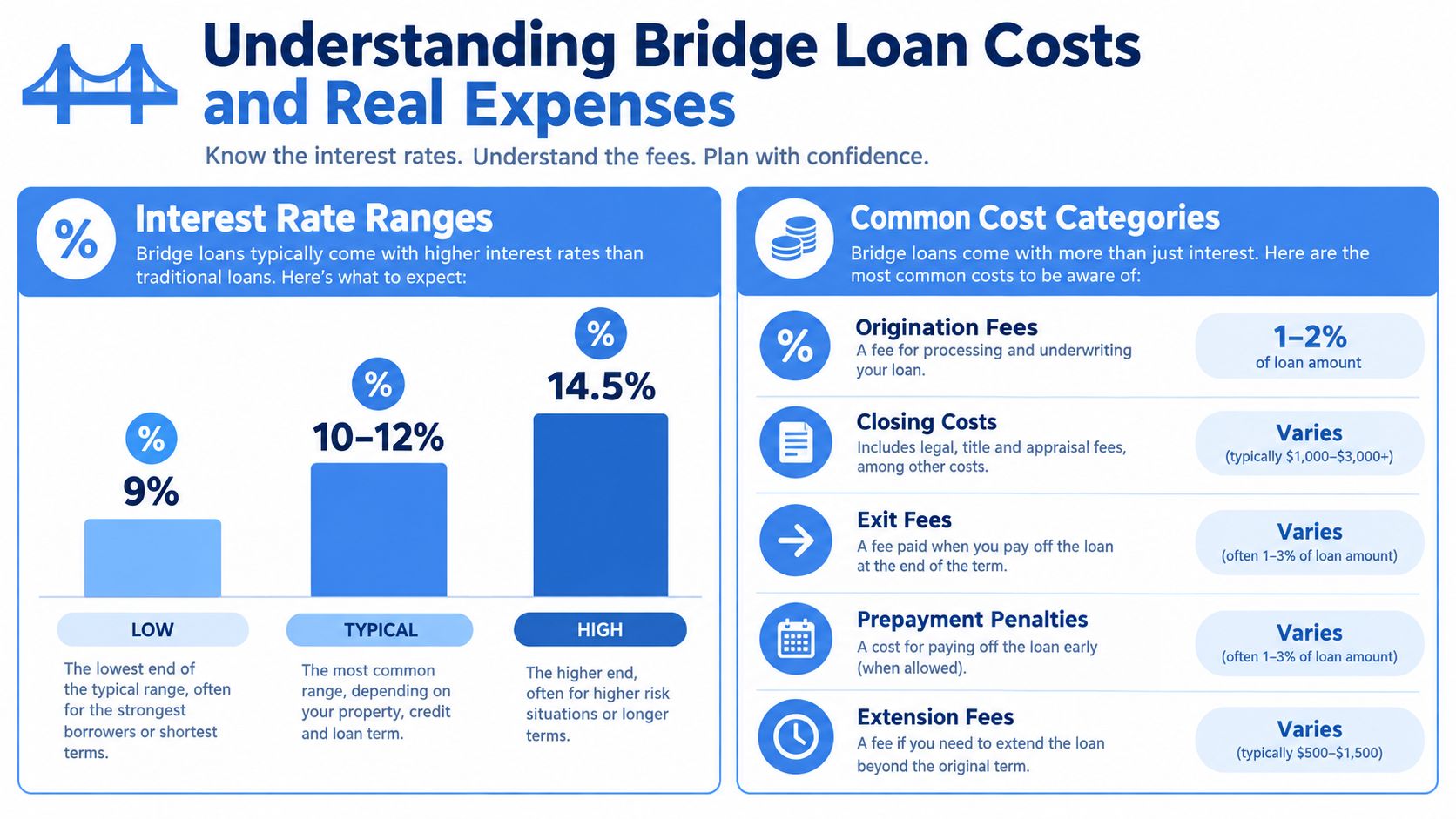
On a $1 million balance at 12%, simple annual interest is approximately $120,000, or about $10,000 per month, before points, legal fees, extension charges, and other expenses (cost reference). That monthly figure matters because a delayed sale or refinance doesn't merely postpone profit. It continues charging interest while taxes, insurance, utilities, management, and construction costs also remain due.
Build an all-in cost sheet
Your analysis should include:
- Interest: Calculate the monthly payment on the actual balance, including any funded interest reserve.
- Origination: Confirm whether the lender charges points on the purchase amount, total commitment, or funded balance.
- Legal and closing costs: Include appraisal, title, documentation, environmental, and inspection expenses where applicable.
- Exit charges: Review payoff fees, minimum interest, and any prepayment terms.
- Extensions: Price the cost of extra time before you sign, not after the original maturity date approaches.
- Project carry: Add taxes, insurance, utilities, maintenance, and construction overhead during the hold.
A useful test compares the all-in bridge cost with the value of closing early. If the loan lets you acquire at a discount or complete renovations that improve income, the premium may be rational. If it merely gives you more time to hope for appreciation, the numbers are weaker. For broader context on how lenders price short-term capital, review this founder's guide to lowering debt costs.
Before accepting a quote, compare the rate, payment structure, draw controls, reserve requirements, and payoff terms through a detailed bridge loan interest rates review. The lowest headline rate may not produce the lowest actual cost if it comes with restrictive draws or expensive extensions.
Comparing Bridge Loans to Traditional Financing Options
Traditional mortgages usually offer lower pricing and longer repayment periods, provided the property and borrower satisfy the bank's underwriting requirements. For a non-owner-occupied asset, that can mean documented operating history, stable income, a conservative valuation, and extensive supporting records. A transitional property may not meet those standards yet.
Bridge financing evaluates the situation differently. The lender may place greater weight on current property value, the renovation or stabilization plan, the borrower's liquidity, and the proposed repayment route. That flexibility suits an asset with sound potential but a condition or income profile that does not fit standard bank underwriting.
Match the financing to the problem
| Financing option | Where it fits | Main limitation |
|---|---|---|
| Traditional mortgage | Stabilized properties with documented income and a borrower who can wait through full underwriting | Slower process and stricter qualification |
| Bridge loan | Time-sensitive acquisitions, repositioning, renovation, or refinance gaps | Higher cost and a maturity-driven exit |
| HELOC or home equity loan | Borrowers with substantial personal equity and strong income documentation | Personal property equity and repayment capacity may be exposed |
| Seller financing | A motivated seller willing to accept payments over time | The seller must agree to carry the debt and terms may be limited |
A HELOC offers flexibility when the borrower has strong personal credit, documented income, and sufficient available equity. It also ties the transaction to the borrower's existing balance sheet. Seller financing allows room for negotiation, but the seller must accept the structure, understand the security, and remain comfortable waiting for repayment.
A fix-and-flip investor may need acquisition capital and renovation funding before the finished property can support permanent financing. A value-add investor may need short-term debt while occupancy and net operating income improve. An owner seeking cash out may need a bridge while resolving title, income, or condition issues that block conventional refinancing.
The comparison should cover approval speed, maximum advance, payment structure, collateral, draw conditions, and the eventual lender's requirements. Investors reviewing construction or substantial repositioning can also compare developer funding solutions across commercial options.
The repayment route deserves equal attention. A bridge loan can fit the acquisition clock while leaving the borrower exposed if the sale, stabilization, or refinance takes longer than expected. A traditional mortgage can suit a stabilized asset but arrive too slowly for a time-sensitive purchase. The defensible choice matches the transaction schedule with a realistic source of repayment and the property's expected future cash flow.
The Hidden Maturity Wall Risk Most Investors Ignore
A renovation can finish on schedule, leases can improve, and the bridge loan can still become a problem if its maturity date arrives before the property supports a sale or permanent refinance. That timing gap, known as maturity mismatch, is often more dangerous than the stated interest rate.
Approximately 20% of outstanding U.S. commercial real-estate loans, nearly $1 trillion, were scheduled to mature in 2025. Tighter standards, lower valuations, and higher rates made refinancing harder (Federal Reserve financial stability report). The FDIC also identified high rates, weaker property cash flow, high vacancies, and slower rent growth as pressures that can impair commercial real-estate refinancing (FDIC risk review).
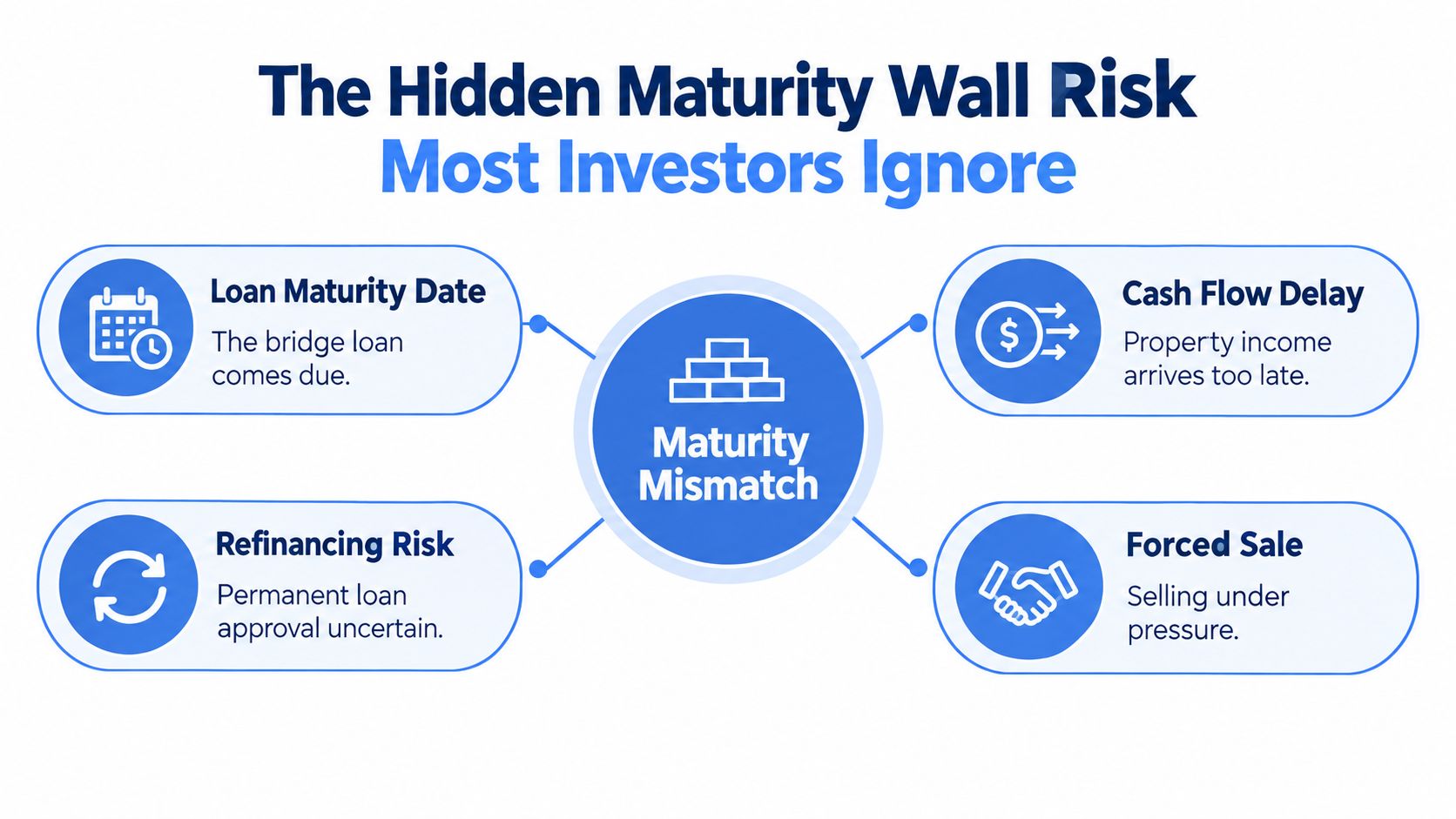
Floating-rate debt adds another layer of exposure. More than 76% of U.S. commercial real-estate transactions from the 2021 to 2022 vintages used floating-rate debt, leaving borrowers exposed when benchmark rates increased (bridge lending market report). Even a well-executed improvement plan can fail the refinance test if higher debt service reduces loan proceeds or a higher capitalization rate lowers the valuation.
Run the downside before closing
Start with the maturity date and work backward. Test the exit under conditions that could realistically occur:
- How long can construction, lease-up, or stabilization run late before liquidity becomes uncomfortable?
- What sale price is required after transaction costs if refinancing fails?
- What loan-to-value ratio will the permanent lender accept using a conservative appraisal?
- Does projected stabilized debt-service coverage remain acceptable at a higher mortgage rate?
- Can the interest reserve cover delays without relying on the next draw?
For example, annual NOI of $600,000 supports only $480,000 of annual debt service at a 1.25x DSCR requirement. A mortgage at 7% supports materially less principal than one at 5%, even before a valuation haircut, as the FDIC's risk review also notes. Completed renovations therefore do not guarantee a successful refinance.
A bridge loan becomes speculative when one buyer, one lender, or one interest-rate outcome must arrive on schedule. Stronger deals include both a sale and refinance path, reserves for delays, and borrowing that still works after testing property value and income.
Building Your Bridge Loan Decision Checklist
A disciplined borrower treats the loan as a project with checkpoints, not as a source of fast money. Before signing, put the assumptions in writing and ask the lender to identify which conditions control funding, draws, extensions, and payoff.
Five checks that protect the exit
Define at least two exits. Name the refinance lender or lending profile, and outline the sale route. “The market should improve” isn't an exit strategy. Identify the property condition, income, valuation, and documentation each route requires.
Fund the interest reserve. Set aside liquidity for interest and operating costs during construction, lease-up, or marketing. Include additional interest, extension pricing, and holding costs if the original timeline slips.
Use conservative borrowing. Test the loan against a lower valuation and a lower advance from the permanent lender. The Federal Reserve's bank-lending survey tracks maximum loan sizes, interest-rate spreads, interest-only periods, and DSCR requirements across construction, nonresidential, and multifamily loans, so compare the bridge structure with the eventual bank criteria (Federal Reserve SLOOS data).
Build a contingency timeline. Set a maximum tolerable delay before the transaction needs a sale, new equity, or another financing decision. Include contractor delays, permitting friction, slower leasing, appraisal timing, and title issues.
Pass the stress test. Increase the permanent-loan rate, reduce the valuation, slow the income ramp, and add construction costs. The deal should still offer a workable repayment route. If one adverse change causes default risk, the capital structure is too tight.
Ask the lender direct questions
Get written answers about minimum interest, extension fees, draw inspections, lender-controlled construction releases, prepayment terms, rate caps, and the exact maturity date. Also confirm whether the lender underwrites the exit based on current income, projected income, completed value, or a combination.
The bank environment can remain selective even when a property has potential. Recent Federal Reserve survey results describe commercial real-estate demand as weaker or basically unchanged while bank standards for commercial and industrial lending were tighter overall (Federal Reserve lending survey). That makes early exit planning more important, not less.
How LendingXpress Handles Bridge Loan Complexity
For non-owner-occupied residential and commercial properties, a private lender can be useful when the asset's current condition doesn't fit a conventional bank process. LendingXpress structures bridge, fix-and-flip, and rental-property loans with asset-based underwriting, staged rehabilitation draws, and terms designed around acquisitions, refinances, stabilization, and renovation.
The firm is based in Orange County, California, and reports typical loan sizes from $100,000 to $18 million or more. It also states that qualified closings can occur in as little as three days, which can matter when the seller's deadline is shorter than a bank's approval cycle. Those figures and product terms should still be confirmed for the specific property and borrower.
What a practical application should contain
Bring a clear package rather than relying on the lender to reconstruct the deal:
- Purchase contract and current title information.
- Property details, rent roll, operating statements, and existing debt.
- Scope of work, contractor information, budget, and draw schedule.
- Current value and projected value assumptions.
- Personal financial statement, liquidity evidence, and real estate experience.
- Sale and refinance scenarios, including downside assumptions.
LendingXpress states that it can finance up to 100% of renovation costs through staged draws for eligible projects, while using conservative loan-to-value ratios. That structure can preserve working capital, but it doesn't eliminate the need to fund interest, overruns, and expenses that fall outside approved draws.
The company's materials also report more than $558 million in originations. Treat that as background, not as a substitute for deal-specific diligence. Review the term sheet, ask how the lender handles extensions and delayed draws, and confirm exactly what happens if the exit takes longer than planned.
A reliable lender should discuss the hard parts early. You want clarity on valuation, collateral, draw conditions, payoff mechanics, and the assumptions behind the refinance. Fast execution helps only when the loan remains manageable after the first plan changes.
Making the Right Choice for Your Investment Strategy
A bridge loan fits an investment strategy when four conditions hold: speed creates measurable value, the property has a credible stabilization or sale plan, at least two exits remain available, and you can fund delays without forced action.
It can work for a time-sensitive acquisition, a value-adding renovation, or a property held until rental income supports permanent financing. The loan is harder to justify when returns depend on rapid appreciation, maximum borrowing capacity, falling rates, or an uncommitted buyer. The hidden risk is the maturity wall: if the loan reaches its due date before sale or refinancing is ready, extension costs, new underwriting, or a forced sale can damage the deal.
Write the exit plan with dates, required proceeds, and a downside case. Stress-test slower leasing, higher renovation costs, and weaker valuation before applying. Compare the bridge's total cost with the value created by closing early, then reject terms that could consume your liquidity.
LendingXpress offers bridge, fix-and-flip, rental, and commercial-property financing for non-owner-occupied investments. Discuss your exit strategy with LendingXpress.