
An investor signs a purchase contract, sends the file to a bank, and waits. The appraisal takes longer than expected, underwriting asks for another round of documents, and the closing date approaches without a clear funding decision. The seller eventually accepts a cash offer, and the investor loses the property despite having a workable project.
That situation is common in non-owner-occupied real estate. The opportunity may be sound, but conventional financing can be too slow, too rigid, or too dependent on personal income documentation. The practical question isn't whether real estate carries risk. It's which risk is controlling the deal, and which capital structure can absorb it without destroying the return.
For California investors, brokers, and accredited trust-deed investors, real estate finance and investments risks and opportunities now sit on the same balance sheet. Higher refinancing costs can hurt an owner, while a bridge lender can solve the timing problem. A distressed asset can threaten a bank's portfolio, while disciplined private capital can acquire or recapitalize it. The sections below match each major risk with the financing structure that can turn it into usable deal flow.
Why Real Estate Finance Looks Different in 2026
The market has moved away from the easy assumptions of 2021. Borrowers can't assume that a rising property value will rescue aggressive risk-taking, that a bank will approve a file quickly, or that a refinance will be available on the same terms as the original loan.
The global real estate market was valued at about US$12.5 trillion in 2024, yet it contracted 4.1% for the third consecutive year, according to the MSCI real estate market size reference. At the same time, research houses expected global investment volumes to rise 7% year over year, with some forecasts reaching 11%, as rate cuts and improved financing conditions reopened transactions. That combination creates the central tension of this market: values and refinancing can remain pressured even while transaction flow and loan demand begin to recover.
A borrower with a maturing rental loan feels the downside first. If the property's net operating income hasn't kept pace with debt costs, the refinance may require more equity, a smaller loan, or a sale. The FDIC has noted that higher operating costs, vacancy, slower rent growth, and rates above pre-2023 levels continued to inhibit CRE refinancing, while office loans represented nearly one-quarter of CRE maturities in 2025, as summarized in Morgan Stanley's 2026 real estate outlook.
Practical rule: Treat the maturity date as a funding deadline, not an administrative detail.
Where private capital fits
The refinancing pressure is creating openings for private bridge lenders, trust-deed investors, and borrowers who can execute a clear business plan. A bridge loan can provide acquisition or renovation capital while an asset is repositioned. A DSCR rental loan can later replace short-term debt when property income supports permanent financing. A first-position trust deed can give an accredited investor exposure to a secured loan while supplying capital to a borrower conventional lenders have declined.
Cross-border capital also began returning. CBRE reported that cross-regional capital flows to North America, Europe, and Asia-Pacific rose 31% year over year to US$37 billion in H2 2024, according to the same MSCI market reference. That doesn't eliminate geopolitical, valuation, or rate risk. It does show why the current environment isn't a freeze. Capital is selective, and selective capital can command better structure.
In my experience closing bridge and fix-and-flip loans in California, speed only works when it's paired with conservative underwriting. A fast loan with an unrealistic exit is expensive failure. A responsive lender that verifies title, collateral, borrower liquidity, scope of work, and takeout options can help a good project close before a slower source finishes reviewing the file.
The Core Risks Every Investor Should Understand
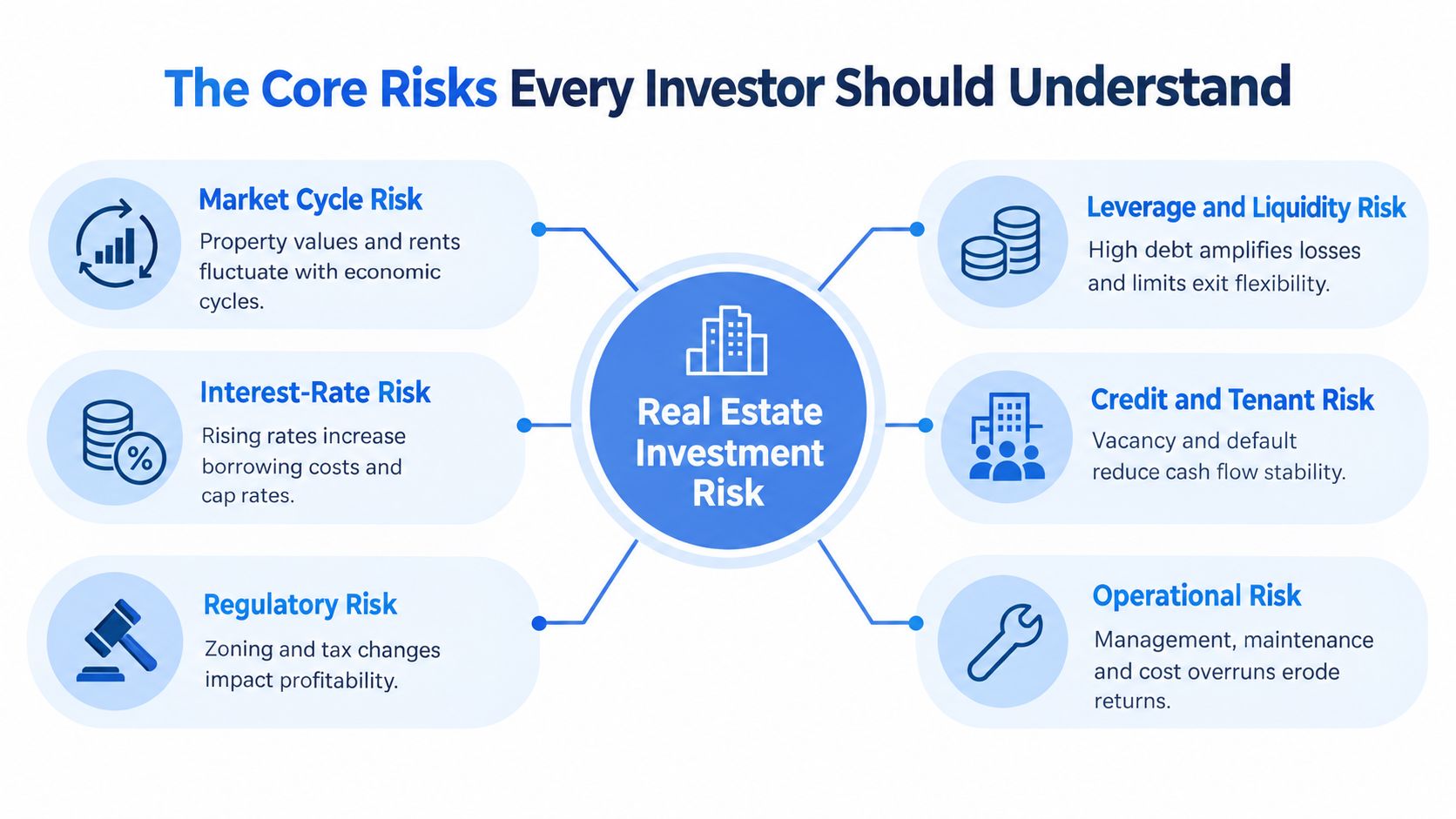
A deal can look attractive until one assumption fails. In five minutes, an investor or broker should identify whether the main exposure sits in the property, borrower, debt structure, or exit plan before debating the interest rate.
Market and interest-rate exposure
- Market cycle risk: Values and rents follow economic conditions. On a fix-and-flip loan, weaker comparable sales can lower the achievable after-repair value, leaving less room for selling costs and debt service.
- Interest-rate risk: Borrowing costs can rise before the project exits. A rental that works at one payment may fail DSCR testing after a reset or refinance. Fixed-rate trust-deed capital can make that exposure easier for an investor to measure.
- Valuation and exit risk: The appraisal, buyer pool, or refinance market may not support the planned takeout. A borrower relying on one exit has little protection if that path disappears. A bridge structure with enough term for sale or refinance gives the project more room to respond.
Debt and liquidity
- Debt risk: Borrowing magnifies gains and losses. A highly indebted property has less tolerance for construction overruns, vacancy, or a lower valuation. Conservative first-position lending and adequate borrower equity shift part of that risk away from the lender.
- Liquidity risk: Real estate cannot always be sold quickly at the desired price. The European Systemic Risk Board reported negative returns and investor outflows for real estate investment funds in 2024, with loans making up 14% of total liabilities and a small subset of funds using borrowing above 300% of NAV, according to the ESRB nonbank financial intermediation report.
A borrower can own a valuable property and still lack cash for interest, taxes, insurance, or contractors while waiting for an exit. A lender should therefore test liquidity separately from collateral value, then require reserves or staged funding where the plan needs them.
Construction, tenants, and rules
- Construction and rehab risk: The scope, budget, or contractor may fail. If a contractor leaves mid-rehab, the lender may be funding a partially completed property with limited marketability. Verified plans, draw controls, and borrower liquidity address that exposure more directly than a higher rate alone.
- Tenant and operational risk: Vacancy, nonpayment, maintenance, and weak management reduce cash flow. A four-unit property can appear stable until one unit turns over during an expensive repair cycle. A DSCR rental loan should be sized to realistic income and operating costs.
- Regulatory and tax risk: Zoning, permits, insurance, rent rules, and tax treatment can change the economics. A city pausing short-term-rental permits can eliminate the exit strategy supporting the purchase price.
The practical test is whether the loan has enough equity, reserves, documentation, and flexibility to survive its most likely failure point.
The FDIC's commercial real estate risk discussion reinforces the need for asset-level analysis. Office, retail, multifamily, and industrial properties respond differently to vacancy, rent, and refinancing pressure. Review the specific property and sponsor rather than approving or rejecting a deal from its sector label alone.
Matching Each Risk to the Right Capital Solution
A financing structure should assign each risk to the party equipped to control it. A value-add buyer may purchase below replacement cost or solve a seller's timing problem in a soft market. A bridge lender can fund the short execution window when collateral controls, verified draws, and a defined exit are in place. A trust-deed investor may choose a first-position loan with conservative LTV, receiving returns from the debt position rather than depending on the property's full operating upside.
Match the problem before pricing the loan
Market cycle risk often fits a value-add acquisition with a longer hold bridge. The borrower needs time to renovate, stabilize occupancy, and decide between a sale and refinance. A short maturity can force a sale into weak conditions, making term flexibility more valuable than the lowest initial rate.
Interest-rate risk fits a fixed-rate trust-deed position for an investor seeking predictable debt income. A shorter bridge can suit a borrower with a credible sale already in view. Floating-rate debt is a poor match for a thin-margin project without an interest reserve.
Debt and liquidity risk call for staged funding. A rehab draw facility keeps undisbursed capital from sitting idle and prevents the borrower from taking the full construction budget before work is verified. For non-owner-occupied purchases, DSCR market guidance commonly cites 20% to 25% down, or approximately 75% to 80% LTV. Stronger cases may reach 70% to 75% LTV, and lenders often seek 1.0x to 1.25x DSCR, according to DSCR loan guidance from PeerSense.
Construction risk belongs with a structure that includes a written scope, contractor review, inspection-based draws, and a contingency reserve. Release funds after measurable milestones are complete. A borrower's request alone does not prove that the work supports the next advance.
Tenant and operational risk can fit a DSCR cash-out refinance after stabilization. DSCR loans evaluate property income rather than relying primarily on W-2s or tax returns. Published 2026 guidance commonly cites credit scores around 620 to 680 or higher, reserves of 2 to 12 months of PITIA, and no personal income documentation, as described in DSCR Authority's requirements guide.
Regulatory and tax risk requires entity-specific review, permitted-use confirmation, insurance verification, and an operating model that complies with applicable rules. A deal built around an unapproved use has a fragile exit regardless of its projected return. Exit risk calls for relationship capital that can support a refinance or extension when a sale is delayed.
| Risk | Best Capital Solution | Ideal Investor |
|---|---|---|
| Market cycle | Value-add acquisition with flexible bridge term | Experienced operator |
| Interest rates | Fixed-rate trust deed or short bridge | Accredited debt investor or time-sensitive borrower |
| Debt and liquidity | Conservative LTV with staged rehab draws | Fix-and-flip investor |
| Construction | Inspection-based draws and completion controls | Borrower with a defined scope |
| Tenant operations | DSCR rental refinance after stabilization | Buy-and-hold investor |
| Exit uncertainty | Relationship lender with refinance or extension capacity | Broker and repeat borrower |
Borrowers comparing structures can review how to finance an investment property before submitting a file. LendingXpress structures bridge, fix-and-flip, and rental loans for non-owner-occupied assets, and offers trust-deed opportunities for accredited investors.
The same condition can hurt one participant and create an opening for another. A bank may decline incomplete renovation, irregular income, or a tight closing. A private lender may accept those facts when the collateral, equity, execution plan, and exit provide adequate protection.
How Different Investors Should Approach the Market
Four investors can review the same property and reach four different conclusions. The difference usually comes from the risk they can control, not from the property's address.
Fix-and-flip operators
A flipper should underwrite the purchase, rehab, carrying costs, selling costs, and contingency against a conservative ARV range. Financing that supports 60% to 70% of ARV can help preserve equity when the resale value is uncertain, while a 12-month bridge term gives the operator room for permits, construction, and marketing. Draw timing matters as much as the headline rate. A lender that can fund verified draws within 5 to 10 business days may be more useful than a cheaper lender that delays the project.
Buy-and-hold investors
A rental buyer needs to underwrite the payment that may exist after refinancing, not only the payment available at acquisition. Stress-testing DSCR at 7.5% to 8% rates, maintaining six months of reserves, and considering cash-out refinancing only when the cap-rate spread exceeds 200 basis points can prevent a borrower from turning short-term equity into long-term payment stress.
Brokers
Brokers save time by qualifying the borrower before circulating the file. Liquidity, completed projects, property condition, purchase contract, borrower experience, and exit strategy should be clear before the lender sees the request. A clean submission lets the lender focus on collateral and structure instead of chasing basic documents.
Accredited trust-deed investors
A trust-deed investor should underwrite the borrower's equity, project feasibility, lien position, title, insurance, and realistic exit. Borrower equity of at least 25% to 30% and LTV typically below 70% are useful starting filters, not substitutes for property-level analysis. Laddering positions across 3 to 5 loans can reduce concentration in one borrower or asset, although diversification doesn't eliminate default risk.
| Investor Type | Primary Risk | Recommended Structure | LendingXpress Product |
|---|---|---|---|
| Fix-and-flip operator | Rehab and resale timing | Bridge loan with staged draws | Fix and flip loan |
| Buy-and-hold investor | DSCR and refinance cost | Rental DSCR financing | Rental property loan |
| Mortgage broker | Placement and closing certainty | Pre-underwritten private bridge | Bridge loan |
| Accredited investor | Borrower and collateral default | First-position trust deed | Trust deed opportunity |
The product choice should follow the risk profile. A borrower who needs speed and flexible income documentation shouldn't be forced into a bank-style process, while a stabilized rental with strong cash flow may not need expensive short-term debt.
Real Deal Examples That Bring the Strategy to Life
A financing structure earns its value at the moment a normal process breaks. Two California deal patterns show how timing and controls can change the outcome.
A Sacramento flip under appraisal pressure
A Sacramento investor entered a flip with a 45-day escrow, but the original bank appraisal came in $40,000 below contract. The lower valuation threatened the loan amount and put the purchase at risk, even though the borrower had a defined renovation plan and a resale strategy.
LendingXpress provided a bridge loan that closed in 9 business days at 75% loan-to-cost. The lender didn't release the entire renovation budget at closing. Instead, staged draws followed foundation, framing, and finishes milestones, allowing capital to move with verified progress.
The property sold four months later for a $62,000 net profit. The important lesson isn't that every discounted appraisal can be overcome. It's that a bridge structure can evaluate the complete collateral and execution plan when a single appraisal gap would otherwise stop a bank loan.
Deal lesson: A fast close only creates value when the lender also controls how construction capital reaches the project.
A Bakersfield rental used as acquisition capital
A Bakersfield owner had held a four-unit rental with a 4.2% conventional loan for six years. Rising rates made the owner cautious about disturbing low-cost debt, but the property had accumulated usable equity and the investor wanted to fund a value-add duplex purchase.
A DSCR cash-out refinance at 75% LTV released $180,000 in tax-free equity for the duplex down payment. The rental's income, rather than the owner's W-2 income, supported the underwriting approach.
This structure carries a trade-off. The owner converted part of the property's equity into new debt, so the resulting payment and DSCR needed to remain workable under stress. The transaction succeeded because the cash-out served a specific acquisition purpose instead of increasing personal liquidity.
Both examples show why financing should be selected at the deal-design stage. The Sacramento borrower needed speed and draw control. The Bakersfield owner needed income-based qualification and access to equity. Neither problem called for the same loan.
Mitigation Playbook for Borrowers Brokers and Lenders
Risk control begins before the term sheet. Each participant has a different job, and missing one document or assumption can create a delay that no interest-rate discount will fix.

Borrower checklist
- Verify draws in writing: Confirm inspection requirements, request procedures, timing, holdbacks, and who approves completed work.
- Confirm prepayment terms: Understand penalties, minimum interest, extension costs, and payoff requirements before signing.
- Reserve for surprises: Document a 10% to 15% contingency reserve for overruns, delays, and unexpected repairs.
- Name the exit: Decide whether the project will be sold, refinanced, or held, then test that exit against lower value and higher debt costs.
Broker checklist
- Package the file completely: Include the purchase contract, rehab scope, ARV comparables, rent information, entity documents, and borrower financials.
- Match the lender to the issue: A tight escrow, major rehab, or non-conforming income profile may fit private bridge capital better than a conventional channel.
- Disclose total cost: Compare rate, points, draw fees, extension terms, default provisions, and prepayment requirements rather than presenting rate alone.
- Protect closing certainty: Confirm the lender's process, decision-maker, valuation method, and conditions before promising the seller a date.
Clean files can receive quotes within 24 to 48 hours when the lender has the information needed to underwrite. That timeline isn't a guarantee of approval. It reflects the practical advantage of submitting a complete request.
Lender checklist
A lender should review three layers:
- Borrower capacity: Track record, liquidity, reserves, and the ability to manage the project. A useful screening standard is at least 3 completed projects or 12 months of reserves, followed by deeper review.
- Property feasibility: Validate the scope, budget, title, zoning, insurance, comparable sales, rents, and independent valuation.
- Exit liquidity: Identify likely buyers, refinance options, stabilized DSCR, and the conditions that could make the exit fail.
| Timing or property condition | Bridge usually fits | Conventional usually fits |
|---|---|---|
| Closing timeline | Tight escrow under 30 days | Flexible closing schedule |
| Property condition | Significant rehab or repositioning | Stabilized rental |
| Income profile | Non-conforming documentation | Strong documented income |
| Hold strategy | Short-term execution plan | Long-term hold |
| Payment objective | Speed and flexibility | Rate buydown or lower long-term cost |
A private lender is the right call when speed, collateral-based underwriting, or flexible structure solves a real problem. Conventional financing wins when the property is stabilized, DSCR is strong, documentation is clean, and the borrower can wait for the process.
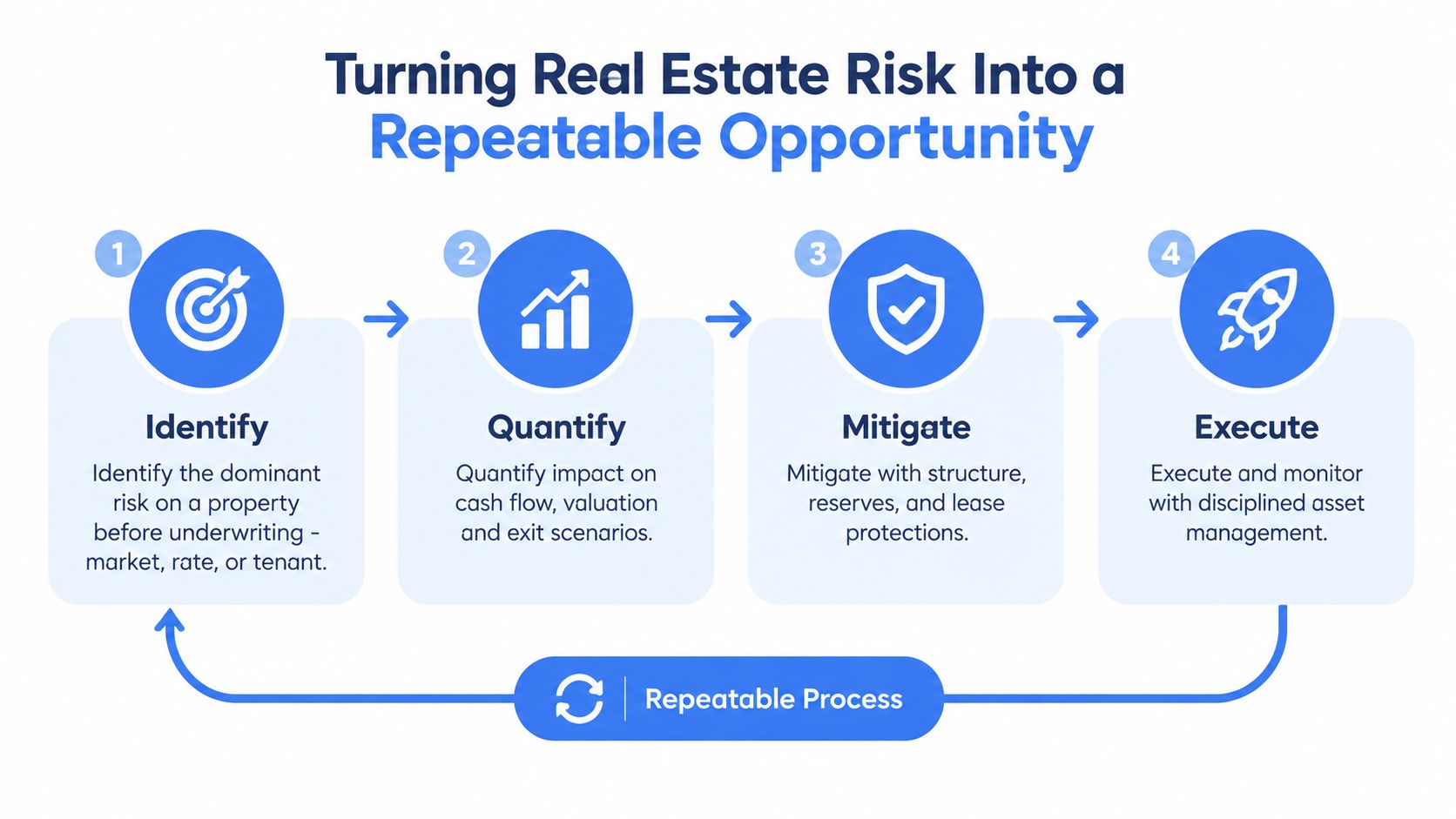
Turning Real Estate Risk Into a Repeatable Opportunity
The investors who handle this market well don't ask whether risk exists. They identify the risk that controls the property, price its effect, and choose capital that can withstand it.
- Identify the dominant risk. Is the deal rate-sensitive, rehab-heavy, tenant-driven, regulatory, or dependent on one exit?
- Quantify the exposure. Recalculate cash flow, valuation, construction costs, reserves, and debt service under less favorable assumptions.
- Mitigate with structure. Use bridge financing for timing, staged draws for construction, DSCR loans for qualifying rental income, and conservative trust-deed positions for secured debt exposure.
- Execute with monitoring. Track milestones, draw usage, leasing, insurance, title, and the exit from the day funds are released.
The refinance plan belongs in the original underwriting, not at the end of the bridge term. That means checking seasoning, expected property income, likely valuation, lender requirements, and the borrower's fallback if the first takeout doesn't close.
Investors also need a capital bench. A stable depository lender may fit a long-term rental, while a responsive private lender can preserve an acquisition opportunity or fund a time-sensitive renovation. Accredited investors evaluating debt opportunities can learn more about real estate debt investments and assess how lien position, LTV, collateral, and diversification fit their objectives.
The central opportunity is disciplined matching. A seller's urgency, a bank's slow process, or a borrower's nontraditional income can create value when the property and exit remain credible. Risk becomes repeatable deal flow when the structure is designed before the closing pressure begins.
LendingXpress provides bridge, fix-and-flip, rental property, and cash-out financing for non-owner-occupied residential and commercial assets, along with trust-deed opportunities for accredited investors. If your next deal needs faster execution, staged rehab funding, or a practical alternative to conventional underwriting, visit LendingXpress to discuss the property, borrower profile, and exit strategy.