
Investment-property cash-out refinance rates commonly run about 0.50 to 1.00 percentage points above comparable primary-residence rates, with conventional investment-property cash-out pricing often around 7.25% to 8.00% and private pricing roughly 9% to 12% or more, depending on the deal. The right benchmark isn't the headline rate alone. You need to weigh total cost, available equity, closing speed, property condition, and how you'll repay the loan.
An investor may be sitting on substantial equity but still have trouble accessing it through a conventional lender. The property might be newly acquired, recently renovated, tenant income may not fit a standard underwriting model, or the next purchase may require funds before a bank can complete its review. In those situations, the lowest advertised rate may not produce the best financing decision.
Cash-out activity also changes with the market. The Urban Institute reported that cash-out transactions represented 82.2% of conventional refinances in August 2022, then fell to 39.9% by November 2024 as refinancing conditions changed. The Philadelphia Federal Reserve's working paper also cites Freddie Mac's estimate of $49 billion in cash-out refinance volume in 2023, compared with $144 billion in 2022 and $485 billion in 2006. For investors, the lesson is straightforward: availability and pricing move with rates, equity, underwriting, and borrower demand.
When an Investor Needs Cash Out
A duplex owner has two years of stable rental income and enough equity to fund the down payment on another rental. The opportunity appears quickly, but the conventional lender wants seasoning, complete tax returns, a full property review, and a closing window of 30 to 45 days. The seller wants a firm offer before that process can finish.
The investor doesn't necessarily need the lowest possible rate. The immediate constraint is access to capital without disrupting the existing rental strategy.
Cash-out refinance: The new loan pays off the existing mortgage, and the borrower receives the remaining proceeds after allowable costs and required reserves.
Rate-and-term refinance: The new loan replaces the old mortgage, but the borrower receives no equity proceeds.
The distinction matters because a rate-and-term refinance can improve the loan structure without creating acquisition capital. A cash-out refinance turns part of the property's equity into usable liquidity, but it also increases the new loan balance and repayment obligation. Investors should compare the expected benefit of the cash against the new payment, closing costs, points, and exit plan.
A useful decision screen has four questions:
- How much equity is required? Pulling only the amount needed may preserve better terms and reduce interest expense.
- How quickly must the funds arrive? A bank process may work for a planned refinance, but not for a purchase with a tight closing deadline.
- Is the property stabilized? A fully leased rental usually presents a different underwriting profile from a renovation with incomplete work.
- Can the borrower document income conventionally? Self-employment, recent acquisitions, variable rent, or incomplete tax filings can slow or derail approval.
Investors researching cash-out refinancing on a rental property should begin with this constraint analysis. Rate is important, but it should answer a larger question: does the loan deliver the required capital on terms the property can support?
How a Cash-Out Refinance Works
Think of a cash-out refinance like trading in a car you've paid down. The lender values the asset, pays off the balance attached to it, and gives you the difference that remains after the new financing and transaction costs. With real estate, the calculation depends on the appraised value, the permitted loan-to-value ratio, the existing payoff, and the lender's reserve requirements.
The proceeds calculation
The process usually follows this order:
- The lender reviews the property. An appraisal or valuation establishes the current value and confirms the property's condition.
- The lender sets a maximum loan amount. The permitted LTV determines how much debt can be placed against that value.
- The closing agent pays existing obligations. The old mortgage, approved closing costs, prepaid items, and points are deducted from the new loan proceeds.
- The borrower receives the balance. The remaining equity is wired after the lender confirms all closing conditions.
For example, assume an investment property appraises at $500,000, the existing mortgage payoff is $300,000, and the lender allows a 75% LTV. The maximum new loan would be $375,000. Before transaction costs, that leaves $75,000 above the old payoff. After costs and any required reserves, the investor might receive roughly $70,000 to $72,000.
| Item | Amount |
|---|---|
| Appraised property value | $500,000 |
| 75% maximum LTV | $375,000 |
| Existing mortgage payoff | $300,000 |
| Gross equity released before costs | $75,000 |
| Illustrative cash returned after costs | Roughly $70,000 to $72,000 |
The quoted cash-out refinance rate applies to the full new loan balance, not only the money returned to the borrower. Closing costs and points may be included in the new balance, which preserves cash at closing but increases the debt being serviced. A lender may also hold back funds for repairs, operating reserves, or other conditions before releasing the full equity amount.
The calculation is simple, but the underwriting behind it isn't. Appraisal support, title history, rent documentation, property condition, and the borrower's repayment plan can all affect the final proceeds and pricing.
What Determines the Interest Rate
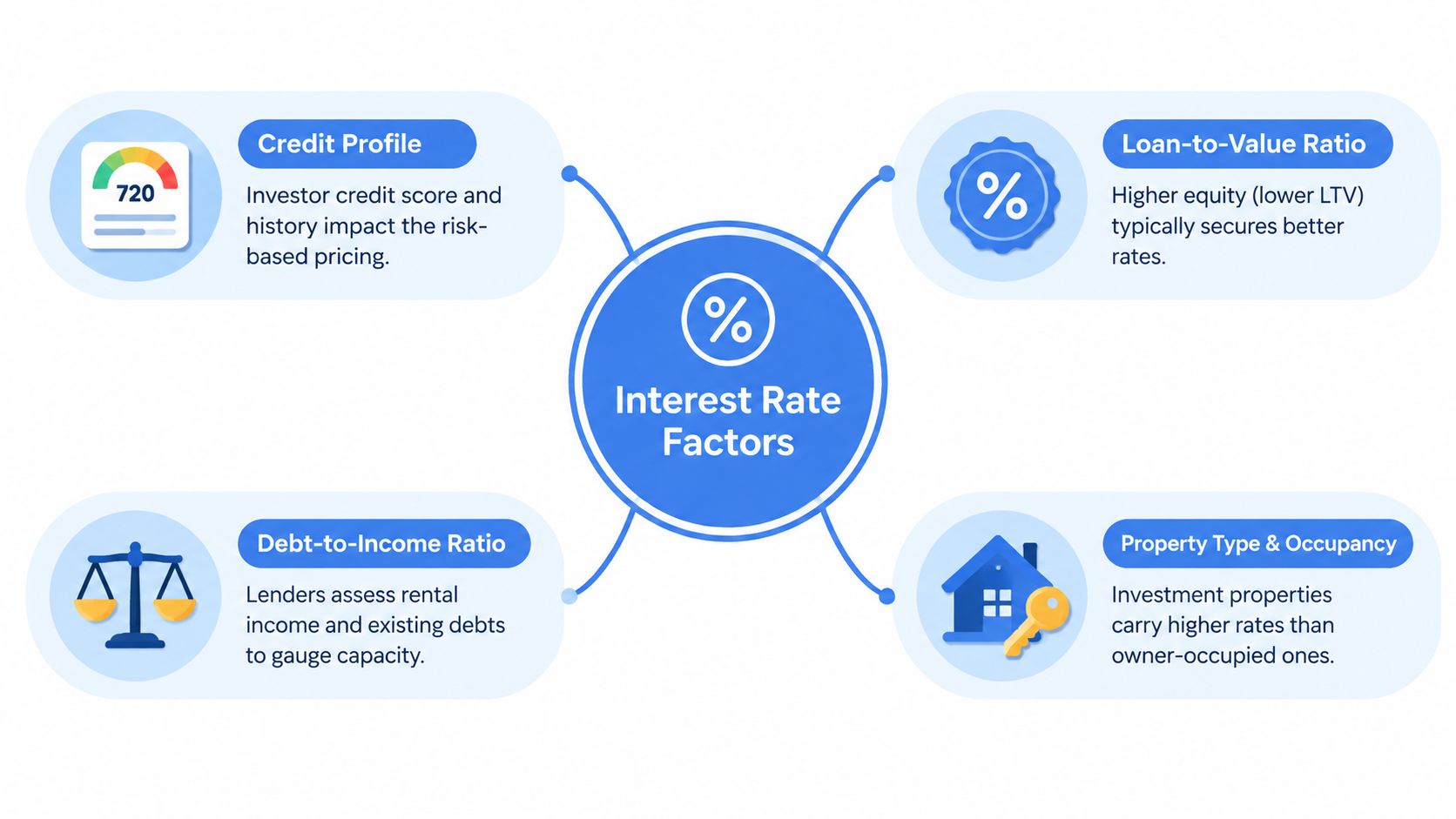
Two investors can own similar rentals and receive different cash-out refinance rates. Lenders price the risk of the entire transaction, not just the property's estimated value.
Credit profile and documentation
Credit history affects both eligibility and pricing. Many investment-property programs look for middle FICO scores in the 700s, with pricing tiers adjusting above or below that range. The practical underwriting question is, “Does this borrower consistently manage obligations, and can the lender verify the income supporting them?”
Self-employed investors should expect more than a personal credit pull. Tax returns, business income, bank statements, property-level income, and debt obligations may all enter the review. For a plain-language explanation of the credit scoring factors for homebuyers, investors can review how payment history, balances, account history, and new credit activity influence a credit profile.
Loan-to-value
LTV is the lender's primary equity cushion. A lower LTV generally supports better pricing because the borrower has more capital at risk and the lender has more protection if the property must be sold. Cash-out transactions already receive tighter scrutiny than many rate-and-term refinances because the borrower is increasing the balance and removing equity.
Property type and condition
A stabilized single-family rental is usually easier to price than a multi-family, mixed-use, or visibly distressed property. Deferred maintenance, unpermitted additions, incomplete renovations, and uncertain rent can trigger additional review or pricing adjustments. The lender wants to know whether the collateral will remain marketable and income-producing after closing.
Term and structure
A 30-year fixed loan, a 5/7 ARM, and an interest-only structure can produce different payment profiles and pricing. A prepayment penalty also changes the effective cost if the investor expects to sell or refinance quickly. Investors comparing DSCR loan rates should ask how the quoted structure handles rental income, reserves, term, and early payoff, not just which rate appears lowest.
Conventional and Private Rate Ranges
Conventional financing generally offers the lowest pricing when the property is stabilized, the borrower has strong documentation, the DSCR is acceptable, and the loan-to-value ratio remains conservative. For well-qualified investment-property borrowers, conventional cash-out refinance rates typically fall in the 6.5% to 8.5% range. The supplied market data also places conventional investment-property cash-out pricing around 7.25% to 8.00% in many 2026 snapshots, while primary-residence cash-out pricing tends to be lower.
Private and hard-money loans commonly price from roughly 9% to 12% or more. That higher range reflects collateral risk, borrower complexity, transitional property conditions, shorter terms, and the lender's willingness to close outside a standard bank process. It isn't a universal quote. Property type, borrower experience, exit strategy, points, and prepayment provisions can move the actual economics in either direction.
| Lender Type | Typical Rate Range | Typical LTV Ceiling | Typical Timeline | Best Fit Scenario |
|---|---|---|---|---|
| Conventional investment-property lender | 6.5% to 8.5% | Program and property dependent | Slower, document-heavy process | Stabilized rental with strong income and borrower documentation |
| Private or hard-money lender | Roughly 9% to 12% or more | Conservative, deal-specific | Faster, subject to complete file | Transitional property, urgent equity need, or nonstandard borrower |
| HELOC or HELOAN provider | Deal-specific | Existing lender and property dependent | Varies by lien and underwriting | Borrower needing a revolving line or separate lump sum |
| Trust-deed lender | Deal-specific | Collateral and note dependent | Structured around the pledged asset | Investor monetizing a note or using another secured asset |
A higher private rate can still produce a lower total project cost when timing is the binding constraint. If a fast refinance preserves a purchase opportunity, avoids carrying expensive bridge debt, or lets the investor complete a planned payoff, the relevant comparison is total dollars and execution risk. Points, extension fees, appraisal costs, legal expenses, and prepayment flexibility belong in that calculation.
The wrong comparison is “bank rate versus private rate.” The useful comparison is “which financing structure delivers the required proceeds, on time, with an exit the property can support?”
Cash-Out Refinance Financing Options
Investors have more than one way to access rental-property equity. Each option solves a different problem, and the best choice depends on whether the priority is a large lump sum, repeated access to capital, a fixed repayment schedule, or speed.

| Option | Loan Size | Speed | Cost | Flexibility | Ideal Property Profile |
|---|---|---|---|---|---|
| Traditional cash-out refinance | Larger permanent loan | Slower | Usually lower pricing | Moderate | Stabilized, well-documented rental |
| HELOC | Revolving credit line | Varies | Variable cost and payment | High draw flexibility | Property with dependable equity and lender support |
| HELOAN | Fixed lump sum | Varies | Fixed repayment structure | Less flexible after closing | Rental needing a defined amount |
| Cash-out purchase | Tied to a new acquisition | Can be efficient at purchase | Deal-specific | Combines acquisition and equity strategy | Investor buying a property with a clear capital plan |
| Trust-deed lending | Depends on pledged note or collateral | Deal-specific | Structured to risk | Can use a separate asset | Investor monetizing another secured position |
Consider an investor who bought a fixer with hard money, completed the main renovation, and stabilized the rent roll. The investor now needs capital for another acquisition. A slow bank refinance may offer attractive long-term pricing, but it could require more documentation and time than the next purchase allows. A fast private refinance may cost more but retire the hard-money balance and release usable equity sooner.
A HELOC could be useful if the investor expects several future draws rather than one large cash distribution. A HELOAN may fit if the required amount is known and a fixed repayment schedule matters. Selling a carryback note or arranging trust-deed financing against another investor's note could preserve the duplex's existing debt structure, but it introduces a different collateral and repayment analysis.
The selection should follow the actual constraint. A rental with clean records and no deadline may justify a conventional refinance. A recently renovated property with a time-sensitive acquisition may need a private structure. A portfolio owner who wants repeat access may prefer a revolving facility, while an investor seeking to protect the current property may evaluate financing secured by a separate asset.
How LendingXpress Structures the Loan
A private lender can structure an investment-property refinance around the property's current condition rather than force every borrower into a permanent-loan template. A representative example is a recently renovated duplex where the major work is complete, the tenants are producing income, but a portion of the remaining scope still needs verification.
The lender may underwrite the as-is value and the expected after-repair value, then apply conservative LTV limits to each. The initial closing can provide enough proceeds to pay off the existing obligation and establish required reserves. Remaining approved capital can be released through staged construction or rehabilitation draws after the lender verifies completed work.
That structure protects both sides. The borrower doesn't pay interest on undisbursed renovation funds, while the lender confirms that the collateral is progressing as represented. The investor also gets a clearer connection between each draw and the work needed to support the exit valuation.
What the file needs
Speed still depends on preparation. A lender typically needs:
- Property information: Current ownership, leases, rent roll, insurance, and title details.
- Value support: An appraisal or other valuation appropriate to the program and property type.
- Scope verification: Contractor information, repair details, invoices, and inspection access where draws are involved.
- Exit evidence: A credible plan to refinance into permanent debt, sell, or repay from operating cash flow.
Term length and prepayment provisions should match the investor's plan. A borrower expecting a conventional refinance after stabilization may need flexibility to pay off early. Another investor may prefer a longer bridge period to avoid refinancing under pressure.
The strategic benefit is capital recycling. The duplex remains an income-producing asset while released equity supports the next acquisition. LendingXpress describes private financing for California investors that can address fast acquisitions, refinances, and cash-out scenarios, with conservative LTV underwriting and staged draws for renovation projects. The structure still has a higher borrowing cost than a conventional loan, so the investor should compare that cost against the value of speed and the expected payoff.
How to Improve the Rate and Loan Terms
Preparation gives an investor more control over pricing and execution. Before requesting quotes, organize the file so lenders can understand the collateral, the income, and the exit without repeated follow-up.
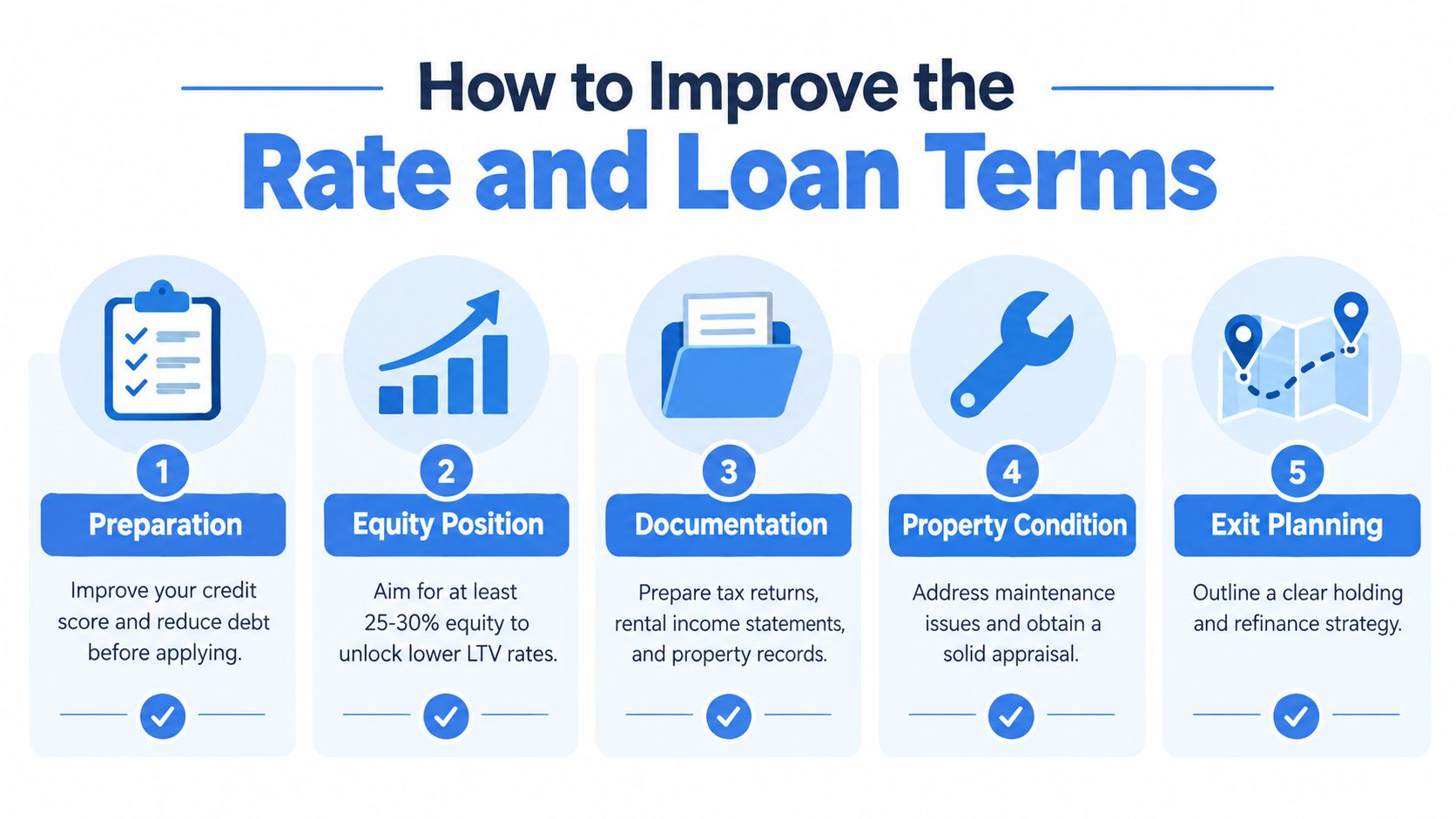
- Preparation: Pull current credit reports, correct errors, and pay down revolving balances where practical. A cleaner profile can reduce avoidable underwriting questions.
- Equity position: Decide how much cash you need. Leaving more equity in the property usually improves the lender's risk position and may support better terms.
- Documentation: Assemble tax returns, rental income and expense records, leases, bank statements, insurance, title documents, and property records before the application.
- Property condition: Complete deferred maintenance, document repairs, and schedule a current appraisal. Unresolved condition issues can delay funding or reduce proceeds.
- Exit planning: State the expected hold period and payoff source. A sale, permanent refinance, operating cash flow, or note payoff each creates a different underwriting conversation.
Request competing quotes on the same day whenever possible. Market pricing can move, and comparing offers from different dates can make a lender look cheaper only because the market changed. Ask each lender for net proceeds, total points, closing costs, required reserves, monthly payment, maturity, and prepayment terms.
A lender's headline rate doesn't tell you how much capital reaches your account. One quote may show a lower rate but require larger reserves or more points. Another may show a higher rate but close quickly, avoid unnecessary extension risk, and release the funds needed for the next purchase.
Preparation also compresses underwriting. Fewer missing documents mean fewer pauses, fewer revised terms, and a clearer path to closing. That time savings has an implicit financial value when another property, payoff deadline, or construction schedule is already in motion.
Choosing the Right Refinance Strategy
Cash-out refinance rates depend on the borrower, property, timing, documentation, and repayment plan. A stabilized rental may justify conventional financing and permanent financing. A newly acquired or partially renovated property may be better matched with a faster private refinance, even when the rate is higher.
Use the constraint as the starting point:
- Speed: Transitional properties and deadline-driven acquisitions need an execution plan first.
- Stability: Stabilized rentals benefit from disciplined LTV management and dependable income records.
- Flexibility: Fix-and-hold or hybrid projects may need staged funds, flexible payoff terms, or a structure that recognizes ongoing work.
Investors planning a buy, renovate, refinance, and repeat strategy can browse the BRRRR calculator to organize acquisition cost, renovation spending, refinance proceeds, and projected equity. Then request quotes that solve the actual capital problem rather than chasing the lowest posted rate.
LendingXpress can review a non-owner-occupied scenario, outline potential LTV, term, and pricing considerations, and structure a faster closing when timing is the priority. The right conversation starts with the property, the required proceeds, and the planned exit.
If you need to refinance a rental, duplex, or recently renovated investment property, visit LendingXpress to submit the property details and funding objective. The team can evaluate a cash-out, bridge, or renovation-related refinance structure and help you compare speed, repayment terms, and total cost.