
Most investors hear the 70 rule as if it were a promise. It isn't. It's a fast ceiling for a flip offer, a screening tool that helps you avoid paying too much before you've fully counted repairs, carrying costs, selling costs, and the risk that the project gets messy.
That difference matters because the rule can look safer than it really is. If you treat the remaining 30% like pure profit, you're already behind. In a real flip, that slice has to absorb the whole operating budget, and if the project slips, the cushion shrinks fast.
Why the 70 Rule Is a Ceiling, Not a Promise
The cleanest way to think about the 70 rule is as a gross-maximum-offer heuristic. It helps you decide the highest number you can put on the table before you've finished every detail, but it doesn't guarantee a successful deal or a profitable exit. The rule has staying power because it's simple enough to use during a walkthrough, and in economics and finance the related Rule of 70 is taught for the same reason, a fast mental estimate that gets close to the exponential-growth formula in common cases, like 1% = 69.7 years actual versus 70 by the rule, and 2% = 35.0 years actual versus 35 by the rule, with a standard illustration that 9% growth doubles income in about 7.7 years academic handout and macroeconomics text.
Why buyers like it so much
The appeal is speed. A buyer can stand in a house, sketch the likely exit value, and know whether the deal deserves more time. That's useful in non-owner-occupied investing, where the seller may want an answer quickly and the borrower may need financing fast.
The problem starts when a shortcut becomes a decision rule. A property can pass the 70 screen and still fail the project if the rehab scope changes, the holding period drifts, or the exit market softens. The rule tells you what to guard, not what to celebrate.
Practical rule: if the math only works because every assumption is perfect, it doesn't really work.
The better framing is simple. 70% of ARV minus repairs is the ceiling, and the leftover 30% is not all profit. It's the space that has to cover the whole deal, including risk you haven't seen yet.
The 70 Rule Formula and a Worked Example
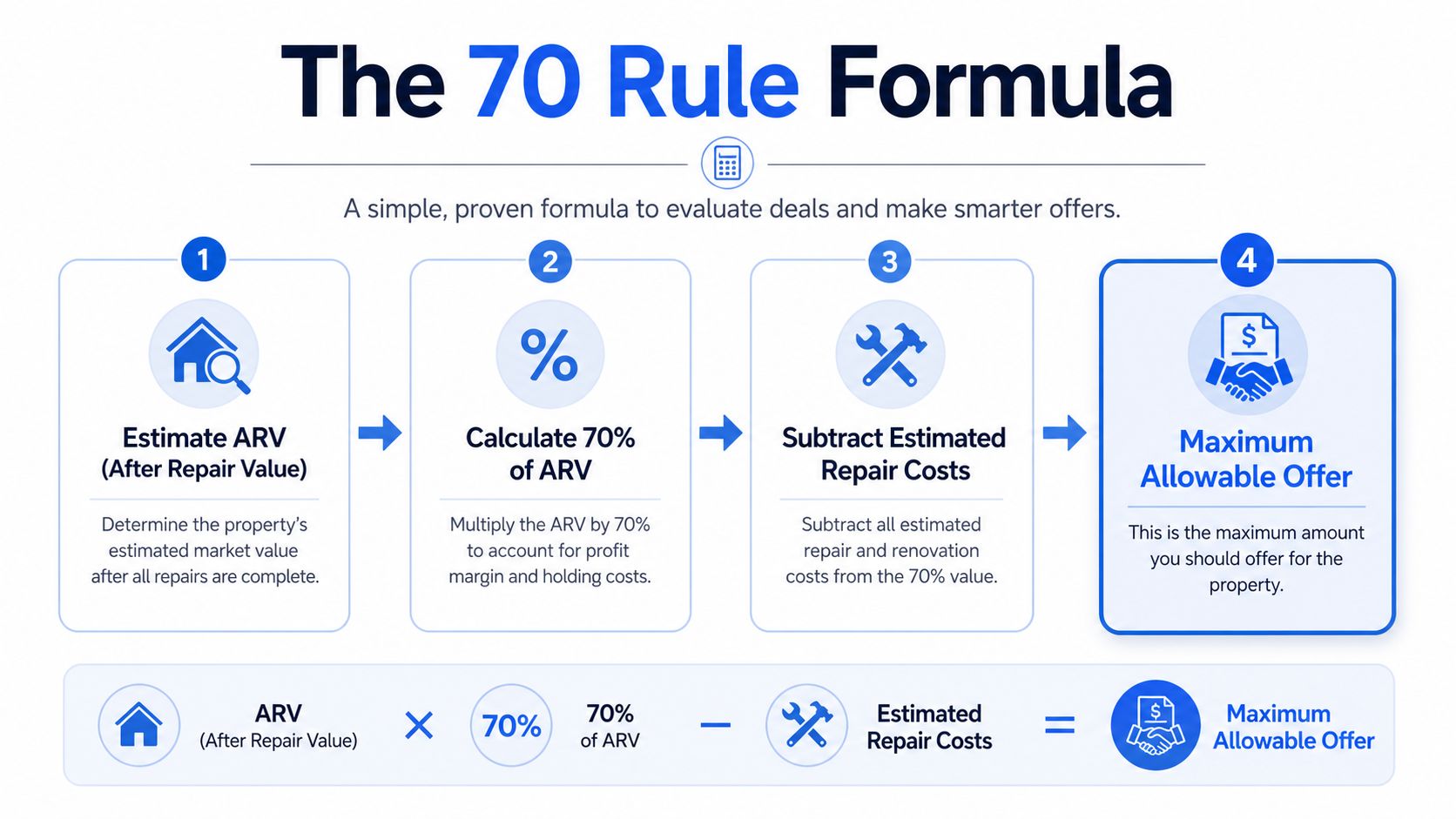
The formula is straightforward: Maximum Allowable Offer = 70% of ARV minus estimated repairs. ARV, or after-repair value, is what the property should sell for once the work is done. The repair number should come from a real walkthrough, a scope of work, and ideally multiple contractor opinions, not a guess made from the curb.
A practical way to sanity-check the repair side is to use a renovation-cost planning resource like Superior Home Improvement cost advice. The point isn't to copy someone else's budget. The point is to pressure-test your own assumptions before you lock into a purchase price.
The same logic shows up in a borrower's loan package too. If you want a clean ARV-based file, start with a clear comp set and a concise explanation of why the exit value is credible, then review the property details in the lender's own ARV overview.
Let's run the numbers on a simple flip. Suppose the renovated home should sell for $350,000. Seventy percent of that is $245,000. If repairs are expected to run $39,000, the maximum offer is $206,000. That's the ceiling, not the target. A buyer who offers more than that is reaching into the margin that was supposed to protect the project.
Cosmetic versus heavier work
A light cosmetic flip can leave more room because the repair budget is smaller. Fresh paint, flooring, fixtures, and cleanup still cost money, but they don't usually crush the spread the way a larger scope can. A gut rehab changes everything because the repair number climbs, and every extra dollar comes straight out of the 30% buffer.
A deal is only as good as the repair scope attached to it.
Here's the useful habit. When the asking price is close to the ceiling, don't ask whether the formula “passes.” Ask whether the margin still makes sense after your real rehab scope, financing, and exit plan are on paper.
Where the Rule Quietly Breaks Down
The 70% screen is easy to trust because the first version of the deal looks tidy. The house is underpriced, the comps are decent, and the offer math leaves room. Then the job starts, and the hidden line items show up.
The pressure points that eat the buffer
Repair overruns are the obvious one. A contractor opens a wall, finds more damage, and the budget moves. Foundation issues, mold, electrical surprises, and plumbing problems can force a borrower to spend beyond the original scope, and the rule gives no protection if the estimate was soft to begin with.
Holding costs are just as important. Interest, taxes, insurance, utilities, and maintenance keep ticking while the project sits. If the sale takes longer than expected, the 30% cushion gets smaller even if the rehab comes in close to budget. Selling costs matter too, because broker commissions and closing costs come out of the exit, not the dream spreadsheet.
The risk is that the rule makes every unknown look manageable. That's why the safer question is not whether the purchase is below 70% of ARV. It's whether the project still works after a realistic buffer is added for delay, resale friction, and stress in the capital stack.
| On paper | After real-world friction |
|---|---|
| Clean rehab budget | Scope changes after demo |
| Quick resale | Longer hold time |
| Strong exit value | More conservative buyer demand |
| Margin looks comfortable | Margin gets absorbed by costs |
The 70 rule helps you screen deals. It does not do the hard work of underwriting the messiness that appears after closing.
How Private Lenders Like LendingXpress Underwrite the Deal
Private lenders study the same flip, but they do not treat the 70 rule as the answer. They use it as a gross-maximum-offer heuristic, then test whether the deal still works once the rehab plan, resale path, and lender buffer are built in. That is the part many borrower-side spreadsheets gloss over.
A lender wants verifiable ARV, not a hopeful comp pulled from a pretty listing feed. It also wants a draw schedule that matches the actual scope, so rehab funds are released in stages instead of all at once. That structure protects both sides. The borrower gets capital tied to progress, and the lender avoids funding work that has not earned the next draw.
The file usually gets reviewed as a whole. Acquisition funds close the property, rehab funds support the work, and the exit is mapped through sale or refinance. When the numbers are thin, a lender may still move forward if the file is strong in other areas, but the terms should reflect the actual risk rather than pretending it is not there. That is where an ARV-based hard money lender in California earns its keep, because the underwriting has to hold up when the market softens or the contractor misses a step.
LendingXpress fits that model with common-sense underwriting, loans from $100,000 to $18 million+, closings in as little as three days, and the ability to finance up to 100% of rehab costs through staged draws. Its track record exceeds $558 million in originations, which matters because speed without process is useless when a borrower needs to close and move.
Why speed matters to investors
A flip borrower often needs a lender who can make a decision fast without turning the file into a long paper chase. That is especially true for non-owner-occupied deals, where the capital has to support acquisition, renovation, or a short-term bridge instead of a traditional home loan. In that setting, speed is not a luxury, it is part of the underwriting edge.
Fast capital only helps if the lender still underwrites the downside.
That is the balance to look for. A responsive private lender should move fast, but it should still size the loan against the project's actual risk, not just the borrower's optimism. Borrowers who understand that trade-off tend to choose better deals, and brokers present cleaner files when they know the lender is checking buffer, exit strength, and draw discipline, not just a headline rule.
When Speed Beats Precision in Deal Selection
Chasing perfect numbers kills more deals than bad math does. In competitive markets, a buyer can lose the property while waiting for one more comp, one more bid, or one more round of debate over the exit value. The better discipline is to stop when the file is good enough to move and stay conservative where the uncertainty is highest.
Acting before the deal gets stale
There's a broader decision principle here, choose when you're roughly 70% confident instead of waiting for complete certainty decision-making under uncertainty. In investing, that doesn't mean being sloppy. It means time-boxing diligence, using conservative assumptions, and reserving flexibility for contingencies.
That approach works because every extra day of analysis has an opportunity cost. The seller may accept another offer. Rates may shift. A contractor may revise pricing. A borrower who can move quickly with a clean package is often in a better position than the borrower who has a slightly prettier spreadsheet.
Private capital can support that speed. A borrower who already knows the rehab plan, the exit path, and the acceptable buffer can present a tighter file and get to a decision faster. That matters most in short-term acquisition and renovation scenarios where hesitation is expensive.
The practical workflow is simple. Set a deadline for diligence, insist on conservative assumptions, and decide whether the deal is good enough under those constraints. If it is, move. If not, walk.
Speed is an underwriting issue too, because lost time creates real cost.
Alternative Valuation Rules and When They Fit Better
The 70 rule is the most familiar shortcut for flips, but it's not the only one that matters. Different assets need different math, and using the wrong shortcut can make a clean-looking deal feel safer than it is.
A quick comparison of common heuristics
| Heuristic | Best For | Key Strength | Main Weakness |
|---|---|---|---|
| 70% rule | Residential flips | Fast screening | Can understate project risk |
| 75% or 80% variants | Tight markets with stronger seller expectations | More flexible pricing | Can compress margin |
| 70 minus repairs approach | Simple flip underwriting | Easy to apply | Still depends on accurate ARV and rehab |
| Cap rate analysis | Rentals and income property | Focuses on cash flow and value from income | Less useful for resale-driven flips |
| Gross rent multiplier | Income-producing properties | Quick rent-based snapshot | Too blunt for heavy rehab deals |
If the exit is a rental instead of a resale, a cap-rate lens becomes more useful than a flip heuristic. A simple calculate cap rate tool can help frame the income side when the question is monthly performance rather than resale spread.
The rule choice should follow the asset class. Residential flips usually start with 70% because it's quick, familiar, and easy to communicate. Long-term rental portfolios need income-based analysis. Commercial or mixed-use properties often need a deeper look at cash flow, debt service, and tenant stability, which is why a single flip formula rarely tells the whole story.
The point isn't to abandon the 70 rule. It's to use it where it fits, then switch tools when the exit strategy changes.
Actionable Takeaways for Borrowers and Brokers
Borrowers get better results when they stop trying to make the rule do more than it can. Start with a detailed repair scope, get multiple contractor bids when possible, and stress-test the 30% buffer against higher holding costs, slower resale, and cleanup work that always seems to appear late. A clean loan package should show the lender how the deal works under pressure, not just on a good day.
What to bring to the lender
- Comparable sales with a clear ARV case: show why the exit value is realistic, not optimistic.
- A line-item rehab budget: separate cosmetic work from structural or systems work so the lender can see where the money goes.
- A simple timeline: include how long the job should take and where delays could hit.
- An exit plan: sale, refinance, or another non-owner-occupied strategy.
- Room for contingencies: show that the deal still works if one part runs hot.
Brokers and agents should look for a private lending partner that answers quickly, explains terms clearly, and underwrites the downside with discipline. Relationship-driven underwriters matter because a good file still needs judgment, not just an automated yes or no.
That's where a lender like LendingXpress can fit into the process for fix and flip, bridge, and rental loans secured by residential or commercial assets. The right partner doesn't just quote numbers, it helps the borrower close with enough speed and enough structure to survive the actual project.

Frequently Asked Questions About the 70 Rule
The 70 rule can apply to multi-family or commercial deals as a starting point, but income and debt service usually matter more on those assets. If comps are thin, use the rule more cautiously and lean harder on conservative ARV assumptions. Some private lenders can fund above 70% in special cases, but the file has to justify the added risk.
If you're weighing a flip, a bridge loan, or a rental acquisition, LendingXpress can help you structure the deal with speed and practical underwriting. Visit LendingXpress to review financing options that fit non-owner-occupied properties and get a file in front of a lender that understands how the 70 rule really works.