
A private money lender is a non-bank individual, investor group, or fund that lends its own capital against real estate, usually outside the consumer-mortgage system. That privately sourced funding makes negotiated terms possible, so flexibility comes from who funds and controls the loan, not the interest rate alone.
You may be looking at an investment property you want to buy, with a seller ready to move and bank financing still uncertain. Before you choose an alternative, you need to know more than whether someone can close quickly. You need to understand who's lending, what they require, and how you'll repay them.
A Quick Scenario Before the Definition
You've signed a purchase agreement for a rental property that needs repairs. Your bank is still reviewing your income documents, and the seller won't extend the closing date.
Perhaps your credit history doesn't fit the bank's requirements. Perhaps the property's condition is the obstacle. In this hypothetical situation, the problem isn't necessarily a bad investment, but a mismatch between the transaction and the lender's process.
Start with the deal, not the rejection
A private lender may evaluate the proposed purchase differently. Instead of stopping at an unusual income profile, the lender can consider the property, your renovation plan, your available cash, and your proposed repayment strategy together.
That doesn't mean credit or income becomes irrelevant. Asset-focused underwriting isn't approval without scrutiny. The lender still needs a convincing explanation of how the investment will work and where repayment will come from.
Practical rule: A fast closing is useful only when the financing gives you enough room to complete the project and repay the debt.
For a first-time investor asking “what is a private money lender,” the useful starting point is a relationship secured by a property, not a shortcut around every lending requirement. The lender supplies capital under negotiated terms, and you accept obligations that continue after the purchase closes.
Before approaching anyone, organize the essentials:
- The property: Identify what you're buying and its current condition.
- The business plan: Explain whether you'll renovate, rent, stabilize, or sell.
- The repayment path: Describe the sale or replacement financing you expect to use.
- Your cash contribution: Show what you can contribute without exhausting your reserves.
Those details help turn a vague financing inquiry into a deal a lender can evaluate.
Who Funds Private Money Loans
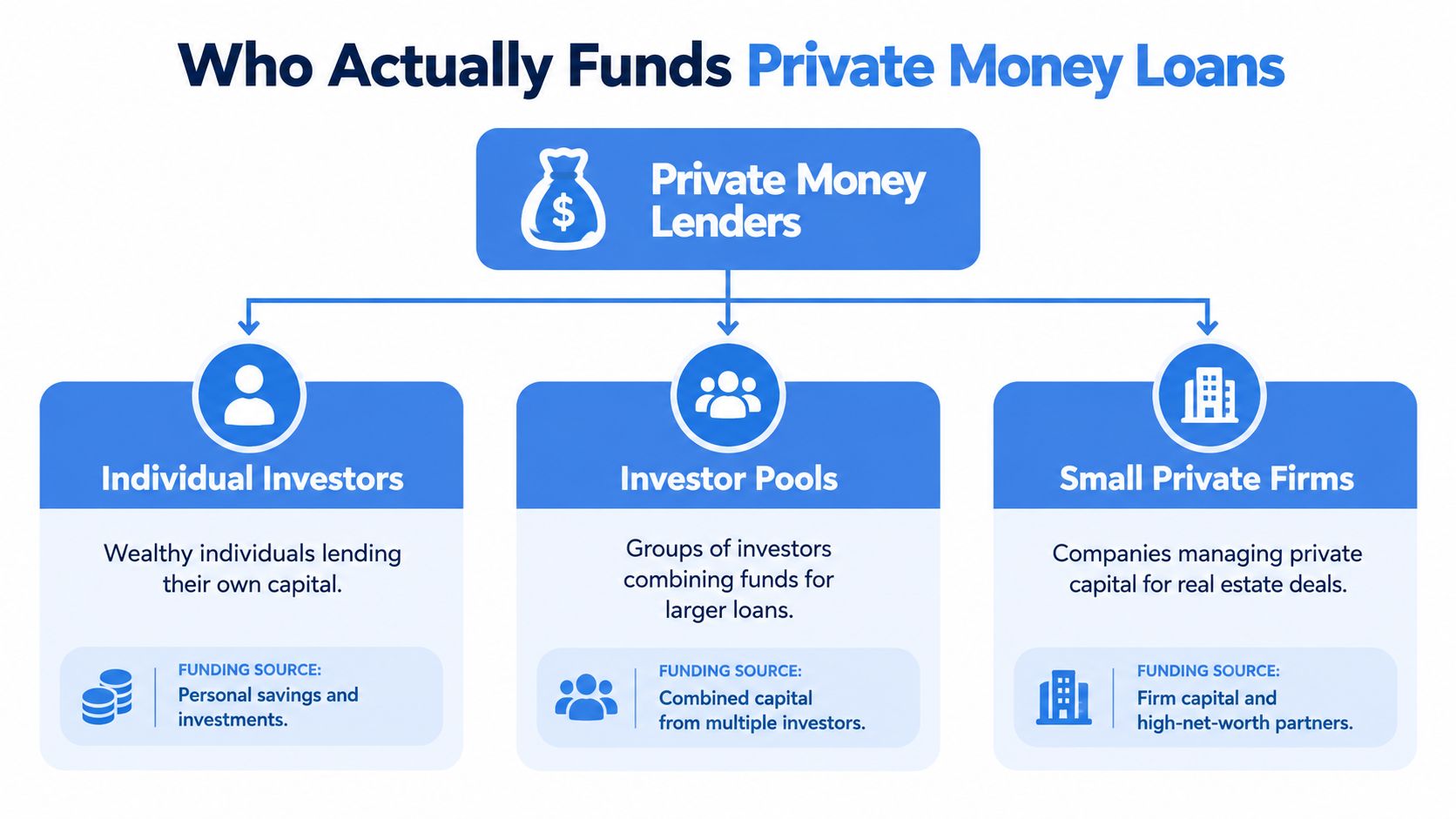
A local investor may fund one loan personally, while a real estate fund may make a similar loan using capital from many investors. Both can be called private money. The label tells you little about who approves the deal or controls the funds.
Follow the capital to understand the lender.
Different capital sources, different decision-makers
An individual investor may lend personal funds directly. An investor group pools money from several people, while a family office manages wealth that may include real estate debt. Debt funds and specialized finance companies can assess loans through a more formal investment process.
These structures don't guarantee a particular experience. An individual may require extensive documentation, while a fund may make its process straightforward. The source of capital helps explain who sets the rules, but the loan agreement shows what those rules mean for your deal.
Private Money Lender Types at a Glance
| Capital Source | Typical Deal Size | Underwriting Focus |
|---|---|---|
| Individual investor | Often an individual property transaction | Collateral, borrower relationship, repayment plan |
| Investor group | Depends on pooled capital | Property economics and agreement among investors |
| Family office | Varies with its investment mandate | Sponsor quality, asset risk, investment fit |
| Debt or mortgage fund | Can accommodate larger transactions | Fund guidelines, fund borrowing structure, project execution |
| Specialized finance company | Depends on available funding | Repeatable property and borrower criteria |
The Federal Reserve reported nearly $1.7 trillion in private credit by 2023, compared with approximately $1.4 trillion in syndicated bank loans and $1.3 trillion in high-yield bonds, in its analysis of private credit in the financial accounts. These figures cover private credit broadly, not just property loans.
Franklin Templeton's discussion of private-credit strategies describes direct lending, asset-based finance, and commercial real estate debt as distinct approaches. Since funds may focus on different types of credit, their loan terms and deal criteria can vary.
For borrowers and investors, that variety makes it useful to ask who controls the money. Does the lender have committed capital? Must other investors approve your loan? Who can authorize changes later? The person arranging the loan may not be the person controlling it.
Private Money vs Hard Money vs Bank Loans
Private money and hard money overlap, but they aren't interchangeable definitions. Private money describes the funding source. Hard money generally describes a short-term, collateral-focused lending approach.
A bank loan is different again. For investment properties, banks use their own credit policies and applicable banking requirements, not necessarily the consumer-mortgage rules that govern an owner-occupied home purchase.

Compare the contract rather than the label
Private Money vs Hard Money vs Bank Loans
| Feature | Private Money | Hard Money | Bank Loan |
|---|---|---|---|
| Interest rate | Negotiated and lender-specific | Often higher-cost, risk-based pricing | May offer lower long-term cost for qualifying deals |
| Speed | Depends on funding and approval authority | Commonly intended for time-sensitive transactions | Depends on the bank's review process |
| Documentation | Property and borrower requirements vary | Emphasis on collateral and execution | More standardized credit and financial review |
| Term length | Depends on the agreement | Generally short-term | Long-term options may be available |
| Best fit | Deals needing tailored terms | Renovation or transitional investments | Stabilized properties and qualifying borrowers |
These are comparison points, not universal promises. As MoneyLion's explanation of private money lending makes clear, a private loan isn't automatically hard money, and neither label establishes safety, licensing, lien priority, or regulatory treatment.
Bank constraints also have a portfolio dimension. Federal Reserve guidance on real estate lending exceptions identifies non-owner-occupied residential loans above 85% LTV among loans that may exceed supervisory limits and describes aggregate limits on such exceptions. A bank's decision can therefore involve more than your property alone.
For a side-by-side explanation, use this private money versus hard money comparison. If you're also sorting through renovation funding terminology, Home Pro's Remodeling & Repairs provides a resource to compare home improvement loan types, but distinguish homeowner products from business-purpose investment financing.
In California conversations, you'll hear private money and hard money used together. Don't rely on that shorthand. Match the actual term, payment obligations, and approval conditions to your investment.
How a Private Money Loan Actually Works
Consider a hypothetical fix-and-flip purchase: an investor finds a vacant property, plans repairs, and intends to repay the loan when the renovated property sells. The lender needs enough information to evaluate both the building and that plan.
Property review is part of that conversation, not a formality.

From property submission to closing
Start with the purchase agreement, property details, renovation budget, proposed schedule, and evidence of available funds. Include your experience. A first project needs a credible execution plan, not an exaggerated résumé.
The lender then evaluates collateral, repayment capacity, and the proposed exit. A term sheet should identify the interest rate, fees or points, loan amount, maturity, and conditions that must be satisfied before funding.
Loan-to-value, or LTV, compares the loan amount with the value used for underwriting. Ask whether that value means today's appraised value, purchase price, or projected value after repairs; BatchData's LTV ratio explained is a useful terminology reference.
- Valuation and title: The lender reviews the property's value and existing claims against it.
- Loan documents: You review payment obligations, guarantees, default provisions, and any renovation conditions.
- Security and closing: A mortgage or deed of trust secures the debt, and closing proceeds follow the agreed settlement instructions.
After the purchase closes
If the contract provides interest-only payments, those payments don't reduce the principal balance. If renovation funds are held back, they may be released through staged draws, with inspections or other conditions before each release.
Ask whether you must pay contractors before receiving reimbursement. Also establish who funds each draw and what happens if the scope changes.
The video below provides an additional viewing resource.
An extension isn't automatic unless your agreement provides for it. Before closing, understand the approval requirements and costs if the project runs late. At payoff, sale proceeds or replacement financing must cover the outstanding balance and applicable charges, not merely the original purchase advance.
Common Use Cases for Real Estate Investors
Private financing can solve a timing or property-condition problem that makes a conventional loan difficult. The following hypothetical examples involve non-owner-occupied investments, not financing for someone's primary residence.
When the timing doesn't match
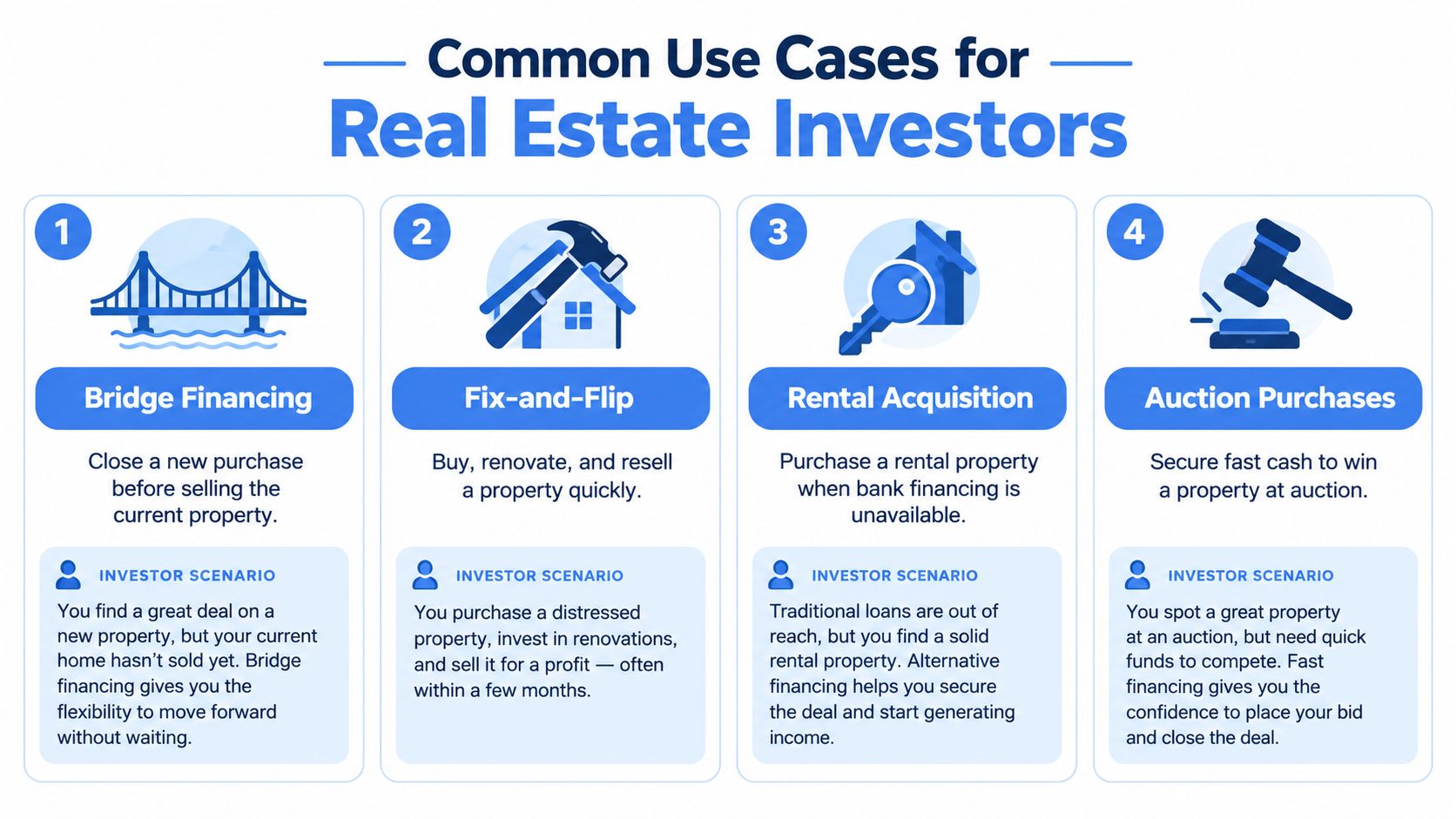
Bridge purchase. An investor wants to buy another rental before an existing investment property sells. A bank process may not fit the purchase deadline; a bridge loan may separate the acquisition from the later sale. The investor still needs a backup if that sale is delayed.
Estate sale or auction acquisition. A buyer encounters a firm closing deadline. Private financing may help when conventional approval can't fit the schedule, but the buyer should verify auction payment rules and obtain a realistic funding commitment before bidding.
When the property isn't ready
A fix-and-flip investor may buy a property whose condition prevents conventional financing. A lender willing to underwrite the purchase and rehabilitation together can provide a path forward, with renovation disbursements governed by the contract.
For a rental acquisition, the obstacle might be incomplete leasing or insufficient operating history for the intended long-term loan. A debt-service-coverage-ratio loan, commonly called a DSCR loan, evaluates rental income in relation to debt payments. Transitional financing may allow time to prepare the property, but it doesn't guarantee later DSCR approval.
Private capital also matters beyond small residential investments. Investor-driven lenders accounted for 14% of U.S. commercial real estate lending in 2025 and originated 34% of construction loans, up from 20% in 2023, according to The Real Deal's commercial real estate lending coverage.
Choose the financing for the obstacle you actually have, not simply because another investor used it.
Cash-out refinancing is another possible use: an investor seeks to release equity from a stabilized rental for a new project. Private financing may accommodate a transaction a bank can't process on the desired schedule. But borrowing against one property to fund another connects their risks, so evaluate both projects before proceeding.
Pros and Cons Most Investors Overlook
The attraction is easy to understand: a lender can consider a transaction that doesn't fit a standardized approval process. The less obvious question is whether the borrower can survive a slower, more expensive outcome than planned.
A conservative LTV protects the lender's collateral position more directly than your cash flow. It doesn't make your investment immune to delays, declining value, or lost equity.
Pros and Cons of Private Money Lending
| Pros | Cons |
|---|---|
| Potentially faster decisions and execution | Speed doesn't remove closing conditions |
| Flexibility around conventional documentation | Financial capacity still matters |
| Property-focused evaluation | You can lose the property after default |
| Possible renovation funding | Draw restrictions can create cash needs |
| Access for deals banks may decline | Higher pricing and fees can reduce profit |
| Negotiated transaction terms | Short maturities require a dependable exit |
Stress-test the borrower's side
Suppose your hypothetical renovation takes longer than expected and buyers won't pay your projected resale price. Even if the lender remains well secured, you may face additional interest, taxes, insurance, contractor expenses, and extension charges.
Selling at a reduced price could repay the lender while leaving you with little of your original equity. That distinction matters: successful lender repayment isn't the same as a successful investment.
Before committing: Test whether you can carry the property through a delayed exit without relying on another unapproved loan.
Experienced investors can reduce exposure by checking comparable sales carefully, challenging optimistic budgets, and keeping cash available outside the closing contribution. There's no universal reserve amount that fits every property and borrower.
- Test a slower sale: Consider how you'll cover holding expenses if buyers take longer.
- Challenge the refinance: Identify the replacement lender's requirements before assuming approval.
- Review the downside: Understand default charges, guarantees, and remedies.
- Protect operating cash: Don't treat every available dollar as money you can safely invest.
A higher-cost loan may still be sensible when it solves a specific problem and the project supports the expense. It's a poor substitute for a workable budget or a credible repayment plan.
California Rules and a Pre-Signing Checklist
A private loan still needs clear legal authority and documented terms. In California, licensing and transaction requirements depend on the lender's activities and the way a loan is structured. Borrowers and note investors should verify the details rather than assume that privately sourced capital means informal paperwork.
The California Department of Real Estate requires a real estate broker license in the circumstances described by the DRE, including when a person makes eight or more loans to the public in one calendar year from their own funds, with the loans held or resold and secured by one-to-four-unit residential property, as explained in the California Mortgage Association's summary of DRE regulations.
Verify authority and collateral
For covered brokered transactions, requirements can include a lender or purchaser disclosure statement, an independent appraisal, and direct security in California real property without subordination. Requirements can vary by transaction, so confirm which rules apply before signing.
A borrower should know who originates, funds, and services the debt. A trust-deed investor should verify what security the investment carries and who has authority to enforce it. These roles are like different hands on the same loan: the company handling payments may not own the note or control enforcement.
Pre-Signing Checklist for Borrowers and Investors
| Verify | Why It Matters |
|---|---|
| Lender or broker licensing and authority | Identifies who may conduct the transaction |
| Actual noteholder and funding source | Establishes who owns the repayment rights |
| Recorded lien position and title exceptions | Shows competing claims against the property |
| Appraisal date and methodology | Helps assess the valuation's relevance |
| Borrower equity and insurance | Clarifies financial contribution and asset protection |
| Draw controls and available funding | Determines how renovation money is released |
| Extension provisions and default remedies | Defines options and consequences if plans change |
| Servicer and modification authority | Identifies who handles payments and requests |
| Required investor disclosures | Supports an informed capital commitment |
For California-specific context, review this lending regulatory compliance resource and seek qualified advice if your transaction raises legal questions.
Cross-border resources serve a different purpose. Royal LePage Brookside Realty's renovation financing options for Maple Ridge homeowners compares homeowner renovation products, which is useful for understanding terminology but not guidance for California business-purpose lending.
Keep copies of the documents you reviewed. Resolve inconsistencies before signing, and get any promise about first-position security, available draws, or an extension stated clearly in the written terms.
Putting It All Together and Your Next Step
An investor buying a property that needs work may need funds before a bank can complete its process. The right choice depends on more than availability: the lender's capital source, approval steps, and written terms all affect whether the loan fits the property and business plan.
Start by identifying the financing problem. Is the property in a transition period, such as purchase and renovation before resale or refinancing? Then determine what you need to verify and who will handle each part of the loan. Clear responsibilities matter, especially when funds are released in stages or plans change.
Prepare a financing conversation that gets useful answers
Gather the property address, purchase agreement, renovation scope, available cash, and intended exit in one package. For a refinance, include current debt details and explain how you plan to use the proceeds.
Ask focused questions:
- Funding certainty: What conditions must be met before the lender commits?
- Execution: Who manages closing conditions and renovation disbursements?
- Total obligations: What payments are due during the loan and at payoff?
- Changes: Who approves a revised budget or extension?
Compare those answers with the rate. A low rate can be misleading if funding conditions or servicing responsibilities remain unclear. The lender's source of capital can affect who makes decisions, so ask who will fund the loan and who has authority to approve changes.
Among California financing options, LendingXpress offers private and hard money bridge, fix-and-flip, and rental property loans, with common-sense underwriting and a stated possibility of closing in as little as three days. Treat that timeline as a possibility, not a promise. You can start the conversation before every detail is settled, as long as you can describe the deal clearly.
A useful next conversation should clarify what the financing can cover, what conditions remain, and what you are responsible for. LendingXpress provides asset-backed financing for non-owner-occupied purchases, renovations, and refinances. Visit LendingXpress to request a quote with your property details, budget, and proposed exit strategy, and ask for written terms covering funding conditions, draw procedures, and repayment.