
A purchase agreement is a written, signed, legally binding contract that turns a verbal offer into enforceable obligations between buyer and seller. It spells out the property, price, and closing terms, and it's the document that decides whether the deal is moving or just being discussed.
That matters the moment a buyer and seller agree in principle on a non-owner-occupied property. One side thinks the price works, the other side wants speed, and the loan file can't move until the contract says who is buying what, on what terms, and what happens if the deal stalls. In private lending, that paper trail is often the difference between a funded close and a lost week of back-and-forth.
The Moment an Offer Becomes a Real Deal
A broker gets the call late in the afternoon. The buyer likes the property, the seller likes the number, and everyone sounds close enough to shake hands, but the deal still isn't real until the purchase agreement gets signed.
That's the point where the conversation changes from “we're probably doing this” to “these are the terms.” The agreement locks in the buyer, the seller, the asset, the price, and the conditions that have to be met before money changes hands. The American Bar Association says the minimum version needs to identify the parties, describe the property, state that the seller agrees to sell it, specify the price or pricing formula, and include both signatures, which is why this document carries so much weight once everyone starts negotiating seriously. American Bar Association guidance on purchase agreements
In a bank deal, that signed contract often sits in a queue while underwriting catches up. In a hard money deal, it's more immediate, because the lender reads the same contract as a risk map. If the agreement is clean, the file can move fast. If the contract is vague, the lender starts asking questions before the first draw or closing wire is even discussed.
Practical rule: if the purchase agreement leaves the price, timing, or contingencies fuzzy, the deal isn't ready for funding yet.
For investors buying non-owner-occupied property, that early clarity matters even more. The contract doesn't just prove intent, it controls earnest money, inspection rights, loan timing, and the path to closing. A strong purchase agreement keeps the deal moving. A sloppy one creates delays that usually show up as funding friction.
What a Purchase Agreement Actually Is
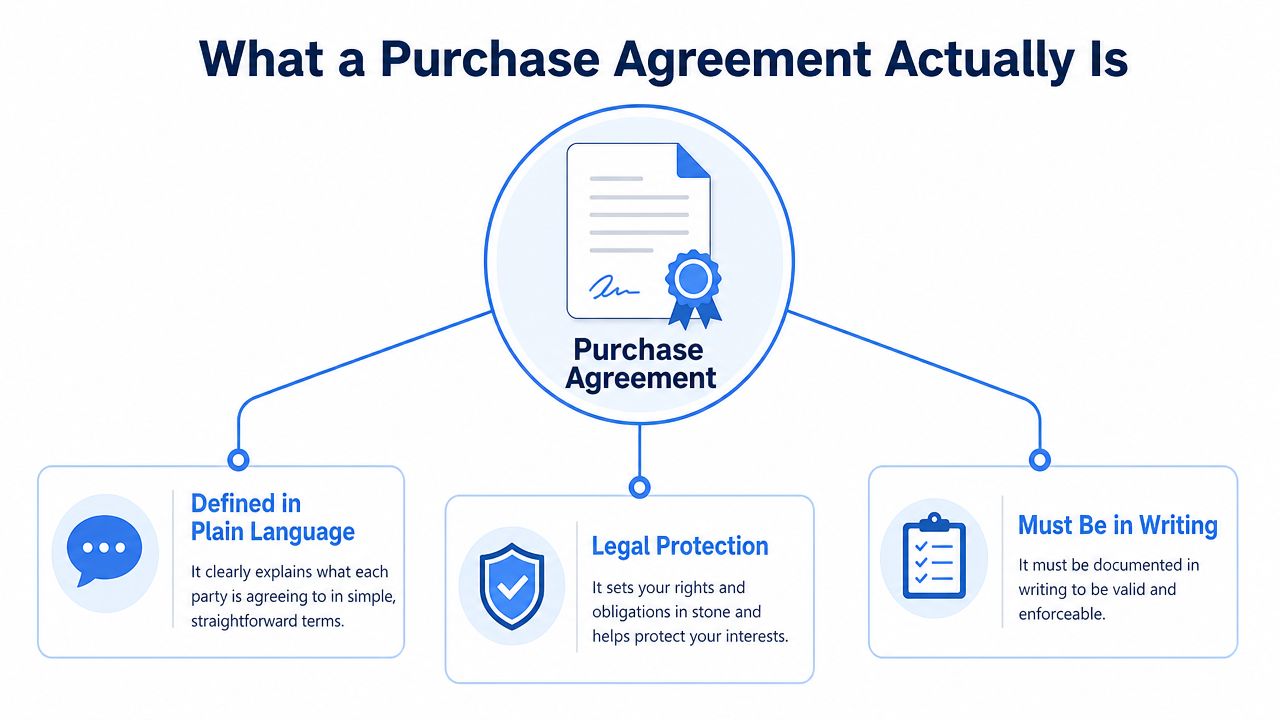
A purchase agreement is the contract that captures the deal in writing and makes it enforceable. In plain English, it says who is buying, who is selling, what is being sold, what it costs, and what has to happen before ownership transfers. A written agreement matters because real estate contracts usually need to be signed by both sides to hold up, and the period between signing and closing is where the parties work through the remaining conditions. LegalShield's home purchase agreement overview
The minimum structure that makes it real
The American Bar Association says the agreement needs four core things at minimum, the parties, the property, the seller's agreement to sell, and the price or pricing formula, plus both signatures. That's the floor, not the finish line. Real estate contracts usually add closing dates, contingencies, earnest money terms, and remedies for breach because those details decide what happens if financing slips or inspections uncover a problem. ABA extract on purchase agreement basics
The cleanest way to think about it is simple, the purchase agreement is the rulebook the transaction follows after the handshake. Once it's signed, the deal isn't just a promise anymore. It's a set of obligations.
Why it's different from related documents
A letter of intent is usually only the outline. It helps the parties frame a deal, but it doesn't do the heavy lifting the purchase agreement does. A contract of sale can be used differently in some contexts, because a purchase agreement often sets the deal now and leaves final transfer for closing later, while a contract of sale may transfer ownership more directly after signing. In real estate, that distinction matters because the agreement can be binding well before title changes hands. Pandadoc's comparison of purchase agreement and contract of sale
That's also where buyer discipline matters. If the contract says the property is under agreement, but the financing language doesn't line up with the actual lender, the file gets messy. Good borrowers and brokers use the agreement to narrow uncertainty, not create it.
The clauses that quietly control the deal
The most useful clauses are rarely the longest. They're the ones that decide whether the buyer can still walk, whether earnest money is exposed, and when the seller can demand performance. Those are the pressure points a lender notices first.
A purchase agreement is not just paperwork. It's the operating system for the deal.
Standard Clauses That Actually Move Money
A purchase agreement can look dense, but the money usually sits inside a handful of clauses. That's where the real leverage lives. In residential deals, industry guidance says these agreements often run 4 to 9 pages and still include enough detail to cover the transaction from acceptance through closing. Amerisave's guide to purchase and sale agreements

Price and payment terms
This is the part everyone reads first, and for good reason. It sets the purchase price, the deposit, and how the buyer will deliver funds. In a private money file, this section also tells the lender whether the buyer is serious enough to move quickly and whether the contract supports staged funding or a fast close.
Earnest money terms matter because they show commitment. If the deposit is too thin, the seller may question the buyer's seriousness. If it's too aggressive and the contingencies are loose, the buyer can get trapped before the due diligence is done.
Contingencies and protections
These clauses are where the deal stays alive or dies. Financing, appraisal, and inspection contingencies give the buyer a path out if the property or the loan doesn't pencil. In high-value transactions, purchase agreements are technically important because they control contingency risk and the timing of title transfer. iCertis on purchase agreements and contingency risk
A buyer who waives contingencies too early may look strong, but that move can expose the deposit and remove the exit routes that protect the deal. A lender reads that as higher execution risk, not just confidence.
Closing mechanics and remedies
Closing date language tells everyone when the deal has to finish. Remedies tell both sides what happens if someone misses the deadline or fails to perform. That's more than legal fine print. It's the framework that keeps a stalled transaction from turning into a verbal argument.
If you want a contract review before signing, a practical resource is avoid liability with contract review. That kind of review is useful when the deal is moving fast and the contract language could shift liability in ways the parties didn't intend.
A purchase agreement should help the buyer and seller solve problems before closing, not create new ones after closing.
The Main Types of Purchase Agreements in Real Estate
Not every purchase agreement works the same way. A homeowner sale, an investor flip, and a commercial purchase don't use identical language, even if they're all trying to do the same basic job. The wording tells you what kind of deal you're holding.
| Agreement Type | Typical Deal | Key Feature |
|---|---|---|
| Residential purchase agreement | Home purchase or sale | Focuses on contingencies, disclosures, and closing timing |
| Commercial purchase and sale agreement | Commercial property transaction | Usually heavier on risk allocation and closing mechanics |
| Investor purchase contract | Fix and flip or rental acquisition | Often shaped around speed, assignment rights, or rehab timelines |
| Assignment of contract | Wholesale or contract flip | Transfers contract rights before closing instead of title |
When the wording changes the outcome
A purchase agreement and a purchase and sale agreement are often used interchangeably in practice, but that doesn't mean the distinction is meaningless. Thomson Reuters notes that many explainers collapse the terms, while legal resources and contract forms don't always treat them the same way. That confusion matters when the deal is moving across states, industries, or transaction types. Thomson Reuters on purchase agreement glossary terms
In residential property, the document usually emphasizes contingencies, disclosures, and the path to closing. In an investor deal, the contract may need to leave room for assignment or quicker execution. In M&A-flavored transactions and other asset transfers, the agreement can carry much more detail about warranties, covenants, and closing conditions, because the risk profile is different.
What to look for first
Read the title, then scan for the clauses that reveal the deal type. If you see financing contingencies, inspection language, and earnest money rules, you're probably in a standard purchase contract. If you see assignment language or language built around a quick resale, you're in a more investor-driven structure.
A quick rule helps here. If the contract assumes a slow, bank-style process, treat it like a bank deal. If it assumes a fast close and limited friction, it's written for private money or another flexible funding source. That difference shapes everything else.
From Offer to Close and What Happens in Between
A signed agreement starts a sequence, not a finish line. The deal moves through offer, acceptance, escrow, due diligence, appraisal, loan processing, contingency removal, and closing. Each stage has a job, and each stage can stop the transaction if the deadline gets missed.

The gates that matter
Offer and acceptance lock in the basic deal terms. Escrow starts the formal holding process, then due diligence gives the buyer time to inspect the property and verify what was promised. Appraisal and loan processing test whether the purchase price and financing still line up with the asset.
The contingency period is where most deals are won or lost, because that's where the buyer either confirms the numbers or finds a reason to walk. Once contingencies are removed, the buyer gives up negotiating power and moves closer to a non-reversible close.
Why lenders care about the timeline
A conventional lender often wants more time because underwriting, appraisal, and documentation all take time. A private or hard money lender can often move faster because the contract and collateral are the key focus points. That speed changes the way the agreement should be written from the start.
Practical rule: a fast lender needs a contract that supports a fast close. A slow contract can kill a fast funding plan.
How the closing path differs in practice
Some California transactions move through longer contingency windows because bank financing and property reviews take time. A hard money scenario is different, because the lender can fund in days if the file is complete and the contract supports it. That doesn't mean the buyer should rush past inspection or title review. It means the contract should match the financing path from day one.
For builders and investors who want a tighter closing workflow, closing workflow tips for builders can help reinforce the sequencing around escrow, documents, and final signatures. The key is keeping the contract, lender, and closing team pointed at the same deadline.
How Financing Clauses Shape the Deal
Financing language is where a purchase agreement becomes a funding document, not just a sales contract. If the buyer is using conventional debt, the contract usually needs enough time for loan approval, appraisal, and underwriting. If the buyer is using private or hard money, the agreement can often be tighter because the lender is reading collateral, execution speed, and exit strategy, not waiting on a slow committee.
What the financing contingency really does
A financing contingency gives the buyer a way out if the loan can't be secured on acceptable terms. The deadline matters as much as the clause itself. Miss the commitment date, and the buyer can lose negotiating power or, in some cases, the deposit protection that was supposed to keep the deal safe.
Private lenders look at that clause differently. They want to know whether the timing is realistic and whether the contract supports their process. If the deal depends on a lender who can close fast, the purchase agreement should not be written like the buyer expects a long bank approval cycle.
Why private money changes the contract conversation
In a hard money file, the agreement often needs to be coordinated with staged draws, rehab timing, and loan documents that control the actual funding process. The purchase agreement should support that structure rather than fight it. That means the closing date, contingency removal, and assignment language have to be realistic.
LendingXpress is one option for investors in that position, because it structures loans around fast acquisitions, bridge transactions, fix and flip projects, and non-owner-occupied rentals with closings in as little as three days, including loans from $100,000 to $18 million+. The value isn't just speed. It's that the loan structure has to fit the contract, or the contract becomes the bottleneck. LendingXpress investment property financing guidance
Clauses that matter to the lender
- Appraisal waivers or flexibility: These can help a fast deal move, but they also increase risk if the buyer overpays.
- Cross-default language: If the loan documents and purchase agreement aren't aligned, one missed step can affect the entire file.
- Closing conditions: These tell the lender what has to be true before funds are released.
- Staged draws: For rehab projects, the contract should leave room for the work schedule and disbursement process.
A lender reads these clauses as execution risk. The cleaner the contract, the fewer surprises at funding.
Negotiation Levers and Common Deal Killers
A broker in a hot neighborhood has two buyers on the same property. One comes in with a clean offer and realistic terms. The other tries to win on paper by promising everything and protecting nothing. Only one of them looks fundable.
The levers that actually help
- Flexible closing date: Sellers like certainty, and a date that fits their move-out or replacement purchase can beat a slightly higher price.
- Waiving minor contingencies: That can help when the buyer has already done due diligence and the property is straightforward.
- Increasing earnest money: A stronger deposit signals commitment, but only when the buyer is comfortable with the contract risk.
These moves work because they reduce friction without breaking the deal. They make the seller feel safe and the lender feel that the file is moving in a controlled way.
The mistakes that break momentum
- Unreasonable price demands: A lowball offer can waste time if it's not tied to real market facts.
- Overly long contingency periods: That can make the seller nervous and slow the entire file down.
- Poor communication: Delayed replies on signatures, addenda, or title questions can sink a deal that was otherwise fine.
The fastest way to lose a good contract is to act confident while missing deadlines. Sellers remember the buyer who missed the inspection window. Lenders remember the file that came in with no clarity on financing or closing conditions.
Useful habit: keep your negotiation centered on what protects the deal, not what makes the offer look aggressive.
Where assignment rights fit
Assignment language matters in investor deals, especially when the buyer may flip the contract rather than close in the original entity. If the agreement forbids assignment, that can cut off a strategy the investor expected to use. If it allows assignment too freely, the seller may feel exposed and tighten the rest of the terms.
The smartest buyers don't try to win every clause. They protect the clauses that affect money, timing, and exit routes, then give ground where the deal can absorb it.
Pre-Close Checklist and Common Questions
Before signing, confirm the property description, price, closing date, financing language, and contingency deadlines. During escrow, track inspections, title review, loan conditions, and any required addenda. Right before closing, make sure the signatures match, the contingencies are handled, and the final numbers line up with the lender and escrow team.
For documentation cleanup, the loan documentation requirements page is a useful place to check what a lender typically wants before funding. That matters most on non-owner-occupied deals, where speed and paperwork have to move together.
Can a verbal agreement count? Usually not in real estate, because the signed writing is what carries the enforceable terms. Can a purchase agreement be canceled without losing earnest money? Sometimes, but it depends on the contingency language and whether the buyer acted within the contract deadlines. How long should the inspection window be? Long enough to inspect the property and solve the issues the contract is supposed to protect against. What happens if financing falls through? The answer depends on whether the financing contingency is still alive when the lender issues its decision.
For California investors and brokers trying to close faster on non-owner-occupied property, the best move is to align the contract with the lender before the offer goes hard. That's where a private lender like LendingXpress can shorten the path from signed agreement to funded closing when the structure is clear and the file is ready.
A CTA for LendingXpress.