
You're under contract, the buyer wants a clean answer, and the clock is already moving. A broker forwards the file, the lender says they'll “circle back,” and two business days later the seller has taken the backup offer. In real estate financing, customer service responsiveness isn't a courtesy, it's part of the closing process.
The hard part is that slow replies usually don't look dramatic in the moment. They show up as a missed term sheet, a delayed payoff quote, a draw schedule nobody confirms, or a borrower who stops calling because another lender answered first. In this business, the inbox is not neutral. Every unanswered message is a decision the client is forced to make without you.
Why Slow Replies Kill Real Estate Deals
A broker can do everything right on the front end, strong borrower, clean collateral, decent exit strategy, solid spread, and still lose the deal because the lender drags its feet. The seller does not care that underwriting was busy. The buyer's agent does not care that the loan officer was in another call. They care about the response that let the file keep moving.
That's why speed sits right next to trust in private lending. 90% of consumers expect immediate responses to service inquiries, and 73% will stop doing business after a bad customer service experience (customer service statistics). Those numbers aren't just consumer trivia. They explain why a delayed lender reply can push a broker, agent, or investor toward the next option before the first one even finishes reading the file.
The deal flow is simple. A borrower needs a term sheet, a lender needs missing docs, a seller wants proof of funds, and everyone wants certainty. If the reply comes back late, the client assumes the file is low priority, and that assumption is expensive.
Practical rule: If a deal is under contract, a slow first reply is not a harmless lag. It's a signal that the lender may also be slow on underwriting, conditions, and funding.
What matters here is not just politeness. It's revenue protection, because response time influences whether the file keeps moving, whether the agent keeps confidence in the lender, and whether the borrower keeps the assignment alive. A lender that answers fast, and answers with something useful, is helping the broker preserve the transaction.
The next question is what “responsive” means in a lending workflow, because speed by itself can still miss the mark.
What Customer Service Responsiveness Really Means

In lending, customer service responsiveness is the mix of how fast you acknowledge the request, how accurate the first answer is, and whether you follow through on the next step. A fast reply that says almost nothing does not help a broker trying to keep escrow alive. A detailed answer that arrives two days later does not help either.
A file can still stall even after someone answers. That is why responsiveness has to cover the first reply, the quality of the information, and the handoff to the next person who needs to act.
Speed gets the deal unstuck
The first job is acknowledgment. A broker, agent, or borrower wants to know the request was seen, who owns it, and what happens next. In lending, that first reply should do more than buy time.
Speed matters because deal flow moves through a chain of waiting. One person is asking for a term sheet, another is checking missing docs, and a third is trying to confirm whether the lender can fund on schedule. If the first reply is slow, the file feels stalled before anyone has reviewed the details.
Accuracy keeps you from sounding busy
A responsive team does not just answer quickly. It answers correctly. A fast message from the wrong person, or a vague answer that creates another round of follow-up, adds work instead of removing it.
The practical test is simple. Did the reply answer the actual question, or did it only acknowledge that someone saw the email? If the borrower asked about conditions, the answer should address the conditions. If the agent needs proof of funds, the reply should make that path clear.
Empathy keeps urgency from turning into friction
This matters most when the borrower is stressed, the agent is trying to protect a commission, or the broker is juggling several parties at once. Responsiveness is not the same thing as friendliness, availability, or resolution quality. It is the way speed, accuracy, and tone work together under pressure.
A calm, useful reply lowers the temperature in the file. The borrower knows who is handling the request, what still needs to be sent, and when to expect the next update. That is what responsive service looks like in a lending workflow, and it often starts with reducing average handle time as part of a tighter process (reducing average handle time). A lender that does that consistently is responsive. A lender that just sounds busy is not.
The Core Metrics That Measure Responsiveness
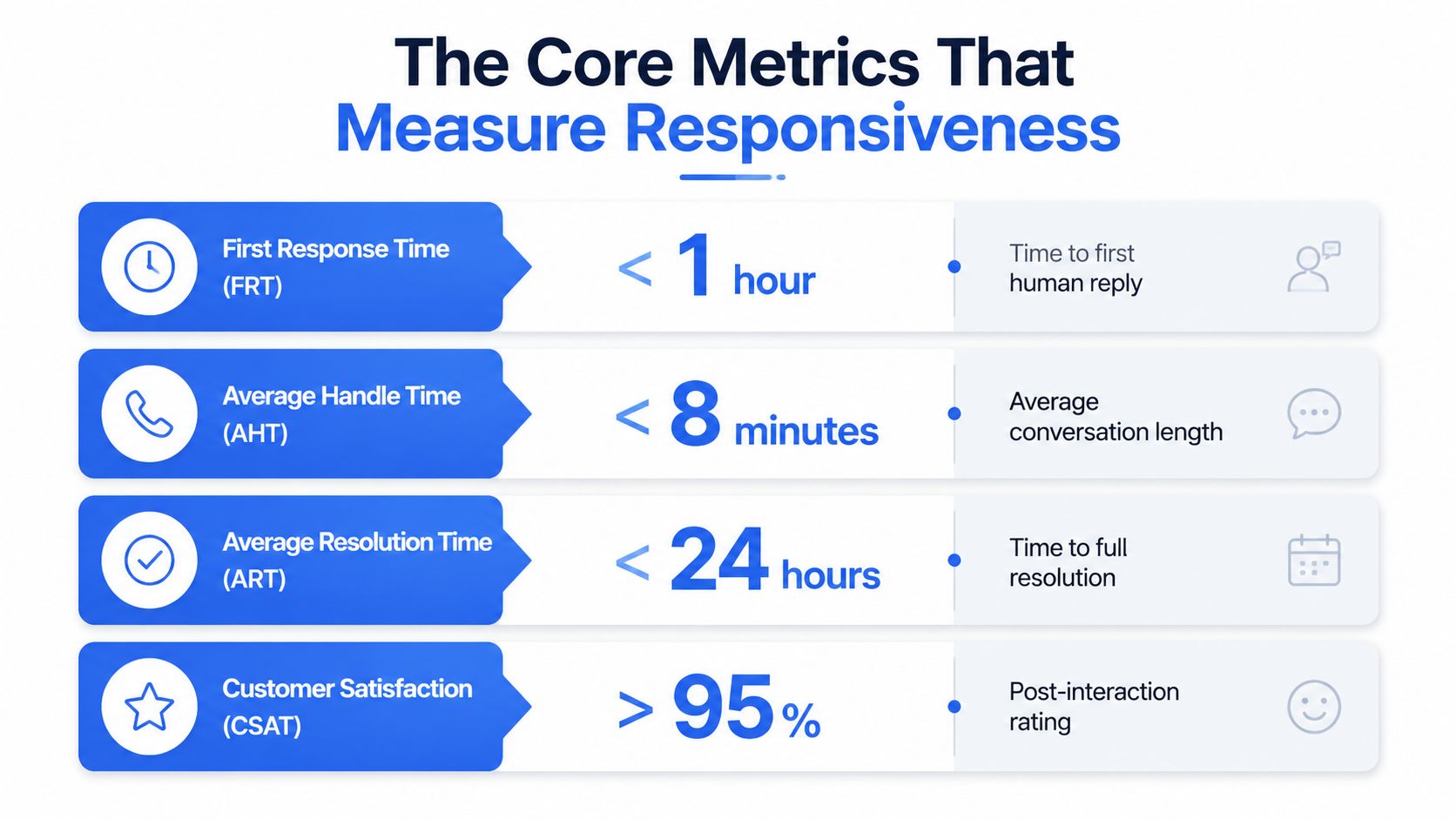
The first number people notice is usually first response time (FRT), because that is the delay a broker, agent, or borrower feels. In a lending file, a quick “got it” can still hide a slow process behind it, so FRT only matters when it leads to real ownership and a useful next step.
FRT is the time between the first inquiry and the first reply. In practice, that clock starts when a broker emails the deal, texts the question, or submits the file, and it stops when someone responds with clarity and takes responsibility for the next action. A same-day acknowledgment is a solid target for an inbound loan request, while a simple question about a draw schedule should feel almost immediate during business hours.
The four metrics that keep teams honest
- First Response Time (FRT): How long a client waits for the first useful reply.
- Average Handle Time (AHT): How long a team spends actively working each contact.
- Average Resolution Time (ART): How long it takes to fully close the loop.
- First Contact Resolution (FCR): Whether the issue gets handled without repeat back-and-forth.
These four metrics work together because speed alone does not keep a deal moving. The chart at the top shows how response time, handle time, resolution time, and satisfaction fit into the same operating picture, and the broader framework in customer service metrics is useful for separating a quick acknowledgment from actual service. A lender can post a fast first reply and still lose time if the file needs three more messages to get the same answer. That is why teams also watch customer service reports, where repeat contacts and resolution patterns show whether the workflow is clean or just busy.
For lenders, reducing average handle time matters because handle time drops when intake questions are tighter and routing is cleaner. A team that spends less time sorting basic details has more time to keep broker files moving, clear borrower conditions, and stop simple requests from turning into a chain of follow-ups.
Useful test: Ask any lender how they track FRT and FCR together. If they only talk about quick replies, they are measuring activity, not responsiveness.
The best private lenders care about one question. Does the first answer move the deal forward, or does it just buy time? If it does not advance the file, the metric looks good on paper and fails in practice.
Benchmarks by Channel and Borrower Type
Not every channel carries the same urgency, and that matters in lending. A text from a broker asking for a term sheet is not the same as a general inquiry buried in email. A social DM from an investor asking about funding availability is not the same as a post asking for company info.
A 2025 roundup says 46% of customers expect email replies in under 4 hours, 31.2% want email responses in 1 hour or less, and 60% define live-chat “immediate” as within 10 minutes or less (customer service statistics). Another 2024 customer experience summary says 40% of consumers expect replies on social media within one hour and 79% within 24 hours (customer experience statistics). That's the backdrop brokers and agents are working inside.
Responsiveness Benchmarks for Lending Channels
| Channel | Customer Expectation | Lender Goal | Why It Matters in Lending |
|---|---|---|---|
| Phone | Immediate human contact during business hours | Answer live or call back fast | Brokers often use phone when a file is under contract |
| Under 4 hours for many clients | Same-day first reply | Email still carries term sheets, docs, and conditions | |
| Live chat | Within 10 minutes or less | Near-instant acknowledgment | Good for quick qualification questions |
| Social DM | Within 1 hour for many users | Fast triage and move to a direct thread | Common for agents and investors who message on the go |
Channel choice also changes the damage from delay. Social and messaging are public or semi-public, so slow replies can look worse than a delayed email. Freshworks says good service should be available through preferred channels such as social media, chat, phone, or email, and that omnichannel consistency signals better service (customer service statistics). That matters when a borrower starts in email, follows up by text, and asks the agent to confirm the lender is still engaged.
For teams trying to set service levels, contact center KPI insights are useful because they frame responsiveness as a measurable operating standard, not a vague promise.
The practical takeaway is simple. If a borrower uses phone, answer fast. If they use email, don't wait until tomorrow. If they use chat or text, acknowledge quickly and route the file to the right loan officer before momentum dies.
How to Build a Responsiveness System That Actually Works
A responsive lender is built, not wished into existence. The fire station doesn't hope the right truck shows up. It keeps the crew, tools, and dispatch rules ready before the call comes in. Lending teams need the same structure.
Start with clear service rules
Document SLAs for inbound calls, emails, and chat. Set an expectation for who answers, when they answer, and what counts as a complete first reply. For inbound loan inquiries, a one-hour FRT target is realistic for a well-run team during business hours. For active deals under contract, the target should be even tighter through escalation rules.
Routing matters just as much as speed. CRM-based assignment should send brokers and agents to the right loan officer, not a general inbox. Auto-acknowledgment messages should confirm receipt, identify the owner, and tell the sender what documents or details are still needed.
Build escalation before you need it
Tag deals by urgency. A refinance with no closing date is not the same as a purchase contract with a hard deadline. After-hours coverage also needs a backup contact, because a single point of failure is how responsive teams turn into silent ones.
Weekly review is where the system improves. Look at FRT, FCR, unresolved items, and handoff quality. If one person answers fast but never closes the loop, that's not a strength. It's a bottleneck.
Operating truth: Responsiveness gets better when the system protects the first reply and the final resolution at the same time.
A useful shortcut is to connect intake, tracking, and follow-up in one workflow instead of juggling disconnected tools. That's where automation helps, and a platform like automated loan processing can fit into a broader routing and follow-up process when a team needs less manual chasing.
When the system is working, the client feels it immediately. The lender sounds organized, the file moves, and the broker doesn't need to keep asking whether anyone saw the message.
Responsiveness in Action for Brokers, Agents, and Investors
A broker gets a fixer-upper deal under contract on a tight timeline. The borrower needs a same-day term sheet to keep the offer alive, and the seller's side is already asking for proof that financing is real. A responsive lender returns the call within the hour, asks for the key property details, issues a preliminary quote, and keeps the broker updated while underwriting reviews the file.
That is the difference between being part of the transaction and watching it stall. A lender that answers quickly gives the broker something concrete to take back to the buyer and the listing side. When the file is moving fast, the borrower feels momentum instead of uncertainty.
For investors using a private lender, the first reply often sets the tone for the entire deal. It tells them whether the lender understands the pace of a purchase contract, a rehab budget, or a refinance that has to clear on schedule. It also shows whether the team can handle direct questions without pushing the borrower through a slow chain of back-and-forth.
In practice, the issue is not just speed. It is whether the response gives the next person in the chain enough information to act. A broker needs a clear yes, no, or request for more detail. An agent needs enough context to advise the client without making another call. A private lender needs clean intake so underwriting does not have to restart the conversation.
That is why a generic support inbox usually creates more follow-up, not less. Every extra round of “just checking in” adds friction to the closing path, and every handoff raises the chance that a contract deadline slips. Direct loan officer relationships keep the file with fewer people, which makes it easier to move.
The practical value shows up in the handoff. A broker wants someone who can answer straight and stay accountable through underwriting. An agent wants a lender who remains reachable after the application is in, because that is when the most important questions start.
Best signal to watch: When a lender answers quickly and keeps the same person involved, the file usually feels calmer all the way to closing.
For brokers who work with investor buyers, it helps to keep a shared communication rhythm with the lender and contractor team. communicating with your private money lender and contractor team is worth reviewing when a project needs tighter coordination across multiple parties. A firm like LendingXpress can show how direct access and clear file ownership support that kind of workflow without turning every question into a new delay.
Where AI Helps and Where Humans Still Matter
AI can make a support team feel much faster, but only if it's used to remove drag instead of adding another layer of clicks. Auto-acknowledgments, triage, and chat summaries all help compress the wait between a message and a useful reply. That matters because 78% of organizations now use AI in at least one business function, and 64% of CX leaders plan to increase investment in AI and related technologies within the next year (customer support trends 2025).
The best use of AI in lending is the front end of the response. It can confirm receipt, capture missing property details, sort urgent deals from general questions, and summarize a borrower's situation for the right loan officer. If you're looking to deploy AI agents for support, the critical test is whether the tool reduces back-and-forth and hands off cleanly to a human when the file gets complicated.
Where AI works well
AI is strong when the question is repetitive, the data fields are known, and the risk of a wrong first pass is low. It can gather borrower basics, route a deal to the correct queue, and keep the client from sitting in silence.
Where humans still have to step in
Nuanced underwriting calls need judgment. Distressed borrower conversations need tone. Complex deal structure needs someone who understands how the terms fit the exit plan. A machine can help organize the file, but it can't replace a loan officer who knows how to read the situation.
The point is not AI versus humans. It's AI plus humans, with the right handoff. The response feels responsive only when the borrower gets speed and context together.
Practical Takeaways for Lenders Brokers and Agents
A deal can look solid on paper and still fall apart because one message sits unanswered while the clock keeps moving. Brokers should ask a private lender for documented FRT and FCR expectations before sending a file, then press for a clear explanation of who answers first, how quickly that reply lands, and how repeat questions get handled. If the lender cannot explain the handoff from intake to underwriting, the deal is already exposed.
Agents need to tell investor clients exactly who owns each part of the process. One person handles the first reply, another handles conditions, and someone else tracks the next deadline. That keeps the file from stalling when everyone assumes a different person is already on it.
Lenders should review first-response and resolution numbers every week, not every quarter. They also need a backup contact on every active deal, because one unavailable loan officer can slow the entire pipeline. If the support model still depends on one hero inbox, it is not a system.
- Brokers: Ask for a lender that responds quickly and keeps the file moving without bouncing it across several people.
- Agents: Set clear expectations on who answers what, so buyers and sellers do not feel ignored.
- Lenders: Measure speed, resolution, and handoff quality together, then fix the bottleneck instead of celebrating a quick acknowledgment.
LendingXpress fits this topic because it operates like a relationship-driven private lender, not a faceless queue. It offers bridge, fix & flip, and rental property loans, and that kind of pace matters when a transaction is already under contract and the response window is tight. If you want a financing partner that treats responsiveness as part of the loan process, visit its contact page and see how the team can support your next non-owner-occupied deal.