
Bridge financing is short-term funding, typically lasting 6 to 24 months, that covers a capital gap until a refinance, sale, or permanent financing pays it off. For a non-owner-occupied investment property, it can give you time to buy, renovate, stabilize, or refinance an asset before traditional financing is ready.
You've found a rental or commercial property at a price that works. The seller wants a fast closing, but your bank's underwriting process is moving too slowly, or the property doesn't yet meet the bank's income, condition, or occupancy requirements. Without another source of capital, a promising deal can disappear before you reach the closing table.
That's the situation bridge financing is designed to address. It gives an investor temporary funding today, with repayment planned around a specific future event, usually a sale, refinance, or permanent loan.
Why Investors Ask What Is Bridge Financing
An investor sees a small apartment building come on the market. The numbers look attractive, but the seller wants certainty and speed. A conventional lender may need extensive documentation, property history, appraisal review, and income verification before issuing a final commitment. By then, another buyer may have closed.
A bridge loan can fill that timing gap. The lender secures the loan against the investment property, advances capital for the acquisition, and expects the borrower to replace the loan later with permanent debt or sale proceeds. The bridge isn't meant to remain in place indefinitely. It's a temporary crossing between the opportunity available now and the financing available later.
Practical rule: A bridge loan only makes sense when you can explain how the loan will be repaid before you sign the commitment.
The structure has become a meaningful part of real estate and growth-company lending rather than a niche workaround. One industry report estimated that the global bridge loans market reached USD 83.5 billion in 2024 and grew at a 7.2% CAGR, while another forecast the bridge financing market at $28.4 billion in 2025, rising to $48.3 billion by 2034 at a 6.8% CAGR. These figures come from market reports summarized in DLA Piper's overview of bridge financing.
For real estate investors, the important question is not just whether bridge financing exists. You need to know whether it fits your property, your timeline, your available cash, and your exit plan. You also need to understand the full cost, including interest, points, fees, extension costs, and the risk of a balloon payoff arriving before your refinance is ready.
This guide focuses on non-owner-occupied investment properties. It explains how bridge loans work, when investors use them, how lenders underwrite them, how they compare with hard money loans and HELOCs, and how to calculate the actual cost before committing.
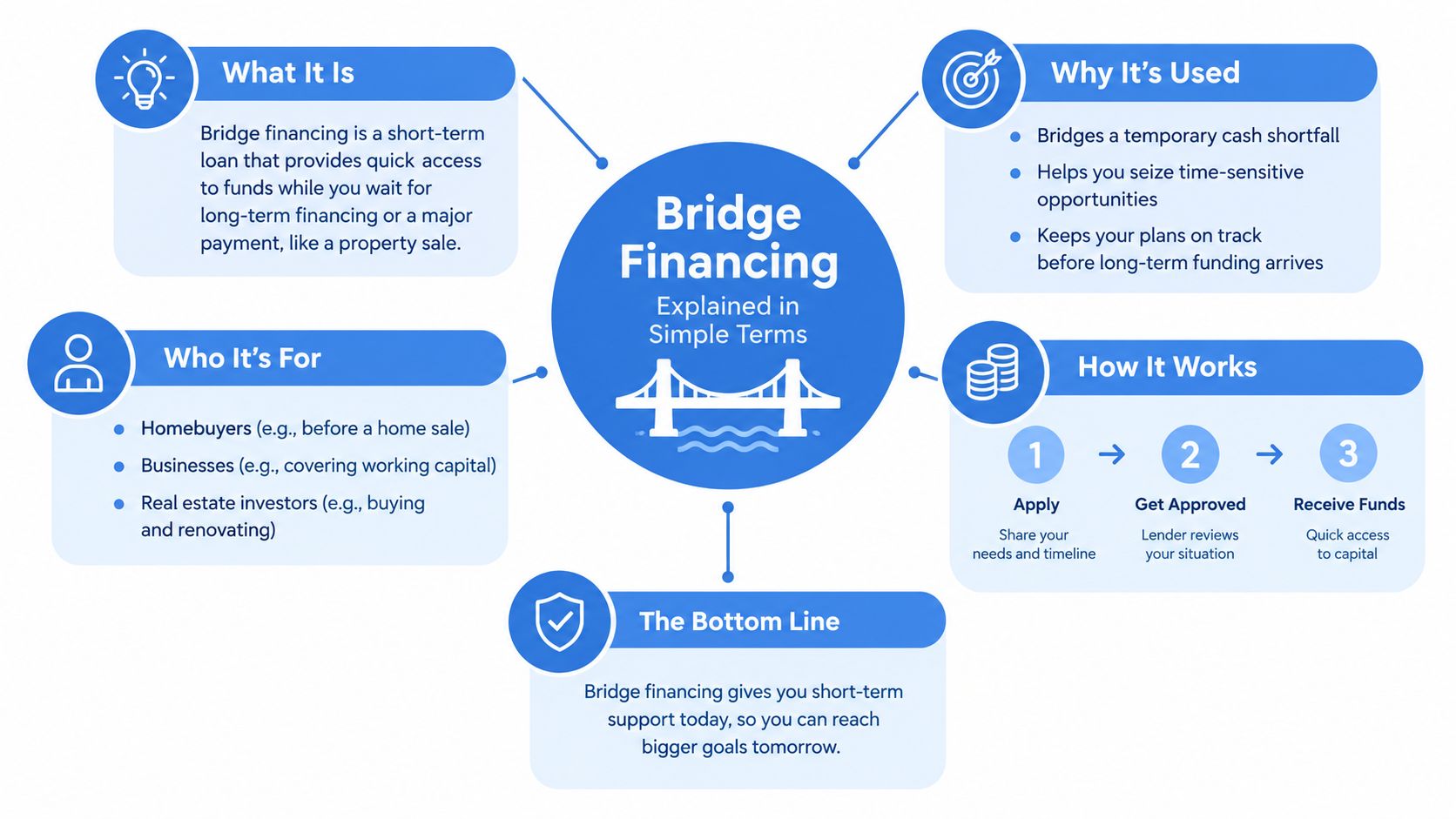
Bridge Financing Explained in Simple Terms
Think of a bridge loan as a temporary road across a gap. On one side is the transaction you need to complete now. On the other side is the permanent financing, sale, or refinance you expect to use later. The loan carries the property across that gap.
Bridge financing: Short-term capital secured by an investment property and repaid when a planned exit event, such as a refinance or sale, occurs.
For a non-owner-occupied property, the basic process usually looks like this:
- You identify the gap. You need money to acquire, refinance, renovate, or stabilize an investment property before a longer-term loan is available.
- The lender reviews the property. The lender considers the asset, its value, condition, income potential, and the amount of equity supporting the loan.
- You close the bridge loan. The proceeds fund the purchase or another approved purpose.
- You improve the financing position. You may complete renovations, increase occupancy, document rental income, or wait for a refinance window.
- You repay the bridge. A permanent loan, sale, or other defined source of funds pays off the balance.
Many investment-property bridge loans use interest-only payments. That means your scheduled payments cover the interest rather than reducing the principal balance. When the bridge period ends, the remaining principal is usually due as a balloon payoff.
That balloon feature is where many first-time borrowers get uncomfortable. A payment can feel manageable during the loan term because you're paying interest only, but the principal still has to be repaid in full. Your exit plan must account for that balance.
A bridge loan also isn't automatically a construction loan. Some bridge products include renovation funds or staged draws, but others are intended only for acquisition or refinance. Ask exactly what the proceeds may fund, how draws work, and whether unused renovation capital is charged.
When Investors Use Bridge Loans
Bridge financing becomes easier to understand when you place it inside an actual investment timeline. The same loan can serve different purposes, but the common feature is a mismatch between when capital is needed and when permanent money becomes available.
A fast acquisition
You find a dated rental property with a motivated seller. The purchase price works because the property needs repairs and has inconsistent occupancy. A conventional bank sees too many unknowns to underwrite immediately, while the seller wants to close before another buyer appears.
A bridge loan can fund the acquisition while you complete the work. Your exit may be a refinance after repairs and stabilization, or a sale once the property is in better condition. The lender will want to understand the renovation plan, the expected property value, and the source of repayment.
Speed matters here, but speed alone doesn't make the deal safe. The purchase still needs enough equity and a realistic value after the planned work.
A refinance before permanent debt
Suppose your existing bridge or private loan is approaching maturity, but a long-term rental loan is still moving through underwriting. The property may be performing well, yet the permanent lender needs updated operating statements, leases, an appraisal, or a longer income history.
A new bridge structure, or an extension negotiated with the current lender, can prevent a forced sale while the permanent loan is completed. The exit is the permanent refinance, not an assumption that the property will somehow generate the payoff on its own.
A cash-out transition
An investor owns a non-owner-occupied property with usable equity. A bridge loan can provide capital against that asset, allowing the investor to fund another purchase, complete improvements, or cover a transition between loans.
The risk is concentration. The first property supports the new borrowing, but the investor still needs a credible plan for repayment. That might involve refinancing the second property, selling an asset, or replacing the bridge with long-term debt after the new acquisition stabilizes.
Exit test: If the only repayment plan is “the property will be worth more later,” the plan needs more work. Identify the lender, loan type, timing, and conditions that will produce the payoff.
In each scenario, the bridge is a transition tool. It solves a defined timing problem, not a permanent shortage of cash flow. Investors should match the loan to the event that will remove it from the balance sheet.
Typical Bridge Loan Terms and Costs
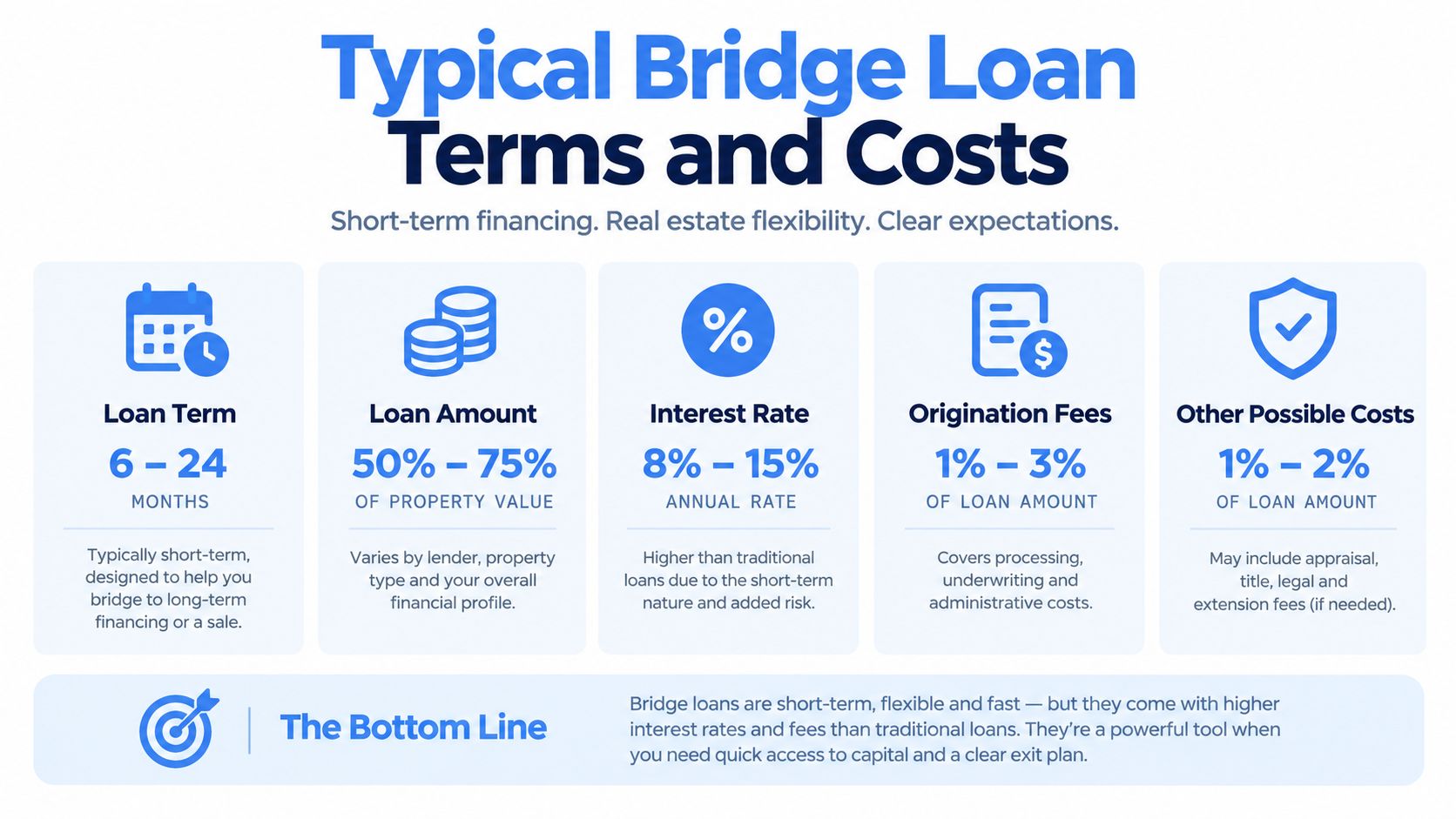
A bridge loan can help an investor close quickly, but that speed usually costs more than conventional mortgage debt. The interest rate is only one line on the term sheet. Points, lender fees, extension charges, and the final balloon payoff determine the true cost of carrying the property.
The main cost components
Bridge terms commonly run 6 to 24 months, matching the period between purchase, renovation, stabilization, refinance, or sale. One industry source describes rates in the 18% to 30% annual range and approvals that can close in 5 to 14 days. Those terms show how urgency and flexible, asset-focused underwriting affect pricing. Review bridge loan interest rates and pricing when comparing proposals.
A term sheet may include:
- Origination points: Reported ranges commonly fall around 1% to 5% of the loan amount, according to OfferMarket's bridge lending overview.
- Lender fees: Additional charges can include underwriting, processing, servicing, appraisal, legal, or draw fees. The documents should identify each fee and state when it is payable.
- Extension costs: If the loan passes its maturity date, the lender may charge an extension fee, raise the rate, or require additional reserves. The signed documents control the result.
- Balloon repayment: Interest-only payments cover the financing cost without reducing principal. The remaining balance is due when the bridge is refinanced or repaid through a sale.
A simple cost model
Suppose an investor takes a $400,000 bridge loan for six months at an 18% annual interest rate, with a 2% origination charge:
- Annual interest: $400,000 × 18% = $72,000
- Six months of interest: $72,000 ÷ 2 = $36,000
- Origination charge: $400,000 × 2% = $8,000
- Interest plus origination: $44,000
That $44,000 is not the complete financing cost. Legal work, appraisal charges, inspections, draw fees, servicing fees, and extension charges may add to it. The calculation also assumes the balance remains outstanding for exactly six months.
A delayed refinance adds another month of interest and may trigger an extension fee or a higher rate. Before closing, calculate the cost at the expected payoff date and at a later date. This exposes exit risk instead of treating the maturity date as certain.
Leverage changes your cash requirement
The amount required at closing depends on the lender's loan-to-value and loan-to-cost rules. For investor bridge financing, one common structure permits up to 95% loan-to-cost on the purchase price, up to 80% of after-repair value, and sometimes 100% of renovation costs, according to Kiavi's bridge loan guidance.
These figures do not apply automatically to every non-owner-occupied property. Location, condition, property type, borrower experience, and exit uncertainty can reduce the amount financed. Confirm whether the stated limit uses the purchase price, total project cost, current value, or after-repair value.
Model three outcomes before signing:
- Base case: The refinance or sale closes on schedule.
- Delayed exit: The balance remains outstanding for additional months and may incur extension charges.
- Adverse exit: The appraisal is lower, renovation costs rise, or permanent financing produces less cash than expected.
The practical question is whether available liquidity and the property's cash flow can support the balloon payoff if the exit takes longer or returns less. A bridge loan's rate and points matter, but the timing and reliability of the exit often determine the all-in result.
Bridge Loans vs Hard Money and HELOCs
Bridge loans and hard money loans can overlap, especially in private real estate lending. A lender may use either label for a short-term, asset-secured loan, so read the actual terms rather than relying on the product name.
A HELOC is different. It provides a revolving line secured by property equity, but availability for a non-owner-occupied investment property depends heavily on the lender, the property, and the borrower's financial profile.
Bridge Loan vs Hard Money vs HELOC at a Glance
| Criteria | Bridge Loan | Hard Money Loan | HELOC |
|---|---|---|---|
| Speed to close | Designed for faster transactions than traditional bank financing | Often fast, especially for asset-focused deals | Can be slower if a new line requires full underwriting |
| Typical term length | Short-term, often tied to a refinance, sale, or stabilization event | Short-term, commonly used for acquisitions or renovations | Revolving access rather than a fixed bridge maturity |
| Pricing | Higher than conventional mortgage debt because of speed and flexibility | Often higher-cost private financing, with terms based on risk | Often priced more favorably than private bridge debt when the borrower qualifies |
| Collateral | Usually the investment property and related equity | Usually the financed property, and sometimes additional collateral | Usually the property securing the line |
| Borrower qualification | Focuses heavily on property value, leverage, and exit plan | Asset value and project economics often carry significant weight | Income, credit, equity, and lender guidelines usually matter |
| Best-fit use case | A defined gap before permanent financing or sale | A purchase or renovation where conventional underwriting doesn't fit | Flexible access to existing equity when the borrower qualifies |
A bridge loan usually wins when the investment property must be acquired or refinanced quickly and the borrower has a defined next step. Hard money can fit a renovation or value-add project where the lender is comfortable with the property and the investor's plan, but the terms may resemble bridge financing closely.
A HELOC can be useful when an investor already has an approved line and wants flexible access to equity. It may not fit a time-sensitive purchase if the line isn't established, and some lenders limit or exclude investment properties. Borrowers should also confirm whether the line can remain open during a refinance or sale.
Decision guideline: If speed is the central problem on a non-owner-occupied property, bridge financing is often the more direct solution. If you can wait, qualify for conventional debt, and don't need transitional flexibility, permanent financing may cost less over time.
For a more focused comparison of available structures, review this guide to bridge loans versus HELOCs. The right choice depends on the property, the timing, and whether you can show exactly how the balance will be repaid.
How Bridge Loan Underwriting Works
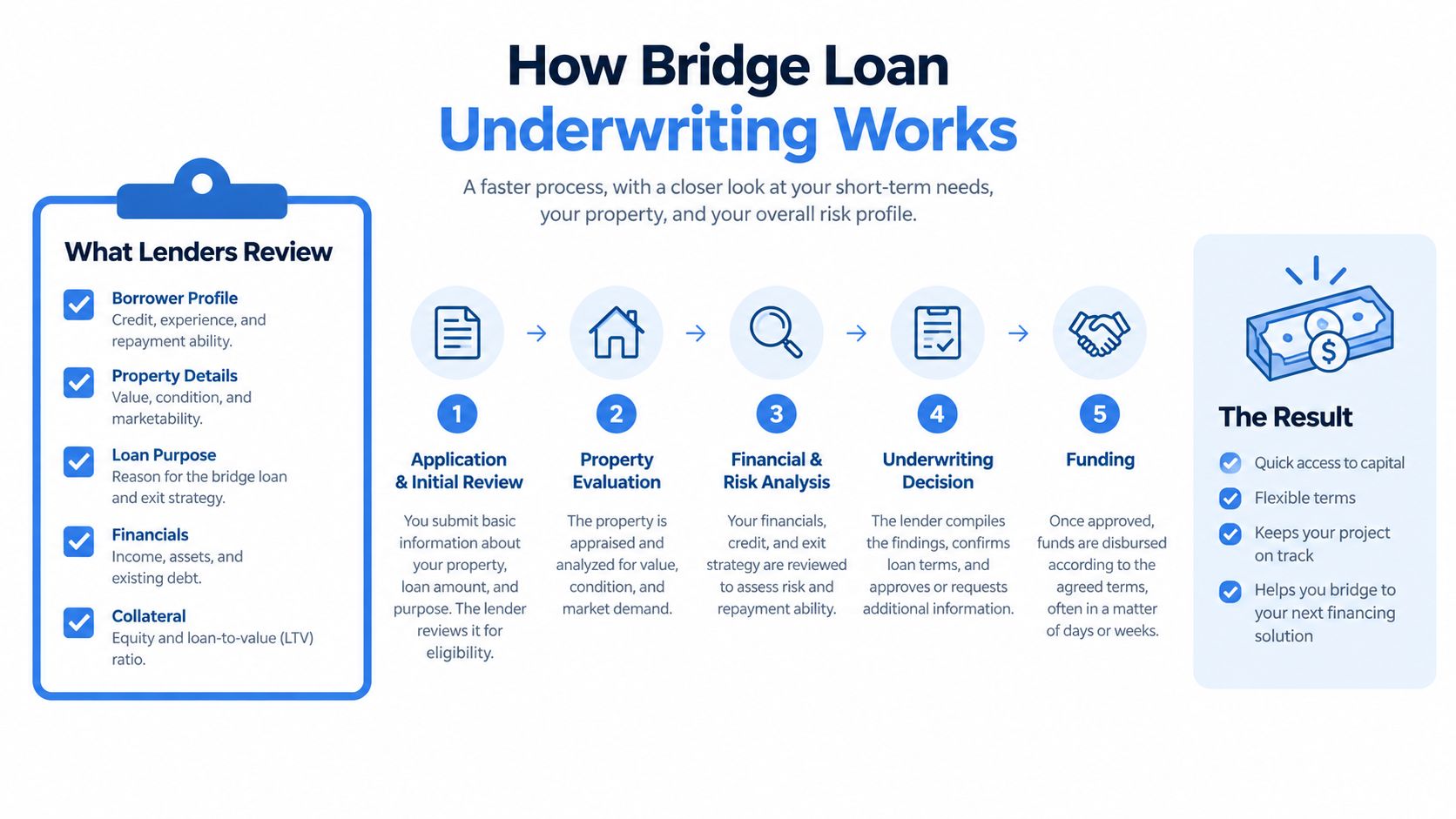
A lender reviewing a non-owner-occupied property is assessing more than the borrower's credit profile. The central question is whether the asset, the proposed work, and the repayment plan fit together well enough for the loan to be repaid.
What the lender reviews
Property value and condition establish the starting point. The lender examines what secures the loan today, how easily the property could be sold, and whether planned repairs or stabilization are likely to support the projected value. A vacant building, unfinished renovation, or uncertain marketability can change the terms.
Borrowing structure shows how much room the lender has if the plan runs into trouble. Loan-to-value compares the loan with the property's current value. Loan-to-cost considers the purchase and project costs. After-repair value estimates the property's value after specified improvements are completed.
Investor bridge financing may use structures allowing a high share of purchase costs, a substantial portion of projected after-repair value, and funding for the full renovation budget. Those limits are not automatic. The lender tests the property, budget, borrower contribution, and market assumptions before approving the final amount.
The exit plan receives the same close review. A lender may ask:
- Which permanent loan will repay the bridge?
- Will the property qualify for that loan after renovation or stabilization?
- What sale price supports the payoff if selling is the exit?
- How will you handle the debt if the appraisal is lower than expected?
- Do you have reserves for interest, taxes, insurance, repairs, and delays?
Underwriting is a stress test for the entire timeline. For example, a rental that needs repairs must still support the planned refinance after the work is finished. If the refinance depends on a higher appraisal or improved rent, the lender may ask what happens if either result arrives late or below forecast.
Prepare before you apply
Bring a purchase contract or refinance statement, property details, a renovation budget when applicable, rent information, insurance details, and a clear timeline. Include the proposed exit loan or sale strategy, rather than saying you will refinance later.
A lender may weigh personal tax returns differently from a conventional bank, but credit, experience, liquidity, and personal guarantees can still affect approval. Thin reserves, an unrealistic repair budget, unsupported value assumptions, unclear title, unresolved liens, or several uncertain exit events can weaken the request.
How LendingXpress Structures Bridge Loans
LendingXpress is a California-based private and hard money lender for bridge, fix-and-flip, and rental loans on residential and commercial investment properties. Its approach uses simple applications, common-sense underwriting, conservative loan-to-value standards, and closings in as little as three days.
Loan sizes range from $100,000 to $18 million or more. Loan officers shape terms around the purchase, renovation, stabilization, refinance, or sale plan. For a renovation, staged draws may finance up to 100% of rehab costs, subject to the property and transaction terms.
That structure can fit a non-owner-occupied property that is unfinished or cannot meet a bank's timeline. Treat the proposal like a whiteboard model: add the rate, points, reserves, draw requirements, extension provisions, and balloon payoff. Then test whether the planned sale or refinance can cover the full balance if work, appraisal, or timing falls short.
A Sundance Lending client success story from Salesmsg also shows why responsive communication matters when a transaction has a narrow closing window.

LendingXpress offers bridge financing for non-owner-occupied acquisitions, refinances, renovations, and cash-out transitions. Review the numbers, define the exit, and contact LendingXpress about the required structure and documents.