
Investment debt is borrowed money used to acquire or improve an income-producing asset, where the borrower keeps ownership and repays principal plus interest on a set schedule. In global markets, that financing world is huge, with $145.1 trillion in fixed-income markets outstanding in 2024 and $10.4 trillion in long-term fixed-income issuance that year, even after a broader 1.9% decline in long-term issuance to $27.4 trillion. (IMF and SIFMA figures)
You're probably not trying to become a bond theorist. You found a duplex, a rental, or a small commercial deal, and the question is simple, can you get the capital fast enough to make the opportunity work?
Investment Debt Explained in Plain English
A buyer spots a distressed duplex at a good price. The seller wants speed, another buyer is circling, and the bank says the file needs more time, more paperwork, or more income history than the borrower can comfortably show. That is the moment investment debt starts to make sense.
Investment debt means you borrow money to buy or improve a property you do not live in, then repay it with interest while keeping ownership of the asset. The lender makes a loan and earns interest through the repayment schedule. It does not take an ownership stake in the building. That is why investment debt sits in the debt side of the deal, while the borrower still controls the property.
Practical rule: If the deal lets you keep title while promising repayment from the property's cash flow, sale, or refinance, you are dealing with debt, not equity.
That difference matters because equity dilutes ownership. Debt does not. A borrower can use debt to control a larger asset with less cash upfront, which is why investors use it for acquisitions, rehab projects, and cash-out refinancing. The trade-off is simple, you accept repayment risk in exchange for speed and control.
The term also reaches beyond a single real estate loan. Debt securities are financial instruments that show a debt obligation, and governments, banks, and corporations use them to raise capital in markets. If you have heard people talk about bonds, mortgage-backed securities, or other tradable debt instruments, you are already in the same family of ideas.
If you want a broader real-estate financing overview, this guide on how to finance investment property is a useful next read.
For a first-time investor, the working definition is easy to remember. Investment debt is borrowed money tied to an income-producing asset, with ownership staying in the borrower's hands and repayment happening on a fixed schedule.
How Investment Debt Works in Practice
A first-time investor often meets investment debt at the closing table, not in a textbook. You find a property that needs work, the lender puts up the money, and your job is to pay that money back from rent, resale, or a refinance. It works a bit like a friend fronting cash for a house flip, except the lender is protected by the property and the loan documents, not trust alone.

The four moving parts in every deal
Principal is the amount you borrow. It covers the purchase, the renovation, or both, depending on how the loan is set up.
Interest is the cost of using that money. It is what the lender earns for taking time risk and repayment risk while the deal is in place.
Term is the loan's clock. Some loans are short and designed for a quick exit, while others give you more time to stabilize the property.
Collateral is what backs the loan. In real estate, that is usually the property itself, which gives the lender a claim if the borrower stops paying.
A simple way to read the deal is this. The lender wants to know what gets repaid, how fast it comes back, and what protects the loan if things go wrong.
That is why underwriting for investment debt looks different from underwriting for a primary residence. The lender cares about the property, the exit plan, the loan structure, and how much cushion exists if the sale price or refinance proceeds come in lower than expected. A borrower's paycheck can matter in some files, but it usually is not the whole story.
Private lenders also look at the broader market for the same reason investors do. Debt securities are a major part of capital markets, and the scale described in IMF and SIFMA market data shows how much money moves through debt-based financing across governments, banks, corporations, and real estate.
Reading a term sheet without getting lost
A term sheet starts to make sense once you translate it into plain English. You are checking how much you are borrowing, what it costs, how long you have the loan, and what secures it. If those pieces fit the deal, the financing can help you move. If they do not, the loan may look workable on paper and still be a bad fit in practice.
For investors comparing bank financing with private money, EndureGo Tax investor loan advice can help frame the questions that come up before you sign.
Common Types of Investment Debt for Real Estate
Not every loan works the same way, and that's the point. A borrower buying a stabilized rental has different needs from someone racing to close on a fixer, and a lender can structure the money around that difference.
| Loan Type | Typical Speed | Best For | Underwriting Focus |
|---|---|---|---|
| Conventional investment-property loan | Slower | Long-term rentals with strong borrower files | Income, credit, reserves, property strength |
| Portfolio loan | Moderate | Borrowers who want a lender to keep the loan in-house | Overall relationship, property quality, repayment ability |
| Bridge loan | Fast | Short-term acquisitions and repositioning deals | Exit plan, collateral, timing |
| Hard-money loan | Very fast | Fix-and-flip projects or deals with tight deadlines | Asset value, rehab scope, resale plan |
| Private debt fund | Fast to moderate | Borrowers needing direct, asset-backed capital outside public markets | Collateral, sponsor strength, structure |
Conventional loans usually fit borrowers who can present clean documentation and wait a little longer. Portfolio lenders can be more flexible because they hold the loan themselves, so the decision doesn't have to fit a one-size-fits-all agency box. Bridge loans and hard-money loans exist for speed, especially when a deal needs a fast close or a property needs work before it can qualify for permanent financing.
Private debt sits in the same family but often comes from funds rather than banks or public markets. Neutral market education sources describe private debt as direct lending, often secured by real estate or other tangible assets, and pooled debt funds are commonly used by accredited investors to access that market. For a plain-language comparison of how investors think about these structures, the EndureGo Tax investor loan advice page is a useful reference point.
Rule of thumb: The faster the close and the rougher the property, the more useful private or hard-money capital tends to be.
That doesn't make one option universally better. It means the best loan depends on the property, the timeline, and how much documentation the borrower can produce. A strong borrower with plenty of time may not need flexible capital. A buyer facing a deadline, a value-add project, or a non-conforming asset usually does.
Rates, LTVs, and How Underwriting Differs
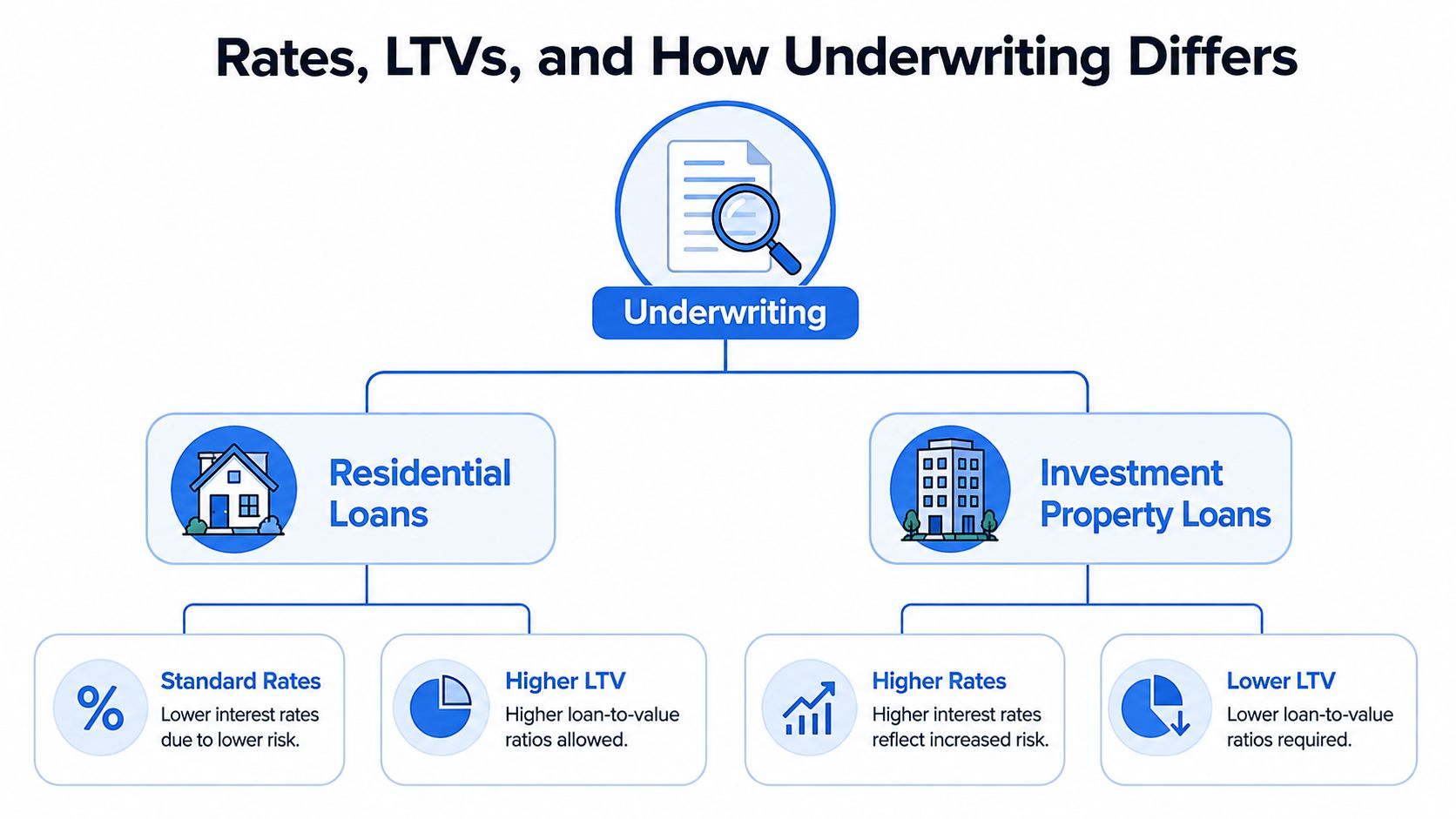
Rates and loan-to-value ratios are where new investors often get surprised. Investment-property loans usually cost more than loans on a primary home, and lenders usually advance a smaller share of value because the risk is higher and the exit depends on the deal performing well.
Why the numbers change
A lender looking at a rental or rehab project usually cares about the property's value, the borrower's experience, and the exit strategy. A bank making a loan on an owner-occupied home is usually more focused on personal income, debt-to-income ratios, and long-term affordability. Those are different questions, so the paperwork looks different too.
For investors, loan-to-value often tells the actual story. Rental loans commonly sit in a more conservative range than people expect, while fix-and-flip loans often use even tighter borrowing because the deal depends on resale and renovation execution. Hard-money and private lenders may stretch further than banks when the collateral is strong, but they still want a clear cushion between loan amount and property value.
What underwriters really want to see
When you're reviewing a term sheet, look for the following:
- Property strength. Does the asset itself support the loan?
- Exit plan. Will the borrower sell, refinance, or stabilize and hold?
- Borrower experience. Has this person completed similar projects before?
- Documentation quality. Are the numbers, rehab scope, and comps believable?
If you want a good way to think about the math, PropLab's LTC guide is a helpful companion because it explains how lenders evaluate loan-to-cost in a project context.
Private lenders often say yes when the story, the collateral, and the exit all line up, even if a bank doesn't like the borrower's paperwork.
That's the practical difference. Banks tend to prefer standard files. Private lenders are often willing to underwrite the asset and the plan more directly. For many real estate investors, that flexibility is the whole reason investment debt becomes useful.
Real-World Examples for Fix-and-Flip, Rental, and Cash-Out Deals
A fix-and-flip investor spots a tired single-family home, buys it quickly, and funds the rehab in stages as work gets done. The goal is to buy, improve, and sell quickly enough that the loan is repaid from the resale. In that setup, debt is a project tool, not a household budget item that stays around for years.
A rental investor takes a different route. She buys a duplex, gets it stabilized, and then shifts into longer-term financing after occupancy settles down. That loan is less about a quick sale and more about helping the property start acting like a durable income asset. The debt is doing its job if the borrower can move from short-term capital into a steadier structure without creating stress.
An experienced investor with equity in a paid-down rental may pull cash out to buy the next property. That is not borrowing for the sake of borrowing. It is a deliberate way to recycle capital into another income-producing asset while keeping the original property in the portfolio.
The same tool, different outcome
Investment debt is a toolbox, not a single product. A hammer, a drill, and a wrench can all help finish the job, but each one fits a different task. The result depends on how long the money stays in the deal, how clean the exit is, and whether the borrower is trying to create speed, stabilize income, or free up equity for the next purchase.
The property market matters too. If you are comparing markets before the next acquisition, it helps to compare top STR investment areas as part of the location screen, especially when short-term income is part of the plan.
Borrow fast for the right reason. Speed helps when it gets the deal done, but speed without a clean exit just creates pressure later.
A rehab loan can use staged draws. A rental loan can support acquisition and stabilization. A cash-out refinance can turn trapped equity into new buying power. The common thread is simple, the borrower is using debt to move an income-producing property forward, not to live in it.
Risks, Tax Treatment, and Common Misconceptions
Investment debt can help a deal work, but it can also create problems if the borrower treats it like free money. The main risks are easy to name and easy to underestimate. Default risk means the borrower can't repay on schedule. Interest-rate exposure means carrying costs can hurt if the loan isn't repaid or refinanced on time. Collateral risk means the property itself can be lost if the deal fails badly enough.
The tax question is where many investors get confused. A plain-language definition of investment indebtedness says the borrowing is used to acquire income-producing assets, and only certain interest may be deductible under the rules that apply in a given tax system. That's why people often ask whether debt tied to real estate, securities, or other investments qualifies, and why mixed-purpose borrowing gets messy fast. The answer is rarely as simple as “all interest is deductible.”
Three myths that cause bad decisions
- Myth one, all debt is the same. A loan on a primary residence and a loan on an investment property don't carry the same underwriting logic or tax treatment.
- Myth two, private lenders are always risky. Some private lenders are just faster and more asset-focused than banks, which can be exactly what a real estate investor needs.
- Myth three, more borrowing always improves returns. More borrowing can increase upside, but it also leaves less room for error when rehab costs rise, rents slip, or resale takes longer than planned.
A useful way to think about this is to separate the financing from the fantasy. Debt is not bad. Debt is a tool. But it only works if the cash flow, collateral, and exit can support it. That's why experienced investors care as much about downside protection as they do about acquisition speed.
The cleanest deals aren't the ones with the biggest loan. They're the ones where the debt matches the asset and the exit.
That mindset keeps borrowers from overreaching. It also helps them ask better questions about interest deductibility, refinancing, and whether a structure is built for a hold, a flip, or a cash-out strategy. If the answer isn't clear, the deal probably needs a closer look.
When a Private Lender Makes Sense and How to Prepare
A private lender makes sense when a bank's rules do not fit the deal. That usually shows up when a closing is tight, the property is non-conforming, the borrower does not fit standard income or seasoning rules, or speed protects the purchase price. In those situations, a lender like LendingXpress can structure bridge, fix-and-flip, and rental financing secured by residential or commercial assets, with terms built around the property instead of a rigid template.

Before you apply, get the deal package ready. A lender can move faster when the file is clean and the borrower looks organized.
What to have in hand
- Scope of work. Show the rehab plan in plain language, not just a rough guess.
- After-repair value comps. Support the future value with real comparable sales.
- Exit strategy. Explain whether you are selling, refinancing, or holding.
- Entity documents. Have the LLC or borrowing entity paperwork ready.
- Proof of reserves. Show you can handle carry costs and surprises.
If you want to see how a private lender organizes this part of the process, the private money lenders page lays out the basic approach in a straightforward way.
A video walkthrough can also help borrowers understand how a private loan fits into a real estate plan.
Private lending works best when the borrower can answer three questions quickly. What is the property worth? How does the loan get repaid? Why does the timeline justify this structure?
If you are still comparing opportunities, it helps to study the market alongside the financing. A useful place to start is this guide to compare top STR investment areas, especially if your next deal depends on rental demand or resale strength.
If you are sizing up a fix-and-flip, rental, or cash-out deal, LendingXpress can help you match the loan to the property instead of forcing the property into a bank's box. Visit LendingXpress to review your financing options and start a conversation about your next investment property.