
You can have a property that looks clean on paper and still hear “no” from the bank. The rent roll is steady, the borrower has a real plan, and the numbers seem to work, but the file still stalls because the lender's box is smaller than the deal. That's the part most brokers learn the hard way, and it's why commercial real estate underwriting matters more than the headline story of the asset.
Underwriting is where a lender decides whether the deal is financeable, not just attractive. The process is built around income, debt, repayment capacity, collateral quality, and borrower strength, and the OCC describes it as a detailed review of those elements, not a simple property valuation exercise (OCC commercial real estate lending handbook). If you understand how the desk thinks, you can structure a stronger file, move faster, and know when a private lender is the cleaner fit.
The Deal That Didn't Close (And Why)
A broker sends over a mid-market multifamily deal in California. The building is occupied, the sponsor has a believable plan, and the pro forma looks solid enough to keep the conversation moving. Then the conventional lender digs in, sees thin reserves, a sponsor profile that doesn't match its template, and a transition story that feels too optimistic for the risk the bank has to carry.
That is usually where the deal dies. The asset can look fine and still fail because the file does not answer the lender's real questions.

What the lender is really checking
Banks ask three questions fast. Can the property support the debt with room to spare, can the borrower execute, and does the collateral still hold up if the market shifts. If a deal is too tight on cash flow or depends on a perfect story, the file gets squeezed even when the sponsor thinks the upside is obvious.
That is why a profitable deal can still fail at the desk. A bank may like the asset and still reject the file because the income is not durable enough, the debt load is too high, or the borrower profile does not fit the loan box. In practice, a loan officer is usually looking for a repayment story that can survive stress, not just a pro forma that looks good on paper.
For brokers, the point is straightforward. Read the file the way the lender reads it, then decide whether the deal belongs with a bank or needs a different capital source. That is also where private money often becomes the cleaner path, because the underwriting can be more flexible when the deal is good but the bank's checklist gets in the way.
A lender still has to defend the loan internally, so cash flow has to make sense under pressure. If you need a way to frame that analysis, the article on how to calculate cap rate is a useful reference, and for forecasting discipline, the best files usually stay closer to direct to scenario-based models than to optimistic assumptions.
Core Metrics That Drive Every Underwriting Decision
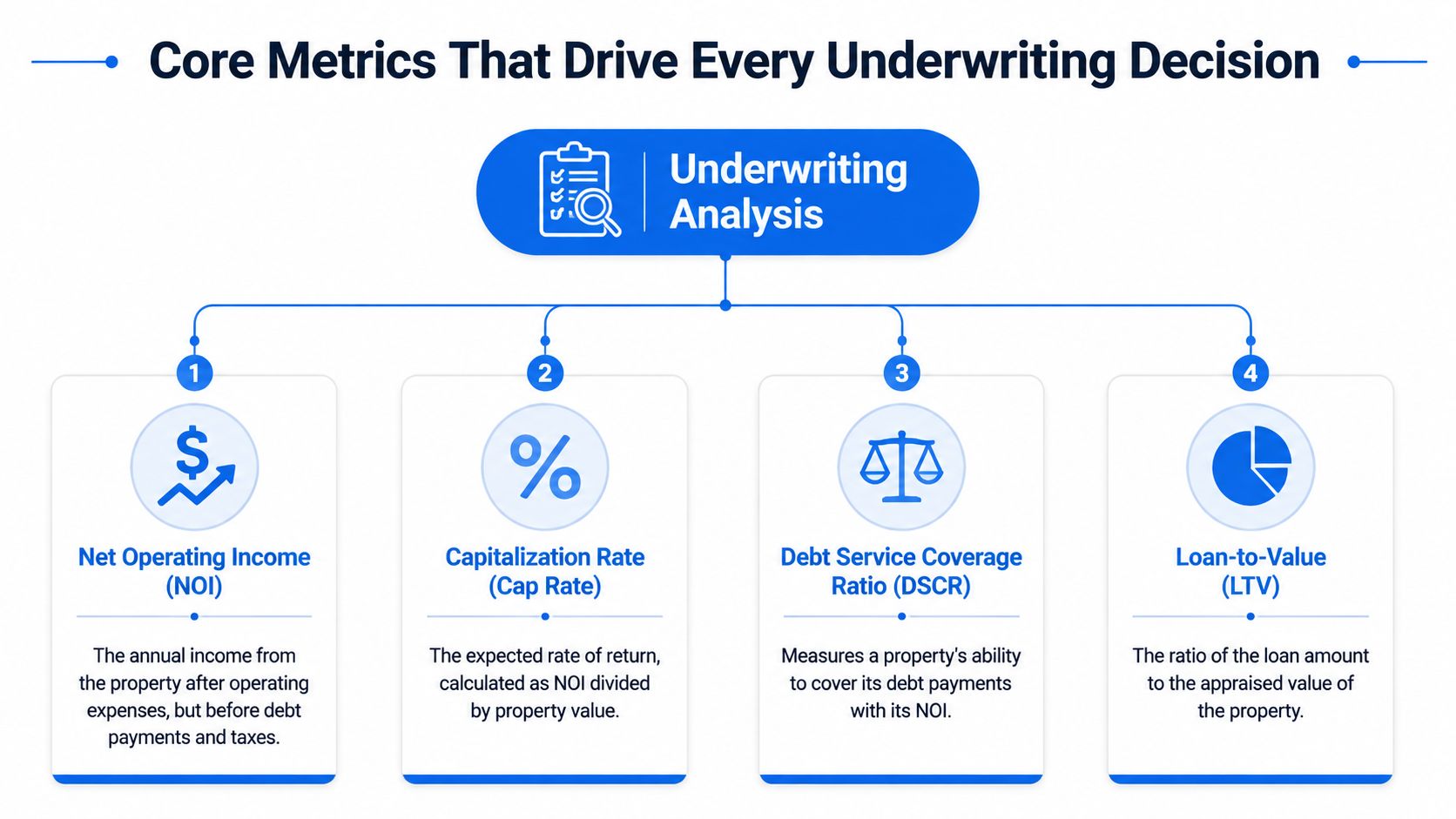
A lender does not need a dozen ratios to make a call. It needs a few numbers that answer different questions fast. NOI shows what the property throws off before debt. Cap rate connects that income to value. DSCR checks whether the property can pay the loan. LTV shows how much of the asset the lender is taking on.
NOI and cap rate
Net Operating Income, or NOI, is the property's income after operating expenses, before debt service and taxes. The formula stays simple, NOI = gross income minus operating expenses. If a property produces $220,000 in annual income and spends $90,000 on operating expenses, NOI comes out to $130,000.
Cap rate is the relationship between NOI and property value, calculated as NOI divided by purchase price. On a $2.5 million property with $130,000 of NOI, the cap rate is 5.2%. That number helps a lender judge pricing, but it does not answer the debt question by itself.
For a practical cap-rate reference, use this guide on how to calculate cap rate.
DSCR, LTV, and debt yield
DSCR is the lender's cash flow test. It is calculated as NOI divided by annual debt service. If annual debt service is $100,000, the deal above produces a 1.30x DSCR. That is the kind of ratio that can keep a stabilized deal in the running, even if the asset is not especially exciting.
LTV compares the loan amount to appraised value. Debt yield measures NOI against the loan amount, so it gives the lender a quick read on how much income backs the debt. These are the numbers that get compared side by side when a file goes through underwriting. A deal can look fine on one metric and still get trimmed on another if the structure looks thin.
A practical way to forecast those moving parts is through direct to scenario-based models. That approach helps borrowers see how the deal behaves when assumptions change, instead of assuming the first-year projection will hold.
Underwriters do not size debt from one number alone. They cross-check the ratios until the file hangs together. If expenses get normalized, income gets trimmed, or the exit looks softer than the sponsor expects, the deal can move from acceptable to marginal quickly.
Sample Underwriting Walkthrough
A $2.5 million stabilized multifamily acquisition in a California submarket is a good example because the deal looks familiar to most brokers. The asset is performing, the borrower wants conventional financing, and the question is whether the cash flow can carry the proposed debt without forcing the debt-to-equity ratio too high.
A simple pro forma
Start with a stripped-down income statement:
- Gross scheduled income: $240,000
- Vacancy and credit loss: $12,000
- Effective gross income: $228,000
- Operating expenses: $98,000
- NOI: $130,000
If the lender advances $1.75 million, the initial LTV is 70%. If annual debt service is $101,000, the DSCR is roughly 1.29x. That clears many stabilized benchmarks, but it doesn't leave a huge cushion if the property softens.
Stressing the deal
Now cut NOI by 15%. That takes NOI to $110,500. If debt service stays the same, DSCR falls to about 1.09x. If rates also rise by 200 basis points, the refinance picture gets worse because the exit debt service becomes harder to support, which is exactly why lenders care about the final loan-to-value and downside cases (PropertyMetrics underwriting guide).
| Sample Underwriting Summary | Baseline | Stressed (-15% NOI) |
|---|---|---|
| NOI | $130,000 | $110,500 |
| Annual Debt Service | $101,000 | $101,000 |
| DSCR | 1.29x | 1.09x |
| LTV | 70% | 70% |
That's the ultimate test. A deal can appear solid at closing yet remain vulnerable if the lender anticipates potential income declines, rising refinance rates, or overreliance on flawless execution. Institutional guidance has consistently indicated that commercial real estate loans are underwritten with substantial caution, incorporating historical data on debt yield and term structure, because default risk is genuine and ongoing (FDIC research paper).
The Underwriting Checklist and Template Framework
A file that is easy to follow usually gets a faster answer. Brokers who hand over a clean package save the lender from chasing missing documents, reworking assumptions, or guessing at the story behind the numbers.
A lender should be able to open the file and see the deal in order. If that is not possible, the review slows down, and weak points get more attention than they would in a tighter package. For a practical overview of how lenders organize their review, see this guide to commercial real estate financing options.
What to review first
Property and market basics. Confirm the asset type, location, occupancy, and local demand. Weak submarkets, thin tenant demand, or a property that does not fit the area create friction before the lender even reaches the model.
Income quality. Pull rent rolls, trailing statements, lease expirations, and any concession history. One-time adjustments matter because underwriters often normalize income before they size the loan, and that can change the actual borrowing capacity.
Physical condition. Deferred maintenance, capital needs, and inspection findings can change the credit story fast. If the file skips over the building's condition, the lender fills in the blanks with caution and usually assumes more risk than the borrower wants.
Loan structure. Match the program to the deal instead of forcing the deal into the wrong box. Term, amortization, reserves, and exit assumptions all need to fit the asset and the borrower's path to repayment.
Use this standard question: if the lender had to defend the file to credit committee, what would still worry them after they read the package?
A simple template structure
- Property address
- Purchase price
- Loan amount
- Interest rate
- Term
- LTV
- DSCR
- Cap rate
- Sponsor background
- Exit strategy
That structure keeps the file readable and shows where the risk sits. It also makes it easier to compare deals without rebuilding the analysis every time a new file comes across the desk.
A lot of brokers still underestimate how much clean documentation speeds a decision. The OCC treats underwriting as a review of the borrower, project, structure, and collateral, and a lender file should be built the same way.
Conventional versus Private and Hard-Money Underwriting
Conventional and CMBS lenders usually price tighter when the deal fits their box. Private and hard-money lenders usually step in when the box is the problem and the borrower needs the file judged on the asset and exit instead of on perfect sponsorship.
A broker who has handled both knows the trade-off. Bank money can be cheaper, but it asks for more proof, more patience, and a cleaner story. Private capital moves faster, but the rate, fees, and exit pressure usually reflect that speed.
Side-by-side trade-offs
| Dimension | Conventional / CMBS | Private / Hard Money |
|---|---|---|
| Speed | Slower, often tied to heavier review and third-party reports | Faster, with streamlined review |
| LTV | Typically more conservative | Often more flexible within the lender's risk box |
| Credit focus | Strong focus on borrower profile and documentation | More emphasis on the asset, equity, and exit |
| Flexibility | Lower, especially on transitional deals | Higher for unusual, time-sensitive, or non-bankable files |
| Best use case | Stable assets with clean paperwork and time to close | Bridge loans, value-add deals, fix-and-flip, and rentals that don't yet meet bank thresholds |
Conventional underwriting still tends to sit on conservative debt levels and coverage, and many lenders want stabilized cash flow, clean reporting, and a sponsor profile that does not raise questions. That works on seasoned assets with steady performance. It becomes a problem when the borrower needs speed, the property is still stabilizing, or the file has a few rough edges that bank credit will not ignore.
For a practical overview of different financing paths, see commercial real estate financing options.
How to choose the lane
If the deal is stabilized, the sponsor is seasoned, and time is on your side, conventional money usually makes sense. If the deal needs a quick close, has a transitional income story, or will not clear bank cash-flow thresholds yet, private lending is often the more realistic route.
LendingXpress is one option in that private-lending lane, because it structures bridge, fix-and-flip, and rental loans on non-owner-occupied property with asset-based underwriting. That matters when the bank wants a cleaner borrower file than the deal can produce.
A hard-money file is usually underwritten with a shorter lens. The lender still cares about repayment and collateral, but the decision can tilt more toward equity position, property condition, and the exit plan than toward long seasoning or a perfect operating history. That is why the same asset can be rejected by a conventional desk and accepted by a private lender with a different risk tolerance.
Insurance and damage exposure can also change the outcome. If the property has a loss history or a current claim issue, it helps to know how a claim is documented before the lender starts asking about risk transfer. A useful resource on that side is documenting a commercial property claim.
Private and hard-money underwriting is not loose underwriting. It is just a different filter, and the borrower who understands that filter can structure the request so the lender sees a clear exit, a believable collateral story, and enough equity to stay comfortable.
Mitigating Risk and Presenting a Strong File
Underwriting gets easier when the lender sees that you've already reduced the risk. More equity, stronger tenants, cleaner reserves, and better documentation all make the file feel financeable before anyone gets into committee.
What improves the file fast
- More equity in the deal. A stronger down payment gives the lender more cushion and gives you more credibility.
- Stable tenancy. Long-term leases and reliable tenant quality reduce rollover risk.
- Debt service reserves. Cash reserves show the borrower can absorb pressure without scrambling.
- Clean documentation. T-12s, rent rolls, estoppels, and inspection reports need to tell the same story.
The messy files usually fail at the soft edges. Sponsor credibility, tenant concentration, deferred capital, and market depth matter because they affect how repeatable the cash flow really is.
If the property has insurance issues or damage exposure, it helps to know how a claim is documented before the lender starts asking about risk transfer. A useful resource on that side is documenting a commercial property claim.
Lenders are usually more comfortable with a file that is slightly conservative and fully documented than one that is aggressive and hard to verify.
Climate and condition risk are also showing up more directly in underwriting. Coverage gaps, building condition, and catastrophe exposure can all influence insurability and financing viability, especially in markets exposed to wildfire, flood, hurricane, or severe storm risk (Cape Analytics on condition underwriting). If you're packaging a deal in a risk-sensitive market, address that upfront instead of waiting for the lender to find it.
Key Takeaways for Brokers and Investors
Commercial real estate underwriting is ratio-driven, but the ratios only work when the file is clean and believable. A deal that looks profitable can still fail if the lender can't defend the income, the financing, the sponsor, or the exit.
Conventional lending isn't the only path. When the property is good but the bank won't bend, private lending exists for exactly that gap. Speed, flexibility, and structure often matter more than chasing the lowest rate.
The strongest files are the most realistic ones. If the sponsor story, rent roll, reserves, and exit plan all line up, the lender can say yes faster. That's true whether the loan is banked or private.
LendingXpress works with brokers and investors who need financing on non-owner-occupied properties and want a faster underwriting path when traditional lenders get stuck. The process is built for practical execution, and closings can move in as little as three days when the file is ready.
If you've got a deal that makes sense but doesn't fit a conventional box, LendingXpress can review the structure, the collateral, and the exit plan without wasting time on a dead-end bank process. Visit LendingXpress to connect with a loan officer and see how the file would be evaluated.