
Most investors ask for the renovation loan interest rate first. That sounds sensible, but it's often how expensive rehab financing gets approved. A rate that looks attractive can cost more when the lender charges interest on undrawn funds, delays draws, adds inspection fees, or gives you no practical extension path.
For a non-owner-occupied property, the useful question is different: What will this capital cost from closing through completion and exit? That calculation includes the note rate, APR, points, draw mechanics, fees, carrying period, budget risk, and the reliability of the sale or refinance.
The difference matters because renovation financing is tied to a moving mortgage market, changing property values, and construction execution. The same loan category can become materially more or less expensive across an economic cycle. Investors who compare only the advertised percentage often miss the costs that affect returns most.
Why the Advertised Rate Is the Wrong Number to Chase
The lowest renovation loan interest rate can produce the highest project cost. For a non-owner-occupied investment property, the useful measure is the dollars required to fund construction, carry the debt, and reach sale or refinance.
A 2025 survey found that 47% of U.S. homeowners would borrow for a renovation, but the financing choices were divided. 13% planned to use a HELOC, 10% a home-equity loan, 10% a credit card, 7% a personal loan, and only 4% a cash-out refinance, so a single “average renovation loan rate” offers little guidance for an investor (survey details).
Term length can outweigh the headline percentage. An 8.5% HELOC on a $20,000 draw over five years produces approximately $4,500 in interest, while a 12% personal loan over three years produces roughly $3,900. The personal loan, however, requires payments of about $664 per month. The lower total interest comes from faster repayment, not from the lower rate.
The comparison investors should actually make
Before accepting a term sheet, calculate the project's full borrowing cost:
- Total interest: Apply the rate to the balance actually outstanding across the expected draw and repayment timeline.
- Financing fees: Include points, appraisal and underwriting charges, draw fees, inspection fees, and extension costs.
- Unused capital cost: Confirm whether interest applies to the entire commitment or only to funds already advanced.
- Exit timing: Model payoff at sale or refinance instead of relying only on the scheduled maturity date.
- Delay exposure: Test the cost of permit problems, labor shortages, inspection delays, and material overruns.
A slightly higher rate may protect more profit if the lender releases draws promptly and handles approved budget changes without avoidable delays. A cheaper quote can become expensive when slow funding extends interest, utilities, taxes, insurance, and other carrying costs.
Practical rule: Compare the dollars needed to complete and exit the project, not the percentage printed at the top of the quote.
What a Renovation Loan Interest Rate Really Means
Think of the rate as the rental price of money. The note rate is the stated interest percentage used to calculate interest under the loan agreement. It may be fixed for the term or may change under an adjustable structure.
The APR adds certain finance charges to the cost calculation, giving you a broader comparison than the note rate alone. It still may not capture every project-specific cost, especially charges tied to draws, inspections, extensions, or delays. For an investor, the most useful figure is often a project-level total cost calculation that runs from closing to payoff.
The terms that affect your real payment
- Fixed rate: The interest percentage stays stable under the agreement. This makes carrying costs easier to forecast.
- Variable rate: The rate can change under the loan terms. It may provide an attractive starting point, but the investor must test the effect of future adjustments.
- Points: Upfront charges generally expressed as a percentage of the loan amount. They reduce the apparent rate only if the borrower keeps the loan long enough to recover the cost.
- Interest-only payment: The borrower pays interest without reducing principal during the stated period. This can preserve cash during construction, but the balance remains outstanding.
- Committed capital: The total amount the lender has agreed to make available.
- Drawn capital: The portion advanced for completed work.
Fannie Mae states that its HomeStyle Renovation mortgage can have rates lower than a HELOC, personal loan, or other more costly alternatives. The product supports 15-year and 30-year fixed-rate mortgages, along with eligible adjustable-rate mortgages (Fannie Mae HomeStyle information).
That comparison doesn't automatically make an agency product suitable for a non-owner-occupied investor. Eligibility, valuation, borrowing capacity, property type, contractor controls, and completion requirements still determine whether the product fits the deal.
The most useful term-sheet question is simple: “Do I pay interest on the full commitment or only on funds advanced?” That answer can matter more than a small difference in the quoted note rate.
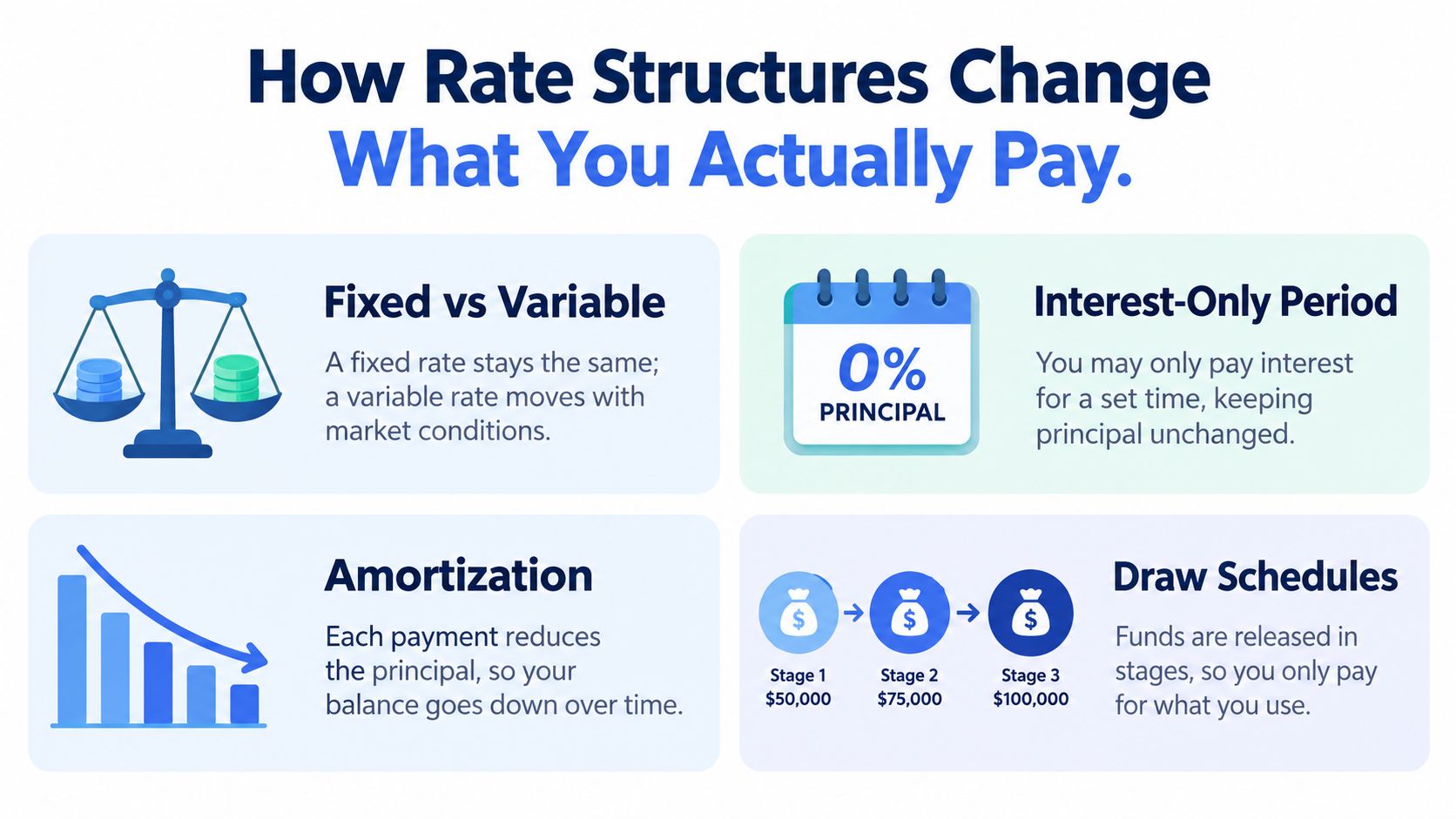
The mechanics become clearer when you separate the rate from the way the lender releases and collects money.
How Rate Structures Change What You Actually Pay
Two loans can carry the same renovation loan interest rate and produce different returns because their structures differ. Fixed versus variable pricing affects predictability. Interest-only terms affect monthly cash flow. Amortization affects how quickly principal falls. Draw schedules determine how much capital is costing you before the project needs it.
Fixed and variable pricing
A fixed structure gives you a clearer carrying-cost forecast. That matters when the exit depends on a sale price, refinance approval, or rental stabilization. A variable structure can work when the project is expected to finish quickly, but the underwriting should include a rate-change scenario rather than assuming the opening rate lasts through payoff.
Interest-only periods
Interest-only payments can be useful during a rehab because project cash is needed for labor, materials, insurance, taxes, and unexpected repairs. The trade-off is that the principal doesn't decline. If the sale takes longer, the investor continues paying interest on the same balance and may also face extension charges.
Amortization
An amortizing loan reduces principal with scheduled payments. That can lower the balance over time, but it also increases the monthly payment during a period when the property may not produce income. For a vacant or partially completed asset, preserving liquidity may be more valuable than rapid principal reduction.
Draw schedules
Staged draws align financing with construction progress. A lender may release funds after inspections or verified milestones rather than handing over the entire renovation budget at closing. That can reduce interest on idle capital, but draw delays can slow contractors and create their own cost.
Ask for the draw calendar before you compare rates. A cheaper loan that releases funds late can be more expensive than a higher-rate loan that keeps the project moving.
The practical benchmark is the total annualized cost through completion, measured against the expected draw schedule and exit date. A lower nominal rate can be economically inferior when the lender adds large points, inspection fees, extension fees, or interest on undrawn funds (Fannie Mae renovation financing guidance).
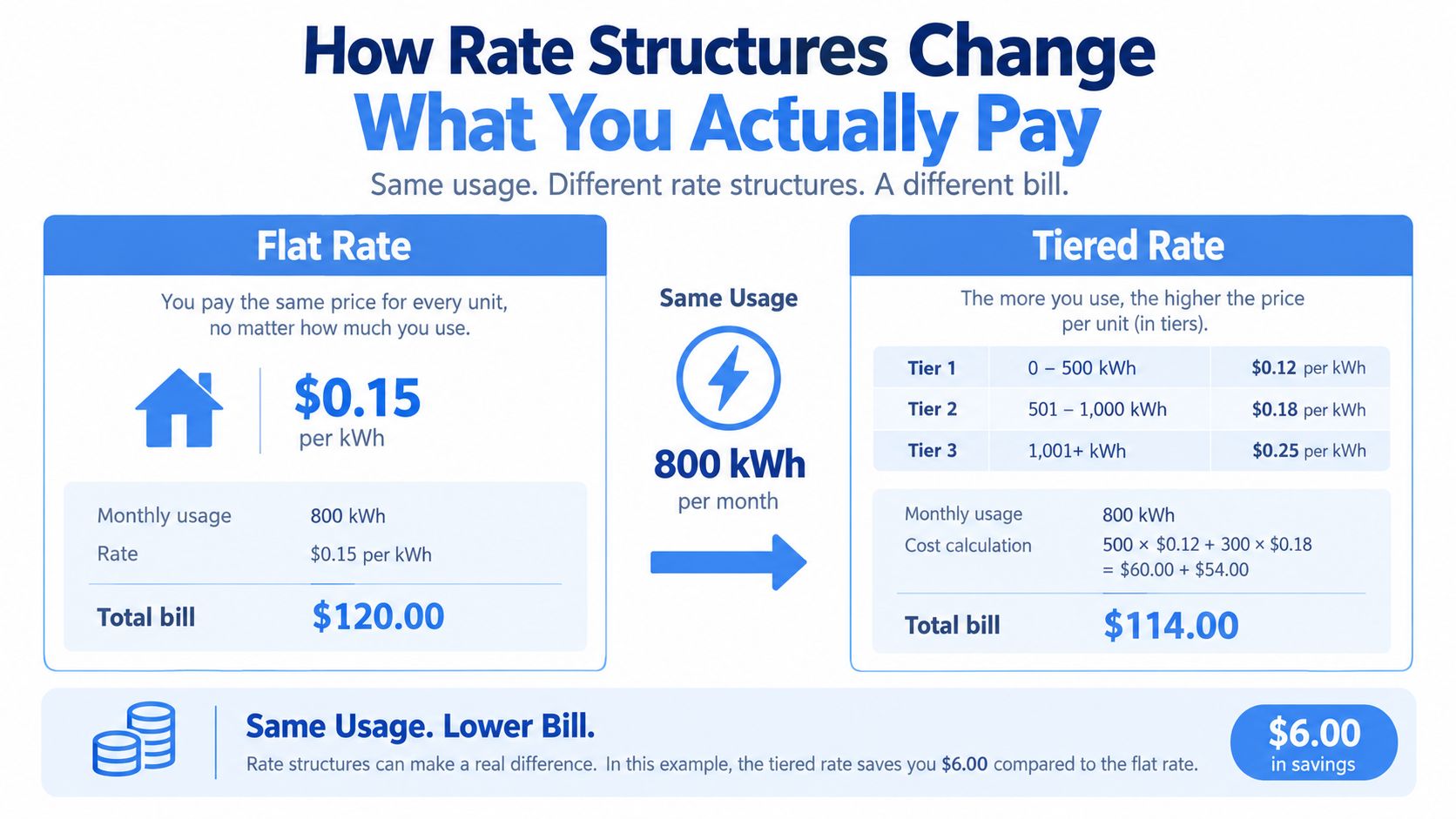
Run the calculation at three points: the expected completion date, a delayed completion, and the payoff date after the property is sold or refinanced. That approach exposes the cost of a draw structure that looks efficient only on paper.
Comparing Conventional, FHA, and Private Renovation Financing
The right financing route depends first on whether the property is owner-occupied. For a non-owner-occupied investment, FHA 203(k) usually isn't the answer. HUD states that investment properties aren't eligible for FHA insurance, and standard 203(k) rules require at least one borrower to occupy the property within 60 days and intend to remain for at least one year (HUD 203(k) handbook).
Conventional renovation programs can be more relevant, but they still impose valuation, property, and completion controls. Freddie Mac's CHOICEReno program allows fixed-rate or adjustable-rate mortgages for one-unit investment properties, with a published maximum LTV of 90% for the listed fixed-rate and adjustable-rate structure and 85% for 7/1 and 10/1 ARMs. It requires renovation work to be completed within 450 days of the note date (Freddie Mac CHOICEReno fact sheet).
Renovation financing options compared
| Financing Type | Max LTV / Leverage | Rate Structure | Key Investor Constraint |
|---|---|---|---|
| Fannie Mae HomeStyle Renovation | Renovation component subject to a 75% as-completed value test in key transaction types | Fixed-rate and eligible adjustable-rate structures | Agency eligibility, appraisal, contractor, and draw controls |
| Freddie Mac CHOICEReno | Up to 90% for listed fixed-rate and adjustable-rate structures, 85% for 7/1 and 10/1 ARMs | Fixed-rate or adjustable-rate | One-unit investment property rules and 450-day completion deadline |
| FHA 203(k) | Not generally available for non-owner-occupied investment property | FHA-insured structure | Occupancy requirement and investment-property exclusion |
| Private or hard-money rehab loan | Set by lender underwriting and collateral strength | Often short-term, fixed or adjustable by agreement | Higher pricing may be offset by speed, flexibility, and tailored draws |
Private financing fits where agency ceilings, occupancy rules, property condition, or closing speed prevent a conventional execution. The trade-off is that investors must inspect the full fee schedule and extension language carefully. Flexibility has value, but it isn't free.
Investors and brokers evaluating project funding can also review practical options for financing your dream kitchen, especially when separating the renovation scope from the investment property's broader financing plan.
What Actually Drives Your Renovation Loan Interest Rate
Lenders price the project's risk, not only the borrower's profile. The same investor may receive different renovation loan terms for two properties because one has clearer value, a simpler scope, a stronger contractor, or a more dependable exit.
Loan-to-value and after-repair value anchor the analysis. The lender needs confidence that the completed property will support the debt. If the appraisal is uncertain, the lender may reduce proceeds, require more equity, add reserves, or raise the rate.
The main pricing inputs
- After-repair value: Comparable sales, location, current condition, and the proposed finished product shape the lender's view of the collateral.
- Borrowing level: More debt leaves less equity protecting the lender if the project underperforms.
- Borrower profile: Credit history, liquidity, experience, and repayment capacity affect execution risk.
- Scope complexity: Structural work, additions, major systems, and uncertain permitting create more risk than a defined cosmetic renovation.
- Contractor quality: A documented contractor with a realistic budget and schedule gives the lender better visibility.
- Permits and plans: Missing approvals can delay draws and completion, increasing the lender's carrying exposure.
- Exit strategy: A credible sale or refinance plan reduces uncertainty around repayment.
Fannie Mae's HomeStyle Renovation rules limit renovation costs on a purchase to 75% of the lesser of the combined purchase price plus renovation costs or the property's as-completed appraised value. For a refinance, the renovation amount is limited by the applicable as-completed value test (Fannie Mae eligibility rules).
Consider a rental purchased for $300,000 with $100,000 in planned renovations. The combined project cost is $400,000. Applying the 75% test produces a $300,000 reference limit before other underwriting requirements. An optimistic value estimate does not guarantee funding for the full project.
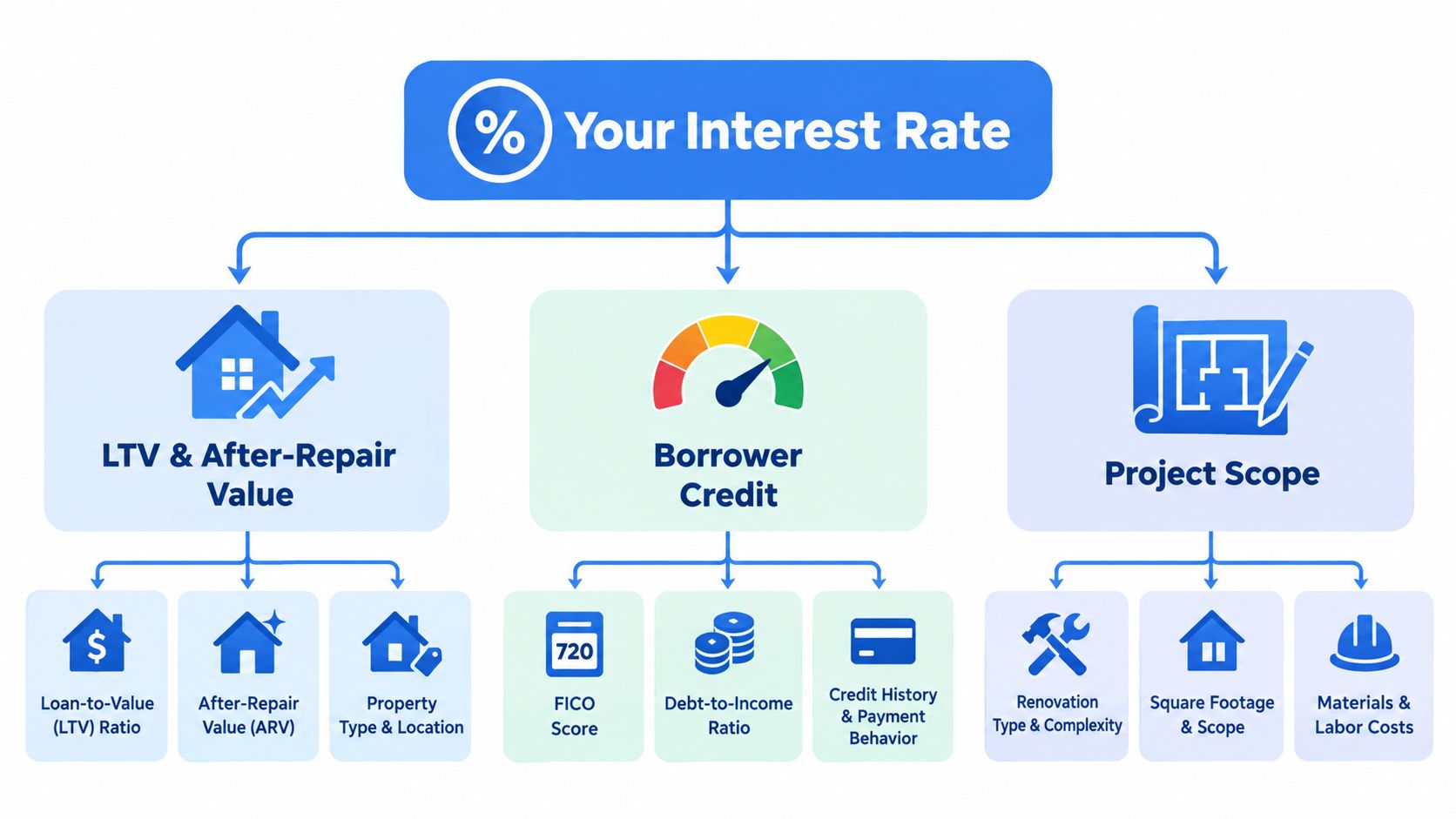
A strong application connects the property, budget, staged draw milestones, contingency, borrower liquidity, and exit in one coherent package. That clarity can reduce uncertainty before the lender sets pricing.
Real Project Scenarios and the True Cost of Borrowing
A rate comparison becomes useful only after you place it inside a project timeline. The same renovation loan interest rate can produce a manageable cost on an on-time rehab and a damaging cost when work stalls, draws lag, or the sale moves out.
Start with a simple model. List each expected draw, the date it should be advanced, the interest charged on that balance, and every fee due before payoff. Then run an on-time scenario, a delayed scenario, and a budget-overrun scenario.
Scenario one on-time completion
Suppose an investor receives renovation funds in staged draws. The first draw covers early work, later draws follow inspections, and the property reaches completion on schedule. If interest applies only to drawn funds, the investor avoids paying for capital that hasn't yet been used. The financing cost is tied to the actual construction curve rather than the full approved commitment.
That structure can preserve cash during the early phase. It also makes the draw process critical. A delayed inspection or incomplete draw package can interrupt labor even when the approved capital is available.
Scenario two a delayed and over-budget project
Now use the same project with completion taking six months longer and the budget increasing by 15%, the stress case investors should model before closing. The effective cost rises when interest continues during the delay, the borrower draws additional funds, extension fees apply, or the delayed sale pushes the payoff date further out.
A lender that charges interest on the full commitment creates a different result from one that charges only on advanced funds. An extension that changes pricing creates another. The note rate hasn't necessarily changed, but the project-level cost has.
A 2025 homeowner survey reported that 73% used personal savings for renovations and 54% relied exclusively on savings. Americans were projected to spend about $608 billion on remodeling in 2025, nearly 50% above pre-pandemic levels. Those figures show substantial renovation demand, but they don't remove the need to model execution risk (renovation financing survey and projection).
Use this renovation cost estimating guide to build a line-item budget before comparing loan offers. Your spreadsheet should show interest, points, inspection charges, draw fees, extension charges, taxes, insurance, and the carrying cost of a delayed exit.
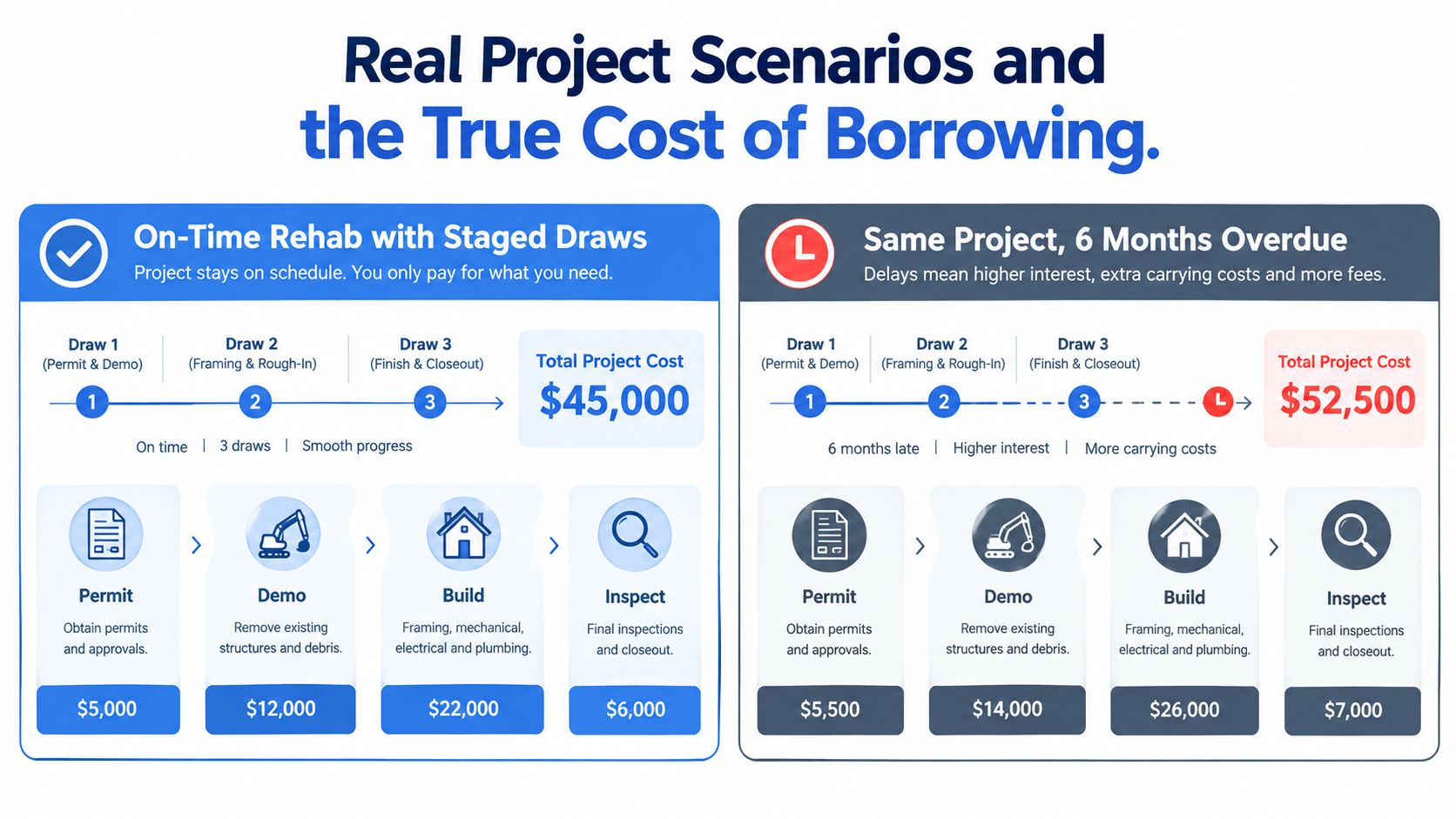
The winning quote is the one that remains workable when the project behaves like a real project, not the one that works only if every draw, inspection, contractor, and closing occurs perfectly.
How to Negotiate a Better Renovation Loan Rate
Lenders can price a clear deal more confidently than a vague one. The fastest way to improve approval certainty is to remove unanswered questions before underwriting begins.
Start with a complete project file:
- Line-item budget: Separate labor, materials, permits, appliances, contingencies, and soft costs.
- Plans and permits: Show what has been designed, submitted, approved, or still requires action.
- Contractor documentation: Provide bids, insurance, licensing information where applicable, references, and a schedule tied to payment milestones.
- As-completed valuation: Support the projected finished value with relevant comparable sales and a realistic finish level.
- Liquidity evidence: Show the cash available for equity, closing costs, reserves, and unexpected work.
- Exit plan: Explain whether repayment comes from a sale, refinance, rental stabilization, or another defined source.
A lender may still price a short-term private loan differently from an agency mortgage, but strong documentation reduces information gaps. It can help the lender decide faster and may support better terms, pricing, or conditions.
Negotiate the structure, not just the percentage
Ask whether the lender will waive or reduce draw fees, how quickly inspections are scheduled, and whether unused funds accrue interest. Confirm the extension pricing before you need an extension. A low initial rate won't protect the deal if the extension terms are punitive.
Also ask how budget changes are handled. If a cost overrun requires a new approval each time, the project may lose time. A lender that can review a documented change order promptly may be more useful than one with a slightly lower rate but rigid administration.
LendingXpress is one private lending option for non-owner-occupied investment properties, offering bridge, fix-and-flip, and rental financing with staged draws and the ability to finance up to 100% of eligible rehab costs, subject to underwriting. The relevant comparison is still the complete term sheet, including rate, fees, loan amount, draw timing, and extension terms.
Choosing the Right Lending Partner for Your Rehab Project
Choose the financing structure after you understand the project timeline, not before. A short cosmetic rehab, a full repositioning, and a delayed stabilization project have different needs for draw speed, payment structure, reserves, and exit flexibility.
Your final comparison should answer five questions:
- What rate structure applies? Fixed, variable, or subject to a future adjustment?
- When does interest begin? At closing, on committed funds, or only after each draw?
- What fees apply? Include points, inspections, appraisals, draws, extensions, and payoff charges.
- What happens if the project slips? Review extension pricing, maturity, and change-order procedures.
- Does the lender understand the exit? The property, renovation budget, and repayment plan should be evaluated together.
For a practical overview of the application process, review how to get a renovation loan. The goal isn't to find a universally low rate. It's to secure capital that arrives when the project needs it, costs what your pro forma can support, and remains workable if construction takes longer than planned.
A responsive lending partner should discuss the scope, valuation, draws, reserves, and exit before quoting a number. That approach gives investors and brokers a clearer basis for protecting project returns.
LendingXpress structures private bridge, fix-and-flip, rental, and rehab financing for non-owner-occupied properties, including staged draws and funding for up to 100% of eligible renovation costs, subject to approval. Visit LendingXpress to discuss your property, budget, timeline, and exit strategy with a lending team that can evaluate the whole deal rather than the rate alone.