
The seller wants a firm closing date, but your bank still needs a rent history the property doesn't have. You can see the investment opportunity: finish the work, bring in tenants, then refinance. The immediate problem is finding financing that fits the property today without creating a repayment problem later.
For non-owner-occupied real estate, bridge loan requirements come down to more than credit and collateral. The strongest application shows how you'll repay the loan, how much cash you can contribute, and how renovation funding will reach the project when you need it.
Why a Deal Can Stall Before the Bank Says Yes
Consider an investor buying a vacant rental property that needs repairs before tenants can move in. The seller won't wait for a lengthy financing process, and the bank wants operating history that reflects the finished property. The investor has a workable business plan, but the property isn't yet ready for the permanent loan.
That's a financing mismatch, not necessarily a bad acquisition. A recently purchased commercial building, an unfinished rental renovation, or a property awaiting lease-up can present the same problem. Federal commercial real estate guidance calls for lenders to examine property cash flow, borrower equity, feasibility, and repayment capacity, rather than value alone, as outlined in the interagency commercial real estate underwriting guidance.
Separate a timing problem from a funding problem
A private bridge can help when the property needs to change before it qualifies for longer-term financing. It can't make an unsupported purchase price sensible or replace cash the borrower doesn't have.
Before pursuing speed, identify what's holding up the transaction:
- Property condition: Does the building need repairs before it can generate qualifying rent?
- Operating history: Are the projected rents supported, even though the current statements don't reflect them?
- Borrower circumstances: Is there a credit event, including a prior foreclosure, that needs a clear explanation?
- Available capital: Can you fund your contribution without using the same money twice for closing and renovations?
Don't assume every bank or private lender treats these issues identically. Ask which conditions prevent approval and which can be addressed through documentation, additional equity, or a different structure.
Practical rule: A bridge should solve a temporary financing gap, not conceal an unresolved shortage of money.
Give the lender a transaction to evaluate
A useful initial conversation starts with the property, purchase terms, intended improvements, available cash, and repayment event. Those details let a loan officer assess fit instead of guessing from a requested loan amount.
A vague promise to refinance later doesn't explain whether the transaction works. A responsive lending partner needs to understand what will make the property financeable, what it will cost to get there, and who will cover the difference if the original plan slips.
How a Bridge Loan Actually Works
A bridge loan carries an investment property from its current condition to a defined next stage. Think of a temporary crossing: it needs to remain usable until the permanent route is ready. It isn't intended to become the permanent route itself.
The European Systemic Risk Board's description of bridging loans identifies them as generally non-amortizing real estate loans, used to facilitate a transaction, with maturities generally no longer than two years and described as non-renewable. For an investor, that means the sale or permanent financing milestone needs to be achievable within roughly that window, not merely desirable.
The basic relationship between the loan and its repayment paths looks like this.

Understand what remains due
With a non-amortizing structure, scheduled payments don't gradually eliminate the principal balance. Even when the borrower makes every required interest payment, the outstanding principal still needs a repayment source at maturity.
That's the important difference from longer-term amortizing financing. The underwriting question isn't only whether you can carry the payment. It's whether you can complete the transaction that pays off the balance.
Read the proposed terms with that distinction in mind:
- Interest-only payments: Confirm the payment calculation and whether interest is paid monthly or supported by a reserve.
- Minimum-interest provisions: Ask whether an early sale still triggers a minimum interest obligation.
- Reserves: Determine which funds are held back and how that changes usable proceeds.
- Extension conditions: Understand any contractual option without assuming another term will be available.
These are potential structural features, not terms every lender offers. An extension clause deserves particular attention because an available option may still require fees, satisfactory performance, or other conditions.
Match the loan to an achievable milestone
For a rental investment, the target may be completed repairs and enough supported rental income to qualify for permanent financing. For a resale project, it may be finished construction followed by a completed sale.
Closing is the beginning of the obligation, not proof that the financing plan succeeded. Work backward from the required payoff date, leaving room for the lender, buyer, appraiser, and closing process that must follow the physical work.
The Exit Plan Lenders Stress Test First
The key approval test is whether the repayment event survives a setback. Strong credit and substantial equity help, but neither identifies where the payoff money will come from.
Xero's bridge-loan guidance recommends a defined repayment event and warns that interest, origination fees, extension charges, late fees, and default costs can change the economics. A useful stress test includes a three- to six-month delay, rather than assuming every construction, leasing, and closing date holds.
Use the following checklist to organize the evidence behind your exit.
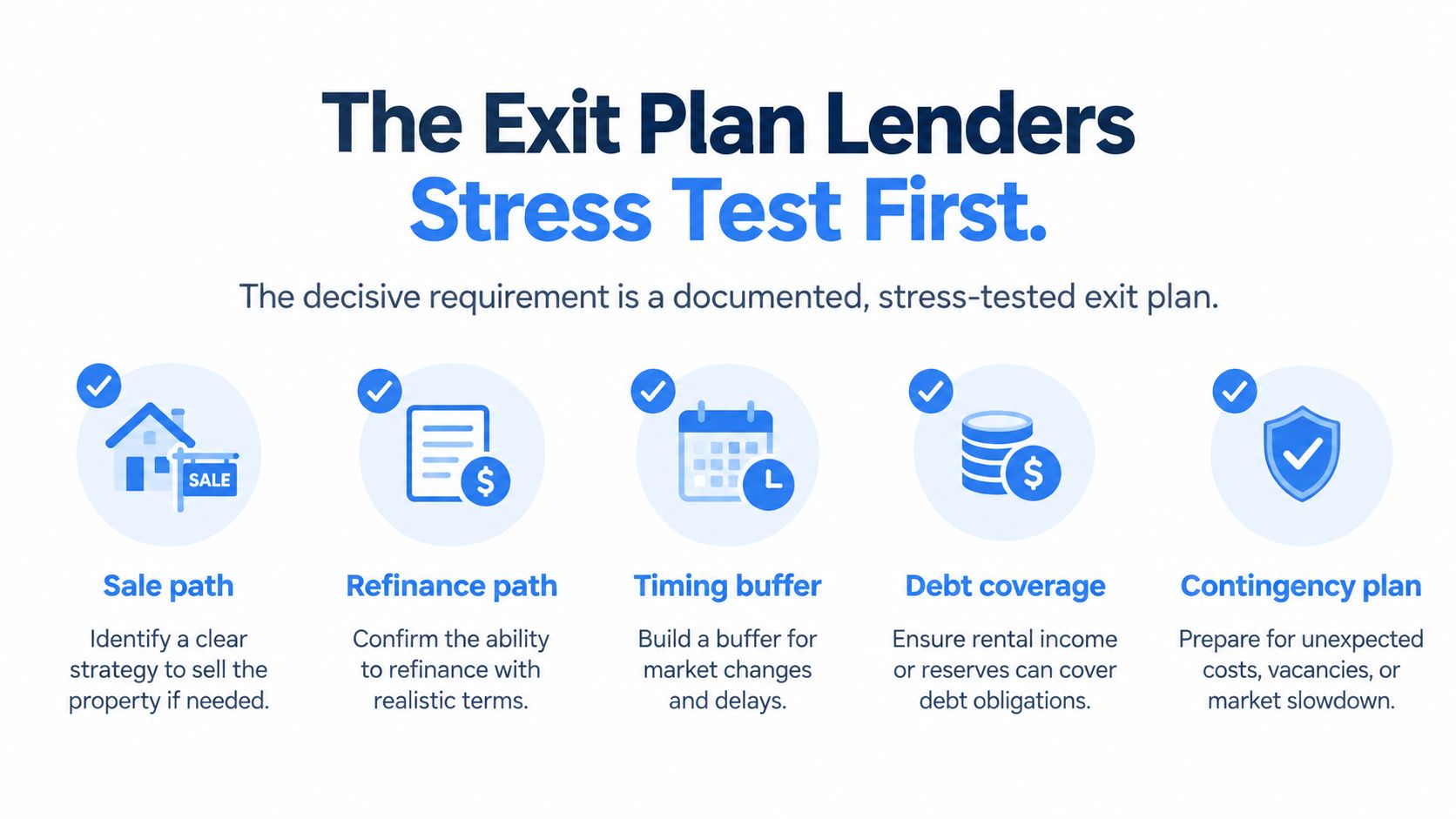
Write an exit memo before ordering the appraisal
Keep the memo short enough for someone unfamiliar with the property to follow. Attach support instead of filling the page with optimistic assumptions.
- Primary repayment event: Name the intended takeout lender, or describe the sale strategy and likely buyer.
- Qualification evidence: Identify the condition, income, valuation, and borrower requirements that permanent financing will require.
- Closing calendar: Include realistic marketing, buyer diligence, appraisal, and escrow time.
- Backup funds: Explain what cash or other repayment source is available if the primary exit fails.
- Downside case: Show how you'll fund the additional holding period and any resulting costs.
A named lender isn't the same as an approval. Distinguish an introductory conversation from a reviewed financing proposal, and identify conditions that remain unresolved.
Follow the delay through to repayment
Consider a rental rehabilitation intended for a refinance. The contractor finishes late, leasing begins later than expected, and the property doesn't have the income evidence the permanent lender requires. The renovation may still create value, but the borrower can't assume that value alone produces a refinance.
The better response isn't to request more time. It's to show which funds cover the extra carrying costs, what must happen before the replacement lender can close, and whether a sale remains a workable alternative.
A backup refinance isn't independent protection if it depends on the same rent and appraisal assumptions as the original refinance.
For additional context on the financing discussion, watch the following video.
Don't treat a fee estimate as fixed when the project schedule is uncertain. Ask the lender to explain the contractual cost of delay, then include that exposure in your decision before committing additional equity.
Credit Experience and the File to Prepare
A file can look strong on paper and still stall when the lender cannot verify the cash, project scope, or borrower's role. For a non-owner-occupied deal, approval depends on more than a high credit score or headline LTV. The lender needs a stress-tested repayment plan and a credible account of how rehab funds will be released as work progresses.
Federal guidance identifies borrower investment, net worth, valuation, property cash flow, and debt-service coverage as underwriting controls to assess together. The Federal Reserve's commercial real estate risk-management guidance explains why collateral alone does not establish a sound loan.

Build a file someone else can verify
Use this loan documentation requirements checklist to assemble a clear submission. Keep current records together, and mark estimates and projections so they cannot be mistaken for completed results.
- Transaction documents: Provide the purchase contract or current payoff information, property address, and purpose of the financing.
- Ownership records: Include entity documents and identify who is authorized to sign.
- Property evidence: Gather photos, valuation support, title information, insurance, and details about the property's condition.
- Income records: Submit rent rolls and operating statements. Label proposed rents and expenses as projections.
- Project materials: Provide the scope of work, contractor bids, schedule, and applicable permits. Make clear which work is funded at closing and which depends on later draws.
- Financial support: Include liquidity evidence, financial statements, and a sources-and-uses schedule showing how each funding need will be covered.
Reconcile the sources-and-uses schedule. It should account for acquisition or payoff costs, improvements, financing expenses, reserves, and borrower cash. An unexplained amount under “miscellaneous” leaves the lender guessing about whether the project is fully funded.
Explain credit and experience directly
If your credit history includes a problem, state what happened and what has changed. Asset-focused underwriting does not mean the lender will ignore credit, and a single issue does not automatically end the discussion.
Describe comparable projects you have completed, your role, and who will manage this job. If this rehab is outside your experience, identify the contractor and management support in place. The lender is assessing execution capacity, not confidence alone.
Liquidity is different from net worth. Property equity can strengthen your financial profile, but accessible cash pays contractors and covers holding costs. Show how much cash is available for the borrower contribution and how you will fund the work between rehab draws. A staged draw plan should match the work schedule, so the project does not rely on funds arriving before the lender's conditions are met.
LTV Rules That Set Your Cash at Closing
A seller may accept your offer before the lender confirms how much cash the loan will provide. Loan-to-value, or LTV, compares the loan amount with the value of the property securing it, and sometimes with acceptable additional collateral. A high headline LTV does not replace a workable exit plan: the lender still needs to see how the project will repay and whether the borrower can cover costs the loan does not fund.
The OCC's commercial real estate lending handbook sets out supervisory LTV ceilings of 65% for raw land, 75% for land development, and 80% for commercial, multifamily, and other nonresidential construction.
Supervisory LTV Ceilings by Property Type
| Property type | Supervisory LTV ceiling |
|---|---|
| Raw land | 65% |
| Land development | 75% |
| Commercial, multifamily, and other nonresidential construction | 80% |
These are supervisory benchmarks, not promised bridge-loan terms. A private lender may set a lower limit after reviewing the property, market, borrower, and repayment plan.
Apply the ceiling without mistaking it for proceeds
Under the handbook's framework, an $1,000,000 commercial property at an 80% ceiling implies no more than $800,000 of credit, before lender-specific adjustments, reserves, or other collateral. That example is not a universal advance rate for commercial buildings.
The loan-to-value ratio explanation may help clarify the calculation, but your closing cash depends on the actual sources and uses. Ask the loan officer to show the valuation basis and proceeds calculation separately. Approved credit and money available to pay the seller are not always the same: reserves or other allocations reduce usable acquisition proceeds.
Ask what value the lender will use
Before signing a purchase contract or waiving financing protections, get answers on:
- Valuation basis: Does the lender use the purchase price, appraised value, or the lower of the two?
- Existing debt: Which liens must be paid off, and how will that affect the loan?
- Additional collateral: Will the lender accept it, and how will it be valued?
- Cash requirement: Which costs must you pay outside the loan?
A lender may structure a deal that a conventional application cannot accommodate, but flexibility does not remove the equity requirement. A lower loan amount means more cash due at closing. It can also leave room if the appraisal comes in below expectations. Compare the total cash needed and the repayment exposure, not just the advertised percentage. A stress-tested exit and enough accessible equity to carry the deal matter more than a headline LTV.
Rehab Draws and As-Complete Value
Consider a vacant rental with an approved renovation scope. The borrower has contractor bids and a completion schedule, but approval of the rehab budget doesn't mean the lender releases all that money at closing.
Under the Federal Reserve's interagency real estate lending guidelines, when a loan finances multiple project phases, the applicable supervisory LTV limit follows the final phase financed, while disbursements shouldn't exceed actual development or construction outlays. That supports staged draws, with funds released against approved progress rather than an unrestricted renovation payment.
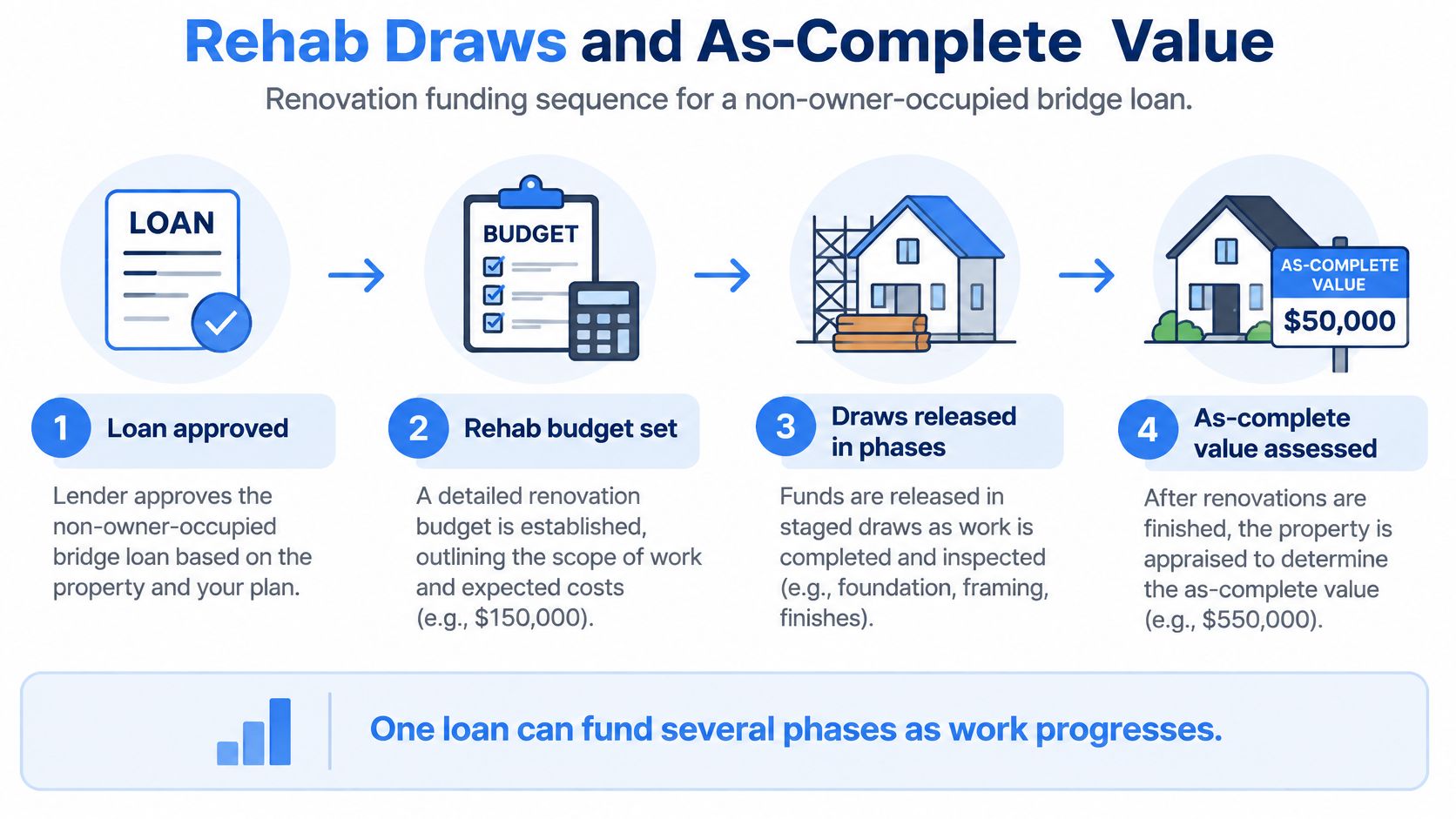
Follow the money through the work
The contractor completes an approved portion of the rental renovation. The borrower submits the required invoices or progress evidence, the lender verifies the work under the agreed procedure, and the corresponding draw becomes available.
The borrower needs to know whether that process reimburses money already spent or provides funding before the next stage begins. Those arrangements create different cash demands, even when the approved rehab budget is identical.
Before signing: Match the contractor's payment schedule to the lender's draw schedule. An approved budget won't solve a payment-timing mismatch.
Ask practical questions before construction starts:
- Release conditions: What inspection, invoice, lien waiver, or completion evidence is required?
- Processing sequence: Who requests the inspection, reviews the package, and authorizes payment?
- Change orders: How are scope changes approved, and who funds costs outside the original budget?
- Contingency: What accessible funds remain available for overruns or delayed reimbursement?
Keep future value separate from completed work
An as-complete valuation estimates the finished property's value. It doesn't prove that the contractor will finish within budget or that tenants or buyers will arrive on schedule.
The Basel specialized-lending framework recognizes that debt-service coverage isn't relevant during construction and instead considers project economics, debt, equity, and repayment assumptions. That distinction matters when current property income can't support the project.
Staged funding gives the lender control over exposure while allowing the borrower to access capital as work progresses. A renovation-focused private lender may finance a substantial share of the approved work, but the inspection and release mechanics still need to fit how the contractor operates.
How to Choose a Private Bridge Lender
A renovation deal can look financeable on paper and still miss its closing date if the lender cannot explain its conditions or how funds will reach the project. Choose a lender whose process fits the property, the contractor's schedule, and the repayment plan, not just one advertising fast funding.
A bank may suit a property that already supports permanent financing and a transaction with time for the bank's process. Private lending may fit a transitional investment that needs an asset-focused review. Either way, approval depends on a credible exit, and speed may come at the cost of more borrower equity or different terms.
Test the execution process
Speak directly with the person responsible for your file. Ask what could delay closing and which approvals are still outstanding.
- Speed with conditions: What must be complete before the proposed closing date is realistic?
- Transparent proceeds: Request a written breakdown of borrower cash, retained funds, fees, and usable proceeds.
- Workable rehab funding: Confirm that the loan structure and draw timing fit the project's cash needs.
- Clear responsibility: Find out who handles valuation questions, title issues, and proposed term changes.
A lender who identifies a problem early can help you avoid committing to a deal you cannot finish. Be cautious if the discussion centers on the headline loan amount but leaves funding conditions unclear.
Compare the offering with your actual deal
LendingXpress is a California private and hard-money lender for residential and commercial investment property. Its published financing profile describes loans commonly from $100,000 to $18 million or more, closings in as little as three days, financing of up to 100% of rehab costs through staged draws, and more than $558 million originated. Those figures describe the company's stated offering, not a guaranteed result for an individual file.
The lender offers acquisition, refinance, and cash-out financing, with common-sense underwriting and conservative loan-to-value ratios. Treat those features as points to compare with your deal, not promises about timing, loan size, or structure.
Start discussions before contingency dates become urgent. Send the purchase contract or refinance purpose, a concise exit memo, a sources-and-uses sketch, and the rehab scope. The lender can then assess the full transaction, including how the exit holds up if work or resale takes longer than expected.
LendingXpress offers private bridge financing for non-owner-occupied investment properties, including deals requiring renovation funding or a faster closing process. Visit LendingXpress to discuss your property, available equity, repayment plan, and draw requirements with a loan officer before your next contract deadline.