
Cash-out refinance loan-to-value, or LTV, is the new loan amount divided by the property's current appraised value. For example, a $450,000 loan on a $600,000 property has a 75% LTV. For a one-unit investment property, the usual cap is 75%; for a two-to-four-unit rental, it is 70%.
The cap sets the maximum loan size. It does not tell you whether refinancing makes financial sense. A lower LTV may leave more equity in the property, yet refinancing can replace the rate on the entire first-mortgage balance just to access some cash. If the existing rate is low and the cash need is modest, even a small rate increase on that larger balance can outweigh the benefit. Compare the added borrowing cost with the cash you expect to receive.
To estimate cash available, subtract the old loan payoff, any prepayment penalty, and closing costs from the new loan amount. The appraisal establishes the value used in the calculation; the cap limits the loan. This guide focuses on non-owner-occupied properties. Owner-occupied figures are included only as a reference, since rental-property limits are tighter. If a bank loan stalls or the rate comparison does not work, a private loan may still be an option. Check the numbers before choosing a structure.
Cash-Out LTV Limits for Investment and Owner-Occupied Properties
A cash-out refinance on a one-unit investment property is typically capped at 75% loan-to-value. A two-to-four-unit investment property is typically capped at 70%. Those figures come from Fannie Mae's published eligibility matrix. They are the first numbers to write down, before payoff math or rate shopping.
On a $600,000 valuation, 75% supports a new mortgage of $450,000. At 70%, the ceiling is $420,000. If the investor still owed $300,000, gross equity extraction would be about $150,000 at 75% or $120,000 at 70%, before transaction costs, reserves, and other loan-level requirements.
| Property type | Max cash-out LTV | New loan on $600,000 value | Notes |
|---|---|---|---|
| Owner-occupied, one unit (traditional benchmark) | 80% | $480,000 | Reference only; this guide covers non-owner-occupied property |
| Investment property, one unit | 75% | $450,000 | Fannie Mae eligibility matrix cap |
| Investment property, two to four units | 70% | $420,000 | Fannie Mae eligibility matrix cap |
| Private or hard money cash-out, investment | Set case by case | Sized to the file | Depends on borrower, property condition and exit plan |
The same matrix lists a 75% cash-out limit for a one-unit principal residence and an 85% limit in another listed principal-residence cash-out category. Occupancy and program structure change the borrowing power a lot. The traditional 80% owner-occupied ceiling is only a reference row here. This guide is about rentals, not a home you live in.
Why the market number is smaller than the cap
In the first half of 2024, the average conventional cash-out refinance extracted $93,000, equal to 24% of the average total property value, according to Freddie Mac's refinance trend research. Borrowers aren't routinely borrowing up to the printed maximum. They're taking a slice.
These percentages are ceilings, not a promise that your file will clear them.
Credit score, debt-to-income ratio, property condition, appraisal quality, subordinate liens, loan size, and documentation can all cut the permitted amount. The 70% to 75% band is the institutional benchmark for rental cash-out. It isn't a universal rule at every lender.
Check the cap for your property type and unit count before you run any other math. A one-unit rental and a fourplex don't share a fill line, and guessing the wrong one wastes the rest of the afternoon.
How Cash-Out LTV Is Calculated Step by Step
Cash out refinance loan to value is calculated in four steps: find the property's current value, add the requested cash to the existing mortgage payoff, divide the new loan by the value, then compare the result with the lender's cap.
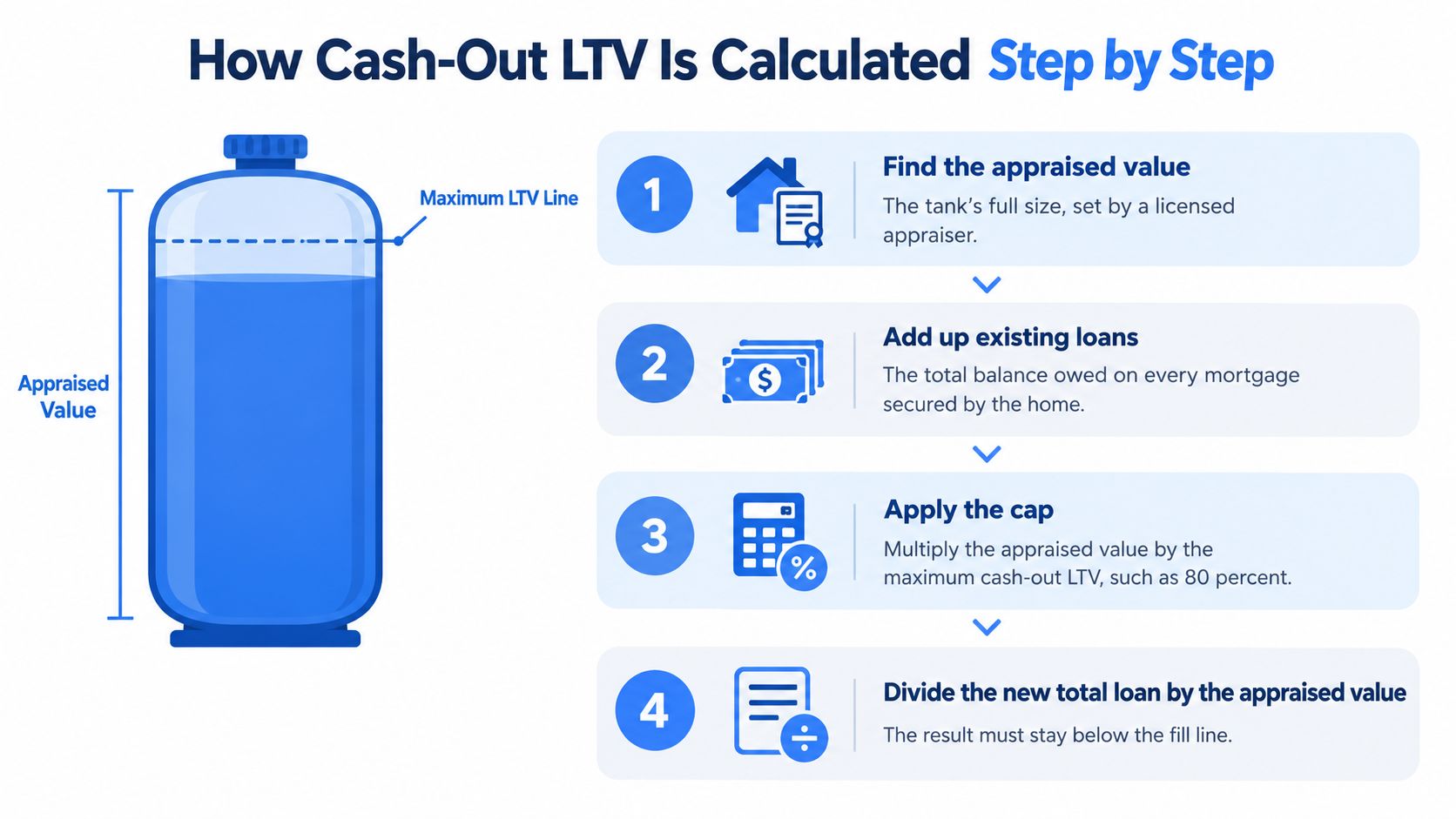
The formula is new mortgage balance ÷ current appraised value = LTV. A Federal Reserve Bank of Philadelphia working paper notes that cash-out proceeds are typically capped so the new mortgage does not exceed 80% of the home's value. That figure is a conventional reference point, not necessarily the limit for a rental.
- Get today's value. Use the current appraisal, not the price paid years ago. In this example, the property is worth $500,000.
- Build the new loan. Add the cash requested to the existing mortgage payoff. For example, a $250,000 payoff plus $150,000 in cash produces a $400,000 new loan, before closing costs and other adjustments.
- Divide. Divide the new loan by the appraised value. A $400,000 loan on a $500,000 property equals 80% LTV.
- Check the cap. Compare that result with the limit for the property and loan program. If the lender's cap is lower, reduce the cash request until the loan fits.
How common the cash-out choice is
In its analysis of 776,981 refinanced mortgages, the Philadelphia Fed study found that about two out of five refinances were cash-out loans, with a reported share of 41.50%. Borrowers used the refinance to withdraw equity rather than only change their rate or loan term.
A common math error is using the old mortgage balance as the numerator. That balance is just the payoff. The lender compares the entire new loan, including the cash taken out, with the appraised value.
The maximum LTV is only one part of the decision. For example, an 80% result may fit a reference cap, but refinancing can also replace a low rate on the full mortgage balance. Compare the cost of that new rate with the cash you expect to receive, and calculate the break-even point before deciding how much equity to withdraw.
What Pushes an Investment Property's Limit Lower
A $30,000 lower appraisal cuts a 75% cap by $22,500. That is why an investment property's cash-out limit depends on both the allowed percentage and the value used in the calculation. Lenders may set tighter limits for rentals than for owner-occupied homes.
The cap on a specific loan file reflects the property's details and the borrower's finances. A lower limit in any one area can reduce the approved amount.
- Occupancy and unit count. Investment properties and multi-unit buildings generally have tighter caps than principal residences. A two-to-four-unit rental starts from a 70% cap, rather than the one-unit investment limit.
- Credit score. A lower score may move a borrower into a lower loan-to-value band or raise the loan's price, even if the property could support a larger balance.
- Debt-to-income and rental income proof. Limited documentation can reduce the approved amount. Lenders may ask for leases, a rent roll, and records that show the borrower's debts and rental income. Review the rental property loan requirements before focusing only on the ratio.
- Property condition and appraisal quality. An outdated report, weak comparable sales, or a disputed value can lower the appraised amount used in the calculation. At a 75% cap, each $1,000 reduction in value cuts the maximum gross loan by $750.
- Subordinate liens. Second mortgages and home equity lines count toward combined loan-to-value. The first mortgage is not the only claim against the property's equity.
- Loan size and cash reserves. Larger loans and limited reserves may prompt closer review. A substantial cash request with little money left in the bank can be harder to approve.
When two limits stack
For a two-unit property, a weak appraisal lowers both the percentage and the value, so the cash shrinks twice. For example, a 70% cap applied to a lower appraisal produces a smaller maximum loan than either change alone.
Ask the lender which factor is setting the limit on your file. A thin rent roll calls for stronger income records, while a low appraisal may require a valuation review.
Worked Cash-Out Examples on a $600,000 Property
The same property value can leave different amounts of cash depending on the payoff and the applicable cap. For a clearer comparison, use a $600,000 appraisal and a $360,000 payoff. At a 75% cap, the gross loan is $450,000, leaving $90,000 before costs. At a 70% cap, the gross loan is $420,000, leaving $60,000. These are two different-sized slices from the same pie.

The chart illustrates three refinance scenarios using different property values and loan balances. The table applies the same basic subtraction to four cap and payoff combinations. The 80% owner-occupied figure is included only as a benchmark, while the investment examples use their respective caps.
| Scenario | Gross new loan | Payoff | Cash before costs | Cash after $15,000 costs |
|---|---|---|---|---|
| One-unit investment at 75% | $450,000 | $360,000 | $90,000 | $75,000 |
| Two-to-four-unit investment at 70% | $420,000 | $360,000 | $60,000 | $45,000 |
| Owner-occupied benchmark at 80% | $480,000 | $360,000 | $120,000 | $105,000 |
| One-unit investment at 75%, lower payoff | $450,000 | $330,000 | $120,000 | $105,000 |
What comes out before you hold the check
The cap sets the largest gross loan, not the check you receive. Subtract the existing payoff, any prepayment penalty, closing costs, prepaid items, and required escrows to estimate usable cash. Fannie Mae's cash-out refinance rules apply a related limit to delayed financing. Even a cash purchase must be supported by records of the original investment and eligible financing costs, and the loan must meet the applicable LTV, CLTV, and HCLTV limits based on the current appraisal.
Now test a lower appraisal. If the $600,000 value comes in $30,000 lower, the 75% ceiling falls by $22,500. That can reduce the cash available dollar for dollar, like trimming the top off a measuring cup before you pour.
Use the same order with your own figures: multiply the appraised value by the cap, then subtract the payoff, penalties, costs, and prepaids. The remainder is a planning estimate, not a guaranteed check. A short walk-through explains the same subtraction in order.
Why Rate Premiums Can Outweigh Extra Cash
The larger the first mortgage, the more a modest rate increase can cost over time. Replacing the whole loan to reach a smaller amount of cash is like changing the price on every item in a cart to buy one more item.

The Philadelphia Fed's 2026 analysis reports that cash-out refinance rates are typically about 0.125 to 0.625 percentage points above rate-and-term refinance rates, depending on credit score and loan-to-value. That premium applies to the full new balance, not just the cash you receive. Compare current cash-out refinance rates with the rate on your existing mortgage, then calculate the added cost across the entire balance.
A break-even test before you give up the old rate
- Price the full balance. Estimate the yearly cost of the higher rate on the new loan, then include points and any prepayment penalty.
- Price the cash's use. Compare that cost with the expected value of the proceeds, such as renovation gains or interest saved by paying off higher-rate debt.
- Test the payment under stress. Check whether you could manage it if rates change or rental income falls for a few months.
For example, renovation proceeds may add value to a property, while paying off expensive debt may reduce interest costs. Those benefits can help offset the higher mortgage cost. Cash spent on consumption usually creates no financial return to offset that added expense.
Large-bank cash-out refinance volume increased from $8.39 billion in the second quarter of 2025 to $11.33 billion in the second quarter of 2026, according to the Philadelphia Fed's analysis of FRED figures. The increase shows that more cash-out loans were originated at large banks over that period. For each borrower, though, the key calculation is still the cost of replacing the existing mortgage.
A smaller LTV can reduce the amount borrowed, but it does not erase the cost of repricing the first mortgage. If the cash need is modest, preserving the existing rate may be the better financial choice.
Compare other ways to access funds before refinancing the entire balance. A second lien, portfolio loan, staged draw, or waiting until improvements raise the property's value may let you keep the existing first-mortgage rate. The cap sets the possible loan size. The break-even test shows whether the extra cash is worth the price.
How Private Lenders Structure Cash-Out Deals
A private lender underwrites the exit first and the borrower second. Banks often begin with W-2 income and a long amortization schedule. Private lenders focus first on the property, how the loan will be repaid, and how quickly the file can close.
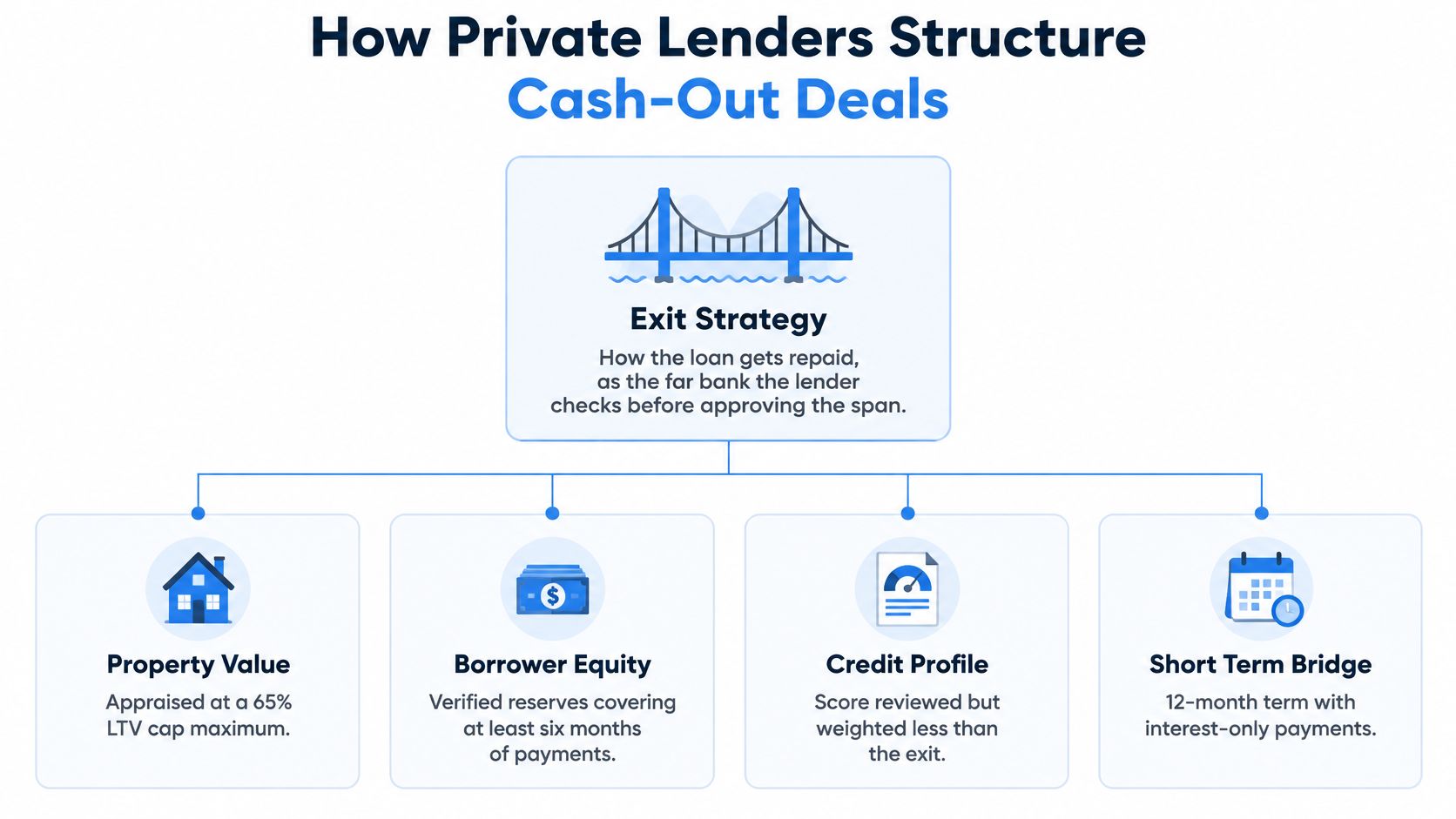
- Value sets the size. The loan amount depends on the appraised value and the lender's cap, not just wage income. A borrower outside a conventional lending template may still qualify based on the property.
- The exit drives underwriting. A clear repayment plan can matter more than a spotless credit file. The borrower might sell, refinance with a bank after the property stabilizes, or repay from another property's proceeds. Without a defined exit, a lender may decline even when the value looks strong.
- Term and payment resemble a bridge. Terms are usually under five years, payments are often interest-only, and a large balance comes due at maturity. The borrower is paying for time, not securing a 30-year payment.
- Reserves need to be visible. Lenders look for cash in the bank and monthly income that can carry the payment. Limited reserves can weaken an otherwise strong property-based application.
Fees and points pay for speed and flexibility. A private lender may consider a borrower with a foreclosure, poor credit, or a short income history, yet still decline a file without a credible repayment plan.
LendingXpress is one option for non-owner-occupied properties. The firm describes its approach as using conservative loan-to-value ratios and underwriting based on the property, with closings in as little as three days. A loan officer can shape terms around the property rather than a bank template.
Bring four documents to the first call: the appraisal, a payoff letter, the rent roll, and a written exit plan. Together, they give the lender a clear view of the property's value, existing debt, income, and repayment route.
Confirm the Numbers Before You Apply
Four routes sit on the table once the cap and the rate premium are both written down. The right one depends on how much cash you need, what the current first lien costs, and how fast you have to move.
| Option | Best when | Main trade-off |
|---|---|---|
| Cash-out refinance of the whole first mortgage | Large cash need and a current rate close to market | Reprices the full balance, usually at a premium rate |
| Second lien behind the existing loan | Existing first-mortgage rate is low and the cash need is modest | Second loan carries its own rate and payment |
| Staged draw or delayed refinance | Value will rise after renovations are finished | Equity stays locked until the work is done |
| Private bridge loan | Timing is urgent or bank credit is thin | Higher cost and a short term that requires a clear exit |
Six checks before you pick a lane
- Value. Pull a current appraisal or recent comparable sales.
- Payoff. Get the exact payoff and any prepayment penalty in writing.
- Cap. Confirm the loan-to-value limit for your property type and unit count.
- Net cash. Subtract the payoff and closing costs from the gross loan.
- Break-even. Run the rate premium against what the cash will earn.
- Fit. Match the option to the cash need and the timeline, not to the largest available loan.
A low existing rate with a modest cash need points to a second lien. A large need with a rate already near the market points to a cash-out refinance of the first mortgage. Value that will rise after the work points to a staged or delayed approach. Urgent timing with thin bank credit points to a private loan.
Send these numbers to a LendingXpress loan officer for a non-owner-occupied file. The goal is a clear answer quickly, with closings in as little as three days once the file is complete.
LendingXpress structures cash-out refinance and bridge financing for investment and rental property when a traditional bank file is too slow or too narrow. A loan officer can take your appraisal, payoff, unit count, and exit plan and show what cash out refinance loan to value leaves after costs. Visit LendingXpress to start a non-owner-occupied review.