
You find a property that fits your strategy. The numbers work, the location makes sense, the exit is clear, and the seller wants a fast close. Then the financing process drags. Documents get requested in rounds. Data gets entered twice. An underwriter asks for something you already sent. By the time the file moves, the deal is gone.
That's the primary reason investors care about automated loan processing. It isn't about flashy software. It's about protecting margin, moving before another buyer does, and getting certainty fast enough to act on a non-owner-occupied deal.
For fix-and-flip investors, bridge borrowers, and rental buyers, speed matters. But so does flexibility. A clean single-family rental with simple income is one thing. A value-add property, a borrower with multiple entities, or a deal tied to rehab scope is another. Automation can help a lot. Used blindly, it can also block good deals that need experienced judgment.
When Slow Financing Kills Great Deals
A lot of investors have lived through the same sequence.
You tie up a distressed property. The seller wants confidence and a short escrow. You send in bank statements, entity docs, a purchase contract, and insurance information. Then the waiting starts. A processor asks for updated files. Someone rekeys the same information into another system. An analyst won't touch the file until the package is “complete.” Meanwhile, a cash buyer or a faster lender moves in.
That's not just frustrating. It's expensive.
Every day of delay can push out rehab start dates, rent collection, refinance timing, or resale plans. On non-owner-occupied properties, timing often affects the entire business model. A bridge loan that closes quickly can create profit. A delayed approval can wipe out the edge that made the opportunity attractive in the first place.
Where traditional workflows break down
Manual lending tends to fail in predictable places:
- Repeated document handling creates avoidable delays.
- Back-and-forth email chains slow decisions when a file has any complexity.
- Human re-entry of borrower data introduces mistakes that have to be corrected later.
- Rigid sequencing means one missing item can stall the whole transaction.
Investors don't need a lecture on process. They need an answer to a simple question. Can the lender get from application to real decision fast enough to help win the property?
Practical rule: If a lender can't tell you quickly what they need, what they've verified, and what still blocks approval, you're already losing time.
The appeal of automated loan processing starts there. Done right, it removes the dead time between steps. It gives you faster answers, cleaner files, and fewer avoidable surprises. Done poorly, it becomes another rigid gatekeeper.
That difference matters most on non-owner-occupied deals.
What Automated Loan Processing Really Means for Investors
Think of manual lending like a workshop where every file gets carried by hand from desk to desk. Automated loan processing works more like a digital assembly line. Information moves once, gets checked as it enters the system, and reaches the right person only when human judgment is needed.
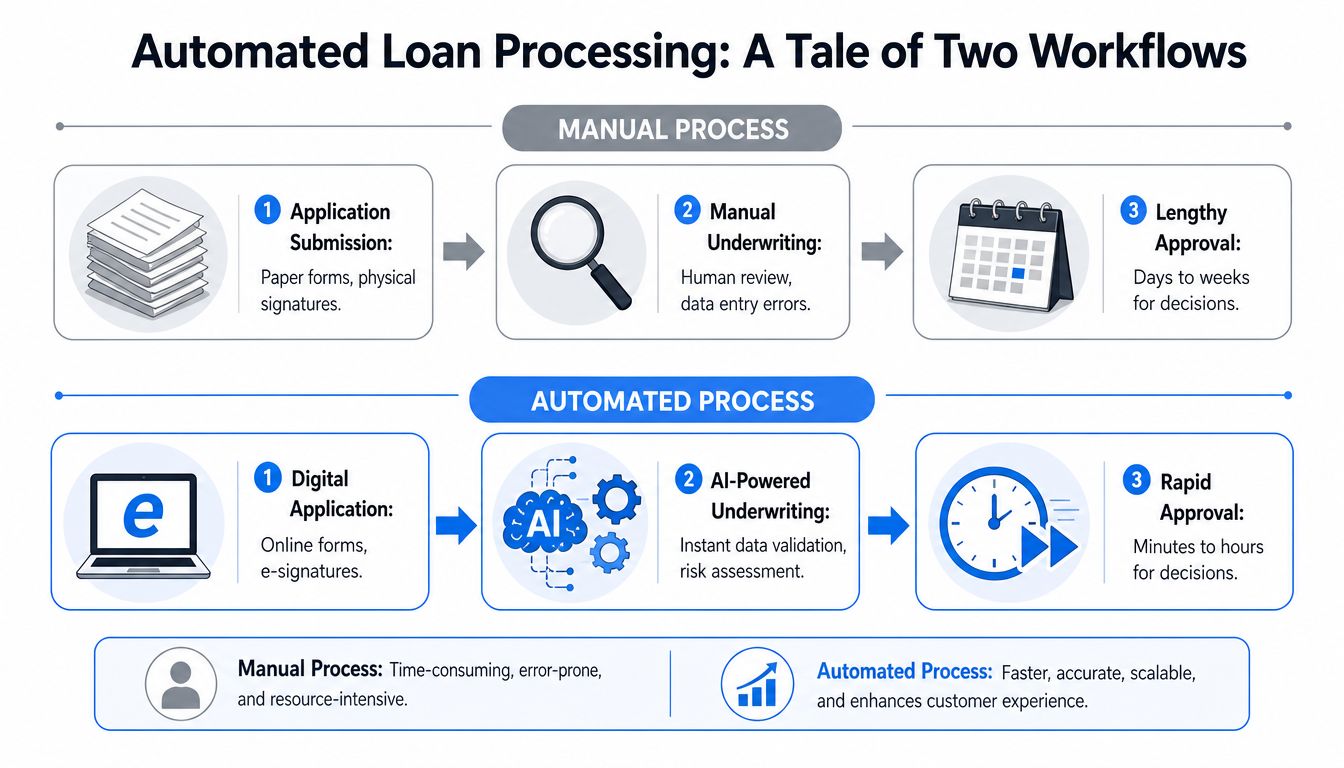
The core pieces that make it work
At the practical level, automated loan processing combines a few tools that investors benefit from even if they never see them directly.
- OCR scans documents into usable data. Optical Character Recognition reads uploaded statements, IDs, leases, and other paperwork so someone doesn't have to type every field by hand.
- AI-driven evaluation reviews the file quickly. It helps sort applications, check for missing items, and support early risk assessment.
- Cloud-based workflows keep the file moving. Borrowers, brokers, processors, and underwriters can work from the same live file instead of passing PDFs around.
MeasureOne describes it plainly. Automated loan processing systems integrate AI-driven credit evaluation, OCR for document extraction, and cloud-based workflows to achieve end-to-end digital onboarding, enabling same-day or instant loan decisions that are essential for high-speed lending environments in its overview of loan processing automation.
What that means on a real investment file
For an investor buying a non-owner-occupied property, this usually shows up in ways that are simple and useful:
- You submit online instead of starting with paper forms.
- The system checks documents for completeness early.
- Credit and identity checks can happen without manual handoffs.
- A lender can spot issues faster instead of discovering them late.
That doesn't mean software replaces underwriting. It means software handles the repetitive work so the underwriting team can focus on the actual deal.
If you want a plain-English primer on how teams apply practical AI automation strategies across real workflows, that resource is useful because it stays focused on process design rather than hype.
Automation is most valuable when it removes clerical drag. It's least useful when it tries to pretend every borrower and every property fits the same box.
For non-owner-occupied financing, that distinction is everything. The technology should speed up intake, verification, and routing. It shouldn't force a good bridge or rehab deal into a template built for a conventional owner-occupied loan.
The Loan Workflow From Days to Hours
The easiest way to understand automated loan processing is to compare the old path with the newer one side by side.
A traditional file moves in fragments. The application comes in. Documents arrive later. Someone reviews them manually. Missing items trigger another email. Data gets keyed into multiple systems. Then underwriting starts. If anything changes, the file circles back and loses more time.
An automated workflow is tighter. The borrower applies digitally, the system starts checking information immediately, and the team sees early whether the deal is clean, incomplete, or needs a closer look.
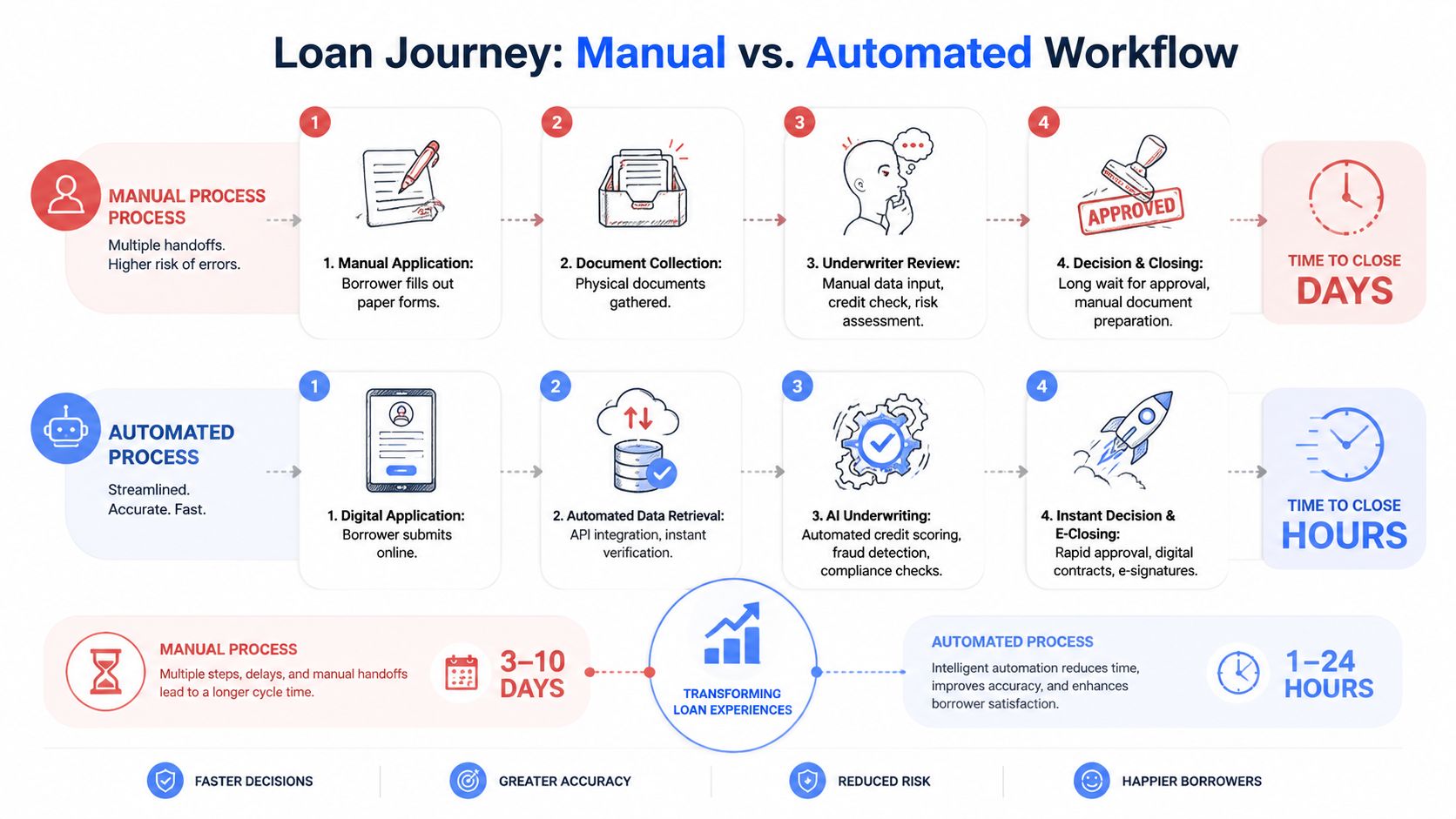
A practical side-by-side view
| Loan Stage | Manual Process (Typical Time) | Automated Process (Typical Time) |
|---|---|---|
| Application intake | Paperwork, emails, follow-up | Online submission, immediate intake |
| Document review | Staff checks files one by one | System flags completeness early |
| Verification | Separate requests and manual matching | Instant retrieval and connected validation |
| Underwriting prep | Re-entry, queue delays, handoffs | Rules-based routing and cleaner files |
| Decision | Delayed by missing items and bottlenecks | Faster path to a clear next step |
The timing advantage is well documented. Heron Data notes that automated loan processing systems can reduce approval time from an industry average of 3 to 5 days to under 15 minutes, with some banks reporting up to an 85% reduction in overall processing time, in its review of automated loan processing systems.
What investors feel during that process
For a real estate investor, the benefit isn't just “faster.” It's more specific than that.
- You know sooner whether the deal is financeable.
- You spend less time chasing status updates.
- You can negotiate with more confidence because your lender has already moved past intake.
- You avoid losing days to preventable clerical delays.
That's especially important on bridge scenarios. A short escrow doesn't leave room for a slow document chase. If you're evaluating options for fast acquisition financing, a lender built for bridge loan closings in as little as 3 to 5 days is aligned with how investors buy.
A big part of that speed comes from better file handling. If you want a deeper look at how documents get extracted, classified, and routed without manual keying, this explanation of intelligent document processing is worth reading.
Here's a quick visual overview of how automated lending workflows work in practice:
Faster workflow doesn't just help the lender. It helps the investor make a stronger offer because the financing side looks organized from day one.
Key Benefits Speed Closing and Reduce Costs
The strongest case for automated loan processing is financial. Investors care because speed affects revenue timing, carrying cost, and deal certainty. Lenders care because cleaner workflows reduce waste.

The hard benefits that matter
Timvero reports that automated loan origination systems achieve an 80 to 95% reduction in application-to-decision time, compressing the process from 3 to 10 days down to minutes or hours. The same source states that automated validation reduces data entry errors from a 5 to 8% error rate in manual processes to less than 1% in its analysis of automated loan origination performance.
Those two gains matter more than they might seem.
When a lender reaches a decision faster, an investor can lock up a property, start rehab planning, or move toward lease-up sooner. When a lender reduces manual error, the borrower is less likely to get hit with last-minute requests caused by someone miscoding income, missing a document, or entering data incorrectly.
How those gains hit the bottom line
For non-owner-occupied property financing, practical benefits usually show up in four places:
- Faster closings help preserve deals with competitive sellers.
- Lower rework means fewer avoidable delays caused by bad data.
- Cleaner files improve communication because everyone is looking at the same information.
- Better use of underwriting time lets experienced people focus on the hard parts of the transaction.
There's also a borrower-experience angle. Timvero states that when a loan application exceeds five minutes to complete, abandonment rates can rise to 60% or more, while an automated under-25-minute experience can push abandonment below 25% in its same review of automated origination performance. That matters because serious borrowers still want a process that feels efficient, not exhausting.
Bottom line: The value of automation isn't just lower internal cost. It's fewer stalled files, fewer corrections, and faster movement from signed contract to funded deal.
For investors, that can mean getting contractors in earlier, listing sooner, or collecting rent faster on a stabilized non-owner-occupied asset.
Why Full Automation Fails Complex Investment Deals
Most articles treat automation like a universal fix. It isn't.
Automation is excellent at standardizing repeatable tasks. It's strong at intake, basic checks, and routing. It struggles when a file needs context, judgment, or a lender who understands the story behind the numbers.

Where rigid systems start to miss good deals
Non-owner-occupied loans often don't fit neat templates. You may have:
- a borrower with income spread across entities
- a property that needs rehab before it performs
- a bridge scenario where timing matters more than conventional seasoning
- a unique asset type that doesn't look clean inside an automated decision engine
That's where over-automation causes problems. A rigid system can read complexity as weakness. An experienced underwriter can separate real risk from explainable variance.
Moody's makes that point directly. While automation excels at standard loans, it struggles with non-traditional income structures or unique property types. Analysts still need time for “data interpretation, ratio analysis, and forecasting models” to assess true repayment capacity, as noted in its discussion of automation in loan origination.
Non-owner-occupied deals require more nuance
The underwriting standards themselves often demand a closer look. For example:
- Credit standards can be tougher. Non-owner-occupied loans may require a minimum credit score in the high 600s to 700s, along with a 43% DTI cap for manual underwriting, which is stricter than what many owner-occupied borrowers see, according to this breakdown of owner-occupied versus non-owner-occupied loans.
- Equity requirements are real. Non-owner-occupied equity loans are typically capped at a 75% combined LTV and may require a 6-month cash reserve on deposit at funding, based on this non-owner home equity lending overview.
Those aren't the kind of files you want judged by a shallow checklist alone.
A serious lender still needs document discipline. That's why the process matters. Clean intake and organized submission help, but so does knowing which loan documents are required for review before a file gets stuck.
Good automation shortens the path to human judgment. Bad automation replaces human judgment with a hard stop.
That's the key trade-off. If the deal is plain vanilla, full automation may be enough. If the asset is transitional, the borrower profile is layered, or the income story needs interpretation, expert underwriting is still the difference between a missed deal and a funded one.
Case Study A Fix and Flip Closed in Five Days
Sarah was buying a distressed non-owner-occupied property that needed work before resale. The opportunity was strong because the property was underpriced for its condition, but the seller wanted a fast close and didn't have patience for a long bank process.
Her first financing route looked familiar. The bank asked for a full package, then paused while documents moved between processing and underwriting. Questions came back in pieces. The issue wasn't just speed. The deal itself didn't fit the clean profile a conventional system prefers. The property needed repairs, the timeline was short, and the file needed someone to understand the business plan, not just the current condition.
What moved the deal forward
A better process usually looks like this on a fix-and-flip file:
- Digital intake happens first. The purchase contract, entity documents, bank statements, and rehab scope are uploaded quickly so the file starts clean.
- Automation handles the repetitive checks. The system organizes documents, flags missing items, and helps verify the basics without wasting underwriter time.
- An experienced lender reviews the deal itself. During this review, the rehab plan, property strategy, and exit either make sense or don't.
Sarah's deal needed that third step. The right question wasn't whether the property looked perfect today. It was whether the borrower, budget, and exit supported the loan.
Why human review still mattered
For investment property lending, some metrics can't be treated casually. On income-producing non-owner-occupied commercial real estate, lenders often require a DSCR of at least 1.25, meaning the property generates 25% more net income than necessary to cover debt obligations, according to Ascend Bank's summary of key lending factors.
A machine can flag that ratio. An underwriter has to judge what sits behind it.
If the property is in transition, the borrower has a clear rehab plan, and the exit is credible, a knowledgeable lender can evaluate the file in context. That's especially true in bridge and fix-and-flip lending, where current performance doesn't always tell the whole story.
On complex investment deals, the file has to make sense as a business plan, not just as a stack of documents.
Sarah closed in five days because the process blended speed with judgment. Automation kept the file moving. Human underwriting handled the exceptions. That combination let the lender act fast without treating a real opportunity like a compliance problem.
That's the model that tends to work best for non-owner-occupied investors.
Finding the Right Lending Partner in the Digital Age
At this point, automation isn't rare. SCNSoft reports that over 70% of lending businesses currently use loan origination automation in its review of lending automation adoption and outcomes.
That changes the central question for investors.
You're not trying to find a lender that uses technology at all. You're trying to find one that uses it intelligently on non-owner-occupied property deals. That means fast intake, organized workflows, and quick early decisions. It also means a real underwriter can step in when the deal has layers.
What to look for in practice
The best lending partner for an investor usually has a few habits:
- They move quickly on the front end. You don't wait days just to find out whether the file is viable.
- They understand non-owner-occupied assets. Bridge loans, rehab scenarios, rental acquisitions, and mixed borrower profiles don't confuse them.
- They don't hide behind software. If the deal needs judgment, a knowledgeable person can review it.
- They communicate clearly. You know what's approved, what's pending, and what could still block closing.
The balanced model wins
Pure manual lending is too slow for many modern deals. Pure automation is too rigid for many real-world investment files.
The strongest model sits in the middle. Technology handles intake, verification, workflow, and document discipline. Experienced lenders handle nuance, exceptions, and asset-level judgment. That balance is what gives investors both speed and flexibility.
The best lender isn't the one with the most automation. It's the one that knows where automation should stop.
If you're financing a non-owner-occupied purchase, refinance, bridge, or fix-and-flip deal, choose a partner that can move fast without forcing your file into the wrong box. That's how you protect time, preserve opportunity, and close while the deal still makes sense.
If you need a responsive lending partner for a non-owner-occupied property, LendingXpress is built for speed without losing common-sense underwriting. The team works with real estate investors who need bridge, rental, and fix-and-flip financing when traditional banks won't move fast enough, with practical structures and a simplified path to closing.