
You found a deal that fits your buy box, the numbers work, and the seller wants certainty fast. The problem isn't spotting the opportunity. The problem is that your cash is tied up, your refinance isn't done yet, and a traditional bank timeline doesn't match the contract in front of you.
That's where most investors start comparing a bridge loan vs Home Equity Line of Credit. On the surface, both can access capital against real estate. In practice, they solve very different problems, and for non-owner-occupied investment properties, the underwriting differences matter more than the marketing language.
If you're buying rentals, funding a rehab, or trying to close before another buyer steps in, you need the financing tool that matches the deal. The wrong choice can slow you down, create qualification issues, or put the wrong property at risk.
The Investor's Dilemma Needing Fast Capital
Investors run into the same problem over and over. A good property shows up with a tight closing window, but the money to grab it is locked in another project, sitting behind a refinance, or trapped in equity you can't access quickly enough.
That gap is exactly where financing strategy separates active investors from sidelined investors. The deal doesn't care that your bank likes you. The seller cares whether you can close.
What usually happens on real deals
For investment property borrowers, two options come up most often:
- Bridge loan for a short-term acquisition or payoff gap
- HELOC for ongoing access to equity already built into another property
Both use real estate as collateral. That's where the similarity ends.
A bridge loan is built for a specific event. Buy the property, stabilize it, refinance it, or sell it. A HELOC is a revolving line that gives you flexibility over a much longer period. One is transactional. The other is ongoing.
Practical rule: If the property has to close fast and the financing has to fit the deal instead of your tax return, a bridge structure is usually the first place to look.
Why investors get this choice wrong
A lot of articles blur owner-occupied borrowing with investor borrowing. That creates confusion fast. Investment properties are underwritten differently, risk is viewed differently, and lenders don't all care about the same things.
What works for a homeowner trying to tap equity for general use may not work for an investor trying to win a non-contingent offer on a rental or light rehab project.
The main question isn't which product sounds cheaper. It's which one gets approved, closes on time, and still makes sense for your exit. If you're comparing bridge loan vs Home Equity Line of Credit, the answer depends on speed, underwriting, collateral, and whether your borrowing profile can survive a second layer of lender review.
Bridge Loans And HELOCs At A Glance
For investors, these products solve different capital problems, and the difference shows up fast once a deal is under contract.
A bridge loan is built around a single transaction. You use it to acquire, carry, refinance, or sell an investment property within a short window. A HELOC is an equity line tied to an existing property, usually with the option to draw, repay, and draw again over time.
That sounds simple. The underwriting consequences are not.
For an investor, a bridge loan usually sits against the property tied to the deal itself. A HELOC usually sits as a second lien against another property you already own, and that creates a layer many borrowers underestimate. The moment you add a line behind a first mortgage, you are not just qualifying for access to equity. You are qualifying for a lender that has to get comfortable being in second position on an investment asset.

Quick comparison table
| Feature | Bridge Loan | HELOC |
|---|---|---|
| Core purpose | Short-term capital for a defined deal | Revolving access to equity over a longer period |
| Collateral position | Commonly a first lien on the subject investment property | Commonly a second lien on a property you already own |
| Typical investor use | Fast purchase, refinance gap, auction, light rehab, payoff | Reserve access, smaller projects, staggered capital needs |
| Repayment style | Often interest-only during the term, then payoff at exit | Draw period payments, then amortizing repayment |
| Approval friction | Driven by property value, exit, and deal structure | Driven by equity, borrower profile, and second-lien risk |
| Best fit | Time-sensitive acquisition or transitional asset | Planned liquidity, if the line is already in place or easy to qualify for |
What investors often miss
The biggest mistake is comparing these products by rate alone. That misses the actual decision point. Can the money be approved and wired before your contract deadline, and can it survive the lien structure on an investment property?
A HELOC can look cheaper on paper, but it often depends on a bank being willing to add or keep a junior lien on non-owner-occupied real estate. If the first mortgage has restrictions, if the property cash flow is uneven, or if your income is hard to document, the line can slow down or die in underwriting. That is the dual-lien qualification risk many investor guides ignore.
A bridge loan has a different job. It is usually the cleaner tool when speed matters, the property is in transition, or the deal does not fit a conventional bank box. For investors weighing options around a purchase, this guide to an investment property bridge loan structure gives a useful picture of how bridge debt is set up for real deals.
How Lenders Underwrite Each Loan For Investors
A significant distinction becomes clear.
A HELOC is usually underwritten like a bank product. The lender wants to understand your personal financial profile, your credit, your income, and your overall debt picture. If your income is hard to document, seasonal, or spread across multiple entities, that review can get tight fast.
A bridge loan for an investment property is often underwritten from the asset first. The lender still cares about the borrower, but the property, the exit plan, and the deal structure carry more weight.
HELOC underwriting is personal-finance heavy
With a HELOC, the lender is usually asking questions that sound familiar to anyone who has dealt with a conventional bank:
- Income stability: Can you document what you earn cleanly enough for the lender?
- Debt load: Do your current obligations leave enough room for another monthly payment?
- Credit profile: Does your score fit the lender's box?
- Available equity: Is there enough room in the property to support the line?
For investors, that creates friction. A borrower can own strong assets and still look weak on paper if income runs through write-offs, partnerships, or uneven distributions.
Bridge underwriting is deal-first
In private lending, the conversation is usually different. The lender starts with the property and the plan.
They want to know what you're buying, what secures the loan, how quickly they can verify value, and how the loan gets paid off. That payoff may be a sale, a refinance, or another clearly defined exit. The point is that the file doesn't live or die only on W-2 style income.
According to Orchard's comparison of bridge loans and home equity borrowing, bridge loans in this context are often asset-based, may ignore debt-to-income entirely, and often require a minimum credit score of 700, while HELOCs may be available to borrowers with scores as low as 620. The same source notes bridge loans can allow qualified borrowers to access up to 90% Loan-to-Value on the existing home for a new acquisition.
The borrower who looks messy to a bank can still look financeable to an asset-based lender if the collateral is solid and the exit is believable.
The dual-lien qualification risk investors miss
The most overlooked issue in this entire comparison is dual-lien qualification risk.
According to this analysis of bridge loan vs HELOC qualification risk, borrowers trying to qualify for both a bridge loan and a second mortgage can run into hidden debt-to-income traps because underwriting treats the payment burden differently. The same source notes that a bridge loan's interest-only payment structure can make borrowing capacity look stronger than a HELOC's stricter repayment modeling.
That matters because an investor may feel approved in theory, then find out late in the process that the second lien changes the math enough to break the file.
If you're evaluating a line secured against an existing rental, it's worth reviewing how a home equity loan for rental property differs from a bridge request tied to a new acquisition. The collateral path and qualification path are not the same.
A Head To Head Comparison Of Costs And Timelines
A lower rate does not help if you miss the closing date.
For investors, the comparison is cost of capital versus cost of delay. Bridge debt is usually more expensive on paper, but it can preserve a purchase contract, shorten time to close, and avoid the qualification problems that often show up when a bank underwrites a second lien on an investment property. A HELOC can be cheaper and more flexible over time, but only if the lender will approve the line, size it where you need it, and fund before the deal goes stale.
Comparison table for investors
| Feature | Bridge Loan (Private Lender) | HELOC (Traditional Bank) |
|---|---|---|
| Typical term | Short-term financing built for acquisition, rehab, or transition | Long revolving line with a draw period and later repayment period |
| Funding timeline | Often measured in days to a few weeks if title, valuation, and exit make sense | Usually slower because underwriting is more document-heavy and committee-driven |
| Interest rate structure | Higher pricing, often tied to speed, property risk, and loan structure | Usually lower initial pricing, often variable, with more sensitivity to borrower profile |
| Payment structure | Commonly interest-only during the term | Often interest-only during the draw period, then amortizing payments later |
| Qualification focus | Asset, equity position, property story, and exit strategy | Income, DTI, global cash flow, reserves, and second-lien policy |
| Best use | Single fast transaction where certainty matters more than lowest rate | Reusable liquidity for planned projects when timing is less aggressive |
What the pricing difference really means
Bridge lenders charge for speed, complexity, and execution risk. On an investment deal, we are often underwriting a property that needs work, a borrower who may already have several financed assets, and an exit that depends on rehab, lease-up, refinance, or sale. That structure costs more.
Banks price HELOCs more favorably because they are usually built around a cleaner file and a slower approval path. The catch is that investment-property HELOCs are not underwritten like owner-occupied consumer lines. The bank may haircut rental income, scrutinize your global debt picture, and reduce the usable line once it models both liens together. That is where dual-lien qualification risk turns from a theory into a failed closing.
The cheaper option can become the expensive one if earnest money is at risk, contractors are scheduled, or the seller will only wait a few more days.
Timeline is an underwriting issue, not just an operations issue
Investors often treat speed as a servicing question. It starts much earlier than that. A private bridge lender can usually make a faster decision because the file is centered on collateral, available equity, title, and exit. A bank HELOC file often slows down because the lender is validating income, reviewing tax returns, calculating debt obligations across your portfolio, and applying second-lien rules that can change the approval late in the process.
That difference matters most on rentals and mixed investment portfolios. A borrower may have strong equity and still get stuck waiting on income documentation, lease review, or internal policy exceptions. If you are buying before selling or repositioning assets across state lines, timing and collateral strategy matter even more. Investors working on financing for NC & VA properties run into this regularly.
Where each option wins
Use a bridge loan when closing speed affects whether you get the asset at all. It also fits better when the property is in transition, the file is too complex for a bank timeline, or you need a lender who can underwrite the deal instead of just the borrower.
Use a HELOC when you already control the timeline, want repeat access to equity, and know your bank will approve the line on an investment property without shrinking it during final review.
Investor rule: The best-priced capital is the capital that closes on time and still leaves you a workable exit.
Real World Scenarios For Investors
You are under contract on a rental, the seller wants a quick close, and your bank is still sorting through tax returns from three entities. Or you already own the asset, have equity sitting in it, and want a line you can draw for turns, repairs, and smaller upgrades over the next year. Those are two very different jobs. Investors get in trouble when they use the wrong tool and ignore how second-lien qualification can fail late.

Scenario one fast acquisition with a bridge loan
You find a distressed 4-unit property at $800,000 that needs $100,000 in rehab. The seller wants a non-contingent close in 15 days. In that situation, speed is not a preference. It is part of the offer.
A bridge loan fits because the lender is focused on the asset, your equity contribution, title, and the exit. An investor might borrow 80% of the purchase price, or $640,000, finish the work, then refinance into a rental loan once the property is stabilized.
This structure works best when the property is not ready for conventional rental financing today but should be financeable after repairs and lease-up. It also avoids a common investor mistake with HELOCs on rentals. You may think you have enough equity for a second lien, then the bank applies a tighter combined loan-to-value limit, discounts rental income, or caps exposure across your portfolio during final review. The deal can stall even though the property itself makes sense.
Use bridge debt here if the file needs to close on a calendar, not on a bank committee timeline.
Scenario two staged improvements with a HELOC
Now take a different investor. You already own a rental property appraised at $500,000 with an existing mortgage of $300,000. You want capital for staged improvements over time, not a one-time acquisition deadline.
A HELOC can work if the lender provides investment-property lines and if the existing first mortgage leaves enough room for the new second lien. On paper, this looks straightforward. In practice, dual-lien qualification is where experienced investors get surprised. The first mortgage payment, the new HELOC payment calculation, vacancy assumptions, lease documentation, and portfolio debt can all hit the approval at once.
Using the same property example, the line might provide meaningful access to equity for a roof this quarter, unit turns next quarter, and exterior work later. That flexibility is useful when the project schedule is spread out and you do not need all the funds on day one.
For investors looking across regional options, resources on financing for NC & VA properties can also help frame how timing and equity planning differ by market and lender type.
Here's a short explainer that helps visualize how these products are commonly used in the market:
The Deciding Factor
The choice usually becomes clear once you identify what the money has to do.
If you need capital for one time-sensitive purchase or repositioning event, bridge financing usually matches the job better. If you need repeat access to seasoned equity on a property you already own, and you are confident the lender will approve the second lien on an investment asset, a HELOC can be the better fit.
For investors, the main question is not just rate. It is whether the loan structure will survive underwriting in time to close the deal.
Navigating Key Risks And Legal Differences
Most investors spend too much time comparing rate and not enough time comparing exposure.
The bigger issue is what property is on the line, how long that obligation sticks around, and whether your payoff plan is realistic from day one.
What can go wrong with a bridge loan
A bridge loan is short by design. That's useful only if your exit is credible.
If you plan to sell, the property has to be saleable. If you plan to refinance, the property has to qualify and your file has to be refinance-ready when the bridge term ends. A weak exit strategy is the main risk in bridge financing because time works against you every month the deal drags.
What can go wrong with a HELOC
A HELOC creates a long-running lien position on an existing property. That can be manageable, but it can also box you in later.
According to Lima One's investor comparison, HELOCs attach a lien to the borrower's primary residence as a second mortgage, while bridge loans in investment contexts are frequently secured by the target asset without attaching a lien to the homeowner's primary residence. The same source notes that HELOC interest may be tax-deductible if used for home improvements, while bridge loan interest is generally a short-term capital cost.
Securing a line against one property to buy another can work. It can also spread the risk of one project across assets you didn't intend to tie together.
Legal and structural differences matter
For investors, this isn't just about preference. It's about containment.
A bridge loan secured by the target investment property keeps the exposure focused on the deal itself. A HELOC can mix your funding strategy with a separate property that may already carry long-term plans, refinancing options, or sale timing of its own.
That distinction gets more important when a project runs late, lease-up takes longer, or market conditions shift. The cleaner the collateral story, the easier it is to manage risk under pressure.
Your Decision Checklist And Finding The Right Partner
If you're still weighing bridge loan vs Home Equity Line of Credit, use a simple screen.
Choose based on the job
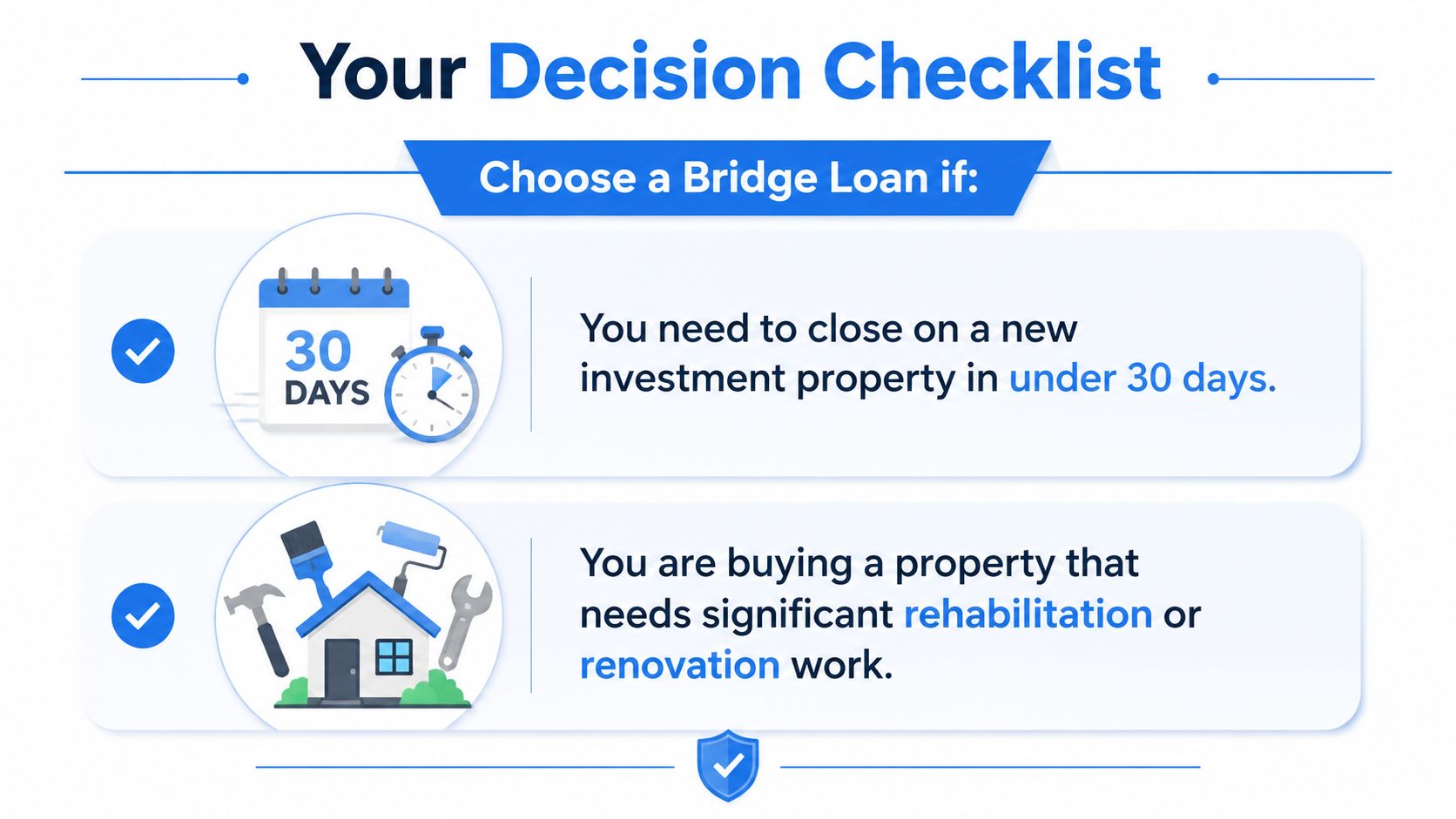
Choose a bridge loan when:
- You need speed: The contract won't wait for a slow approval cycle.
- The property is transitional: It needs work, stabilization, or a later refinance.
- Your file is strong on collateral: The deal makes sense even if your personal income looks complex.
- You need financing built around one event: Purchase, rehab, refinance, or sale.
Choose a HELOC when:
- You have seasoned equity: The line is backed by a property you already own.
- Your need is ongoing: You want reusable funds for multiple projects over time.
- Your bank profile is clean: Income, credit, and debt picture fit traditional underwriting.
- Timing is flexible: You can wait for the line to be set up correctly.
Final filter
If the deal depends on moving quickly and traditional banks are slowing you down, bridge financing is usually the cleaner investor tool. If your goal is flexibility over years and you're comfortable placing a long-term lien on another property, a HELOC can be useful.
The best financing decision is the one that closes on time, fits the asset, and leaves you with a realistic path out.
If you need a lending partner that understands investor timelines, non-owner-occupied properties, and common-sense deal structuring, LendingXpress is worth a conversation. They focus on fast, practical financing solutions for real estate investors who need to move when banks won't.