
A lot of California investors and brokers hit the same wall at the worst possible moment. They have a strong non-owner-occupied deal under contract, the seller wants a quick close, the borrower doesn't fit a bank box, and private money looks like the obvious answer. Then someone asks a simple question that changes everything. Are you licensed to do this?
That question is more significant than commonly understood. In California, lending isn't just about having capital and collateral. It's about whether your activity falls under the California Finance Lenders Law, whether an exemption applies, and whether your model crosses into Department of Real Estate territory.
If you're funding business-purpose loans on investment property, or you want to build a real private lending operation instead of doing the occasional one-off deal, the California finance lender license is often the gate you have to walk through. It isn't just paperwork. It's what separates a compliant lending platform from a model that can create avoidable risk later.
The Real Estate Investor's Licensing Dilemma
A broker finds a borrower buying a rental property that needs work. The borrower has equity, experience, and a clean exit plan, but the file won't move through a bank fast enough. The obvious solution is private capital.
Then the next question comes up. If you're arranging the money, funding the loan, or planning to repeat this process as a business, what license do you need?
That's where many new lenders and investor groups get stuck. They assume private lending is informal as long as the deal is secured by real estate and the borrower is using the property for business purposes. California doesn't work that way. The state has rules around who can make loans, who can broker them, and how those loans can be sold or offered to investors.
Practical rule: If you're going to make lending part of your business, treat licensing as part of deal execution, not as an afterthought.
The Department of Financial Protection and Innovation, or DFPI, is the regulator that sits at the center of this process for California finance lender licensing. For newer operators, the confusion usually starts with broad terms like "finance lender," "broker," "commercial loan," and "real-estate-secured loan." Those terms sound familiar, but the legal boundaries don't always match industry shorthand.
What matters in practice is simple. You need to know whether your current loan activity requires a license, whether an exemption fits your facts, and whether your business model creates overlap with a DRE license. If you miss that analysis, the problem usually doesn't show up at closing. It shows up later, when you're scaling, selling loans, bringing in investors, or responding to compliance questions.
What Is the California Finance Lenders Law
A borrower calls for a fast bridge loan on a non-owner-occupied property. You can fund it, the collateral works, and the exit makes sense. The licensing question is what trips people up. California does not treat private lending as informal just because the deal is business purpose and secured by real estate.
The California Finance Lenders Law, or CFLL, is the statute that governs many nonbank lenders and brokers making consumer or commercial loans in California. At a practical level, it tells you who needs DFPI oversight, who can act as a lender or broker, and which operating rules apply once you start doing this as a business.
The basic purpose
The core rule is broad. Under Cal. Fin. Code § 22100(a), a person engaged in the business of a finance lender or broker generally must be licensed unless an exemption applies.
For private lenders, that rule matters early. A lot of people enter the business through one-off investor deals and assume real estate collateral keeps them outside the lending statutes. It usually does not. If your company is regularly originating or arranging loans, the state starts with the licensing question first.
That is why experienced shops sort out licensing before they build volume.
Who the law reaches in practice
The CFLL reaches more activity than many new operators expect. It can apply when you make loans through your own entity, arrange loans for compensation, or build a repeat business around investment-property financing. If your model starts to look organized, marketed, and ongoing, you should review it as a licensed activity, not a casual investment sideline.
In the private money space, that often includes:
- Direct lending through an LLC or corporation: originating bridge, rehab, or rental-property loans with your own capital or a warehouse line
- Broker activity for a fee: sourcing borrowers and placing loans with another lender
- Programmatic lending: advertising products, using standardized underwriting, and closing a steady flow of deals
Banks, credit unions, and some other institutions may fall under separate regulatory treatment or exemptions. Nonbank private lenders usually need a more careful analysis.
For borrowers and brokers trying to place deals, working with established California private money lenders helps because the licensing and origination model is already built around California rules, not patched together after the fact.
Why private lenders get confused
The confusion usually is not about making the loan. It is about what happens around the loan.
A lender may originate a business-purpose loan secured by real property and assume one license covers the full life cycle. Then the lender starts selling whole loans or fractional trust deed interests to investors, pays referral fees, or has a real estate broker involved in sourcing and servicing. That is where the overlap gets complicated. The CFLL covers one part of the activity. A DRE license may become relevant for another part. The answer depends on your exact role, how the loan is offered, and who is being compensated.
That overlap matters in practice because many private lenders do not just hold loans to maturity. They fund, close, and then move paper to investors. If you miss the line between finance lending and real estate brokerage, the deal can close and the compliance problem still follows you.
The CFLL sets the baseline for many nonbank lenders in California. It is the starting point, not always the full answer, for private lenders active in trust deed sales and investor-backed originations.
Determining If You Need a CFL License
A common mistake looks like this. An investor makes a few bridge loans on California property, gets repaid, then starts taking regular requests from other operators. Soon there is a website, a rate sheet, and a pipeline. At that point, the question is no longer whether the loans are secured by real estate. The key question is whether the person has crossed into the business of lending and whether another license may also come into play if trust deeds are later sold to investors.
Start with the conservative assumption. If you regularly make loans in California, treat the California finance lender license as the baseline unless a clear exemption fits your facts.

The general rule
Frequency matters. Marketing matters. Holding yourself out as a source of funds matters.
One hard lesson in private lending is that collateral does not answer the licensing question by itself. A business-purpose loan secured by non-owner-occupied real estate may still require a CFL license depending on who is making the loan, how often the activity occurs, and whether lending has become a real business line instead of an occasional side transaction.
That is why newer lenders get tripped up. They focus on the property and miss the operating model.
The de minimis exemption
California does have a narrow exemption that gets a lot of attention. Under Cal. Fin. Code § 22050(e), a person making no more than five commercial loans in a 12-month period, where those loans are $5,000 or more and primarily for business or commercial use, may be exempt if the lending is incidental to that person's primary business.
The word incidental does a lot of work there. A flipper or buy-and-hold operator who occasionally carries a short commercial loan as part of a broader real estate business may have an argument. A lender with repeat deal flow, referral partners, branded loan programs, or outside capital usually does not fit that fact pattern cleanly.
That distinction matters even more for private lenders who do not plan to hold every loan. If you originate, then sell whole loans or fractional trust deed interests, you may be dealing with both CFL issues and DRE issues. One license does not automatically cover the full chain of activity.
A practical way to assess your position
Use this as a first screen before you fund another deal:
- Lending is occasional and secondary to your main business: review whether the exemption may apply.
- The loans are clearly commercial: that helps, but it does not settle the licensing question.
- You advertise, quote terms, or accept regular loan requests: that looks much more like operating a lending business.
- You plan to sell trust deeds or fractional interests to investors after closing: check the DRE side as carefully as the CFL side.
- You are building repeat origination volume: get the structure reviewed before volume makes the problem bigger.
For brokers and borrowers who want certainty on execution, working with experienced California private money lenders is often the cleaner route. The file gets underwritten and funded inside a model that already accounts for California licensing lines, including the overlap that confuses many new private lenders.
Core Requirements for Your CFL Application
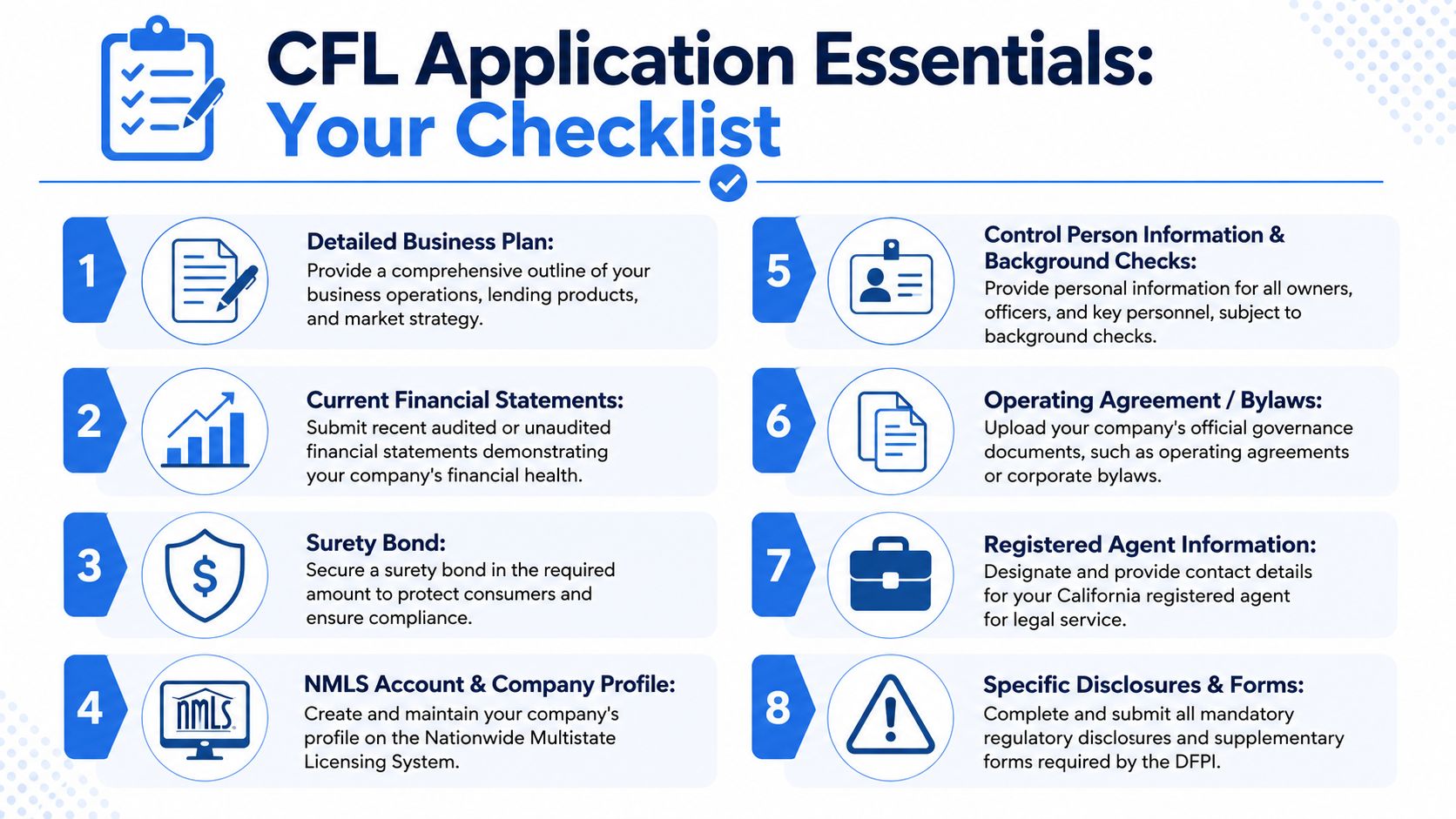
A CFL filing gets easier once you treat it like an underwriting package for your own company. The Department of Financial Protection and Innovation is looking for the same thing any disciplined capital partner would look for. A real business, real controls, real money behind the operation, and people who can explain exactly how loans will be originated and managed.
The financial thresholds
Start with the basics. California expects a surety bond, adequate net worth for the license type, filing fees, and background checks for the people responsible for lending activity.
For private lenders, the practical issue is not the fee. It is whether your entity is capitalized and described in a way that matches what you plan to do. If your model involves residential mortgage activity, the net worth standard can be higher. If your model is business-purpose lending secured by non-owner-occupied property, your filing still needs to show that clearly and consistently across the application, financials, and business plan.
A few points deserve attention:
- Surety bond: This supports the license filing and has to be in place in the proper amount.
- Net worth: The required level depends on the scope of your lending activity. Get this wrong and the file stalls.
- Fees and background checks: These are routine, but they still delay approvals when owners, control persons, or branch-level responsibility is not clearly identified.
The documents that slow people down
The forms are rarely the problem. Supporting documents are.
The application package usually turns on whether your company records match each other. The legal entity on your Secretary of State filings should match the NMLS filing. The financial statement needs to be current. The business plan has to describe an actual lending operation, not a vague intention to make private loans when opportunities appear.
You should expect to prepare:
- Company Form MU1: The core company application.
- Recent financial statement: It needs to be current enough to support the filing.
- Business plan: Explain loan products, borrower type, collateral, geography, underwriting approach, servicing plan, and capital sources.
- Certificate of Authority or Good Standing: Entity status needs to be clean and current.
- Background check materials: The responsible individuals must be properly disclosed.
A short, generic business plan causes more trouble than applicants expect.
For example, saying you will do "private lending in California" is not enough. A stronger plan states whether you will make business-purpose bridge loans, who approves credit, whether you broker or lend, how you source capital, and whether loans will be held or sold after closing. That last point matters for private lenders because once trust deeds or fractional interests enter the picture, the DRE side can become part of the compliance analysis even if the CFL filing itself looks straightforward.
What a credible file looks like
A credible application reads like it came from an operating lender, not a newly formed entity testing ideas. It shows clean ownership records, current financials, a defined lending model, and internal responsibility assigned to named people.
That is what regulators want to see, and it is also what helps deals get funded later. Warehouse providers, capital partners, brokers, and investors all move faster when the licensing story is clear.
At LendingXpress, we see the same pattern repeatedly. Lenders run into trouble when the file describes one business model, but the actual plan is broader. If you expect to originate, fund, and later move paper to investors, build that logic into the structure early. Cleaning it up after volume starts is slower and more expensive.
A Step-by-Step Guide to the CFL Application Process
You form the entity, line up capital, and find a deal. Then the NMLS filing slows everything down because the application says one thing, your operating plan says another, and nobody decided early whether the company will only hold loans or also sell trust deeds after closing. I see that problem often with new private lenders in California.
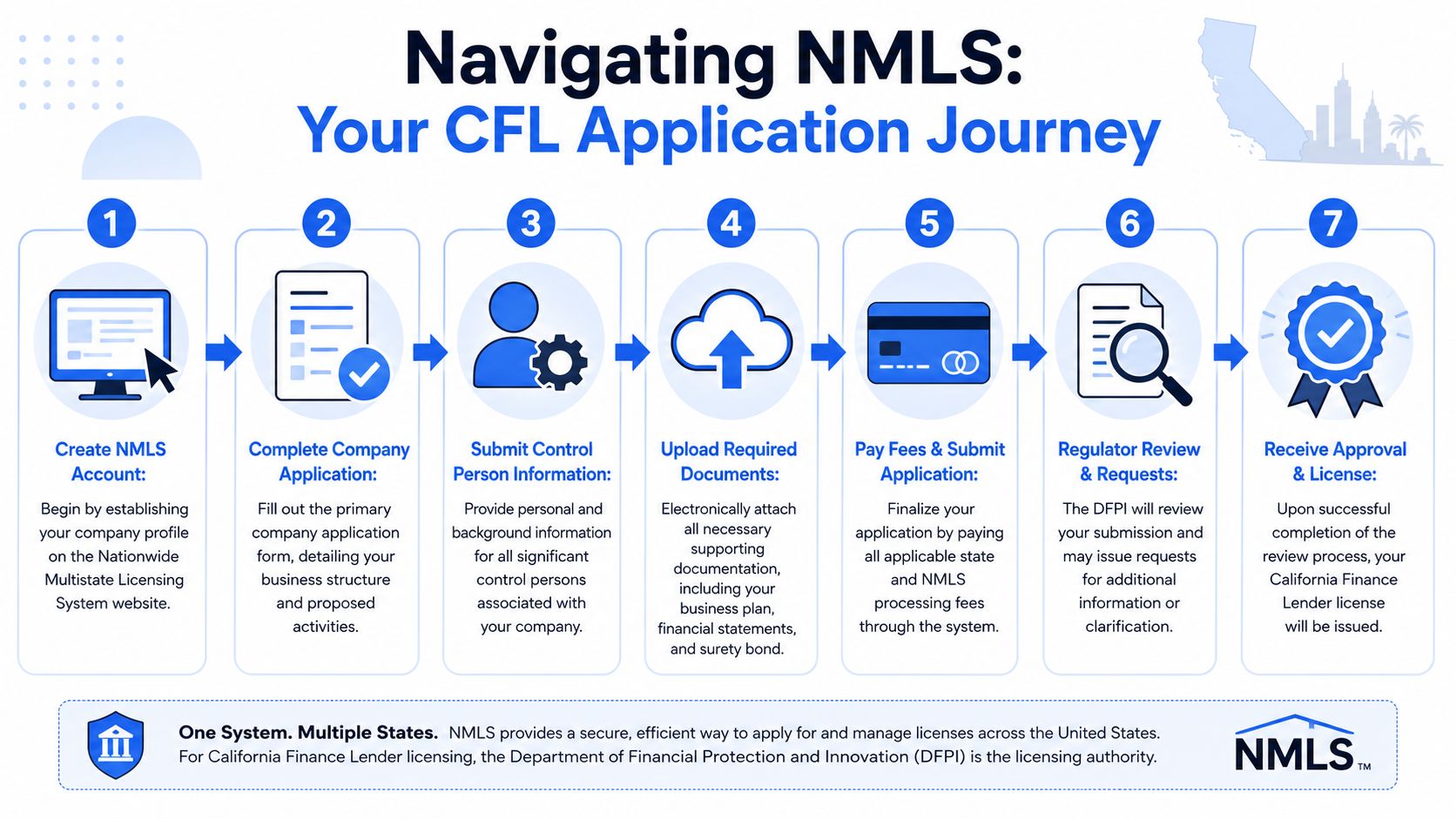
The CFL application runs through the Nationwide Multistate Licensing System, or NMLS. The filing itself is straightforward. The work is in making sure the application matches the business you plan to run.
Build the file before you log in
Start outside the portal. If you try to complete the application while you are still making decisions about ownership, capital sources, or loan disposition, the file usually gets messy.
For a private lender, the sequence should look like this:
- Set up the legal entity correctly. The company name, Secretary of State records, and formation documents need to match exactly.
- Open the NMLS company account. Use the same legal information everywhere. Small naming inconsistencies create avoidable review comments.
- Complete the MU1 filing. Describe the business model clearly. State whether the company will lend, broker, or both.
- Add control persons and owners. Disclose the people who control operations and credit decisions.
- Upload the supporting documents. That usually includes current financials, entity records, the business plan, and the items tied to the company structure.
- Review the narrative for consistency. If the business plan says balance-sheet lending but your capital strategy assumes selling paper to investors, fix that before submission.
- Submit and answer follow-up requests fast. A slow response can drag out approval even when the file is otherwise solid.
If your model includes brokers, referral partners, or branch activity, it helps to review California broker licensing requirements for mortgage and lending businesses before the filing goes in.
Where applications get stuck
Delays usually come from inconsistencies, not from one dramatic error.
A lender will list one ownership structure in NMLS, another in internal documents, and a third on a supporting attachment. Or the application says the company will make business-purpose loans, but the business plan never explains who approves credit, how funds are deployed, or whether loans stay on the balance sheet. Regulators notice those gaps because they are trying to understand the actual operation, not just check boxes.
Private lenders run into another issue that does not always show up until later. The CFL application may look clean if the company plans to originate and hold loans. The compliance analysis changes if the actual plan is to close loans and then sell whole trust deeds or fractional interests to investors. That does not always stop the CFL filing, but it should affect how you describe the model and how you prepare for licensing on the DRE side if that activity is part of the business.
What to check before you hit submit
Review the file like an operator, not just an applicant.
- Entity records match exactly. Legal name, addresses, and ownership details should be identical across NMLS, formation records, and supporting documents.
- The business plan matches the revenue model. Explain whether income will come from origination, points, servicing, brokering, spread, or sale of loans.
- Control is assigned to named people. California wants to know who is responsible for lending activity, supervision, and branch oversight.
- Financials are current and readable. Old or incomplete statements create an easy reason for a deficiency notice.
- Loan disposition is stated accurately. If you expect to move paper after closing, say so in a way that matches the actual structure.
A short walkthrough can help if you're new to the platform.
Use the application to pressure-test the business
A clean filing usually reflects a clean lending operation.
At LendingXpress, we push lenders to answer the practical questions early. Who controls the company. Where does the capital come from. Who approves loans. Are you holding paper, brokering it, or planning to sell trust deeds to investors after closing. Those answers affect more than approval timing. They affect how fast you can fund, how confidently brokers send you deals, and whether your license structure still works once volume picks up.
CFL vs DRE License A Critical Distinction for Private Lenders
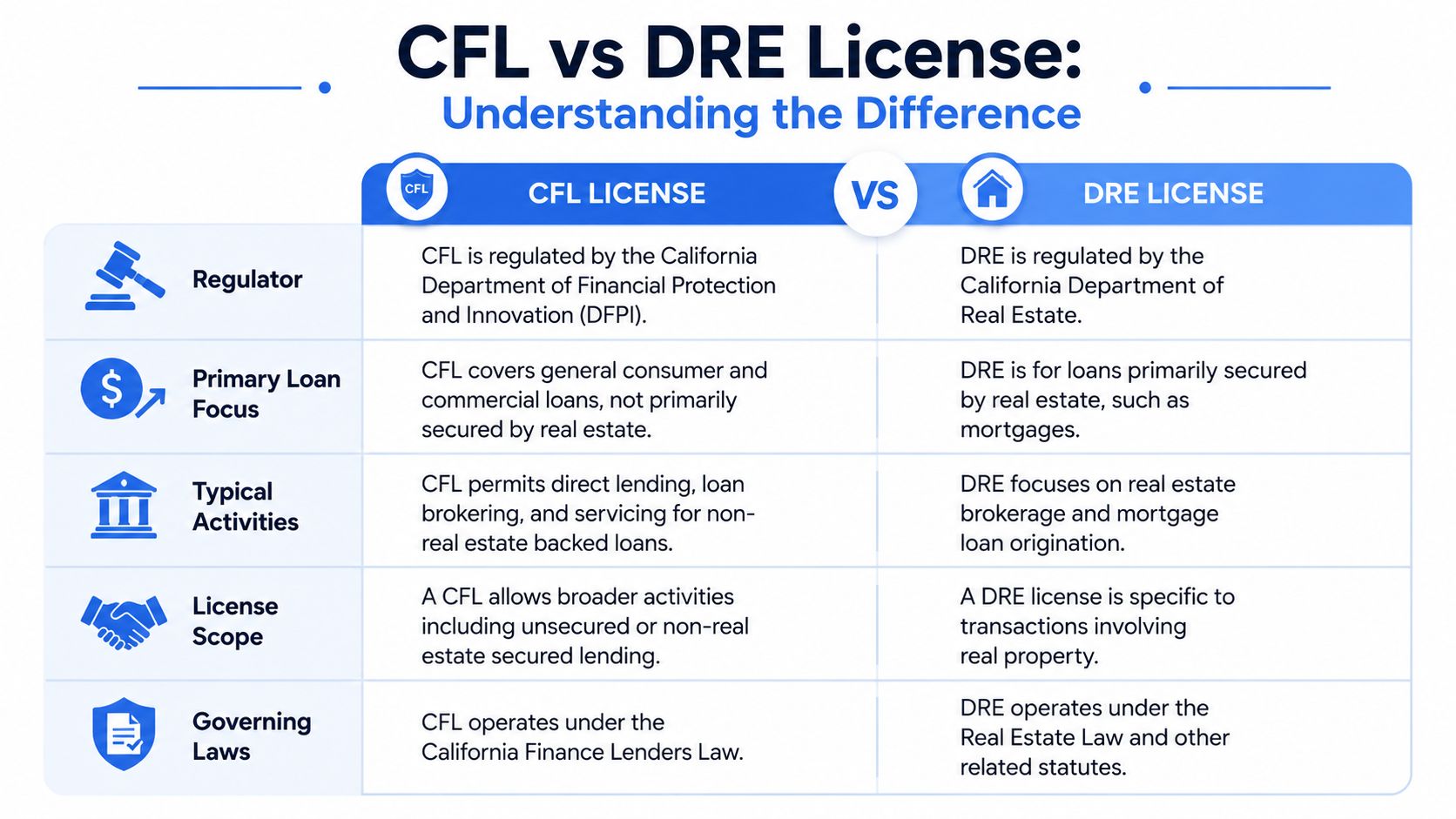
Many private lenders often get tripped up, assuming the CFL and DRE licenses are interchangeable because both show up around real estate finance. They aren't.
Here is the side-by-side view.
The core difference
A key distinction is that CFL licenses are designed for balance-sheet lending, while DRE licenses facilitate brokering loans for unlicensed investors. Selling loans made under a CFL to unlicensed individuals can trigger DRE regulations and potential violations, as explained in this Fortra Law discussion of private lender licensing in California.
That point matters a lot in the trust deed world.
If you use your own entity to make loans from your balance sheet, you're in classic CFL territory. If you're arranging loans for investors, especially unlicensed investors, you're moving into DRE territory. If you do both, the analysis gets more serious.
Where private lenders make mistakes
A common mistake looks like this. A lender gets comfortable originating loans under a CFL structure. Then the lender starts selling those loans, or fractions of those loans, to unlicensed individual investors as trust deed opportunities. At that point, the operation may no longer fit neatly inside the original assumption that a CFL alone covers everything.
That's the gap a lot of new operators miss. The problem isn't always the initial origination. It's what happens after origination.
A simple comparison helps:
| Activity | Likely licensing focus |
|---|---|
| Lending your company's own money | CFL analysis |
| Brokering loans backed by real property for investors | DRE analysis |
| Originating, then selling trust deed interests to unlicensed investors | Potential overlap that needs careful review |
When both may matter
For some private lenders, the right question isn't "CFL or DRE?" It's "Do we need both based on how this platform works?"
If your business model includes direct lending and investor-facing trust deed activity, don't assume one license solves the whole structure. Review the operational flow from origination through sale, servicing, and investor participation. That's where compliance problems usually hide.
For brokers and lenders trying to sort out those boundaries, this guide to broker licensing requirements is a useful starting point for mapping where a transaction sits.
Selling trust deed investments isn't just a capital strategy. It's a licensing and compliance question.
Staying Compliant and Partnering for Fast Funding
Getting licensed is only the beginning. A CFL license creates ongoing obligations, and you need to run the business like a regulated operation after approval, not just during the filing phase.
Licensed entities are subject to a recurring annual assessment of $250 and must submit an annual report to the DFPI to maintain good standing, according to this Morgan Lewis overview of California Finance Lender Law obligations.
The practical side of compliance
For a working private lender, compliance usually comes down to discipline:
- Keep reporting current: Annual filings shouldn't become a scramble.
- Match your operations to your license model: Don't drift into activities your original structure didn't account for.
- Review investor-facing practices carefully: Trust deed activity can create avoidable exposure.
- Use systems that document the process: Good records make audits, reviews, and internal controls easier.
If you're building internal procedures, tools that help reduce real estate risk can be useful, especially when your pipeline includes multiple borrowers, investor communications, and documentation workflows.
When partnership is the better move
Not everyone should build a licensed lending platform. If you're a broker focused on closing loans for investor clients, or an investor who wants to stay focused on acquisitions, rehab, and exits, it may be smarter to work with a lender that already understands the California rules and can move quickly on non-owner-occupied deals.
That choice often saves more than administrative time. It can prevent structural mistakes that don't show up until after a deal funds.
If you need a reliable lending partner for non-owner-occupied property in California, LendingXpress can help you move quickly with bridge, fix and flip, and rental property financing structured for real-world investor deals. Reach out to discuss your next transaction, get clarity on the best loan path, and keep your closing on schedule.