
You've found a duplex with room to add value, but the roof needs replacing, the electrical work isn't finished, and the seller wants a firm closing date. Your contractor needs money to start. Your bank wants a property that's already ready to rent. The financing problem isn't just getting approved, it's keeping enough cash available until the work is finished and the property sells or refinances.
A rehab loan program can connect the purchase to the renovation. For a non-owner-occupied investment property, the right structure needs to cover more than construction costs. You need to know when funds become available, what you must pay before reimbursement, and who covers the difference when the final bill exceeds the approved budget.
What a Rehab Loan Program Pays For
Say you're buying a 1960s duplex for $240,000 that needs $70,000 of kitchen, bath, roofing, and electrical work. Those are hypothetical deal figures, but the obstacle is familiar: a conventional acquisition lender may reject the property's condition even when the finished duplex could make a workable investment.
A purchase-and-rehab loan combines acquisition financing with an approved improvement budget. The lender advances the purchase portion at closing and holds renovation money for later disbursement. It works like paying a contractor milestone by milestone instead of handing over the full construction budget on day one.
The property inspection helps establish what belongs in that budget.

The property, the work, and the repayment
Every investor rehab deal rests on three connected decisions:
- Purchase price: Can you acquire the property at a basis that leaves room for repairs, financing, and profit?
- Renovation budget: Will the approved work produce the condition and value your business plan requires?
- Exit plan: Will you repay through a sale, a refinance, or a rental strategy followed by refinancing?
The acquisition-plus-renovation model has a longstanding public-program counterpart. HUD's history of the FHA Section 203(k) program describes combining acquisition or refinancing with rehabilitation financing and holding repair proceeds in escrow until work is satisfactorily completed. That's useful background, not an indication that an investor qualifies for an owner-occupant program.
For private investment financing, the lender evaluates the proposed finished property alongside its current condition. That doesn't mean the lender ignores a damaged roof or unfinished electrical system. It means the lender needs a funded, credible plan to correct them.
Practical rule: If the property needs work before it can earn the intended rent or sell at its intended value, evaluate the renovation financing before committing to the purchase.
Eligible improvements still need written approval. Don't assume furniture, owner labor, speculative upgrades, or costs outside the contractor's scope will receive loan proceeds.
Four Rehab Loan Types and Where Each Fits
Rehab loan types compared
| Loan type | Best for | Typical term | How funds are released | Basis for sizing |
|---|---|---|---|---|
| Fix and flip | Buy, renovate and sell | Illustrative planning range of 6-18 months | Purchase at close, repairs released in draws | Loan-to-cost and after-repair value |
| Renovation-to-rent | Renovate, lease, then refinance | Illustrative planning range of 12-36 months | Purchase advance and repair draws, refinance at the end | As-completed appraisal and rent |
| Construction draw | Gut rehab or ground-up build | Set by build schedule | Draws after each inspected build phase | Approved line-item budget |
| 100% rehab financing | Heavy renovation with limited borrower cash | Illustrative planning range of 12-18 months | Renovation budget funded in staged draws | Up to 100% of approved rehab costs, plus separate purchase terms |
The term ranges above are planning examples, not market statistics or loan quotes. Actual terms reflect the lender, property, borrower, construction schedule, and repayment strategy. These categories also overlap: a fix-and-flip loan can use construction draws and finance the full approved renovation budget.
Match the structure to the job
Fix and flip fits a property you intend to improve and sell. A dated duplex needing interior updates and a roof may suit this structure if completed comparable sales support the resale price. Build the timeline around permitting, construction, listing, and buyer financing, not just the contractor's estimated finish date.
Renovation-to-rent fits a property you intend to keep. The short-term loan gets the asset into rentable condition, but the permanent refinance needs its own underwriting. Before buying, confirm that the expected rent, finished appraisal, ownership structure, and refinance requirements support repayment.
Construction draw financing suits a gut renovation or ground-up project with a detailed build sequence. Demolition, foundation work, framing, mechanical systems, and finish work need separate budget lines. Ground-up construction isn't automatically eligible under every rehab product, so identify that scope before requesting terms.
Full rehab financing addresses the approved construction budget, not the entire investment. Financing 100% of renovation costs doesn't eliminate the purchase down payment, lender fees, carrying expenses, or cash needed between contractor payment and draw reimbursement.
Choose the exit before the leverage
LendingXpress offers private financing on non-owner-occupied residential and commercial collateral, with loan sizes described as approximately $100,000 to $18 million or more, subject to property and underwriting approval. A purchase-and-rehab structure or renovation-only loan may fit, but the written proposal should distinguish acquisition proceeds from construction funds.
For a sale, prioritize a realistic marketing period and payoff flexibility. For a hold, verify the permanent loan before relying on it. For a build, prioritize budget controls and a completion schedule that includes municipal sign-offs.
Choose by what happens at the end: sell, hold, or build. Starting with the largest available loan can leave you with the wrong maturity date or an exit you can't complete.
Worked Example of a Fix and Flip From Purchase to Sale
Consider a hypothetical duplex purchase. The figures below are assumptions for illustrating the calculation, not a quote, appraisal, or promised return.
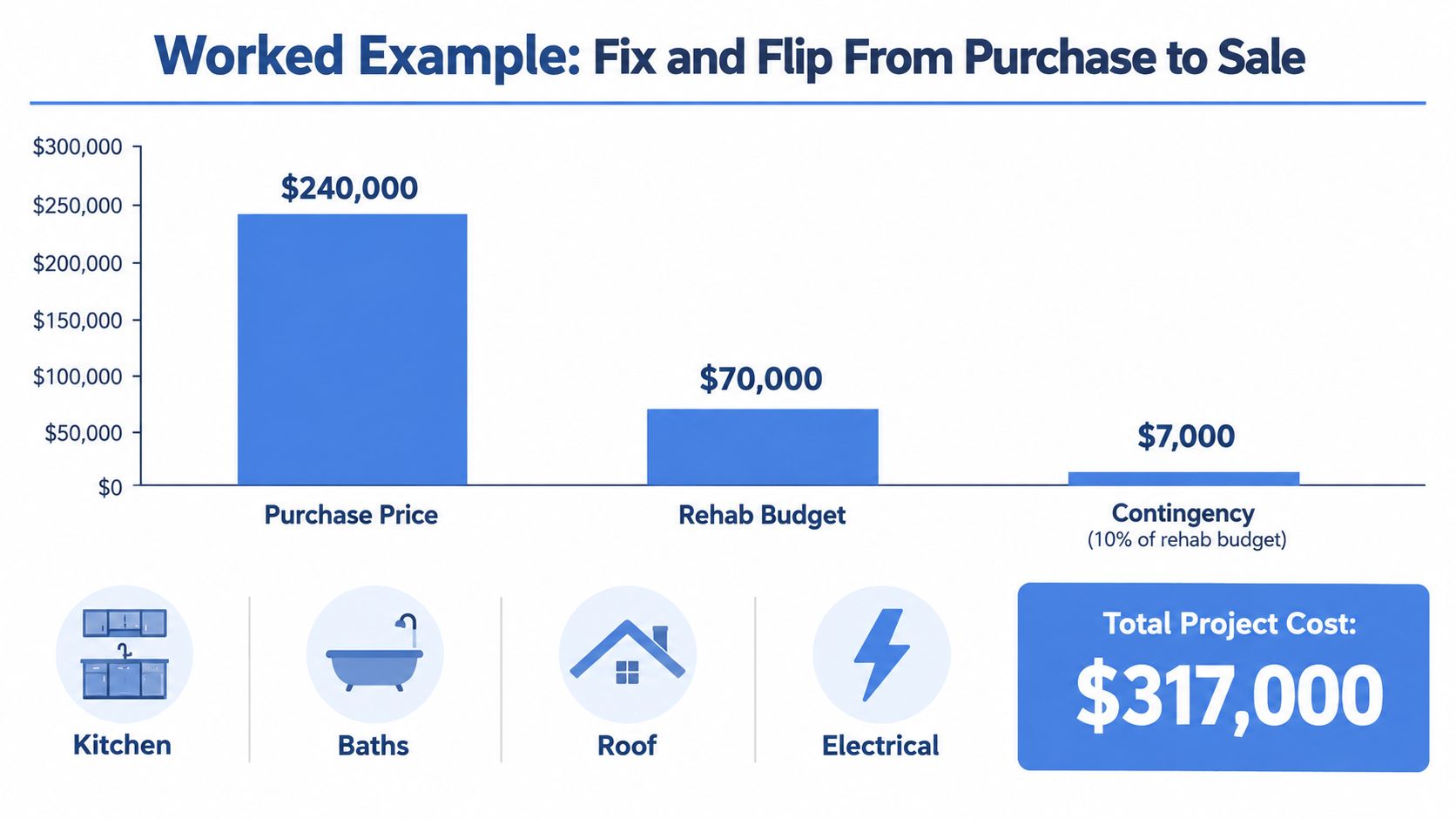
The acquisition and construction budget starts with these amounts.
Build the capital stack
Purchase price is $240,000. The approved rehab budget is $70,000 for the kitchen, baths, roof, and electrical work.
Contingency is $7,000. That equals 10% of the $70,000 rehab budget and comes from the borrower unless the lender expressly includes it.
The purchase advance is $180,000. Calculate it as $240,000 × 75%.
The total loan commitment is $250,000. Add the $180,000 purchase advance to $70,000 of renovation funding.
The purchase down payment is $60,000. Subtract the purchase advance from the purchase price. Closing costs, points, contingency, and required reserves need separate cash unless the documents specifically finance them.
Assume the completed appraisal is $380,000. Loan-to-after-repair-value is $250,000 ÷ $380,000, or approximately 66%.
Total project cost before financing and carrying expenses is $317,000, calculated as $240,000 + $70,000 + $7,000. Using that cost definition, loan-to-cost is $250,000 ÷ $317,000, or approximately 79%.
Calculate the sale, not just the loan
Assume an 11% annual interest rate, a $180,000 average outstanding balance, and a 12-month holding period. Interest under those assumptions is $180,000 × 11% × 12/12 = $19,800.
That average balance needs scrutiny. Because the acquisition advance already equals the assumed average, drawing renovation money while keeping the purchase balance outstanding would raise the average and increase interest. Treat $19,800 as a simplified baseline, then replace it with a month-by-month draw forecast before deciding whether to buy.
Assume the property sells for $380,000, with selling expenses equal to 8%, or $30,400. Net sale proceeds before loan payoff are $349,600.
Purchase, rehab, full contingency, and assumed interest total $336,800. Subtracting that from $349,600 leaves $12,800 before lender points and fees.
If points and fees total an assumed $6,000, the remaining amount is $6,800. It isn't a complete net-profit calculation because property taxes, insurance, utilities, and any other omitted expenses still need to be deducted.
A low loan-to-value ratio can protect the lender while leaving the borrower with a thin profit margin.
Tax treatment also affects the amount you keep. Allied Tax Advisors' property flipping guidance for San Diego investors is a useful starting point for questions to bring to your tax adviser.
The decision isn't whether the lender can approve the loan. It's whether the deal still works after realistic financing, operating, selling, and tax costs.
What Lenders Check Before They Approve
Underwriting factors and what lenders want
| Factor | What lenders want to see | Red flag |
|---|---|---|
| Exit plan | Sale, refinance or rent-and-refinance path with timing | Vague plan with no timeline |
| Borrower cash | Cash for down payment, closing costs and reserves | All cash committed to the purchase |
| Scope and budget | Line-item bids from licensed contractors | One rough estimate with no detail |
| After-repair value | Realistic ARV supported by recent comparable sales | ARV based on hopes or list prices |
| Liquidity | Reserves for interest, permits and change orders | No reserves after closing |
| Experience | Past flips or rentals, or a proven contractor | First project with no team in place |
| Credit | Reviewed alongside equity and exit strength | Recent defaults with no offsetting equity |
Establish eligibility and repayment first
For the investment financing discussed here, establish who will borrow and hold title, usually an individual or an LLC acceptable to the lender. Confirm the property will be non-owner-occupied, and document the money available for closing. An entity name on an application isn't a substitute for formation documents, signing authority, and proof of funds.
Next, establish how the loan gets repaid. Strong credit won't rescue a refinance exit that requires unsupported rent or an unrealistic appraisal. Conversely, a private lender may consider a borrower with weaker credit when meaningful equity, adequate cash, and an experienced project team offset the risk.
That flexibility isn't automatic approval. Recent defaults, unresolved title problems, or insufficient completion funds can still stop a file.
Test the finished value
Completed value constrains renovation financing even outside private lending. The Fannie Mae HomeStyle Renovation eligibility guide limits renovation costs on refinances to 75% of the as-completed appraised value.
The practical lesson is straightforward: an optimistic resale estimate doesn't create usable equity. If the independent appraisal comes in below your projection, the lender may reduce proceeds and require more borrower cash.
For a hypothetical stress test, reduce your expected appraisal by 10%. Recalculate the sale proceeds or refinance amount, then check whether they cover principal, interest, carrying expenses, and transaction costs. If repayment requires your original optimistic figure, renegotiate the purchase or reduce the scope before closing.
Submit a file someone can underwrite
Prepare these items together rather than sending disconnected documents:
- Proof of funds: Statements supporting the down payment, closing costs, and reserves.
- Ownership documents: Entity formation records and evidence of signing authority.
- Written scope: Trade-by-trade work descriptions, materials, allowances, and exclusions.
- Contractor comparisons: At least two bids as a practical way to identify missing scope and inconsistent assumptions.
- Value support: Recent closed comparable sales, with clear differences in condition and size.
- Exit summary: A one-page explanation of repayment, timing, and the backup plan.
For a first project, explain who controls construction, approves invoices, and resolves problems. A licensed contractor helps, but the lender still needs to know who manages the budget.
How Staged Draws Release Renovation Money
A renovation commitment isn't a construction checking account. The lender needs evidence that each release corresponds to approved work, and the borrower needs enough working cash to reach that release.
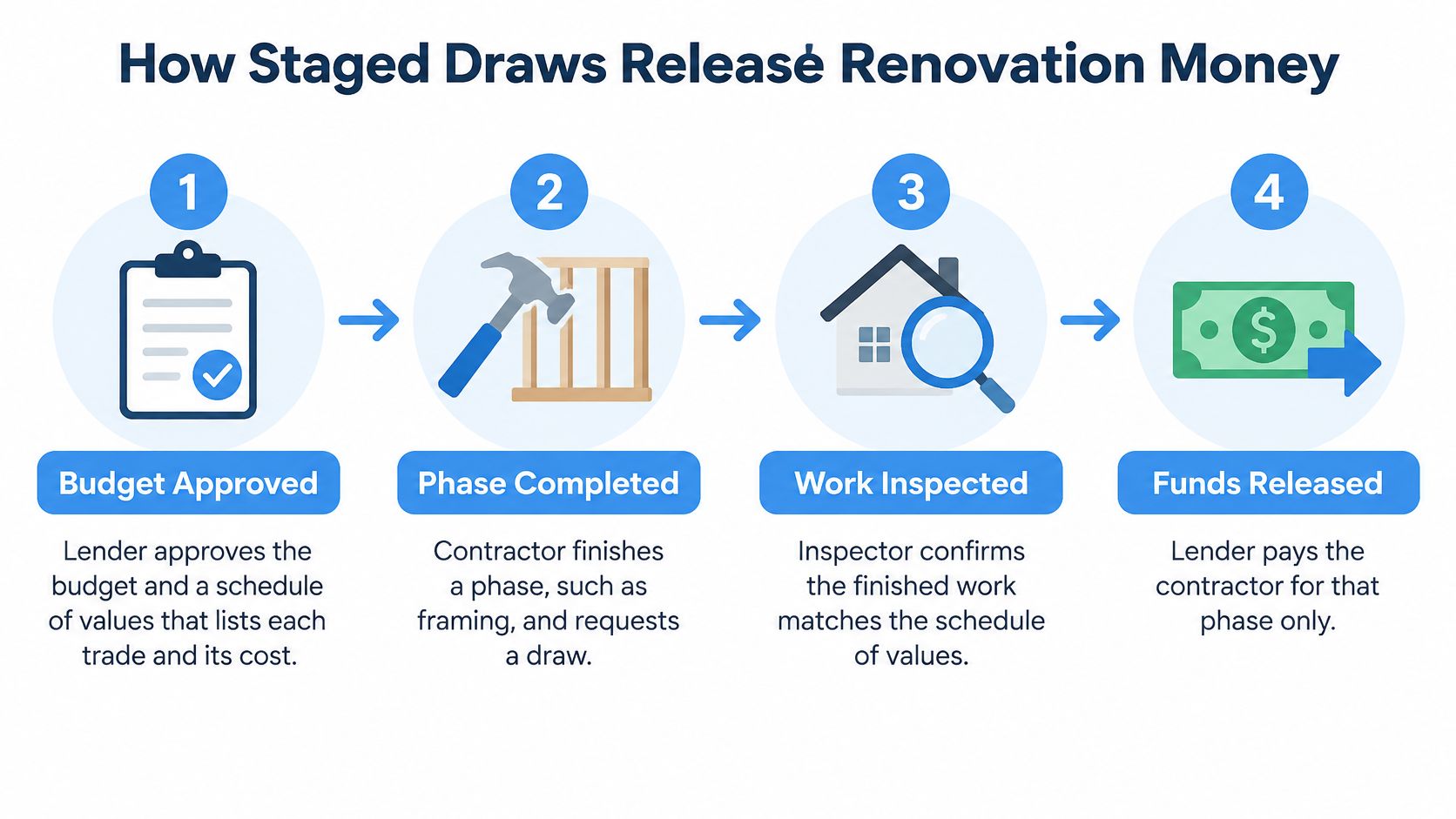
This visual shows the core sequence.
Follow the money through each phase
Approve the budget and schedule of values. The lender reviews each trade and its cost so draw requests can be matched to a specific approved line. Separate demolition, roofing, electrical, plumbing, cabinets, and finishes rather than grouping everything under general renovation.
Complete a phase and request payment. The contractor submits an invoice and the required conditional or unconditional lien waivers appropriate to payment status and local law. These documents help the lender verify what's owed and control potential lien exposure.
Inspect the completed work. An inspector checks progress against the approved scope because an invoice alone doesn't establish completion. Work outside that scope needs written approval before you assume it will support a draw.
Release the approved amount. The lender pays the contractor or reimburses the borrower according to the loan agreement, less any retained holdback. Confirm the payment recipient before signing the construction contract so nobody expects a payment route the lender won't use.
Pay interest and repeat. Under a drawn-balance structure, interest accrues on disbursed funds, so each release changes the carrying cost. Confirm this provision explicitly, because some loans charge interest on the full commitment or impose minimum-interest requirements.
Close out the project. The final release requires completion evidence, final lien waivers, and a certificate of occupancy or equivalent sign-off when applicable. These conditions protect against funding a project that still has unresolved legal or construction obligations.
Prevent administrative delays
The escrow principle has a clear public-program example. HUD's rehabilitation mortgage guidance describes renovation proceeds held partly in an interest-bearing escrow account and released as work is satisfactorily completed.
For a private investment loan, the governing documents set the actual process. Ask whether the lender funds deposits or stored materials, whether inspections carry separate fees, and whether a partial completion can support a partial draw.
Missing permits, unsigned waivers, inspection scheduling, and unapproved change orders can all interrupt payment. Have the contractor submit a complete draw package rather than asking the loan officer to collect missing pieces.
The video below provides additional context for renovation financing.
A fast closing doesn't guarantee fast construction payments. Ask separately about inspection scheduling, review time after a complete submission, and the time between approval and funds reaching the recipient.
Cost Documentation and Contingency Planning
A fully funded approved budget doesn't guarantee a fully funded finished project. In Block Renovation's 2025 survey of 1,002 U.S. homeowners, 37% exceeded their original renovation budget; the report identifies materials at 58%, labor at 40%, and unexpected repairs at 20% among cited overrun causes.
Those are homeowner survey findings, not investor performance estimates. For an investment purchase, the practical response is to document uncertainty before committing your cash.
Cost items and the documents to prepare
| Cost item | Documents to provide | Why it matters |
|---|---|---|
| Purchase | Settlement statement and signed contract | Sets the basis for loan-to-cost |
| Hard costs | Itemized contractor bids and scope of work | Each draw must match an approved line |
| Soft costs | Permit fees, architect and inspection invoices | Often left out of the first budget |
| Contingency | Separate reserve line, proof of funds, and release rules | Covers overruns and hidden defects |
| Holding costs | Interest schedule, tax bills, insurance quotes, and utility estimates | Paid while the property is unfinished |
| Change orders | Written approval with the new price | Keeps the budget and draws in line |
Reserve for specific problems
For a hypothetical $70,000 rehab, a 10% contingency provides $7,000. An unexpected $6,500 electrical panel change order would leave only $500 for everything else.
For preliminary planning, I'd test a 10% to 15% reserve, then replace that allowance with property-specific estimates. That's a budgeting recommendation, not a universal lender requirement. Older or distressed properties may justify more after inspecting wiring, sewer lines, foundations, roofing, and water damage.
Don't merely add a percentage to the contractor's total. Identify what remains unknown and price the likely remedies.
- Hidden conditions: Obtain inspections or specialist quotes before demolition where possible.
- Allowances: Replace vague fixture and material allowances with selected products and delivered pricing.
- Payment gaps: Keep cash available for approved work completed before reimbursement.
- Carrying expenses: Reserve separately for taxes, insurance, utilities, and debt service.
Use calculators to find omissions
Excellent Home Improvement's bathroom remodeling cost calculator can help organize an early bathroom budget, but it doesn't replace a site-specific contractor bid. Cross-check room estimates against the whole-property scope using LendingXpress's guide to estimating renovation costs.
Maximum construction leverage isn't the same as maximum financial safety.
The borrower covers overruns the loan doesn't fund. Before closing, establish whether contingency is financed, who approves its release, and how unused funds are handled. An undisbursed reserve may remain unadvanced rather than become cash available to the borrower.
How Private Rehab Loans Compare With Bank and Government Options
Government-backed rehabilitation financing can offer attractive pricing, but eligibility comes before price. FHA 203(k) is an owner-occupant program, not an option for the non-owner-occupied investments discussed here.
The FDIC's FHA 203(k) lending guide describes maximum financing of 96.5% for qualifying borrowers at the applicable higher credit threshold, 90% loan-to-value for scores from 500 to 579, and ineligibility below 500. These are program boundaries, not a promise that a lender will approve every eligible application.
Rehab financing options compared
| Option | Typical speed | Financing limit | Occupancy and scope | Best fit |
|---|---|---|---|---|
| FHA Standard 203(k) | Consultant review and multi-step approval | FHA leverage and mortgage limits apply | Owner-occupied; broader rehabilitation | Eligible homeowners who can accommodate program requirements |
| FHA Limited 203(k) | Simpler scope, still document-heavy | Limited-program rehabilitation cap applies | Owner-occupied; minor nonstructural work | Eligible homeowners with smaller projects |
| Fannie Mae HomeStyle | Conventional underwriting timeline | Agency value and renovation-cost limits | Conventional property and borrower guidelines apply | Agency-eligible borrowers who can wait |
| Bank construction loan | Bank underwriting and construction review | Bank loan-to-cost policy | Investment eligibility set by the bank | Borrowers with strong financials and scheduling flexibility |
| LendingXpress private rehab loan | Closings in as little as three days when conditions permit | Up to 100% of approved rehab costs | Non-owner-occupied residential and commercial | Investors needing acquisition speed and staged construction funding |
Compare execution, not labels
The distinction is broader than interest rates, as this comparison illustrates.

Private financing can fit a vacant property, a short purchase deadline, or a borrower whose file doesn't fit a bank's standard process. The lender can evaluate the collateral, equity, construction team, and repayment plan together. That flexibility doesn't remove title review, valuation, contractor review, or permit dependencies.
A bank can make more sense when the property qualifies, the borrower can document strong financials, and the closing schedule allows a longer review. Ask the bank whether it funds the property in its current condition before spending time comparing rates.
HomeStyle shouldn't be dismissed as universally unavailable to investors. Certain investment properties may qualify under agency rules, so an investor should have an approved lender check the exact property and transaction.
Price the delay
For an owner-occupant, a government program may be cheaper, but that borrower falls outside this investment financing discussion. For a non-owner-occupied purchase, compare eligible alternatives.
Estimate the carrying expense of a delayed closing or stalled renovation. Then compare it with the private loan's additional interest, points, draw charges, and potential extension costs. Don't justify expensive debt merely by calling it fast.
LendingXpress's private lender versus bank comparison can help organize that decision. Request written assumptions from each lender so a lower advertised rate isn't concealing a smaller advance, more required cash, or an impractical completion deadline.
Confirm the Draw Schedule Before You Sign
A rehab loan is only as useful as the payment process behind it. Ask for the draw schedule in writing before signing, and have the contractor review it alongside the construction agreement. A contractor expecting deposits may not be able to operate under a reimbursement-only structure.
Ask these questions before committing
Who receives each draw? Confirm whether payment goes to the contractor or borrower, how often requests are accepted, and whether deposits or stored materials qualify.
Who inspects the work? Ask how many business days scheduling normally takes, what documentation starts the review, and who pays for repeat inspections.
How does contingency work? Establish whether it's included in the commitment, what authorizes its release, and whether unused funds remain unadvanced or reduce an outstanding balance.
What interest is due during construction? Confirm the balance used to calculate it, the payment dates, and which account must fund each payment.
What ends or extends the loan? Get payoff terms, extension fees, maturity requirements, and any minimum-interest or prepayment provisions in writing.
Make the term sheet usable
Send the scope, contractor bids, comparable sales, proof of funds, and a one-page exit plan to a LendingXpress loan officer for review and a written term sheet. Ask that the proposal identify the acquisition advance, construction holdback, cash required at closing, and draw conditions separately.
Closings can happen in as little as three days when the documents, property review, and closing conditions are complete. Don't build the purchase contract around that possibility until the loan officer confirms your specific file can meet it.
A clear draw schedule protects the construction timeline as much as the interest rate protects the budget. Sign only when you understand both.
LendingXpress offers purchase-and-rehab and renovation financing for non-owner-occupied residential and commercial properties, with staged funding tied to approved work. Visit LendingXpress to submit your property, scope, and exit plan and request terms that show how much cash you'll need and when renovation funds can be released.