
A commercial bridge loan is a short-term, asset-based loan, usually lasting 12 to 24 months, that buys time until a property qualifies for permanent financing or a sale closes. In 2026, borrowers commonly face pricing around 350 to 650 basis points over SOFR, with all-in rates often near 8.5% to 11.5%, so bridge debt makes sense only when the transaction creates value or solves a timing problem that justifies the premium.
You may be staring at a property with strong potential, a seller demanding a quick closing, or an existing loan approaching maturity before the business plan is finished. Traditional banks may like the asset eventually, but they often won't lend against a property while occupancy, leases, renovations, or cash flow remain transitional. That gap is where commercial bridge financing earns its place.
The right question isn't, “Can I get a bridge loan?” It's, “Can I execute the exit before the bridge becomes expensive or impossible to refinance?”
What Commercial Bridge Financing Actually Is
An investor wins a 30-day auction close on a $4.2 million mixed-use building. The rent roll looks solid, but the property cannot qualify for permanent debt until lease-up is documented. The seller's bank line matures in 60 days, so the buyer needs capital that solves the timing problem before conventional financing is available.
Commercial bridge financing fills that gap. It is short-term debt secured by commercial real estate while the borrower completes an acquisition, refinance, renovation, lease-up, or repositioning plan. Repayment usually comes from permanent financing, a property sale, or a stabilization event.
Commercial bridge loans commonly run for 12 to 24 months. Banks pulled back from transitional real estate lending after the Global Financial Crisis, and private credit providers began financing properties that needed time before they could support conventional debt.
The loan is a bridge, not a destination
Give the facility one defined job:
- Acquire quickly: Close before a seller accepts another offer or an auction deadline passes.
- Refinance a maturing loan: Avoid a forced sale while leasing, construction, or stabilization continues.
- Fund repositioning: Pay for renovations that improve income, occupancy, or marketability.
- Buy time for a takeout: Move into permanent debt after the property meets the next lender's requirements.
The decision is not whether bridge debt can close. It is whether the property and sponsor can reach the exit before maturity creates a refinancing problem. A short-term loan can solve a deadline today and create a maturity wall later if lease-up, construction, appraisal, or permanent-loan approval takes longer than planned.
Bridge lenders evaluate the asset and the execution plan, not only current income. That flexibility suits properties that are incomplete, underleased, non-conforming, or outside a bank's standard credit policy. It also carries a cost: the borrower must fund the plan and preserve a credible refinance or sale option.
Senior loan officer's rule: If you cannot explain exactly who will repay the bridge, when repayment will occur, and what happens if the plan slips, you are not ready to borrow.
Review the structure, pricing, qualification standards, closing speed, use case, alternative capital, and exit risk before signing. You can also review LendingXpress's commercial bridge loan options when evaluating private financing for a non-owner-occupied acquisition, refinance, stabilization, or repositioning.
How Bridge Loans Are Structured and Priced
Bridge pricing reflects execution risk. The lender is advancing capital against a property with incomplete income, planned improvements, or an uncertain permanent-financing path. A useful term sheet must show the advance amount, interest mechanics, fees, reserves, maturity date, and the milestones required before repayment.
Start with loan-to-value
Lenders usually quote terms using loan-to-value, or LTV, based on the property's current as-is value. Commercial bridge financing commonly falls around 65% to 75% LTV. Value-add transactions may use loan-to-cost limits around 80% to 85% when renovation or repositioning costs are financed, according to commercial bridge loan underwriting guidance.
Loan-to-cost matters when acquisition proceeds and improvement capital are combined. A lower initial LTV gives the lender more equity protection if performance weakens or the appraisal declines. For the borrower, it also means bringing more cash to closing.
Bridge pricing generally floats over SOFR. Market commentary places spreads around 300 to 600 basis points, with wider spreads for weaker sponsors, higher debt levels, or more complicated assets, according to commercial bridge loan pricing guidance. Other market commentary places common spreads around 350 to 650 basis points, with all-in rates often around 8.5% to 11.5% for stabilized assets. Treat those ranges as deal indicators, not promises.
The spread can improve when the sponsor has relevant experience, contributes more equity, maintains strong liquidity, and presents a short, credible stabilization plan.
| Term Component | Typical Range | What Drives It |
|---|---|---|
| Term | 12 to 24 months | Stabilization schedule and refinance or sale timing |
| As-is LTV | 65% to 75% | Asset quality, debt level, location, and borrower equity |
| Value-add LTC | Up to about 80% to 85% | Renovation budget, cost basis, and draw controls |
| Pricing | 300 to 650 basis points over SOFR | Sponsor strength, asset risk, and exit certainty |
| All-in rate | About 8.5% to 11.5% in cited market commentary | SOFR plus the lender's spread |
Build the full cost, not just the coupon
The fee stack can include origination, underwriting, processing, legal, inspection, exit, extension, and appraisal charges. Prepayment terms also deserve review. Yield maintenance, defeasance, or other restrictions can make an early payoff more expensive than expected.
Consider a hypothetical $5 million bridge loan at 70% LTV, priced at a 9.5% rate, with a 2-point origination fee and a 24-month term with one extension option. The origination fee alone would equal $100,000, calculated as 2% of the loan amount. Annual interest at the stated rate would be $475,000, before amortization, extension charges, legal costs, or other fees.
That example makes the decision clear. Underwrite the refinance or sale before accepting the loan, because a maturity extension can turn a workable bridge into expensive emergency capital. For a broader explanation of rate mechanics, review LendingXpress's bridge loan interest rate resource. Require the lender to show proceeds, monthly interest, reserve requirements, extension pricing, and the projected payoff amount in one sources-and-uses schedule.
Who Qualifies and What Lenders Underwrite To
A bridge lender is deciding whether the property can reach a refinance or sale before maturity, not merely whether it performs like a stabilized bank loan today. The approval rests on four tests: collateral protection, cash flow, exit certainty, and sponsor execution.
Is the collateral protected?
Underwriting starts with property type, location, condition, marketability, and the borrower's equity. A common structure uses approximately 65% to 75% LTV. Value-add projects may reach about 80% LTC when renovation costs are included, according to commercial bridge loan requirements.
An underleased property, special-purpose asset, or non-conforming property can still qualify when the basis is defensible and the business plan is achievable. The lender will test the appraisal, comparable sales, repair budget, and borrower contribution. An optimistic value conclusion does not replace equity.
Does cash flow support the plan?
Transitional assets often have weak in-place debt service coverage. Some bridge lenders may accept a DSCR below 1.0x when the plan credibly reaches approximately 1.20x to 1.25x stabilized DSCR, as described in the same bridge loan requirements analysis. Other lenders may seek an in-place DSCR around 1.10x to 1.20x, depending on the property and structure.
The rent roll, market rents, operating expenses, renovation schedule, and projected refinance proceeds must support one consistent case. Underwriters will challenge unsupported occupancy gains, aggressive rent growth, and expense assumptions that ignore the asset's operating history.
Is the exit credible?
A signed refinance application is not an exit strategy. The borrower should identify the permanent loan product, its expected income requirements, the valuation support, and the amount of debt the stabilized property can carry. Underwrite a fallback if the takeout lender reduces proceeds or the sale takes longer than planned.
That maturity-wall risk matters more than the initial approval. A bridge loan can close against today's value and still fail if the property cannot satisfy tomorrow's refinance conditions.
Can the sponsor carry execution risk?
Lenders review experience, net worth, liquidity, credit history, guarantees, and construction oversight. Recourse may apply when the asset or sponsor carries greater risk. Stronger transactions may qualify for non-recourse structures, but customary carve-outs remain and the lender still focuses on property performance and the exit.
Clean approvals usually pair conservative financing with a realistic budget, documented liquidity, and a sponsor who has completed comparable work. Deals fail when the borrower needs maximum proceeds, has no reserve cushion, or depends on one untested refinance assumption.
The Application and Closing Timeline Step by Step
A bridge closing moves quickly only when the borrower supplies a complete package and resolves title, zoning, insurance, and entity issues early. A loan officer can screen the transaction from a concise submission, but the lender still needs enough evidence to verify collateral and repayment.

Seven stages keep the file moving
- Deal screening call: Discuss the property, requested proceeds, purchase or payoff deadline, sponsor background, and proposed exit.
- Term sheet: A lender may issue preliminary terms within 48 to 72 hours when the initial submission is complete.
- Parallel diligence: Underwriting, appraisal, title, insurance review, property reports, leases, and financial analysis proceed at the same time.
- Appraisal and title: These items may be completed in roughly 10 to 14 business days, depending on property complexity and vendor availability.
- Commitment and legal documents: The lender issues a commitment, identifies closing conditions, and negotiates loan documents.
- Borrower deliverables: The borrower supplies insurance, entity documents, organizational resolutions, bank wiring details, leases, tax information, and any remaining third-party items.
- Funding: Stabilized assets may fund in 14 to 30 days, while value-add transactions may require 30 to 45 days, based on the stated transaction profile.
The borrower controls much of the schedule. Send a clean rent roll, trailing operating statement, purchase contract, entity chart, borrower financial statement, renovation budget, and exit memo at the start.
Common delays include missing zoning letters, unpaid property taxes, unresolved title exceptions, incomplete insurance certificates, and liquidity gaps that surface during underwriting. A broker should confirm each item's owner and deadline rather than assuming the lender will find a solution at closing.
Real-World Uses for a Commercial Bridge Loan
Bridge debt works best when the borrower has a time-sensitive opportunity or a property that needs a defined transition period. The following deal patterns show how the product fits different stages of ownership.
Fast acquisition
An investor finds a 24-unit multifamily property priced below market. The seller wants to close in 10 days, and a competing contract may appear if the buyer can't perform. A bridge lender might structure acquisition financing at a negotiated floating rate, with a 12 to 24-month term and an exit through agency, bank, or other permanent debt after the borrower completes diligence and stabilizes operations.
The borrower accepts a higher short-term cost because losing the asset would eliminate the investment opportunity. That decision is rational only if the purchase basis and refinance assumptions remain sound under conservative valuation.
Maturity management
A sponsor's construction loan matures before the property reaches stabilization. Selling under pressure would destroy value, but the building needs additional leasing time. A 24-month bridge facility can refinance the maturing balance, fund remaining transition costs where approved, and give the sponsor time to complete the business plan.
The exit should be tied to measurable milestones, such as executed leases, completed work, and updated operating statements. The sponsor shouldn't rely on a lender extending the loan indefinitely.
Repositioning an underoccupied office asset
A value-add operator buys a 60% occupied office building at a 5.5% cap rate, sets aside $1.2 million for renovations, and plans to refinance after occupancy reaches 85%. A bridge loan can combine acquisition financing with controlled renovation draws, subject to the lender's loan-to-value and cost limits.
The refinance depends on more than the renovation itself. The sponsor must prove that tenants will sign, operating expenses are under control, and the stabilized cash flow supports the permanent loan.
Auction execution
A buyer wins a trustee sale and needs non-recourse capital within seven days. A conventional lender is unlikely to complete its process inside that window. A bridge lender may consider the transaction if the title, value, property condition, sponsor liquidity, and exit are clear.
Auction financing is unforgiving. The borrower must understand redemption rights, liens, possession issues, insurance, and the consequences of missing the funding deadline before committing to the bid.
Bridge Financing Compared to Permanent and Mezzanine Debt
The cheapest capital isn't always the correct capital. A stabilized property with predictable cash flow may deserve permanent debt, while a property facing a deadline or requiring a business plan may need a bridge. Mezzanine debt serves a different role, filling an equity gap behind senior financing.
| Factor | Bridge Loan | Permanent Financing | Mezzanine Debt |
|---|---|---|---|
| Cost | Higher floating-rate cost, commonly about 350 to 650 basis points over SOFR in cited market commentary | Usually lower than bridge debt when the asset is stabilized | Generally more expensive than senior debt because it sits behind it |
| Speed | Designed for time-sensitive closings and transitional assets | Slower underwriting focused on durable income | Often faster than permanent debt, but depends on the capital stack |
| Flexibility | Highest, especially for acquisitions, stabilization, and repositioning | Lowest, with tighter property and income requirements | Moderate, with negotiated intercreditor and control rights |
| Primary risk | Takeout, extension, and floating-rate risk | Refinance, prepayment, and long-term underwriting constraints | Subordination, equity dilution, and senior lender restrictions |
Permanent financing is usually the better choice when the property already produces the income needed for the loan and the borrower can wait through a conventional process. Its lower cost can improve long-term returns, but the borrower gives up bridge lending's speed and tolerance for transitional conditions.
Bridge debt is appropriate when the transaction's value depends on closing now or completing work before permanent underwriting. It becomes expensive if the borrower uses it merely because permanent financing feels inconvenient.
Mezzanine debt can increase total financing when the senior lender caps the first mortgage below the borrower's required capital. That extra financing comes with greater cost and may give the mezzanine lender meaningful approval, cure, or control rights.
Decision rule: Use bridge debt when speed or flexibility matters more than rate. Use permanent debt when the asset is stabilized and the rate drives returns. Use mezzanine debt only when senior leverage is capped and the additional cost is justified by the equity outcome.
Risks, Exit Strategies, and When Bridge Debt Backfires
Bridge debt fails when the borrower treats the maturity date as a hope instead of a deadline. Four risk vectors deserve attention before signing.
Extension fees can consume the margin
Warning sign: The stabilization schedule has no buffer, and the lender's extension terms appear only in a vague summary.
Mitigation: Negotiate extension rights, pricing, reserve requirements, and approval conditions before closing. Start the refinance or sale process well ahead of maturity, not after the first missed milestone.
The takeout can disappear
Warning sign: The exit depends on one permanent lender, one valuation, or cap rate improvement that hasn't occurred.
Mitigation: Underwrite at a lower refinance proceeds assumption, identify alternative lenders, and show how the sponsor can contribute cash if the takeout is smaller. Current market commentary shows conservative financing remains important, with CBRE-reported Q2 2026 average commercial LTV at 59.6% and multifamily LTV at 63.3%, as summarized in 2026 bridge loan market data.
Leverage compression creates a payoff gap
A permanent lender may approve the refinance but reduce proceeds because valuation, debt yield, or DSCR falls short. The bridge borrower then needs additional equity at payoff. Model that cash requirement before signing the acquisition contract.
Loan documents can restrict an early payoff
Read the prepayment section carefully. Yield maintenance, defeasance, minimum interest, exit fees, and extension charges can materially change the economics of a sale or refinance. Ask for a payoff illustration under multiple repayment dates.
The three practical exits are:
- Permanent refinance: Usually the cleanest path, but it depends on income, valuation, debt level, and market conditions.
- Third-party sale: Can repay the bridge quickly, but a weak sales market may require a price reduction.
- Recapitalization: Mezzanine debt or preferred equity can provide payoff capital, but it adds cost, structural complexity, and possible dilution.

Bridge debt is smart when the gap between as-is and stabilized value is closable inside the term with margin to spare. It's a value trap when repayment depends on cap rate compression or rate relief that hasn't materialized.
The maturity-wall problem makes this discipline more important. Independent industry reporting describes commercial real estate borrowers facing up to $2 trillion of maturities through the end of 2026, while borrowers increasingly use short-term capital to complete business plans or manage higher-for-longer rates, according to Private Equity International's bridge lending coverage. A bridge loan can buy time, but it can't repair an asset with no credible path to sustainable cash flow.
Choosing the Right Bridge Lender and Next Steps
A term sheet is only as good as the lender's ability to close, service, and manage problems after funding. Compare lenders on execution and documentation, not just the headline spread.
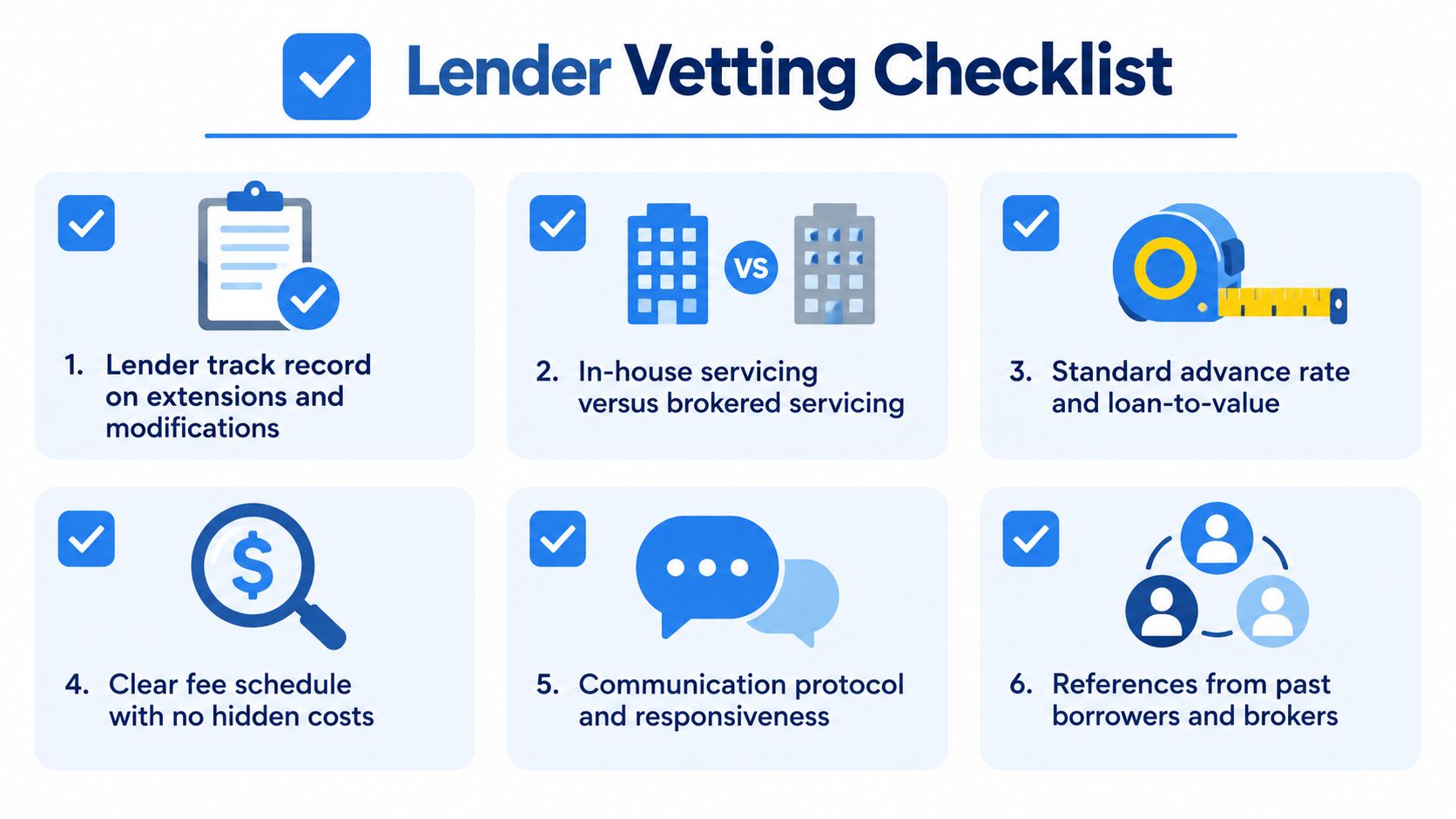
Run this lender checklist
- Extension history: Ask how the lender handles reasonable extensions, modifications, and delayed exits.
- Servicing model: Confirm whether servicing stays in-house or moves to a separate brokered servicer.
- Advance flexibility: Understand whether future draws, interest reserves, and approved cost overruns are available.
- Prepayment language: Review minimum interest, exit fees, yield maintenance, defeasance, and release provisions.
- Capital certainty: Determine whether the money is committed or depends on a fund with a finite life and changing deployment priorities.
- Communication standards: Identify who answers underwriting, construction, servicing, and closing questions after the term sheet.
Direct private lenders, debt funds, and bank bridge programs each bring different trade-offs. A direct lender may provide clearer communication and faster decisions. A debt fund may handle larger or more complex capital needs but impose institutional processes. A bank bridge program may offer a familiar relationship while applying stricter credit and documentation standards.
Before approaching anyone, pre-underwrite the property and the exit. Prepare a deal memo with the purchase contract, rent roll, trailing-12 operating statement, current debt, renovation budget, sources and uses, sponsor liquidity, and a concise explanation of the permanent-loan or sale strategy.
Request terms from at least three lenders in parallel, but don't create a race based only on rate. Compare proceeds, reserves, fees, extension language, reporting requirements, recourse, appraisal standards, and the lender's record of solving problems.
The strongest borrowers treat the lender relationship as a multi-cycle partnership. A lender who understands your asset, communicates clearly, and documents the exit properly can be more valuable than a slightly cheaper quote that fails under pressure.
LendingXpress offers commercial bridge loans for non-owner-occupied acquisitions, refinances, stabilization, and repositioning, with deal structures that can include staged rehabilitation draws when the transaction qualifies. Share your property, timeline, capital need, and exit plan with LendingXpress to discuss a practical bridge structure before your deadline becomes a crisis.