
You've got a non-owner-occupied property under contract, the numbers make sense, and the bank still says no. Maybe the closing window is too tight. Maybe the property needs work before it can support permanent debt. Maybe your income, tax returns, property type, or recent investment history doesn't fit a bank's approval box.
That rejection doesn't mean real estate capital has disappeared. It means the deal needs a different source, structure, or timeline. Real estate capital markets connect borrowers with banks, debt funds, private lenders, insurers, equity investors, and other capital providers, each with a different view of risk.
When the Bank Says No, Where Does the Money Come From
An experienced investor has a 12-unit value-add property under contract for 60 days. The purchase price works, the neighborhood is improving, and the renovation plan is clear. The bank reviews the file, sees a 1.18 DSCR, notes that the property needs $180,000 in repairs, and says it can't close within the contract timeline.
The deal isn't dead. It's unfunded through that particular channel.
A bank usually wants the property to show stable income today. A value-add investor is often buying the property because the current income is below its potential. That difference creates the financing gap. The borrower needs money before the improvements are complete, while the bank wants evidence that the improvements already happened.
This is the everyday reality behind the headlines about real estate capital markets. Capital is available, but it isn't distributed evenly. One lender may reject a transaction because of its DSCR policy, while another may focus more heavily on collateral, the renovation budget, the sponsor's experience, and the exit plan.
Practical rule: A bank rejection is information about fit, not always a verdict on the property.
The investor can approach a private lender or bridge lender with a different structure. The loan might rely on current value, projected value, borrower equity, repair milestones, and a refinance or sale strategy. Once the property is improved and income rises, the borrower may refinance into longer-term debt.
That path moves from rejection to execution. Understanding who supplies the money, how lenders evaluate the deal, and how to present the request starts with the larger system of private money lenders.
What Real Estate Capital Markets Really Are
Real estate capital markets are the network of debt and equity funding used to buy, build, renovate, refinance, and operate income-producing property. They include the money behind apartment buildings, industrial facilities, retail centers, hotels, office properties, and non-owner-occupied residential investments.
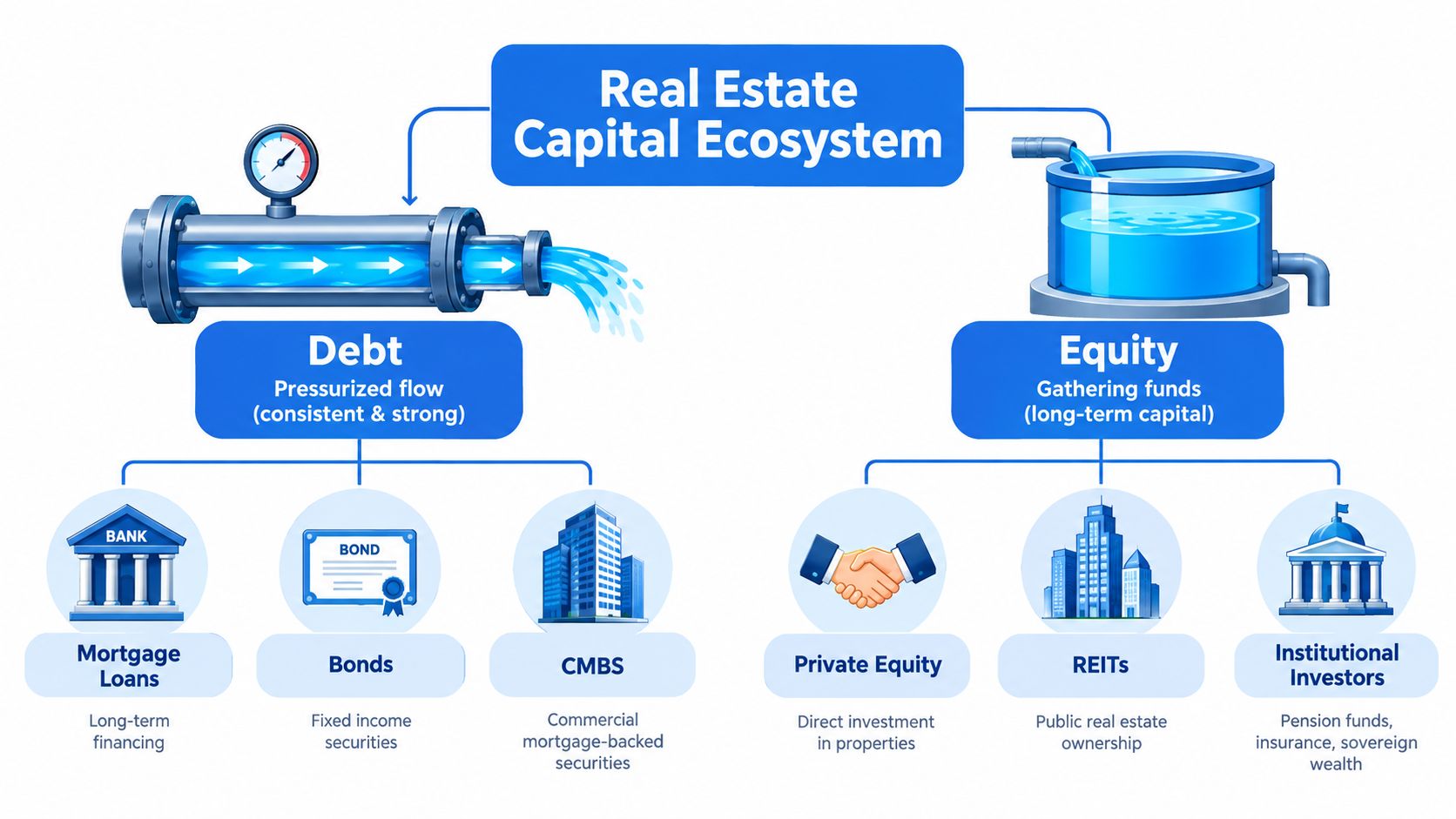
A simple plumbing analogy helps. Debt is the pressurized pipe. It sends a defined amount of capital to the property and expects scheduled repayment, interest, and compliance with loan terms. Equity is the reservoir. It supplies risk-bearing capital that absorbs losses first but receives more upside if the project succeeds.
The system includes:
- Mortgage loans from banks and private lenders
- Commercial mortgage-backed securities, or CMBS
- Bridge loans for transitional properties
- Private credit and hard money loans
- Mezzanine debt and preferred equity
- Joint venture equity
- REITs and institutional investment vehicles
Owner-occupied home mortgages sit outside the focus here. This article concerns income-producing residential and commercial property that the borrower doesn't live in.
Why the system matters to a borrower
The scale is substantial. MSCI reports that the professionally managed global commercial property market reached USD 13.5 trillion in 2025, an 8.5% increase, and the first rise in global market size since 2021. Industrial property grew to 20.5% of that market, while offices remained the largest share at 26.8%, according to MSCI's global real estate market size research.
That scale affects an individual borrower because a loan request enters a network of competing capital pools. A bank may prioritize low-volatility assets. A debt fund may accept transitional income if the collateral and sponsor are strong. A private lender may move faster because the decision process is built around the specific property rather than a broad consumer-style credit model.
The question isn't, “Is money available?” The useful question is, which capital provider understands this asset, this borrower, and this business plan?
Key Players and Instruments That Move the Money
A borrower can have a workable property and still hear no from a bank. The next question is not only whether financing exists. It is which provider can accept the property's income pattern, timeline, and risk. The capital stack maps those choices by showing who gets paid first and who absorbs losses first. Senior debt generally has the first claim on property cash flow and collateral. Common equity sits at the bottom, taking greater loss exposure in exchange for greater potential upside.
| Layer / Instrument | Typical Provider | Use Case |
|---|---|---|
| Senior bank loan | Regulated banks | Stabilized rental or commercial property |
| Agency debt from Fannie Mae, Freddie Mac, or FHA | Agency lenders and approved servicers | Qualifying multifamily assets with predictable income |
| Life company loan | Life insurers | High-quality, stabilized properties |
| CMBS loan | CMBS conduits | Stabilized commercial assets with durable cash flow |
| Bridge loan | Debt funds and bridge lenders | Value-add acquisitions, lease-up, renovation, or recapitalization |
| Hard money loan | Private lenders and private credit funds | Time-sensitive closings, distressed assets, or non-conforming borrowers |
| Mezzanine debt or preferred equity | Specialized funds | Filling a gap between senior debt and common equity |
| JV equity or REIT equity | Family offices, institutional investors, and REITs | Larger acquisitions, development, or growth strategies |
Debt providers
Regulated banks commonly prefer documented income, established borrowers, and properties with a proven operating record. Life insurers tend to seek stable assets with conservative debt levels. CMBS lenders package qualifying loans for securitization. That structure may support competitive pricing, though it can leave less room to change the loan after closing.
Private credit funds and mortgage REITs can build financing around collateral, the business plan, and the expected exit. A private lender may fit a borrower who needs to close quickly, owns a property under renovation, or falls outside a bank's standard underwriting rules. The tradeoff is often a higher cost or shorter repayment period.
Equity providers
Equity investors do not have the same contractual payment priority as senior lenders. They may provide common equity, preferred equity, or joint venture capital. In return, they may receive current distributions, a preferred return, profit participation, or control rights.
For a borrower, that difference affects both cash flow and control. A bridge loan creates repayment obligations and usually has a defined maturity. Equity can reduce scheduled debt pressure, but it may require sharing ownership, profits, and decisions.
The lower a source sits in the capital stack, the more risk it usually accepts. That risk must be compensated through pricing, control, or upside.
A value-add acquisition may pair a senior bridge loan with borrower equity. A stabilized apartment property may suit agency or life company debt. A short closing on a distressed, non-owner-occupied property may call for private capital, where speed and flexible underwriting matter more than the lowest headline rate.
The Metrics That Decide Who Gets Funded
Underwriters speak a common language. Four measures appear repeatedly in non-owner-occupied financing: cap rate, spread, loan-to-value ratio, and DSCR.
Cap rate
The cap rate compares a property's net operating income with its value. Suppose a $5 million apartment purchase produces net operating income equal to a 5.5% cap rate. That calculation helps the lender judge the relationship between current income and the purchase price.
A low cap rate can reflect a desirable location, strong demand, or aggressive pricing. It can also leave less room for error if income falls or expenses rise. Lenders don't read the cap rate alone. They compare it with the property type, market evidence, condition, and projected exit.
Spread
A spread is the additional interest charged above a reference rate. A 250-basis-point spread over SOFR means the lender adds 2.50 percentage points to the applicable SOFR rate. The spread reflects credit risk, debt levels, property quality, loan structure, duration, and lender competition.
A stronger borrower and stabilized asset may receive a tighter spread. A transitional property with uncertain income may carry a wider spread, additional fees, stronger reserves, or more restrictive covenants.
LTV
Loan-to-value compares the loan amount with the property value. At 65% LTV on a $5 million purchase, the senior loan would be $3.25 million, with the remaining capital coming from equity or another source. The loan-to-value ratio is explained in more detail in this guide to what loan-to-value ratio means.
LTV is especially important to private lenders because collateral provides a practical recovery source if the borrower can't repay as planned. A lower LTV generally gives the lender more value protection, although it doesn't eliminate operating or execution risk.
DSCR
A 1.25 DSCR means the property's net operating income covers scheduled debt service by 1.25 times. In plain language, the property generates more income than the required loan payments, creating a cushion.
These measures affect both approval and pricing. A deal with a 5.5% cap rate, 65% LTV, and 1.25 DSCR may be financeable, but the lender still needs to evaluate the spread, property condition, sponsor history, and exit. Private and hard money lenders use the same basic framework, but they may place more weight on LTV, collateral, and exit clarity than on current income alone.
Where the Market Stands in 2026
Real estate capital markets are recovering, but borrowers shouldn't mistake recovery for easy money. McKinsey reports that global real estate deal value reached USD 873 billion in 2025, up about 12% year over year, while transaction counts stayed broadly flat. The same analysis says closed-end real estate fundraising rose 16% to USD 146 billion, still about 50% below prepandemic peaks. Those figures point to larger, more selective transactions rather than universal access to capital.
Cross-border activity also shows regional rebalancing. CBRE reported that cross-regional capital flows to North America, Europe, and Asia-Pacific reached USD 37 billion in the second half of 2024, up 31% year over year. Europe received USD 21.63 billion, the United States received USD 9 billion, and Asia-Pacific flows rose 221% to USD 6.3 billion, as detailed in CBRE's global real estate capital flows report.

Why borrowers still feel pressure
Capital exists, but lenders are selective about structure and collateral. Newmark reports that U.S. closed-end real estate funds held $328 billion in dry powder in 2025, down 13% since December 2022, while commercial and multifamily mortgage debt reached $4.81 trillion in the first quarter of 2025. The Newmark capital markets report describes a market with substantial total debt but more selective new lending.
Maturity pressure adds urgency. Banks had $371 billion and securitized lenders had $232 billion maturing through 2026 in the Q4 2025 CRE debt universe, while about $1.6 trillion matures in 2031 and beyond, according to Trepp's CRE debt universe analysis.
Owners facing refinancing may need to contribute equity, sell, recapitalize, or use bridge and rescue capital. Interest-rate volatility, office distress, rising insurance costs in states such as Florida, Texas, and California, and tighter construction underwriting make property-level analysis more important than broad market averages.
How Brokers and Investors Access Capital in Practice
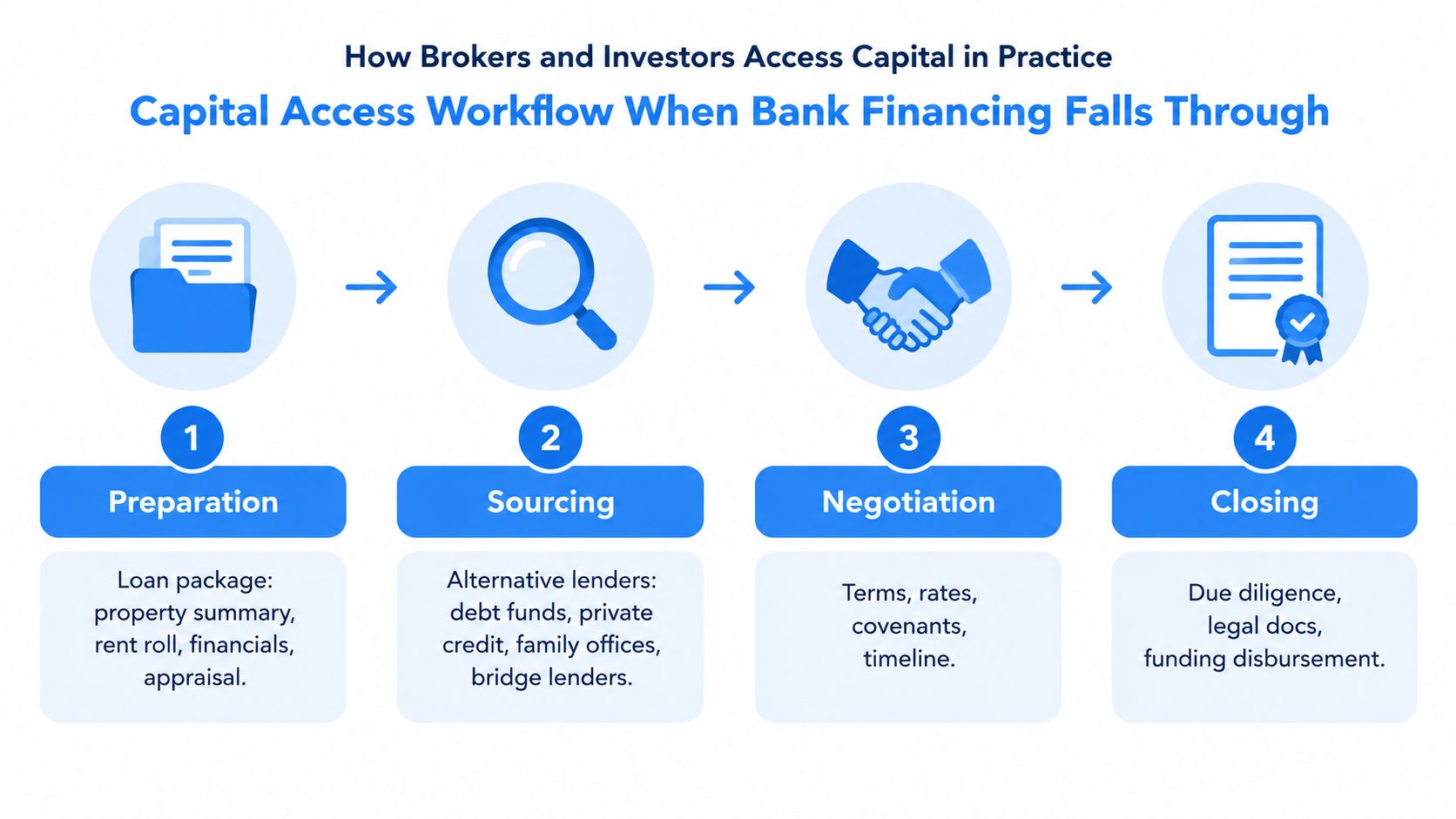
A failed bank process becomes manageable when the borrower changes from “I need a loan” to “I need this exact capital structure for this exact exit.” Start with a complete package:
- Property summary: Address, property type, purchase price, current value, projected value, and business plan.
- Operating evidence: Rent roll, trailing 12-month operating statements, leases, taxes, insurance, and utility information.
- Capital request: Loan amount, desired term, renovation budget, reserves, and proposed funding schedule.
- Exit strategy memo: Refinance, sale, stabilization, or another clearly explained repayment path.
- Borrower file: Entity documents, financial statements, credit information, liquidity, and investment history.
Match the deal to the capital pool
A stabilized rental property with dependable cash flow may suit a bank, life company, agency lender, or conventional debt fund. A property with renovations, lease-up, or below-market rents may fit a bridge lender. A tight closing, distressed acquisition, or borrower with non-conforming income may require hard money or private credit.
The sourcing channel matters. Brokers use direct lender relationships, mortgage brokers, lender email lists, online lending platforms, family offices, and private credit funds. A warm relationship can reduce the time spent explaining a lender's own process and reveal whether the request fits current appetite.
A realistic short-closing workflow
Suppose an investor has an acquisition that must close within 30 days. A bank may still be the right long-term source, but its appraisal, committee, documentation, and approval sequence may not match the contract. A private bridge lender can evaluate the collateral, sponsor, renovation plan, and refinance strategy as one package, then structure a short-term loan that gives the investor time to execute.
The borrower pays for that flexibility through pricing, fees, reserves, or a shorter loan term. The value comes from preserving the acquisition and creating a clear path to permanent financing or sale.
Experienced brokers don't wait for a bank decline before building alternatives. They keep responsive private lenders available before the next contract arrives.
For renovation projects, funds are often released through staged draws rather than delivered all at once. Industry guidance describes an initial draw of about 10% to 15%, milestone draws of 20% to 30%, and a final draw of 10% to 20% after inspection or a certificate of occupancy, as outlined in this renovation financing guidance. The lender can match funding to progress, while the borrower avoids paying interest on undisbursed renovation capital.
Bank Financing Compared With Private and Hard Money Options
No single capital source wins every deal. The right choice depends on the property's current income, the closing deadline, the borrower's documentation, and the plan for repayment.
| Source | Typical LTV | Rate Range | Days to Close | Documentation | Best-Fit Deal |
|---|---|---|---|---|---|
| Bank loan | Conservative and policy-driven | Usually the lowest available for qualifying borrowers | Longer approval process | Extensive income, property, and borrower documentation | Stabilized, conventional assets |
| Conventional debt fund | Asset and sponsor dependent | Market-based, often above bank debt | Moderate timeline | Detailed property and sponsor package | Stabilized or lightly transitional assets |
| Bridge lender | Structured around collateral and execution risk | Above permanent mortgage pricing | Faster than most banks | Property, budget, exit, and sponsor review | Value-add, lease-up, or refinance gap |
| Hard money or private lender | Often driven by collateral and exit | Higher than bank and permanent debt | Fast when the file is complete | Focused underwriting with supporting documents | Tight closings, distressed assets, non-conforming borrowers |
| Crowdfunded equity | Project and sponsor dependent | Equity return structure rather than a loan rate | Depends on investor fundraising | Offering materials, due diligence, and sponsor disclosure | Larger acquisitions or projects needing equity |
Bridge loans are commonly priced above permanent mortgages. One 2026 market summary places commercial bridge loans at 350 to 650 basis points over SOFR, while another places national bridge-loan rates at roughly 9% to 14.5%, with single-family investment properties commonly at 9.0% to 11.5% and value-add or heavy-rehab deals around 10.5% to 13.0%, according to this 2026 bridge loan market summary.
When a bank is the obvious choice
Choose a bank when the non-owner-occupied property is stabilized, the borrower has complete documentation, the closing timeline allows full underwriting, and the borrower values lower long-term pricing over structural flexibility.
When bridge or debt funds fit better
Bridge lenders and debt funds make more sense when the asset needs work, income is temporarily weak, or the borrower has a defined plan to stabilize and refinance. They can underwrite the transition rather than relying only on current operations.
When private or hard money is realistic
Private capital becomes useful when the property is non-conforming, the closing date is tight, the borrower needs a renovation budget, or a bank's process doesn't fit the transaction. The borrower should still compare total cost, prepayment terms, extension options, reserves, and exit requirements.
Building a Reliable Financing Strategy Going Forward
A repeatable strategy starts before the next property goes under contract.
Pre-qualify the deal and borrower
Review the purchase price, current value, projected value or ARV, cap rate, DSCR, LTV, renovation budget, liquidity, credit profile, and sponsor history. Identify the likely exit before asking a lender to approve the entry. A borrower who can explain how the loan gets repaid gives every capital source a clearer risk picture.
Keep a tiered lender list
Build one group for banks and agency lenders, another for debt funds and bridge lenders, and a third for private and hard money providers. Each group should have a defined use case. This prevents a borrower from sending a value-add acquisition to a lender that only wants stabilized cash flow.
Package the request around lender screens
Lenders need more than a property address. Give them a concise summary of the collateral, operating performance, requested structure, renovation scope, exit timeline, and sponsor experience. Include stress scenarios that show what happens if stabilization takes longer or the refinance market changes.
Nurture the relationship between deals
A lender who already knows the borrower can respond more efficiently when a contract lands. Discuss target property types, preferred loan sizes, expectations for debt structuring, documentation standards, and closing timelines before an urgent request arrives.
MSCI's real assets database covers more than USD 50 trillion in deals across sales, financings, and construction, with consistent analytics across more than 70 countries, according to MSCI's real assets market data. That type of market evidence helps institutional lenders benchmark pricing and liquidity, but individual borrowers still need a lender who can interpret the specific property and execution risk.
Private credit will remain relevant as refinancing pressure, rate volatility, and uneven bank appetite continue. For non-owner-occupied investors, a responsive private lender isn't merely a fallback. It can be part of a deliberate financing plan that protects timing, funds improvements, and creates a bridge to the next capital event.

If a bank has delayed or declined your non-owner-occupied purchase, refinance, bridge, or renovation request, visit LendingXpress to discuss a private financing structure built around the property, timeline, and exit plan. Prepare your property summary, rent roll, financials, and capital request so a LendingXpress loan officer can help identify whether a bridge, fix-and-flip, rental, or commercial loan fits your next move.