
You've found a non-owner-occupied commercial property that looks like a strong investment. The rent roll appears healthy, your personal credit is solid, and the purchase opportunity is time-sensitive. Then the bank declines the request because its underwriting model doesn't support the property's income after accounting for vacancy, expenses, lease rollover, or the proposed debt payment.
That situation is common because commercial property loan requirements focus on more than the borrower's credit profile. For an investment property, the asset needs to support the debt, the valuation needs to justify the loan amount, and the repayment or refinance plan needs to make sense. Personal strength helps, but it won't automatically repair weak property cash flow.
This guide uses a practical, cash-flow-first approach for investors and brokers financing non-owner-occupied office, retail, industrial, multifamily, mixed-use, and other income-producing assets. You'll see how lenders evaluate DSCR, LTV, borrower liquidity, property type, documentation, timing, and private lending alternatives when a conventional bank's checklist doesn't fit the deal.
Introduction to Commercial Property Loans for Investors
A commercial property loan differs from a residential mortgage because the lender is primarily analyzing an income-producing asset. With a home loan, personal income and household obligations often dominate the decision. With an investment property, the lender also asks whether tenants, leases, rents, and operating performance can support the proposed payment.
Consider an investor with good credit who wants to refinance a small retail building. The investor has a reliable income source and a strong payment history, but two tenants are approaching lease expiration and the property's expenses were understated in the seller's financials. A traditional lender may reduce the underwritten income or require more equity, making the request fail even though the borrower looks acceptable on paper.
A private lender may approach the same file differently. The lender still needs a credible valuation, a defensible repayment plan, and enough protection against downside risk. However, the review may give more weight to the property's current condition, the borrower's plan, available liquidity, and the practical path to stabilization or refinance.
The central question
The first question isn't just, “What's your credit score?” It's, “What will the property produce, what will the debt cost, and how much equity protects the loan?”
That distinction matters in the current capital environment. $875 billion in commercial and multifamily mortgage debt is scheduled to mature in 2026, with another $652 billion due in 2027, according to the 2026 capital reset analysis. The same source estimates $706 billion in commercial real estate borrowing and lending in 2025, up 40% from 2024 and 65% from 2023. These figures describe a refinancing-heavy market, so lenders may scrutinize documentation, equity, valuation, and extension conditions even while lending activity rebounds.
Practical rule: A strong borrower can support a borderline property, but strong credit alone usually can't make an underperforming property cash-flow positive.
You'll get better results by preparing the property-level income story first, then matching the loan structure to the asset and exit. That's where flexible private capital can help investors move quickly without pretending that risk doesn't exist.
How Commercial Property Underwriting Really Works
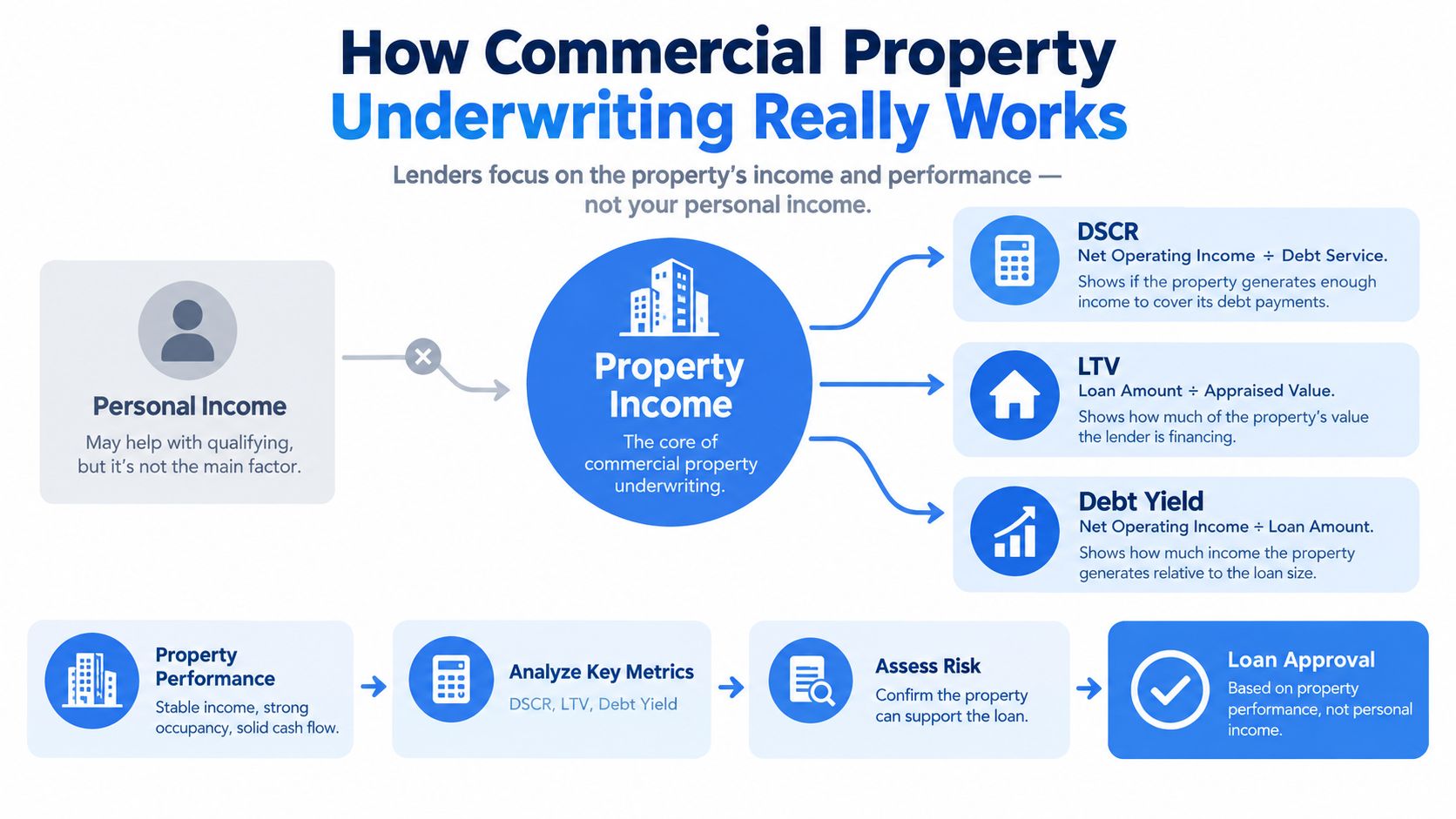
Commercial underwriting is best understood as a stress test for the property. The lender wants to know whether the asset can continue making payments if rents soften, a tenant leaves, expenses rise, or the valuation comes in below expectations.
Start with DSCR
Debt service coverage ratio, or DSCR, equals net operating income divided by annual debt payments. A property with net operating income of $120,000 and annual debt payments of $100,000 has a DSCR of 1.20x. The ratio indicates how much income remains relative to scheduled debt service, not how much profit the owner can freely distribute.
Across major markets and lender types, the commonly cited DSCR floor is about 1.20x to 1.35x, with many conventional commercial lenders clustering around 1.25x, according to commercial mortgage guidance from Commercial Loan Direct. In practical terms, the property generally needs to generate 20% to 35% more income than its debt service to qualify under those standards.
A DSCR below 1.0x usually means the property can't fully cover its own debt. The borrower may have outside income, but the asset itself is showing a repayment shortfall. That's a major concern for a non-owner-occupied loan because the property is expected to carry much of the repayment burden.
Then measure the equity cushion
Loan-to-value, or LTV, compares the loan amount with the property's value. If a building is valued at $1 million and the proposed loan is $700,000, the LTV is 70%. The remaining value represents an equity cushion that can help protect the lender if the property must be sold after a default.
DSCR is the property's payment cushion. LTV is the collateral cushion. A lender typically wants both to work because a property can have adequate income but an inflated value, or a conservative value but insufficient income for the requested debt.
The lender also studies tenant concentration, vacancy, lease rollover, operating expenses, property condition, and marketability. A building with one major tenant nearing expiration presents a different risk from a diversified property with durable leases, even if both show similar current rent.
For a more detailed look at the underwriting workflow, review LendingXpress's commercial real estate underwriting resource. Investors should also understand how a transfer restriction can affect a future sale or refinance, so a practical 2026 alienation clause guide can be useful when reviewing loan documents.
The following video offers another visual explanation of commercial underwriting concepts:
Borrower Requirements That Drive Approval
Property cash flow may lead the analysis, but lenders still evaluate the people and entities responsible for ownership, management, and repayment. A borrower with limited experience can qualify when the property and structure are compelling, but the file needs compensating strengths.
What lenders verify
A lender normally reviews credit history, liquidity, net worth, relevant ownership experience, entity documents, contingent obligations, and the proposed exit. Private underwriting may be more tolerant of an imperfect credit profile or thin income documentation, but it still needs evidence that the borrower can fund closing, handle property costs, and follow through on the business plan.
The Office of the Comptroller of the Currency's commercial real estate lending guidance identifies cash flow and DSCR as core underwriting factors. Industry guidance used by lenders often targets 1.20x to 1.35x DSCR, with 1.25x commonly cited as a floor.
Credit issues don't all carry the same meaning. A recent unresolved default is more difficult than an older event with a clear explanation, paid obligations, and stronger current liquidity. A borrower should explain adverse history directly rather than force the underwriter to reconstruct it from scattered records.
Compensating factors that help
- Liquidity: Demonstrate funds for the down payment, closing costs, reserves, repairs, and operating needs.
- Experience: Show prior ownership, leasing, construction, property management, or a qualified operating partner.
- Structure: Reduce debt, add a guarantor, use staged draws, or choose a shorter bridge strategy when appropriate.
- Exit: Explain whether repayment will come from a sale, refinance, lease-up, or stabilization.
- Transparency: Provide a clean timeline for credit events, litigation, bankruptcies, liens, or other obligations.
Private and hard money lenders often have more room to evaluate the complete transaction instead of relying only on a bank's standard income model. That flexibility isn't a waiver of underwriting. It's a different way to weigh collateral, execution, liquidity, and risk.
Property and Deal Requirements by Asset Type
The property type affects nearly every part of the loan decision, including capital structure, valuation, DSCR interpretation, tenant analysis, and exit risk. A stable multifamily asset may support a different structure from a vacant office building, a hotel, a land acquisition, or a specialized facility.
For conventional permanent financing, typical commercial LTV ceilings cluster around 65% to 75%. Stronger cash flow may support 75% to 80% in select segments, while borrowers generally contribute roughly 25% to 35% equity, according to Pilot House's commercial financing guidance. Lenders often require larger equity stakes for value-add, hotel, land, and special-purpose properties because income volatility and liquidation risk are higher.
A practical comparison
| Property Type | Typical LTV Range | DSCR Expectation | Lender Notes |
|---|---|---|---|
| Multifamily | 65% to 75% | Around 1.20x to 1.35x | Review unit rents, occupancy, expenses, concessions, and reserves |
| Industrial and warehouse | 65% to 75% | Around 1.20x to 1.35x | Tenant quality, lease term, access, configuration, and specialized improvements matter |
| Retail | Often 65% to 75% | Around 1.20x to 1.35x | Tenant concentration, anchor exposure, parking, and rollover can affect leverage |
| Office | Often more conservative | Around 1.20x to 1.35x | Lease expiration, tenant improvements, re-leasing costs, and demand receive close review |
| Hotel and hospitality | Often below conventional ranges | Lender-specific | Operating performance, management, licenses, and business income create added risk |
| Land or special-purpose | Often below conventional ranges | Lender-specific | Limited alternative use and uncertain income can restrict proceeds |
The DSCR ranges in the table are general market guidance, not guaranteed approvals. A lender can require stronger coverage when the property has near-term rollover, weak condition, volatile income, or a complicated refinance.
Owner-occupancy confusion
SBA 504 financing is a separate program with specific occupancy rules. The borrower must be a small business located in the United States, and an existing building must be at least 51% owner-occupied. SBA materials also identify a 60% owner-occupancy threshold for new construction in the first year, rising to 80% within 10 years, as explained in the SBA 504 loan requirements. That structure generally doesn't fit a purely non-owner-occupied investment property, so investors should not assume SBA terms apply to a passive rental or third-party tenant asset.
The market is also split by asset class. The CBRE Lending Momentum Index reached 1.5 in Q1 2026, up from 1.2 in Q4 2025 and 0.3 a year earlier. Commercial mortgage spreads averaged 181 basis points in Q1 2026 and 204 basis points in Q2 2026, while MBA data showed Q2 2026 originations up 16% year over year, led by a 61% increase in retail lending and a 47% increase in office lending. Improving volume doesn't create one universal checklist. Asset quality and property type still drive the terms.
Documents Timelines and the Path to Closing
A complete package gives the lender fewer reasons to pause the file. For a non-owner-occupied property, the documents should tell one consistent story about ownership, income, expenses, value, use of funds, and repayment.
Prepare the core file
Start with the purchase agreement or current loan statement, a current rent roll, executed leases and amendments, property operating statements, tax information, insurance details, entity formation documents, and a personal financial statement. Add the appraisal, title materials, environmental information, property-condition reports, contractor scope, permits, rehab budget, and projected completion schedule when the transaction involves renovation or repositioning.
The LendingXpress loan documentation requirements can help brokers organize the submission before sending it to a loan officer. For teams also comparing borrower-facing mortgage data tools, RealtyAPI.io Realtor mortgage provides relevant context for mortgage workflows, although the commercial lender's own checklist controls the actual approval.
Move through the file in order
- Initial review: Send the property address, type, occupancy, requested loan amount, purchase or refinance purpose, ownership entity, rent roll, and operating summary.
- Preliminary terms: The lender evaluates fit, likely loan-to-value ratio, property cash flow, and the proposed exit before deeper diligence.
- Underwriting: The lender reconciles leases, revenue, expenses, valuation, borrower information, title, insurance, and property condition.
- Reports and conditions: Appraisal, environmental, title, survey, and other third-party reports may be ordered as required.
- Closing: The borrower signs final documents, satisfies conditions, funds required equity and reserves, and receives loan proceeds.
Private capital can move faster than a bank when the file is organized and the collateral fits the lender's program. Timing still depends on appraisal access, title issues, entity documents, lease quality, environmental findings, and how quickly the borrower answers conditions. Missing leases, unexplained deposits, inconsistent ownership names, or an unclear use of funds can delay any lender.
Real World Examples and How to Improve Your Approval Odds
Requirements become easier to understand when you compare two different investment strategies.
Example one, a fix-and-flip bridge
An investor is buying a dated commercial asset that needs work before it can support stabilized occupancy. Current income may be too weak for a conventional permanent loan, so the lender focuses on acquisition value, renovation scope, the borrower's execution plan, and the sale or refinance exit.
A private bridge lender may consider financing up to 100% of rehab costs, provided the overall structure uses conservative LTV assumptions and the borrower can demonstrate the capacity to complete the work. That doesn't mean the lender ignores equity, collateral, or payment risk. It means the renovation budget can be handled separately from the borrower's cash contribution when the broader transaction supports it.
Example two, a stabilized rental refinance
A borrower owns a leased multifamily or industrial property and wants to refinance an existing loan. The lender focuses on the rent roll, lease terms, recurring expenses, stabilized NOI, valuation, current debt, and refinance proceeds. Strong documented cash flow can support a cleaner approval, while near-term rollover or weak expense records may reduce proceeds even if the property appears fully occupied.
These examples show why a borrower shouldn't submit every deal using the same structure. A transitional asset needs a credible improvement and exit plan. A stabilized asset needs clean operating evidence and enough coverage for the proposed payment.
Ways to make the file more financeable
- Improve documented cash flow: Reconcile deposits, leases, reimbursements, expenses, and bank statements before submission.
- Lower the requested loan amount: A smaller loan can improve the equity cushion and make valuation risk easier to manage.
- Add operating capability: Bring in an experienced property manager, contractor, or partner when your own track record is limited.
- Fund reserves: Show that the property can handle repairs, vacancy, insurance changes, tenant improvements, or delayed stabilization.
- Clarify the exit: State the expected sale, refinance, lease-up, or stabilization path and identify the conditions that support it.
- Use staged draws: For renovation work, align disbursements with inspections, invoices, permits, and measurable completion milestones.
A private lender can be useful when a bank's income model doesn't capture the transaction's practical strengths. The strongest files still present downside protection clearly. Speed helps you compete, but clarity helps the lender say yes.
Next Steps to Secure Your Commercial Property Loan
The right financing decision starts with a short diagnosis. Ask four questions before requesting terms:
- Does the property produce enough documented income for the proposed debt?
- Does the requested loan leave a reasonable equity cushion for the asset type?
- Can the borrower fund closing, reserves, repairs, and operating needs?
- Is the exit realistic under conservative value and cash-flow assumptions?
If the answer to one question is weak, adjust the structure instead of sending the same request to more lenders. Reduce the loan amount, add equity, improve the operating package, bring in experienced management, or use a bridge loan that matches the property's transition period.
Don't confuse a general lending guideline with a commitment. DSCR, LTV, valuation, tenant quality, property condition, recourse, reserves, and exit terms all interact. A property can satisfy one metric and still fail because the lender sees rollover risk, incomplete documentation, or an unsupported refinance plan.
Investors who are using equity from another asset should also review the tax and repayment implications before choosing a structure. A resource covering a home equity loan on rental property can help frame that discussion, but the final financing decision should account for both properties, their obligations, and the planned investment exit.
For brokers, the fastest path is usually a complete first submission with the rent roll, leases, operating statements, entity documents, valuation information, requested proceeds, use of funds, and exit strategy. For investors, it's a direct conversation about what the property can support today and what it should support after stabilization.
Private lending makes the most sense when timing matters, the collateral has a clear path to value, and traditional underwriting doesn't reflect the full transaction. It shouldn't replace disciplined analysis. It should give a viable deal a structure that fits its actual stage.
LendingXpress structures private and hard money financing for non-owner-occupied commercial and investment properties, including bridge, fix-and-flip, refinance, and cash-out scenarios. Visit LendingXpress to submit your property details and connect with a loan officer who can review the cash flow, collateral, and exit strategy together.