
You've found a non-owner-occupied property, run the rent numbers, and the deal works. Then the bank offers less than you need, moves too slowly, or says no because the property needs work. That's where gap funding for real estate investors comes in. It doesn't replace a sound deal. It fills a specific, dated shortfall between your senior loan, your cash, and the money required to close, renovate, or stabilize the property.
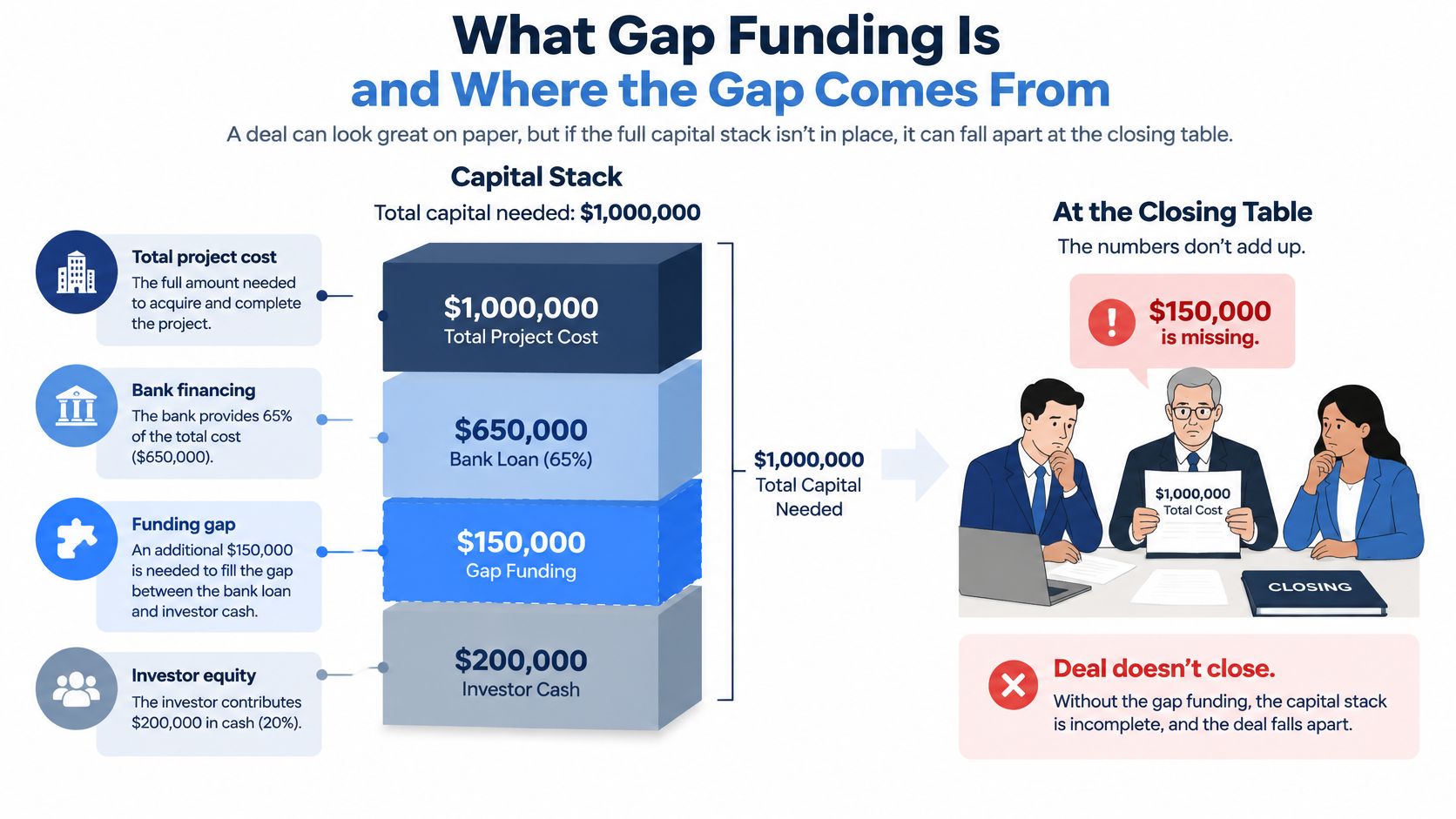
What Gap Funding Is and Where the Gap Comes From
Say a deal needs $1,000,000 in total capital for the purchase, closing costs, and repairs. A bank will lend 65%, or $650,000. You have $200,000 cash. You don't have a bad deal. You're $150,000 short at the closing table.
Think of the project as a bucket that must be full before it holds water. The senior loan fills most of it, your cash fills another part, and the missing $150,000 is the hole. Gap funding is the short-term capital that plugs that hole for a non-owner-occupied residential or commercial property.
Why Banks Leave a Hole
The shortfall isn't always about value. A bank may limit the loan size, dislike the property's condition, question your experience, need more documentation, or take longer than the seller will wait. At the end of 2024, outstanding U.S. commercial real estate mortgage debt totaled approximately $6 trillion, and banks held about 50% of that debt, according to Federal Reserve research on CRE lending. Even in a market that large, one lender's rules can leave one good project underfunded.
Gap capital can sit behind the senior loan as a second lien, mezzanine debt, or preferred equity. It can also work as a standalone bridge loan, meaning short-term financing you repay from a sale, refinance, or permanent loan.
Find your own number with three figures:
- Total capitalization: Purchase, closing costs, repairs, reserves, and carry.
- Senior proceeds: What the first lender will fund in writing.
- Cash available: Money you can put in without emptying reserves you need later.
Subtract the last two from the first. That's your starting gap, before you stress test it.
Three Deals Where Investors Need Gap Funding
| Situation | Where the shortfall comes from | Typical gap term | Required exit |
|---|---|---|---|
| Acquisition with a tight closing | Senior loan capped at about 65% of value; seller needs a fast close | 3 to 12 months | Refinance or sale |
| Rehab overrun | Renovation costs rise after change orders and permit delays | Renovation period plus 3 to 6 months | Sale or refinance after completion |
| Bridge to permanent | Property not yet stabilized; permanent lender needs documented income and reserves | 6 to 24 months | Long-term rental loan or sale once leases and income are documented |
A Seller Who Won't Wait
A bank approves 65% of value, but the seller needs closing in 14 days. A short bridge covers the difference and buys execution speed. The exit is a refinance or sale on a date you set before closing, not a hope that a bank will move faster later.
A Rehab That Grows
Say your renovation budget is $200,000. Permit delays and change orders push it to $260,000. Gap capital can cover that $60,000 overrun through staged draws, which means the lender releases money in pieces after inspecting completed work. You pay for work that's done, not work that's promised.
A Rental That Isn't Ready for Permanent Debt
A property at 60% occupancy may not yet pass a permanent lender's income test. Reserves add another hurdle. Fannie Mae's minimum reserve requirements require six months of reserves for a non-owner-occupied investment property, based on PITIA, which is principal, interest, taxes, insurance, and assessments. At $3,000 a month in PITIA, that's at least $18,000 in eligible liquid reserves, and the requirement can increase when you own multiple financed properties.
A bridge can fund the acquisition while you keep cash for those reserves, finish repairs, and let leases season.
Every gap facility needs a defined exit with a date. Without one, you don't have a bridge. You have expensive debt with nowhere to land.
Gap Funding Sources and What Each One Costs
| Source | Typical pricing | Lien position | Speed to close | Best fit |
|---|---|---|---|---|
| Hard money lender | 10% to 15% interest plus 2 to 4 points | Usually first lien, or second behind a senior loan | Days to a few weeks | Fast acquisitions and short bridges |
| Mezzanine lender | 12% to 20% | Behind senior debt, secured by ownership interests | 3 to 6 weeks | Larger deals with an experienced sponsor |
| Private investor | 8% to 12% plus possible profit share | Negotiated; often second lien or preferred equity | 1 to 4 weeks by relationship | Trusted partners and flexible terms |
| Lender gap program | Set by the senior loan relationship; quoted case by case | Within the same lender's structure | Several weeks | Borrowers already banking with that lender |
A point is 1% of the loan amount paid as a fee. On a $150,000 loan, 3 points cost $4,500 at closing. That matters as much as the rate.
Do the All-In Math
Don't compare headline rates. A 12% rate plus 3 points over a 12-month term costs roughly 15% for the year, because you pay 12% interest plus a 3% upfront fee spread over that same year. If the loan lasts six months, that 3% fee is spread over half the time, so the annualized cost climbs further.
Ask each lender for the same list. You need the rate, points, legal and processing fees, extension fees, prepayment terms, and default interest. Add them up, divide by the amount you receive, and annualize the result. That's the number to compare.
Hard money is asset-based private lending. The lender focuses on property value and your exit, so it can close fast when a bank can't. If you're comparing that route, review how bridge loans for real estate investors are structured before you request quotes. Mezzanine capital costs more because it sits behind senior debt and takes more risk. A private investor may quote less interest but ask for a share of profit, which can cost more on a strong deal.
Borrowers sometimes mix this up with homeowner renovation financing. That's a different product for a different property, closer to funding upgrades without leaving your Houston home. Gap funding here is for non-owner-occupied investment property only.
Speed rule: Pay more for speed only when delay costs more than the premium, in lost rent, a lost purchase, or penalties you can put a number on.
How Gap Capital Gets Structured
The structure decides who gets paid first, who can take control, and what happens if you miss a payment. Price is only one part of that choice.
Six Common Structures
- Second lien: A loan recorded against the property behind the senior mortgage. It's simple and direct, but the senior lender must allow it, and a default puts the property at risk.
- Mezzanine loan: Secured by your ownership interests in the entity that owns the property, not by a lien on the property itself. It usually needs an intercreditor agreement, which sets the rules between the two lenders.
- Preferred equity: Ownership that gets paid after all debt. It avoids a lien, but you give up cash flow and sometimes control rights.
- Participation or profit share: The capital provider takes a slice of upside instead of, or alongside, interest. Cheap when profits are thin, expensive when the deal performs.
- Staged draws: Funds released against inspected milestones. This controls rehab spending and protects both sides from paying ahead of the work.
- Interest reserve: Money set aside at closing to cover interest during renovation, so you're not paying monthly from empty pockets.
Recording details matter for a second lien. In California, for example, review the recording requirements for California trust deeds so the lien position you negotiated is the lien position on record.
Terms to Negotiate Before Closing
- Maturity: Aligned with, or after, the date your senior loan can be refinanced.
- Extensions: How many, how long, and what each one costs.
- Cure rights: A chance to fix a missed payment before default interest and enforcement start.
- Draw conditions: What inspections and paperwork release each draw.
- Default interest: The penalty rate, and exactly what triggers it.
A gap tranche that matures before you can refinance the senior loan can force a discounted sale, even on a property that's performing.
How to Size the Gap for Overruns and Delays
Most investors size the gap once, on the day everything goes right. That's the mistake. Size it three ways, then fund to the case that tests whether the deal survives.
Start with the earlier example. Total capital is $1,000,000, the senior loan is $650,000, and your cash is $200,000, leaving a $150,000 gap. Add a $15,000 interest reserve so carry is funded through the exit. The base facility is $165,000.
| Scenario | Test it must pass |
|---|---|
| Base case, $165,000 facility | Gap and interest reserve cover carry through exit |
| Delayed completion, $193,000 facility | Reserve covers added carry without a second loan |
| Lower exit, $874,000 net proceeds | Net proceeds clear the $843,000 combined payoff with money left over |
The Delayed Case
Now slip completion by six months. Say that adds $18,000 in interest and $10,000 in taxes, insurance, utilities, and other holding costs. Your facility must grow to $193,000. Size to this case, not the base case, because borrowing twice costs a second set of fees and the second lender knows you're stuck.
Delays aren't rare enough to ignore. Development and renovation costs in many markets are estimated to be 30% to 40% above pre-pandemic levels, and 58% of surveyed multifamily firms experienced construction delays in early 2025, according to PwC and ULI emerging trends research. Build your budget line by line using realistic renovation cost estimates, then add contingency.
The Lower-Exit Case
Say the property sells for $950,000 instead of $1,000,000. After 8% selling costs, you net $874,000. The senior loan plus the $193,000 facility total $843,000, so the exit still clears both loans. If it doesn't, the gap is too big, whatever a lender offers.
Hold back three reserves inside the facility:
- Interest reserve: Carry through the delayed exit date, not the planned one.
- Tax and insurance reserve: Bills that arrive whether the property earns or not.
- Rehab contingency: 10% to 15% of rehab cost for change orders and surprises behind walls.
Decide what funds at closing and what waits for inspected draws. Then run three tests: current-value ratio, stabilized-value ratio, and debt-service coverage under a downside rate and occupancy case. Debt-service coverage means net operating income divided by debt payments. Take the lowest result as your ceiling, and let that number, not the lender's maximum, set the facility size.
Risks That Turn a Gap Loan Into a Default
The most common failure is a maturity mismatch. The gap loan comes due before the senior loan can be refinanced or the property sold at a fair price. You aren't insolvent on paper. You're out of time, and being out of time forces discounted sales and emergency capital at the worst pricing.
Refinance risk is real across the market. The Federal Reserve reported that banks further tightened standards across all major commercial real estate loan categories in late 2024 and identified upcoming refinancing needs as a continuing vulnerability, in its April 2025 Financial Stability Report. Your takeout lender next year may be stricter than the one quoting you today.
The Other Ways It Breaks
- Negative spread: Your cost of debt exceeds the property's yield, so every month of delay eats equity instead of building it.
- Cross-default: One missed gap payment triggers default interest or enforcement rights on both loans.
- Personal guarantees: Many gap lenders require one, which puts assets beyond the property at risk if the deal fails.
- Stacked fees: Points, extension fees, and legal costs add several percentage points a year to the true cost.
- Appreciation assumptions: An exit that needs a 15% price rise isn't a plan. It's a bet dressed as underwriting.
The Walk-Away Test
Compare the cost of delay with the cost of capital. Delay costs include lost rent, the seller walking to another buyer, and extension penalties. Capital costs include interest, fees, and the risk added by higher borrowing. Gap funding for real estate investors is defensible for a short, clearly defined bridge to a credible takeout. It's dangerous when it covers recurring operating shortfalls or a deal that can't carry its own debt. If you can't name the takeout lender, the takeout terms you'd qualify for, and the date, walk away.
What Lenders Check Before They Fund the Gap
Start with loan-to-value, or LTV. The OCC commercial real estate lending handbook defines LTV as the loan amount divided by the value of the collateral, including qualifying additional collateral. A $700,000 loan on a property valued at $1,000,000 is a 70% LTV before any additional collateral.
LTV is only the first screen. Lenders also weigh repayment ability, property condition, location, useful life, comparable rents, expenses, and sales prices. That's why you can hold real equity and still get denied by a bank. Your income history or documentation doesn't fit a standard model, so a private gap lender underwrites the collateral and the plan instead.
What Gets You Funded Faster
- A written exit: Sale, refinance, or permanent loan, with a date and supporting numbers.
- A defensible value: An appraisal or broker opinion backed by comparable sales and rents.
- A real scope of work: Line items with contractor bids, permits identified, and a draw schedule.
- Experience that matches the project: Completed deals of similar size, or a contractor and manager who supply that track record.
- Reserves after closing: Cash left for carry and surprises, not a bank account emptied to close.
Remember the full principal comes due at maturity. A short-term lender isn't buying 30 years of payments. It's buying a credible repayment event. Arrive with a defensible value, a credible exit, and conservative financing, and your file moves to the front of the stack.
How to Secure Gap Financing Step by Step
The sequence below keeps you from sizing expensive capital on guesses.

- Write the exit in one sentence with a date. Sale, refinance, or permanent loan. The gap is only as safe as this date.
- Build a line-item budget and the capital stack. Include closing costs and the interest reserve so you find the exact gap, not a rounded guess.
- Run the base, delayed, and lower-exit cases. Set the facility size to the delayed case if the lower exit still clears both loans.
- Get the senior term sheet in writing. Confirmed proceeds keep you from sizing the gap against a loan that shrinks in underwriting.
- Assemble the package. Send entity documents, the purchase contract, scope of work with contractor bids, an appraisal or broker opinion of value, leases or a rent roll, and bank statements showing reserves.
- Request two or three gap term sheets. Compare them on all-in annual cost, and judge every lender, including LendingXpress, on the same terms.
- Check maturity, extension, and default terms before signing. Confirm cure rights and draw conditions while you still have the ability to negotiate.
- Close, then draw against inspected milestones. Keep the contingency untouched until a real change order earns it.
Watch the walkthrough below if you want to see the process laid out visually before you approach a lender.
Talk to a loan officer before you sign the senior term sheet, not after. When the senior loan and the gap are sized together, maturities line up, reserves are funded once, and you don't discover a second shortfall at the closing table.
If a bank's timeline or loan amount is about to cost you a non-owner-occupied deal, LendingXpress can structure short-term bridge and gap capital around your property, your budget, and a dated exit. Bring your capital stack, senior term sheet, and scope of work, and ask for the all-in cost on the delayed case, not just the base case. You'll know quickly whether the gap makes the deal work or whether you should walk away.