
Your apartment purchase is under contract, or your existing loan is nearing maturity. The rent roll looks healthy, but the lender's proposed loan amount is lower than you expected, leaving you to find more cash or renegotiate the deal.
An apartment complex loan for a non-owner-occupied investment property starts with what the building can support. Your credit, liquidity and experience still matter, but a strong personal balance sheet won't automatically overcome weak property cash flow. The practical task is to identify which limit is holding back proceeds, then choose financing that fits the building's condition and your exit plan.
Apartment Complex Loan Types and Where Each Fits
Apartment financing is a substantial market. The Federal Reserve's Financial Accounts show outstanding U.S. multifamily residential mortgage liabilities of $2,307.3 billion in 2024. That scale supports different financing channels, not a single standard apartment loan.
The first distinction is between financing today's income and financing a business plan. Permanent lenders want dependable operations; transitional lenders need a credible route from the property's current condition to a refinance or sale.
Apartment complex loan types compared
These are typical planning terms, not commitments. Pricing and borrowing capacity shift with the lender, market, property quality and sponsor's experience.
| Loan type | Typical term | Typical LTV | Rate pattern | Best use |
|---|---|---|---|---|
| Bridge | Short term, matched to renovation and lease-up | 65% to 75% of as-is or after-repair value | Higher, usually interest-only | Buying, repositioning or leasing up a building |
| Permanent (agency) | 5 to 10 years, 30-year amortization | Program maximum, subject to coverage and stabilization | Lowest for stabilized assets, fixed | Long-term hold of a stabilized, well-run building |
| CMBS | 5, 7 or 10 years, fixed rate | Typically 60% to 75% | Fixed, with prepayment lockouts | Large stabilized assets seeking fixed-rate debt |
| Construction | 12 to 36 months, paid in draws | Limited by both approved cost and completed value | Variable, interest on drawn funds | Ground-up or major new build |
| Private or hard money | Short term, with a defined sale or refinance exit | 65% to 75%, conservative | Highest, fastest to fund | Speed, unusual condition or credit-challenged buyers |
Don't compare these products by rate alone. A low-rate permanent loan isn't useful if the property can't satisfy its occupancy, condition or documentation requirements before your closing deadline.
Choose by condition, exit and deadline
Ask three questions: Is the building stabilized? How long will the business plan take? How quickly must funding occur?
Consider a hypothetical 60-unit building at 85% occupancy with deferred repairs. Bridge financing may fit because the borrower needs to improve the asset before requesting permanent debt. A hypothetical 120-unit building at 95% occupancy, supported by two years of clean statements, is a stronger permanent-loan candidate.
Homebase's guide can help borrowers navigate the multifamily underwriting process before choosing a financing channel. For an acquisition requiring repairs and lease-up, multifamily acquisition bridge financing is another useful route to evaluate.
Practical rule: Buy-and-improve points toward bridge or private money. Steady income points toward permanent or CMBS financing. Ground-up development points toward construction debt.
For construction, confirm whether the quoted commitment includes interest reserves and contingency funding. For bridge or private financing, distinguish the amount available at closing from renovation proceeds released later through draws.
How Lenders Size Your Loan With DSCR and LTV
Lenders generally cap an apartment complex loan at the lesser of the LTV limit and the DSCR limit. Fannie Mae's multifamily underwriting guidance establishes maximum loan amounts through minimum debt-service coverage and maximum loan-to-value requirements, using underwritten cash flow after operating expenses and required capital expenditures or replacement reserves.
A purchase price doesn't establish borrowing capacity by itself. Neither does the seller's advertised net operating income.
The financial review separates collateral value from repayment capacity.
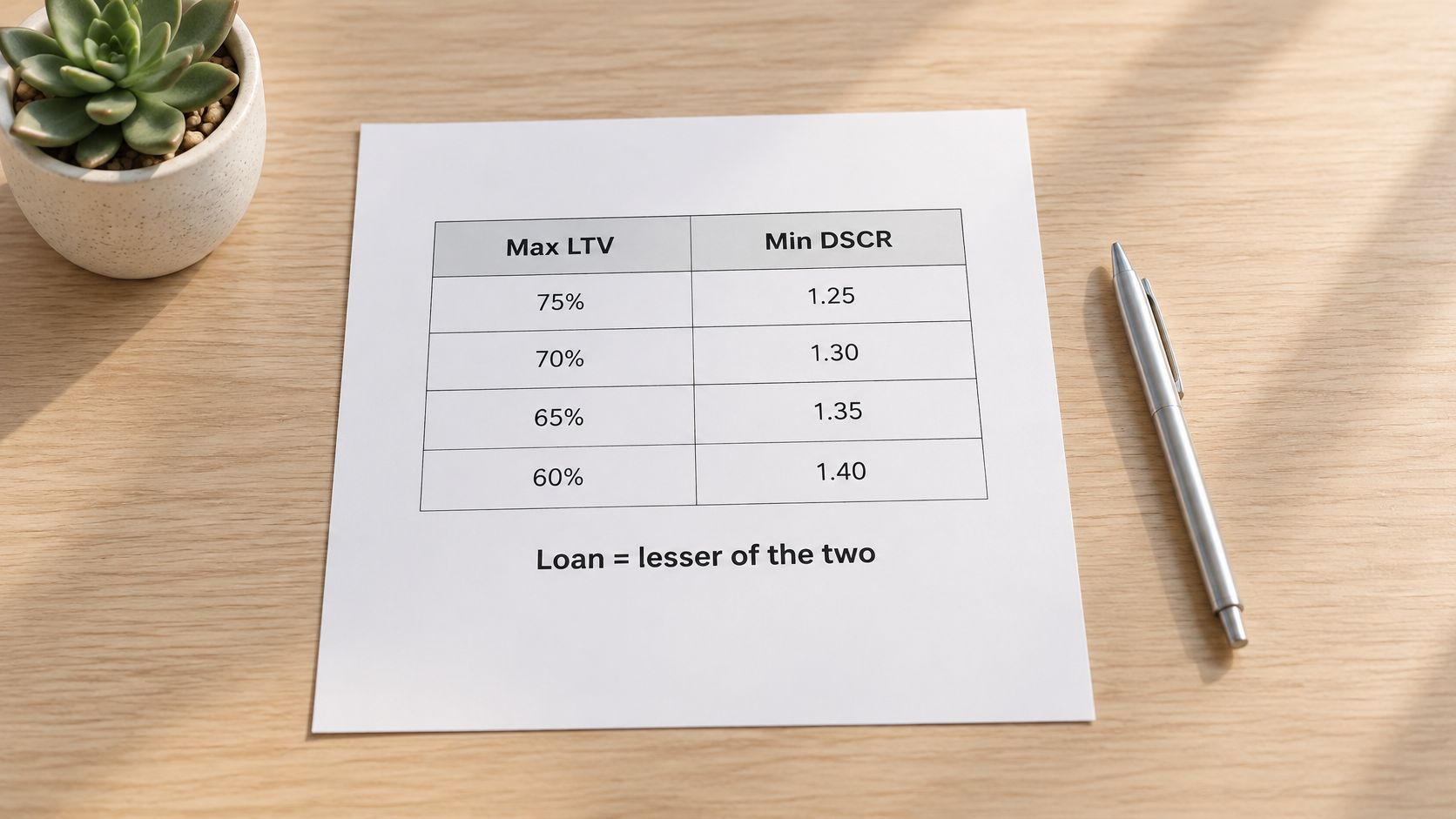
Underwriting tests that set apartment loan size
| Test | Formula | Typical threshold | What lowers the result |
|---|---|---|---|
| LTV (loan-to-value) | Loan balance ÷ appraised value | Maximum established by the loan program | A lower appraisal reduces allowable proceeds; a higher balance raises LTV |
| DSCR (debt-service coverage) | Underwritten net cash flow ÷ annual debt service | Minimum established by the loan program | Higher vacancy, expenses, reserves or interest rate |
| Underwritten net cash flow | Effective rent collections minus operating costs, insurance, taxes and reserves, with vacancy normalized once | Not a threshold; it feeds DSCR | Insurance and tax increases, weak collections |
| Debt yield | Net operating income ÷ loan amount | Lender-set, often 8% to 10% | Higher loan size, lower rents or higher expenses |
Net cash flow isn't gross rent. Start with supportable collections, reconcile concessions and vacancy, then deduct the expenses the lender will recognize. Don't subtract vacancy again if your starting income already reflects those missing collections.
Debt yield provides another perspective: property income relative to the requested debt, without using the interest rate. A comfortable debt yield doesn't excuse a failed payment-coverage test.
A building can pass one test and fail the other
Take a hypothetical building worth $8 million. At a 75% LTV cap, collateral supports $6 million of debt.
Now assume annual underwritten net cash flow is $600,000, with a required 1.25x DSCR:
$600,000 ÷ 1.25 = $480,000 maximum annual debt service.
The lender converts that payment allowance into a loan amount using the applicable rate and amortization. If that amount is below the collateral ceiling, cash flow controls the commitment.
Insurance can materially change this calculation. CRED iQ's apartment insurance analysis found per-unit insurance costs increased from $339 to $778. Obtain a current quote, review deductibles and confirm the lender accepts the coverage rather than relying on the seller's old bill.
If value is the constraint, INTELLI's appraisal guidance for Texas commercial owners offers useful context for reviewing commercial valuations. If income is the constraint, organize the operating evidence before challenging the proceeds; commercial real estate underwriting requires more than a rent-roll total.
Improve the weaker test first. Documented collections, corrected expenses or resolved appraisal issues can help; optimistic rent projections without supporting leases usually won't.
Lender Options From Banks to Private Money
Choosing a lender means deciding what you're willing to trade for speed, flexibility or long-term payment certainty. Compare the same factors across each option: execution time, underwriting flexibility, total cost and the expense of getting out.
Compare the lender, not just the coupon
Banks: Best suited to relationship borrowers and properties with understandable operations. They usually move more slowly, scrutinize personal credit and tax returns, and may offer competitive pricing. Ask about recourse, deposits, covenants and prepayment terms; weak documentation or a troubled property can stop approval.
Agency lenders: Fannie Mae and Freddie Mac channels fit stabilized, well-run apartment properties seeking long-term debt. Plan around a 45-to-90-day process with full underwriting rather than emergency funding. Pricing can be attractive, but property condition, cash flow and documentation must qualify, and the exit provisions need review.
CMBS conduits: These lenders originate loans that are packaged into commercial mortgage-backed securities. They can provide fixed-rate financing for larger stabilized assets, but securitization requirements limit flexibility. Prepayment lockouts and other release requirements can make an early sale or refinance expensive.
Debt funds: Often a fit for value-add buildings needing bridge capital. They can accommodate transitional operations more readily than permanent lenders, but borrowers pay for that flexibility through higher rates, fees and sometimes minimum-interest provisions. An unsupported renovation budget or refinance assumption remains a reason to decline.
Private and hard money lenders: These lenders focus heavily on the asset, available equity and exit plan. A complete, eligible file can close in as little as three days, with room to evaluate foreclosure situations, weak credit or thin income history. Conservative leverage, higher borrowing costs and short maturities are the trade-offs.
Where a private lending partner fits
LendingXpress is a California-based private lender for non-owner-occupied residential and commercial income property, with loan sizes from $100,000 to $18 million-plus. It's an option for investors a bank has declined or borrowers facing a time-sensitive refinance, subject to property review and final approval.
Private financing isn't a substitute for a workable investment. It can give a borrower time to repair, lease or refinance a property, but carrying costs and exit requirements must fit the budget.
Use the following video as a companion to your financing review.
Ask every lender the same question: What proceeds, rate, fees and exit penalty apply to my actual numbers?
Request the answer in writing. A larger headline commitment may be less useful if substantial proceeds are held back for reserves or future draws.
Apartment Loan Timeline From Application to Funding
Work backward from the contractual closing date or loan maturity. The schedule below is a planning framework: several tasks overlap, and a private lender's expedited process doesn't follow the same calendar as institutional financing.
Build a file the lender can act on
Send the deal summary, typically 1 to 3 days for initial review. Include price or payoff, financing purpose, requested amount, address and unit count. State the deadline immediately so the lender can determine whether its process fits.
Build the package, typically 3 to 7 days with organized records. Gather the current rent roll, leases, trailing 12-month operating statement, property tax bill, insurance quote, renovation budget and schedule, entity documents and personal financial statements. Reconcile discrepancies before submission rather than leaving the underwriter to discover them.
Review the term sheet, typically 2 to 5 days. Check proceeds, rate, term, reserves and origination points, often 1% to 2% in the planning range. Separate cash available at closing from money retained for repairs, interest or other reserves.
Order third-party reports, typically 2 to 4 weeks for most deals. These can include appraisal, property condition, environmental, flood and insurance reviews. Arrange access promptly and disclose known issues before reports create unexpected conditions.
Complete underwriting and obtain a commitment, typically 3 to 10 days after the required material is available. Respond with complete answers and supporting documents. A commitment may still contain conditions that must be cleared before funding.
Satisfy closing conditions during the final underwriting-to-closing window. Clear title issues, provide insurance binders, establish entity good standing and arrange any reserve deposits. Ask the closing team to identify outstanding items by owner and deadline.
Close and fund on the lender's approved schedule. An eligible private loan with a complete file may fund in as little as three days overall, while agency or CMBS financing may require 45 to 90 days overall. Signing documents alone doesn't guarantee immediate release of proceeds.
Treat the calendar as a dependency map
The visual below illustrates a conventional workflow. Individual lender schedules and the order of application tasks can differ.

Don't add every stage together as though nothing overlaps. Insurance review can proceed while the appraiser works, and title review should begin before final underwriting.
The delays most likely to add weeks are missing leases or stale operating statements, unresolved title liens, and an appraisal below the lender's expected value. Order payoff statements early, keep an accessible document folder and assign someone to answer lender questions.
Adding a Second Loan Without Overborrowing
A second loan may provide renovation capital or cash-out proceeds while leaving an existing senior mortgage in place. It can also create a payment problem that isn't obvious from the property's remaining equity.
Fannie Mae's supplemental-loan guidance requires combined existing and supplemental balances for LTV, and combined debt service for DSCR. The lender doesn't evaluate the new advance as though the first mortgage disappeared.
Work through both combined calculations
Consider this hypothetical capital stack:
| Item | Amount |
|---|---|
| Property value | $10 million |
| Existing first mortgage | $5.5 million |
| Requested second loan | $1 million |
| Combined balance | $6.5 million |
| Combined LTV | 65% |
The new advance alone equals 10% of value, but that's not the relevant debt-to-value measure. The combined calculation is $6.5 million ÷ $10 million = 65%.
Now assume the first loan requires $400,000 in annual debt service and the second adds $100,000. With $600,000 of underwritten net cash flow, combined coverage is $600,000 ÷ $500,000 = 1.20x.
At an assumed 1.25x minimum, maximum total debt service is $480,000. After the first mortgage payment, only $80,000 remains for the second loan.
If payments scale directly with principal on unchanged terms, the second-loan request must shrink to approximately $800,000.
Check permission before paying for reports
A financially supportable second loan may still violate the senior mortgage documents. Don't assume a new lender can record a junior lien without consent.
Gather the following before ordering an appraisal or paying substantial fees:
- Current balance: Obtain an updated statement and identify accrued charges.
- Consent or payoff requirements: Confirm whether subordinate financing is permitted.
- Prepayment terms: Determine whether replacing the senior loan would trigger an additional cost.
- Updated value and payment schedule: Test the proposed structure against current collateral and total obligations.
Available equity isn't the same as available borrowing capacity.
Compare a permitted supplemental loan with a full refinance. Preserving favorable senior debt can be useful, but not if the combined payments leave too little operating cushion.
Refinancing When the Property Outgrows Its Loan
Your loan can mature even though the building no longer supports its outstanding balance. The problem isn't necessarily poor occupancy: a higher refinance rate, weaker valuation and increased operating costs can reduce replacement proceeds simultaneously.
Realty Today's discussion of multifamily maturities cites approximately $757 billion projected to mature between 2026 and 2028, including about $300 billion in 2026, and describes refinancing rates that can be roughly twice those available five years earlier.
Identify the shortfall before maturity
Higher rates increase the payment on replacement debt. A revised appraisal reduces the value against which the lender advances funds.
The new lender also applies its coverage requirement to the new payment, not the expiring loan's payment. If it offers lower loan-to-value, the borrower must supply more equity even when the property remains profitable.
Use this refinance test:
- Collect current records. Pull the rent roll and trailing 12-month operating statement, then reconcile collections.
- Normalize expenses. Recalculate cash flow using the current insurance quote, tax bill and appropriate reserves.
- Stress the replacement debt. Run LTV and DSCR at the expected new rate and a higher-rate scenario.
- Compare proceeds with payoff. Use the lower supported loan amount and include transaction costs in the cash requirement.
- Fund the shortfall deliberately. Evaluate equity, a partial paydown or bridge capital with a supportable exit.
Match the solution to the cause
An extension can buy time, but it doesn't repair inadequate income. Bridge financing makes sense when identifiable improvements can support the eventual refinance, not just because the maturity date is inconvenient.
Preferred equity or subordinate capital also brings payment, consent and control considerations. If the property can't support the resulting capital stack, a sale may be more defensible than adding expensive obligations.
The maturity case below illustrates a dollar shortfall. For an early refinance review, submit the maturity date, payoff balance and current NOI before the remaining financing options narrow.
Worked Loan Sizing Cases and Your Loan Type Decision
| Case | Result |
|---|---|
| A: Stabilized 24-unit purchase | $3 million loan after both tests; LTV controls and DSCR is approximately 1.41x |
| B: Value-add bridge | $2.85 million illustrative commitment, sized on the exit plan; interest-only; refinance needed later |
| C: Refinance at maturity | $3.9 million replacement loan; $700,000 payoff gap before closing costs |
These are hypothetical sizing scenarios, not financing quotes. Permanent and refinance calculations use 6.5% interest, 30-year amortization, an approximately 7.6% annual loan constant and a 1.25x DSCR requirement. The bridge uses the same assumed rate for its interest-only payment, with the amortizing assumptions reserved for evaluating its exit.
Case A shows when collateral controls
Assume a stabilized 24-unit property costs $4 million and produces $320,000 in annual underwritten net cash flow.
DSCR-supported debt: $320,000 ÷ 1.25 ÷ 7.6% ≈ $3.38 million; LTV-supported debt: $4 million × 75% = $3 million.
The lender selects $3 million. Annual debt service is approximately $228,000, producing coverage of approximately 1.41x.
The borrower needs $1 million toward the purchase price, plus closing costs and required reserves. Stronger cash flow alone won't increase proceeds while the assumed LTV cap remains unchanged.
Case B requires a defensible refinance
Assume a $3.2 million acquisition and $600,000 renovation budget. The hypothetical bridge commitment equals 75% of total cost, not an automatic advance against projected value.
($3.2 million + $600,000) × 75% = $2.85 million.
At the assumed interest-only rate, annual interest is $185,250. Current cash flow of $180,000 doesn't cover that payment, so the borrower must address the carry shortfall and any renovation disruption through approved reserves or additional capital.
Projected post-renovation cash flow is $300,000. Under the illustrative permanent underwriting assumptions, that supports approximately $3.16 million before applying the exit lender's valuation limit.
That potential refinance isn't guaranteed. Verify the renovation schedule, achievable rents, lease-up costs and completed value, and confirm how much of the bridge commitment is available immediately versus released through draws.
Case C exposes the maturity gap
Assume an existing $4.6 million loan on a building now valued at $6 million. Insurance and tax increases reduce annual net cash flow from $480,000 to $420,000.
DSCR-supported debt: $420,000 ÷ 1.25 ÷ 7.6% ≈ $4.43 million; LTV-supported debt: $6 million × 65% = $3.9 million.
Replacement proceeds are therefore $3.9 million, leaving $700,000 to repay the old principal balance, before costs. Equity or a negotiated paydown can resolve the gap; additional bridge capital requires its own repayment capacity and exit analysis.
These cases show why advertised borrowing power isn't a commitment. A lender must approve both the amount and the structure.
Turn the numbers into a financing request
Classify the property as stabilized, value-add or ground-up. Name the exit as sale, refinance or long-term hold, then set the deadline in days or months.
Before requesting terms, verify:
- Investment use: The property is non-owner-occupied and the financing purpose is clear.
- Supported income: Cash flow reflects realistic expenses and reserves.
- Tested proceeds: LTV and DSCR work at current and stressed rates.
- Known obligations: Liens, payoff balances and senior-lender permissions are documented.
- Combined borrowing: Any additional loan has been tested with existing debt.
- Executable exit: The budget, timetable and repayment plan are written down.
- Organized records: Rent roll, operating statement and entity documents are ready.
Send a one-page deal summary with the address, price or payoff, requested amount, rent roll and operating statement for an indicative term sheet. Ask the lender to identify conditions that could reduce proceeds before you commit to an expensive closing schedule.
LendingXpress offers private apartment acquisition, bridge, refinance and cash-out financing for non-owner-occupied investment properties. Visit LendingXpress to submit your property numbers and discuss a structure that fits your deadline, available equity and repayment plan.