
You've got the lot under contract, the plans are approved, the general contractor is ready, and the project finally looks executable. Then a bank declines the loan because the build doesn't fit its income model, timeline, or preferred borrower profile. The deal may still work. The financing structure doesn't.
Ground-up construction financing is designed for non-owner-occupied residential and commercial projects built from vacant land or a cleared site. The lender isn't just reviewing your income and a property that already produces cash flow. It's evaluating the land, plans, budget, builder, draw process, completed value, and the way its capital gets repaid.
That's why private-capital deals require a different mindset. The capital stack, draw mechanics, reserves, and exit plan matter more than a thick application package. The Federal Reserve/FRED series illustrates the scale of this market, with commercial banks holding $468.1 billion in construction and land development loans in April 2025, after the series reached $489.6 billion in February 2024, as reported in this ground-up construction financing overview. But bank capacity doesn't mean every viable project fits a bank box.
When the Bank Says No and the Deal Still Has to Close
An investor had a teardown lot under contract in a strong suburb. The site was fully entitled, permits were in hand, and the general contractor had completed comparable builds. Two regional banks still declined the request because the project needed 75% LTC and carried a 14-month construction timeline.
The rejection letters weren't really about the lot. They focused on three issues. First, projected debt service coverage was weak because the property wouldn't produce operating income during construction. Second, the banks wanted more seasoning on the borrower's equity and project ownership. Third, the timeline sat outside the underwriter's comfort zone, even though the schedule was realistic for the scope.
That distinction matters. A bank often asks, “Does this borrower and property fit our standardized credit policy?” A private lender asks, “Can this project be completed, and can the loan be repaid through a credible sale or refinance?”
Practical rule: A bank rejection often identifies a structure problem, not a failed real estate deal.
The investor's solution wasn't to rewrite the entire application. It was to restructure the capital stack. The land equity became part of the sponsor contribution, the construction facility was sized against total project cost and completed value, an interest reserve was included, and the exit was underwritten before closing. The lender also focused on the contractor's ability to finish the work and the project's marketability at completion.
That's the private lending mindset. Speed, certainty of close, equity-first structuring, and exit-driven underwriting can solve problems that a retail-style approval process can't. Private capital may cost more than a bank loan, but losing a controlled site or missing a contract deadline costs more.
If traditional financing says no, don't automatically abandon the deal. Ask whether the lender rejected the project itself or routed it outside its mandate.
What Ground Up Construction Financing Actually Is
Ground-up construction financing is short-term, asset-based capital that funds a project from a vacant parcel or cleared site through completion and, usually, a certificate of occupancy. The collateral changes as the work progresses. At closing, the lender may have land and plans. At completion, it expects a finished property with a defensible market value or rental strategy.
That's different from a renovation or fix-and-flip loan. Those products assume an existing structure, even if the property needs major repairs. A ground-up loan must account for entitlement, site work, vertical construction, inspections, contractor performance, and the transition from construction to sale or permanent debt.
Four structures investors commonly encounter
- Interest-only construction-to-permanent: The construction facility later converts into long-term financing, subject to the lender's conversion requirements and the finished property's performance.
- Standalone construction loan: The borrower pays off the facility through a sale, refinance, or other takeout at completion.
- Hard money construction bridge: A private, non-owner-occupied loan emphasizes collateral, project economics, borrower liquidity, and execution rather than conventional income documentation. Some investment-property lenders state that tax returns or pay stubs may not be required, depending on the structure and borrower profile, as described in this non-owner-occupied construction financing guide.
- Joint venture or equity participation: The capital partner contributes equity or structured capital and shares in the project economics instead of relying only on a fixed-rate debt return.
The mechanics are consistent across most serious facilities. The lender establishes an interest reserve so carrying costs can be paid from the loan during construction. It creates a percentage-of-completion draw schedule, releasing money after verified milestones rather than wiring the entire commitment at closing. It also underwrites both sides of the deal, the sponsor and the finished project.
| Loan Type | Repayment | Typical Term | Best For |
|---|---|---|---|
| Construction-to-permanent | Conversion to long-term debt | Short construction period followed by permanent financing | Investors planning to hold rentals |
| Standalone construction | Sale or refinance | Short-term construction facility | Spec builders with a defined takeout |
| Hard money bridge | Sale, refinance, or replacement loan | Short-term private loan | Borrowers needing speed or flexible underwriting |
| JV or equity participation | Sale, refinance, or agreed project distribution | Tied to project completion and exit | Sponsors needing more than senior debt |
This isn't a 60-day retail mortgage process. It's a relationship-driven, fast-cycle product where the lender, borrower, contractor, and closing team need to make decisions quickly and document them clearly.
How Lenders Underwrite a Ground Up Deal
A bank decline does not automatically kill a ground-up project. Private lenders assess the capital stack, construction risk, and repayment path together. Their core questions are direct: How much equity is in the project? What will the completed property be worth? Who can build it? Can the sponsor absorb problems? How does the lender get repaid?
The five underwriting pillars
LTC versus LTV: Construction lenders focus first on loan-to-cost because the property has no stabilized operating income. Financing commonly falls around 70% to 80% LTC, with 75% often used as a practical benchmark, according to this construction loan sizing analysis. LTV matters more once the lender evaluates the completed asset.
As-built value: The lender tests projected value against comparable sales, rents, absorption, and project feasibility. Some structures reference up to 70% of after-build value or 80% LTC, with higher LTC possible under certain lender policies, borrower profiles, and project risks, as outlined in this ground-up loan structure guide.
Borrower experience: A repeat builder with comparable completed projects is easier to approve than a sponsor whose background is limited to owning rentals. Experience does not replace equity, but it gives the lender more confidence in budgets, sequencing, and contractor oversight.
Liquidity and net worth: The sponsor must show capacity for delays, change orders, and added carrying costs. Strong liquidity can offset limited construction experience. Thin reserves can sink an otherwise attractive deal.
Exit strategy: Sale, refinance, and rental stabilization require different tests. The lender evaluates the likely buyer or takeout lender, competing finished properties, and whether repayment still works if the schedule slips.

A first-time builder with substantial liquidity, conservative financing, and an experienced GC may receive a better response than a repeat sponsor with aggressive debt and weak reserves. An experienced developer can still lose approval when the market cannot support the finished product.
The funding package must tell one coherent story. The budget supports the plans, the contractor supports the schedule, the sponsor supports the contingency, and the exit supports repayment. For documentation and lender expectations, review construction loans from RBA Home Plans. Borrowers combining land acquisition with vertical construction can also review construction financing for land and house projects.
Strong underwriting is not a paperwork exercise. It proves that the capital stack, construction plan, draw structure, and repayment path work together from closing through payoff.
Draw Schedules, Interest Reserves, and Contingency Planning
A ground-up loan funds progress, not promises. The lender releases capital after completed work is inspected and matched to the approved budget. That structure protects the lender, while making cash management the borrower's responsibility.
Approval may take weeks, but closing is only the start. Before the first wire, the borrower must coordinate insurance, title, permits, draw requests, invoices, lien waivers, inspection access, and updated budgets. A weak process can delay a strong project and expose the sponsor to unpaid contractor bills.
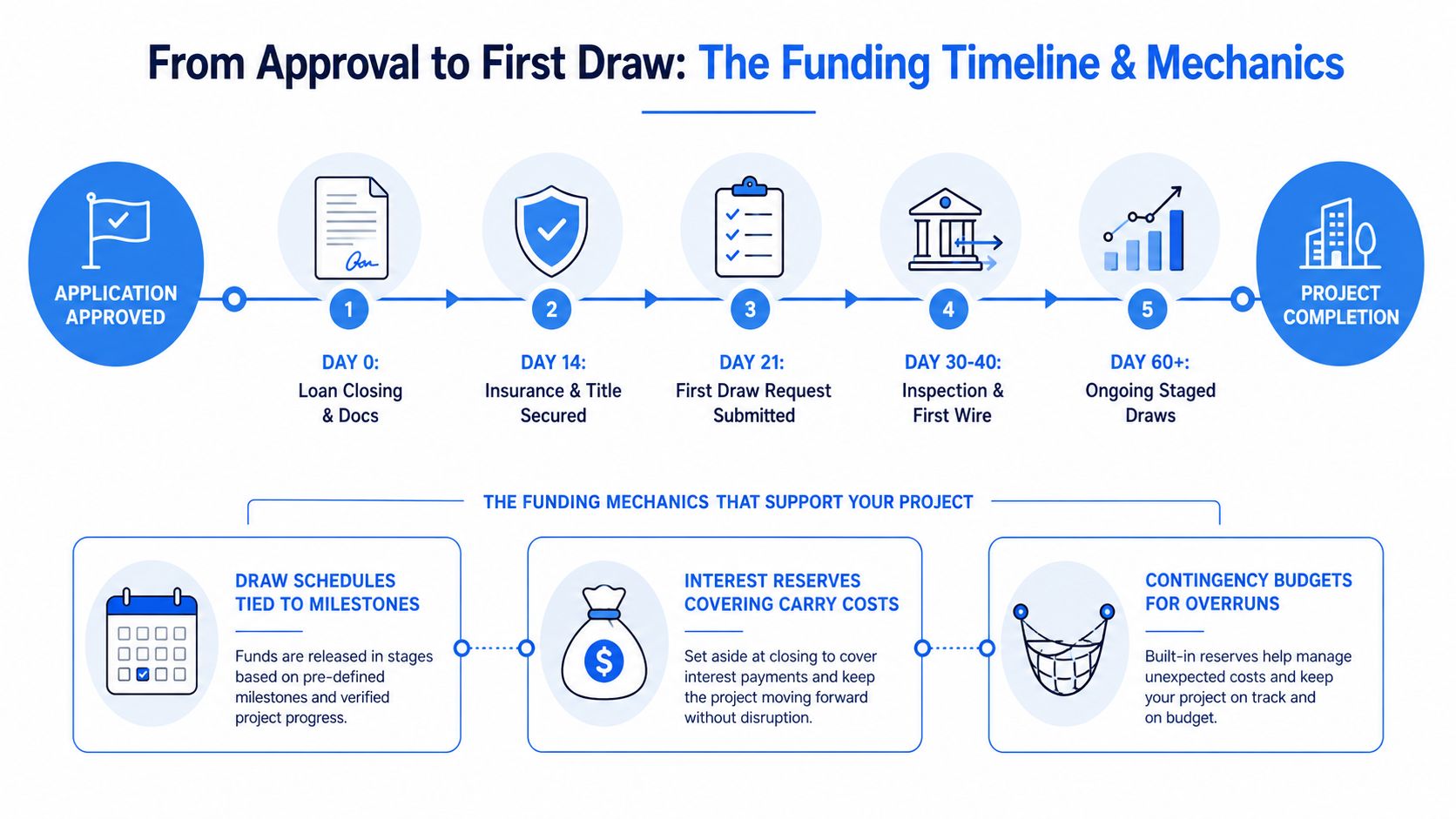
Build the draw process before construction starts
Set the draw schedule before mobilization. Funding may be divided among foundation, framing, rough mechanicals, drywall, finishes, and final retention. The inspector verifies completed work, compares it with the budget, and confirms that the requested amount reflects actual progress.
Some market processes can take roughly 15 to 18 days from submission to wire, according to this ground-up construction draw guidance. Keep working capital outside the loan so payroll, materials, and subcontractors remain covered during that gap. Reimbursement timing is part of the deal structure, not an administrative detail.
Cash-flow warning: Never schedule subcontractors on the assumption that a draw arrives the same day you submit it.
The interest reserve is added to the loan balance and pays carrying costs while construction continues. The lender sizes it around the expected build period, draw pace, and outstanding balance. A delayed project can consume the reserve before the property produces rent or sale proceeds, leaving the sponsor responsible for the shortfall.
Contingency covers costs missing from the original budget. Industry guidance commonly places it around 3% to 10% of construction costs, with the higher end suited to uncertain scope, as explained by RedTower Capital. Keep a separate soft-cost buffer for design revisions, permit changes, legal work, and financing extensions. Do not combine every reserve into one pool that obscures what remains available.
The CEFCore construction draw schedule shows how milestone-based reimbursement is commonly organized. Borrowers should also review the construction loan draw schedule before closing and align the contractor's pay applications with the lender's requirements.
A draw is commonly held when work is incomplete, an inspection fails, invoices do not match the budget, lien waivers are missing, insurance has lapsed, or construction has moved materially outside the approved scope. Complete requests move faster when the site is inspection-ready, the contractor's pay application is clear, and every supporting document reconciles. These mechanics often decide whether private capital stays available when a bank would decline the request.
Bank Loans vs Private and Hard Money Lenders
A bank is usually the cheapest source of construction debt when the project fits its policy. Private and hard money lenders become more useful when the closing date is tight, the property is unusual, or the borrower needs terms a bank will not approve.
Banks typically require extensive personal financial records, a full appraisal, a detailed contractor package, and several rounds of conditional approval. That lower pricing can protect project margins, but the process may not fit a land contract with a short closing window or a seller unwilling to wait through extended underwriting.
Private lenders review the asset, sponsor, construction plan, and repayment path with greater flexibility. They may consider nontraditional income, unusual property types, or borrowers without a conventional W-2 history. The trade-off is direct. You may close faster and structure financing more flexibly, but you'll pay for that certainty through points, interest, fees, or tighter asset controls.
| Factor | Bank Construction Loan | Private / Hard Money Lender |
|---|---|---|
| Speed to close | Slower, policy-driven process | Faster, deal-specific execution |
| Documentation | Extensive personal and project records | Focused on project, sponsor, and collateral |
| Financing Terms | Often conservative and policy-based | More flexible, subject to risk and equity |
| Pricing | Usually lower | Usually higher |
| Prepayment | May include institutional restrictions | Often more negotiable |
| Experience | Strong preference for established records | May offset limited experience with liquidity and a strong GC |
| Exit underwriting | Formal takeout and income analysis | Direct focus on sale, refinance, or rental economics |
A bank's lower rate does not automatically make it the better deal. If approval arrives after the purchase contract expires, the cheaper debt has no practical value. Private capital costs more, so the project must support that cost through a credible exit, sufficient equity, and disciplined construction management.
Federal Reserve survey data show construction and land-development loan demand turning higher while lending standards were “basically unchanged on net.” Construction spreads also tightened from roughly 310 basis points in Q4 2024 to about 237.5 basis points by Q3 2025, according to the 2026 ground-up lending analysis. Better pricing does not mean easy approval. Lenders remain selective about sponsorship, collateral, budget quality, and repayment.
Private capital fits when the purchase contract is time-sensitive, the property falls outside bank policy, the borrower needs a non-owner-occupied solution, or the exit depends more on execution than current income. Choose it for a specific financing advantage, not because the application appears simpler. A bank may decline the deal because of policy. A private lender may fund it because the capital stack, draw structure, and exit make sense.
Two Ground Up Deal Scenarios Worth Studying
A ground-up deal can look attractive on paper and still fail because the capital stack leaves no room for construction problems. The two scenarios below show why financing structure, draw control, and exit planning often matter more than a lender's headline rate.
Scenario A, the controlled spec build
An experienced sponsor planned a single-family spec home in a Tier 1 suburb. Total project cost was $620,000, supported by a $500,000 loan, or 70% LTC. The lender approved five draws and funded a six-month interest reserve. The sponsor hired a qualified GC, kept the plans tightly controlled, and maintained a sale exit supported by local comparable properties.
The home sold within four months of completion at a 22% gross profit, as specified in the deal scenario. That result came from disciplined financing and execution, not a lucky closing. The borrower contributed meaningful equity, chose a lender that could match the construction schedule, and kept the facility from absorbing avoidable budget gaps.
Scenario B, the overleveraged townhouse project
A first-time developer took on a six-unit townhouse project at 85% LTC. The contingency was undercapitalized, and a mid-construction cost increase created an immediate funding gap. Rather than address the shortfall early with additional equity or a revised budget, the borrower pursued a forced refinance on worse terms.
The replacement debt kept construction moving but weakened the project economics. The projected margin fell by nine percentage points, as specified in the scenario. The project may still have created value, but the borrower no longer controlled the financing decision. Once a funding gap forces a refinance, the new lender sets the terms and the original business plan becomes secondary.
| Deal Factor | Scenario A: Single-Family Spec | Scenario B: 6-Unit Townhouse |
|---|---|---|
| Sponsor profile | Experienced builder | First-time developer |
| Loan-to-cost ratio | 70% LTC | 85% LTC |
| Reserve planning | Six-month interest reserve and controlled budget | Undercapitalized contingency |
| Draw structure | Five planned draws | Funding pressure during construction |
| Exit | Sale after completion | Forced refinance |
| Result | Sold within four months at 22% gross profit | Projected margin reduced by nine points |
The takeaway is specific: higher debt levels magnify execution risk. A borrower with limited experience needs more liquidity, a stronger contractor, clearer reporting, and a lender willing to address problems before the project becomes distressed. First-time builders can still get funded, but the financing must provide enough room for imperfect execution.
Real Risks and How Serious Borrowers Mitigate Them
Ground-up construction has three risks that deserve more attention than generic approval checklists give them.
Completion risk appears when the GC walks, subcontractors fail, permits stall, or the schedule slips. A lender can have strong collateral and still face a loss if the building remains unfinished. The borrower should verify the contractor's comparable work, use a detailed contract, confirm insurance, and arrange independent progress inspections at every draw.
Cost-overrun risk starts with incomplete plans, optimistic bids, material volatility, labor shortages, or unmanaged change orders. The best defense is a realistic budget with documented allowances, a hard-cost contingency, and a separate soft-cost reserve. Industry guidance commonly places contingency around 3% to 10% of construction costs, with the appropriate level depending on scope certainty, according to RedTower Capital's construction loan guidance. Don't let a lender's minimum become your maximum.
Market risk arrives when comparable values decline, absorption slows, rents miss projections, or takeout financing becomes less attractive. A sale exit and a rental exit should be tested independently. If the project only works under one optimistic assumption, it isn't ready to finance.
| Risk Type | What Triggers It | Mitigation Tactic |
|---|---|---|
| Completion risk | GC failure, inspection delays, sequencing problems | Vetted GC, milestone inspections, documented schedule |
| Cost overrun risk | Change orders, labor or material increases, incomplete plans | Hard-cost contingency, soft-cost buffer, written approvals |
| Market risk | Lower sale prices, slower absorption, weaker rents | Dual-exit analysis, current comps, conservative valuation |
| Carry risk | Construction extends beyond the reserve | Adequate interest reserve and outside liquidity |
| Takeout risk | Refinance terms change or rental income falls short | Early lender relationship and alternative repayment path |
Rate caps can help protect a future refinance, while pre-sales or pre-leases can reduce uncertainty where the project and market support them. Serious sponsors stress-test the exit before signing loan documents, then monitor the market throughout construction instead of waiting until completion.
Your Action Checklist and Investor FAQ
A lender can't rescue an unorganized project. Before applying, assemble the deal so the lender can understand it without chasing missing information.
- Confirm land control: Provide the contract or deed and verify access, zoning, utilities, and entitlement status.
- Finalize plans and budget: Submit architectural plans, a detailed construction budget, schedule, and scope of work.
- Line up the GC: Use a contractor with a verifiable track record on similar ground-up projects.
- Document liquidity: Prepare personal and entity financial statements, bank statements, and evidence of available reserves.
- Define the exit: Explain whether repayment comes from sale, refinance, rental stabilization, or a combination.
- Brief a private lender early: Get capital-structure feedback before relying solely on a bank approval.

Questions investors ask before applying
Do ground-up loans exist outside major metros? Yes, but availability depends on local demand, comparable sales, contractor depth, permitting, and the lender's ability to evaluate the market. Recent lending activity has been concentrated in Florida, Texas, and New Jersey, which ranked as the top three states in both 2025 and the first four months of 2026 in one lending-documents dataset, while Ohio and Oregon also recorded notable gains, according to Realtor.com's housing supply analysis.
Can a foreign national or first-time builder qualify? Possibly. Private lenders may focus on liquidity, experience, the property, and the exit rather than conventional employment documentation. A first-time builder becomes more financeable when paired with an experienced GC and a conservative structure.
How long from application to first draw? The answer depends on document quality, closing conditions, insurance, title, permits, and inspection scheduling. Build extra time into the cash plan because draw timing can affect contractor payments.
Can land and construction close together? Many structures can include land acquisition and vertical construction, but the lender will underwrite the complete cost, equity contribution, and site readiness.
What happens if the project runs long? Notify the lender before the reserve is exhausted. The solution may involve a budget revision, extension, additional equity, a revised exit, or a refinance. Silence is what turns a delay into a default.
Can a DSCR rental exit work? Yes, if the completed property's rental income supports the permanent loan and the lender accepts the stabilization plan. Underwrite that takeout before construction begins.
LendingXpress helps investors structure ground-up construction financing for non-owner-occupied residential and commercial projects when traditional banks move too slowly or decline the structure. Visit LendingXpress to discuss your land, budget, draw schedule, liquidity, and exit plan with a private lending team focused on getting viable deals funded.