
You've found two promising non-owner-occupied properties. One is a two-unit building with a straightforward layout. The other adds a third apartment, more rent potential, and a higher purchase price. On paper, the triplex appears to win. In practice, the right choice depends on whether that extra unit still creates value after financing, vacancy, taxes, renovation, insurance, and management are fully underwritten.
A duplex and a triplex both sit in the small multifamily segment, but unit count changes more than the rent roll. It can affect the property's layout, operating workload, appraisal evidence, financing options, and resale audience. The strongest investment is not the property with the most doors. It's the one whose marginal unit improves the total risk-adjusted return.
Choosing Between a Duplex and a Triplex
A buyer recently compared a four-unit side-by-side duplex priced at $385,000 with a corner triplex priced at $475,000. Both properties needed light rehabilitation. The triplex offered an additional rent stream, but it also required more capital at closing and presented more questions about the third unit's condition, utility setup, parking, and tenant appeal.
That's the decision many investors face. The triplex looks stronger if the analysis stops at gross rent. It becomes less obvious once the investor asks what the third unit contributes after debt service, repairs, insurance, taxes, leasing costs, and reserves.
Practical rule: The third unit has to earn its keep. Don't pay a triplex premium simply because the property has one more door.
A duplex offers two income streams, while a triplex offers three. If one unit is vacant, a triplex has about 67% of its gross unit count still occupied, compared with 50% for a duplex, based on the unit-count comparison in LoopNet's duplex, triplex, and fourplex analysis. That diversification can make income less dependent on a single tenant, but it doesn't eliminate vacancy risk. A triplex can also experience more turnover, more work orders, and more leasing activity.
The acquisition price matters just as much. A higher purchase price can absorb the income benefit from the third apartment, especially when the additional unit is smaller, harder to access, or less desirable than the other two. Renovation risk can rise as well, because a triplex may have three kitchens, more bathrooms, more electrical panels, and more areas where deferred maintenance appears during due diligence.
Model the marginal unit
Start with the duplex as the base case. Then add only the income and expenses directly tied to the third unit. This separates the unit's real contribution from the property's headline rent.
Ask four questions:
- Income: What rent can the third unit achieve after realistic lease-up?
- Cost: What renovation, utility, insurance, and maintenance costs does it add?
- Financing: How does the higher price change borrowing power, reserves, and debt service?
- Exit: Will buyers and appraisers recognize the extra income, or will the property face a narrower resale market?
Cap rate compression can also weaken the triplex case. If buyers value the building at a lower yield because of complexity, legal uncertainty, or limited comparable sales, the added rent may not translate into equal value. The correct comparison is therefore not “two units versus three.” It's simpler income versus denser income with additional execution risk.
Understanding the Small Multifamily Difference
A duplex contains two dwelling units, while a triplex contains three. Both are multifamily residential structures, and either may use side-by-side, stacked, or mixed layouts with separate entrances and utility arrangements, depending on local code, as explained in this technical comparison of duplexes and triplexes.
In U.S. housing data, buildings with two to four units form the small-multifamily segment. An analysis from the National Association of Home Builders and Enterprise describes that segment as accounting for about 38% of all small-to-medium multifamily units, which places duplexes and triplexes firmly in the mainstream rental supply rather than treating them as niche properties. The U.S. Census classifies duplexes as two-unit structures and triplexes as three-unit structures, while broader multifamily housing represented roughly 27% of the national housing stock in 2023 in ACS-based analysis. These figures are summarized in the housing data reference.
Canada tracks duplex-style housing as a distinct dwelling form as well. The Census Bureau's reference guide explains that the “apartment or flat in a duplex” category expanded in 2006, and the 2021 Census reported duplex dwellings at 5.5% of occupied private dwellings, compared with 5.6% in 2016 and 5.3% in 2011, as shown in Statistics Canada's dwelling-type guide. Local definitions still control the underwriting outcome, so investors must verify the legal unit count instead of relying on marketing language.
Property profile
| Feature | Duplex, 2 units | Triplex, 3 units |
|---|---|---|
| Income streams | Two separate rents | Three separate rents |
| Common layouts | Side-by-side or stacked | Side-by-side, stacked, or mixed |
| Vacancy concentration | One vacancy affects half the units | One vacancy affects about two-thirds of the unit count remaining occupied |
| Management load | Lower leasing and maintenance coordination | More tenant, repair, and turnover coordination |
| Key diligence issue | Confirm both units are legal and separately usable | Confirm all three units are legal, functional, and properly served |
| Four-unit boundary | Below the four-unit limit | Below the four-unit limit |
The fourplex boundary deserves attention because moving beyond four units can change the lending and regulatory analysis. A triplex remains within the two-to-four-unit residential category used by conventional guidelines, but the property still needs local confirmation of zoning, certificates, parking, fire separation, utilities, and occupancy rules.
Physical design drives operations. A triplex may include one basement or upper-level apartment that attracts a narrower tenant pool. Shared meters can make expense recovery difficult, while limited parking can reduce achievable rent or increase turnover. Maintenance access also matters. A building with separate entrances and accessible mechanical systems is easier to operate than one where a repair requires entering another tenant's space.
Housing policy can add another layer of complexity. Investors evaluating Canadian or urban multiplex markets may find the discussion in how cities grapple with housing debate useful for understanding how density, neighborhood response, and local rules shape small multifamily decisions.
Comparing the Investment Trade-Offs
The triplex's appeal is obvious. It can produce more gross income, spread fixed costs across more units, and reduce dependence on a single lease. Those advantages only matter if the property's operating structure supports them. A third kitchen, bathroom, utility connection, and tenant relationship can create a larger expense base than an investor expects.
The table below is designed as a decision tool, not a list of automatic advantages.
Investment trade-off matrix
| Factor | Duplex Impact | Triplex Impact |
|---|---|---|
| Income ceiling | Lower gross rent, with a simpler rent roll | Higher gross rent potential from a third lease |
| Vacancy exposure | One vacancy removes a larger share of scheduled income | One vacancy leaves more units occupied, but still creates lost rent and leasing work |
| Operating expenses | Fewer unit-specific repairs, appliances, and turnovers | More recurring repairs, inspections, utilities, and tenant coordination |
| Acquisition cost | Usually requires less capital because the purchase price may be lower | Often commands a premium that can reduce initial yield |
| Rehab scope | Fewer kitchens, bathrooms, and systems to renovate | More unit finishes and systems, with greater coordination risk |
| Financing leverage | More conventional options may be available within two-to-four-unit rules | May support income-based underwriting, but higher leverage can strain coverage |
| Management load | Often manageable with direct oversight or limited management support | More tenant relationships and operational touchpoints |
| Valuation and cap rate | Broader buyer pool may support easier comparison | Fewer comparable sales can make appraisal and resale more complex |
| Tax planning | Depreciable building components remain relevant | More components may create additional cost-segregation review opportunities |
| Legal and zoning constraints | Unit legality and use still require verification | More pressure on parking, access, utilities, fire safety, and zoning compliance |
| Exit liquidity | May appeal to investors and some owner-occupant buyers | May appeal to income buyers, but the resale audience can be narrower |
The tax angle shouldn't decide the purchase by itself. A triplex may offer more building components to review for depreciation or cost segregation, but those benefits depend on the property, ownership structure, tax position, and advice from a qualified tax professional. They also don't compensate for weak operations.
Where the extra unit helps
The triplex is more compelling when the third apartment is legal, independently marketable, and close in quality to the other units. It can also work well when the lot, parking, utilities, and maintenance systems already support the added density. In that situation, the investor gets a genuine income stream instead of a unit that exists only on a brochure.
The duplex often wins when the price premium for a triplex is large, the third unit needs heavy work, or local rules create uncertainty. It can also provide better exit liquidity if the likely buyer pool includes smaller investors who value easier management.
The extra door matters only after the extra costs have been deducted.
Review the property as an operating business. Compare projected net operating income, debt service, reserves, and resale assumptions. A triplex can outperform on gross income while underperforming on cash retained per dollar invested. That distinction is the center of the duplex vs triplex decision.
Underwriting Returns and Hidden Costs
A sound comparison starts by separating three measures.
Cap rate compares net operating income with the property's purchase price, showing performance before financing. Cash-on-cash return compares annual cash flow after debt service with the investor's cash invested, showing how borrowed funds affect the result. Gross rent multiplier compares purchase price with gross scheduled rent. It works as a quick screening tool before a full expense review.
Consider a duplex priced at $400,000 with combined monthly rent of $3,800, alongside a triplex priced at $525,000 with combined monthly rent of $5,400. Those figures show revenue and acquisition cost, but they do not establish which property produces the better investment result.
| Metric | Duplex | Triplex |
|---|---|---|
| Purchase price | $400,000 | $525,000 |
| Combined monthly rent | $3,800 | $5,400 |
| Annual scheduled rent | $45,600 | $64,800 |
| Gross rent multiplier | 8.77 | 8.10 |
| Units | 2 | 3 |
| Main underwriting question | Does simpler operation protect cash flow? | Does the third unit justify the higher basis? |
The gross rent multiplier uses the stated purchase price and rent assumptions. It is only a screening measure. Subtract vacancy, repairs, property taxes, insurance, utilities, landscaping, snow removal, management, legal compliance, and replacement reserves before judging the return.
Stress the expenses investors miss
Insurance depends on construction, location, claims history, and property use. Unit count and dwelling type can affect the quote, so obtain property-specific coverage before committing. Investors reviewing regional risks can use home insurance for wildfire areas as a starting point, while the lender still needs an insurance binder or other acceptable evidence of coverage.
Utilities require their own review. A triplex with shared water or electrical service may require owner-paid utilities, submeters, or a written allocation policy. A larger lot can also increase lawn care, snow removal, exterior lighting, and maintenance contracts. Set capital reserves according to the number of units and the age of major systems, rather than applying a broad percentage without checking the building.
Vacancy sensitivity can change the conclusion quickly. If the third unit is empty, the triplex still has two occupied apartments, but the owner loses a meaningful rent stream while fixed expenses continue. Tax reassessment after purchase or renovation can further reduce cash flow, so the model should allow for a higher bill instead of assuming the current assessment remains unchanged.
Compare financed outcomes
A triplex may show a lower cap rate because its purchase price is higher, yet still produce a stronger cash-on-cash return if the added income supports manageable debt service and the investor contributes a similar amount of capital. The reverse is also possible. Higher debt levels can strain coverage, while larger reserves, expensive renovation, or weak rent from the third unit can leave less cash retained.
Use a worksheet that shows each unit separately. Enter market rent, lease-up timing, utilities, repairs, and expected turnover for every apartment. Then calculate property-level NOI and test lower rent, longer vacancy, higher insurance, and delayed renovation. Before comparing the properties, review this guide on how to calculate cap rate. The third unit improves the investment only if its added income exceeds its acquisition cost, financing burden, operating risk, and management demands.
Financing Non-Owner-Occupied Properties
Non-owner-occupied financing starts with a different question than an owner-occupied mortgage. The lender isn't relying on the borrower's residence in the property. The lender evaluates the asset, the rent support, the borrower's liquidity, the condition of the building, and the repayment plan.
For conventional financing, Fannie Mae's matrix generally limits a non-owner-occupied two-to-four-unit investment property to 75% loan-to-value, or LTV, which means at least 25% down under that guideline. The same matrix also requires careful review of property eligibility, borrower qualifications, and documentation. Fannie Mae's reserve rules require six months of reserves for an investment property transaction and also six months for a two-to-four-unit principal residence transaction, as described in its minimum reserve requirements.
Freddie Mac's investment-property guidance includes single-family homes, duplexes, triplexes, and fourplexes, while limiting borrowers to no more than 10 financed one-to-four-unit properties, including the subject property and the borrower's primary residence, according to the investment-property guideline summary. Fannie Mae's rental-income rules can also vary based on the borrower's current housing payment and property-management experience, rather than treating every rent roll the same. Its rental-income guidance sets out those restrictions.
Match the loan to the execution plan
A portfolio loan may provide more flexibility because the bank keeps the loan rather than selling it into a conforming channel. A DSCR loan focuses on whether property income supports debt service, which can help when personal income documentation doesn't fit conventional requirements. Private or hard-money financing can offer faster decisions, asset-based underwriting, renovation draws, and interest-only structures, but the higher cost and shorter repayment horizon require a credible refinance or sale exit.
The third unit can strengthen a DSCR calculation when it produces verified, supportable rent. It can hurt the conventional path when the property's condition, legality, appraisal evidence, or documentation doesn't satisfy the lender. A higher loan amount can also create weaker debt-service coverage even when gross income rises.

A lender will typically want the purchase contract, borrower financial statement, bank statements, rent roll or market-rent support, insurance information, property tax details, leases, entity documents, scope of work, contractor bids, and an appraisal or valuation review. Private lenders may prioritize collateral and exit clarity, but they still need enough information to understand the project.
For a practical overview of the broader process, review how to finance an investment property. Before closing, watch for red flags such as thin reserves, unsupported projected rents, unresolved zoning questions, an incomplete rehab budget, an interest-only payment that masks weak permanent coverage, or a refinance plan that depends on optimistic valuation.
LendingXpress is one private lending option for investors seeking bridge, fix-and-flip, or rental-property capital on residential and commercial assets. Its lending model is designed for cases where traditional bank timing or documentation doesn't fit the transaction, including renovation funding with staged draws.
Matching Property Type to Investment Strategy
A duplex usually suits a buy-and-hold investor who values operational simplicity. With two units, the owner can focus on durable finishes, reliable tenant screening, and predictable maintenance without coordinating as many leases. That makes the property practical for an investor building a rental portfolio or testing direct management.
A triplex may suit an experienced operator who can handle more tenant activity and who has a clear plan to create value. The opportunity might come from improving an under-rented unit, correcting poor layouts, or finishing a property where the third apartment is legally usable but poorly presented. The work only makes sense if post-rehab rent supports the added basis and debt.
Align the sequence
Buy and hold: A suburban duplex can be acquired, lightly renovated, leased, and held for stable income. A triplex can also fit, but the owner should budget for more turnover coordination and verify that each unit attracts a sustainable tenant profile.
BRRRR: A triplex can offer more room for forced appreciation through unit finishes and improved operations. The refinance must be based on stabilized income and an acceptable valuation, not solely on the amount spent.
Fix and flip: A duplex may offer a broader buyer audience, especially when the layout is attractive to smaller investors. A triplex can appeal to income buyers, but the resale analysis should account for fewer comparable sales and a potentially narrower market.
Bridge financing: Transitional properties often need speed before permanent financing is available. Private capital can fund acquisition and improvements, but the investor must identify the refinance or sale path before taking the loan.
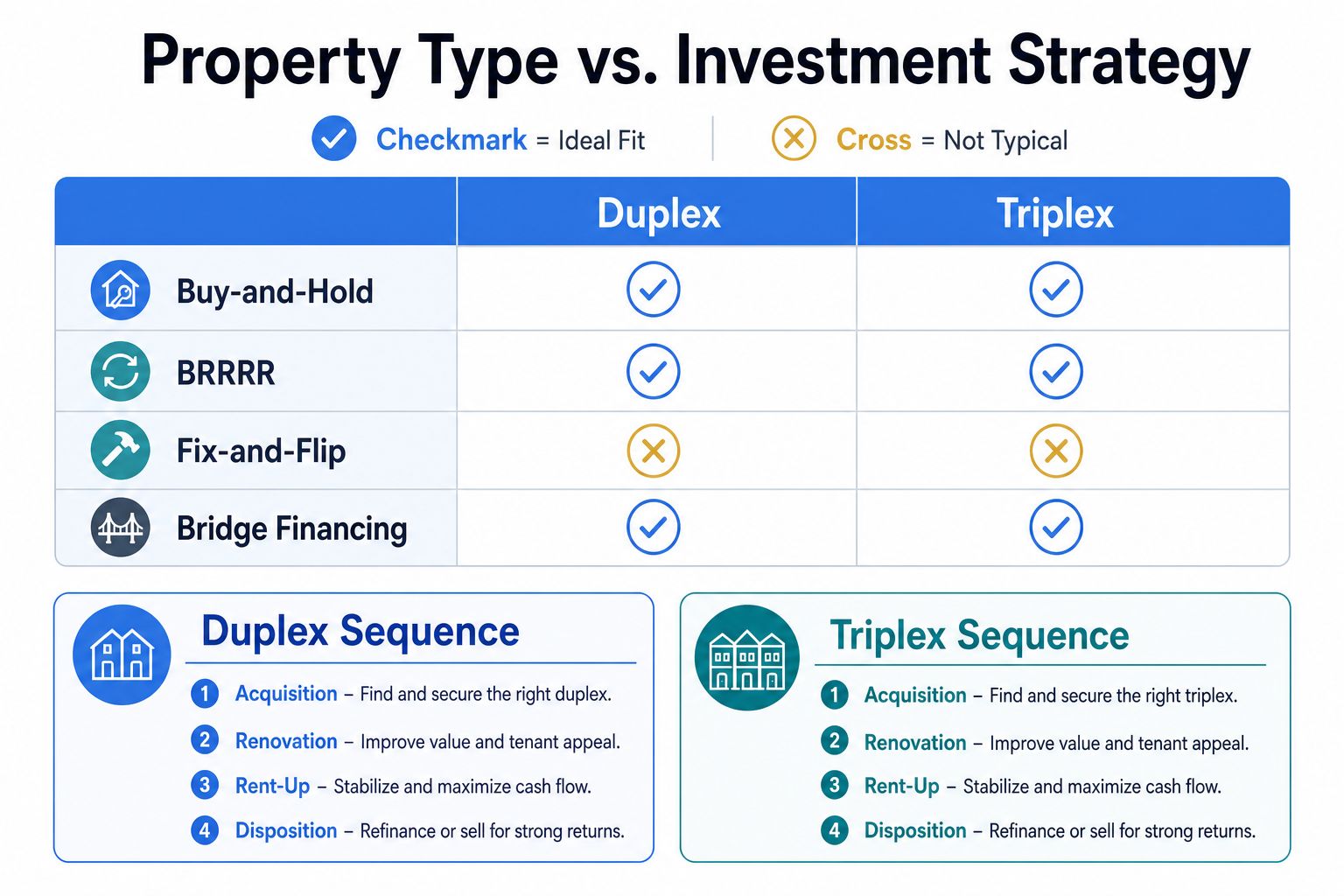
A representative strategy might involve a suburban duplex held long term beside a transitional urban triplex acquired with private money, repositioned, and refinanced into a DSCR loan. The first asset prioritizes simplicity. The second accepts greater execution risk in exchange for more income density.
The following video offers another visual resource for investors comparing small multifamily strategies:
Choose the duplex when capital is limited, management tolerance is low, or the exit depends on a broad buyer pool. Choose the triplex when the third unit is legal, rentable, financially productive, and supported by adequate reserves and a clear financing plan.
Making the Final Investment Decision
Don't ask which property type is universally better. Ask whether the third unit improves the investment after every material cost and whether the chosen exit can support the financing structure.
Start with projected NOI after stabilization. Then calculate debt-service coverage, cash-on-cash return, and the investor's total cash requirement, including down payment, closing costs, rehab, reserves, and contingency. The triplex should survive a conservative case where the third unit leases slowly, insurance increases, repairs exceed the initial budget, or taxes are reassessed.
Final decision matrix
| Decision Factor | Duplex Score, 1-5 | Triplex Score, 1-5 |
|---|---|---|
| Lower acquisition burden | 5 | 3 |
| Simpler management | 5 | 3 |
| Income diversification | 3 | 5 |
| Vacancy resilience by unit count | 3 | 4 |
| Rehab simplicity | 5 | 3 |
| Potential for higher gross income | 3 | 5 |
| Conventional financing simplicity | 4 | 3 |
| Fit for experienced operators | 3 | 5 |
| Resale flexibility | 4 | 3 |
| Value from added density | 3 | 5 |
These are decision scores, not market facts. Adjust them for the actual property. A triplex with three strong apartments, separate utilities, compliant parking, and limited repairs may deserve a higher execution score than a poorly configured duplex. A duplex with one large renovation risk can be harder to operate than a clean triplex.
Identify downside triggers before you submit an offer. Examples include prolonged vacancy, an insurance premium spike, zoning complaints, unverified unit legality, unsupported rents, or a refinance value that depends on perfect lease-up. Write the response for each trigger into the investment plan.
Your exit should override a marginal yield difference. A long-term hold may favor the property with the more dependable operating profile. A refinance after stabilization may favor the asset with stronger documented NOI. A short-term resale may favor the building with broader buyer demand and clearer comparable sales.
Underwrite both properties using the same assumptions, separate each unit's economics, and pressure-test the third unit instead of granting it automatic value. If the triplex still produces an acceptable return after conservative adjustments, it may justify the additional complexity. If it doesn't, the duplex is the more disciplined investment.
LendingXpress helps investors structure private and hard-money financing for non-owner-occupied duplex and triplex purchases, bridge transactions, renovations, refinances, and rental-property loans. Share your property details, capital plan, and intended exit by visiting LendingXpress, so the financing structure can be evaluated against the actual deal rather than the unit count alone.