
You've probably had this moment already. A property hits your desk at a price that looks right, the seller wants a fast close, and your first thought is, “I can make money on this.” Your second thought is the problem. You don't want to tie up your own cash in the down payment.
That's where most searches for hard money for fix and flip no money down begin. The goal is real. The confusion is real too. A lot of investors think this is a special loan product sitting on a shelf. It usually isn't. In practice, zero-down deals get approved when the property gives the lender enough protection on day one.
The Truth About 'No Money Down' Fix and Flip Loans
A true no-money-down fix-and-flip loan does exist. It's just not common. Some lenders will fund up to 100% of acquisition and rehab costs, but that structure is generally reserved for experienced borrowers and for deals where total project costs stay under about 70% to 75% of after-repair value according to Nav's overview of hard money loans with 100% financing.
That's the part many new investors miss. The lender is not getting comfortable because the borrower asked confidently. The lender gets comfortable because the asset has a real equity cushion.
What no money down really means
In this business, “no money down” usually means one of two things:
- The purchase price is low enough that the lender can fund the deal against value, not against your cash.
- Additional collateral or structure fills the gap, such as other property equity or negotiated seller terms.
If the property is worth far more than the purchase and rehab combined, the deal can sometimes finance itself. That's not magic. That's underwriting.
Practical rule: The stronger the spread between your all-in cost and the finished value, the more flexible the financing conversation becomes.
A lot of investors chasing real estate investing with little capital start in the right place by looking for creative entry points. The next step is learning that hard money lenders still need protection. They're moving fast, but they're not ignoring risk.
What actually gets attention from a lender
A lender reviewing a highly financed flip wants to know three things right away:
- Did you buy well
- Is the rehab plan realistic
- Can this property sell fast enough to clear the loan
If those answers are strong, the conversation changes. If they're weak, “no money down” usually falls apart quickly.
Hard money remains attractive because it's built for speed and flexibility, not for long bank-style approvals. That matters when a seller won't wait. It also matters when the property condition would stop a conventional lender before the deal even starts.
Finding Deals That Qualify for 100% Financing
The property creates the opportunity. Not the pitch. Not the spreadsheet design. Not the borrower's enthusiasm.
Historically, hard money lenders have capped their financing at about 65% to 75% of value or after-repair value, and that equity cushion is the lender's primary protection according to REI Ink's industry overview of hard money versus fix-and-flip loans. That means a true zero-cash structure usually starts with a property bought at a serious discount.
Why ARV drives the conversation
ARV, or after-repair value, is the number that frames the whole deal. It answers a simple question. What should this property be worth once the work is done?
The lender compares that finished value to your total project cost. If the spread is wide enough, the property may supply the equity that a borrower would otherwise bring as cash.

What a fundable deal usually looks like
The easiest way to think about it is this:
- Discount first. You need to buy below market.
- Rehab second. The renovation budget has to be believable.
- Exit third. The finished product has to appeal to the local buyer pool.
That's why experienced flippers spend so much time hunting distress. Estate sales, inherited properties, deferred maintenance houses, and properties sold by owners who need speed all create better financing options than polished listings do.
If you're working with homeowners in that situation, it helps to understand how sellers think about distressed inventory. A plain-English guide on how to sell a house as is is useful because it shows why some sellers accept lower prices in exchange for certainty and speed.
Where investors go wrong
New investors often focus on whether a lender offers 100% financing. That's the wrong first question.
Ask these instead:
- Is the purchase price low enough to create built-in equity
- Are the comparable sales strong enough to support the ARV
- Will the rehab produce the value bump you're projecting
- Is the asset type easy to resell
A plain single-family house in a steady neighborhood is easier to finance than a quirky property with a thin buyer pool. Broad appeal matters.
One practical route is to line up funding expectations before you make offers. If you're reviewing projects where rehab dollars matter as much as purchase power, fix and flip loans with 100% rehab funding show how staged rehab financing is typically structured.
The best no-money-down deals usually don't look flashy. They look safe to the lender and profitable to the investor.
Structuring Your Hard Money Loan for Zero Down Payment
There's more than one way to get to zero down. The mistake is assuming every zero-down deal uses the same structure.
In real underwriting, the sequence is usually straightforward. The investor acquires a property at a discount, the lender verifies a conservative ARV, rehab funds are released in draws, and the property gets sold before loan maturity. Market summaries also note that these loans often run about 6 to 12 months, with some lenders going longer, and that clean files can close in about 5 to 15 days. Those same summaries note that lenders often cap the amount financed around 70% to 80% of ARV on these deals, which is why the collateral has to be strong according to Nvestor Funding's hard money comparison.
The main structures investors use
Some deals qualify for 100% loan-to-cost. Others need extra support.
Here's the practical comparison.
| Structure | How It Works | Best For | Key Challenge |
|---|---|---|---|
| 100% LTC | The lender funds purchase and rehab because the total project fits safely within the lender's ARV limits | Deeply discounted flips with clean numbers | Hard to find. The deal must be strong from the start |
| Cross-collateralization | The borrower pledges equity from another property to support the new loan | Investors who own other assets with available equity | Another property is now tied to the deal |
| Seller financing gap | The seller carries part of the purchase price behind the senior loan | Sellers who value speed or flexibility over full cash at closing | Terms must align cleanly with the hard money lender |
100% LTC when the property does the heavy lifting
This is the version often implied when searching for hard money for fix and flip no money down.
The lender looks at the purchase, the rehab budget, and the expected resale value. If those numbers leave enough room, the lender may finance the whole project cost. In that structure, the “down payment” exists inside the property because you bought well.
That's the cleanest version of zero down.
Cross-collateralization when you have equity but not cash
This is a strong tool for investors who are asset rich and cash tight.
You may have a rental or another investment property with usable equity. Instead of writing a check at closing, you pledge that equity as added collateral. The lender gets more security. You preserve liquidity for the rehab and carrying period.
This works well in the right hands, but it raises the stakes. If the project goes wrong, more than one property can be affected.
A zero-down structure is only smart if it leaves you enough room to manage the deal after closing.
Seller financing when the seller helps bridge the gap
Sometimes the easiest path is negotiation, not employing pressure.
A seller may agree to carry part of the purchase price, especially on a property that needs work or has been difficult to sell conventionally. The senior lender funds the first-position loan. The seller carries a second-position note or defers part of the proceeds.
That can solve a down payment gap without forcing the senior lender to exceed its comfort zone.
What works and what doesn't
What works
- Clean collateral that supports a conservative ARV
- Simple scopes of work that don't depend on heroic assumptions
- Fast resale inventory with broad buyer demand
- Clear title and organized documents that let the loan close quickly
What doesn't
- Thin margin deals where every number has to go perfectly
- Overbuilt renovation plans for the neighborhood
- Unique properties that are hard to comp and harder to sell
- Borrowers with no backup plan if the exit takes longer than expected
Zero down is a structure. It is not a reason to overpay.
What Lenders Require from Borrowers on These Deals
Strong deals get attention. Strong operators get approvals.
Even when the property carries most of the underwriting weight, lenders still look closely at the person running the project. That matters even more when the request is aggressive. A lot of programs offering full financing are limited by state, policy, or exception-based approval, and borrower qualifications can include credit review, liquidity verification, and even proximity to the property according to LendEDU's guide to no-money-down fix-and-flip loans.
What lenders want to see
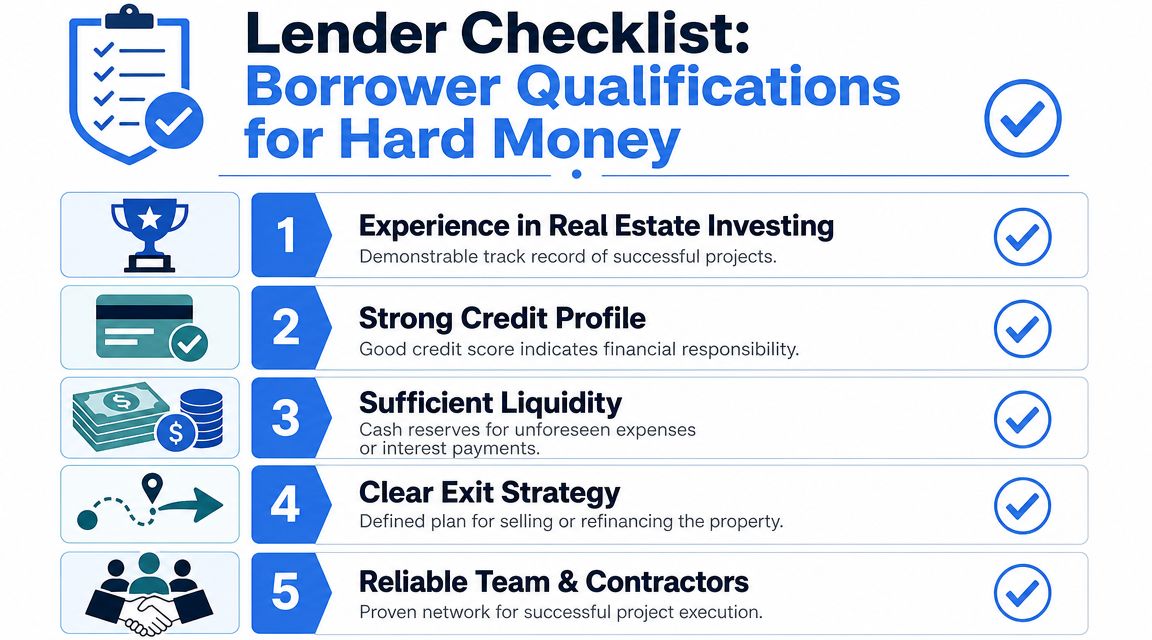
A lender usually wants confidence in five areas:
- Experience. Completed projects matter, but relevant construction, property management, or partner experience can help.
- Liquidity. Even if the purchase and rehab are financed, the borrower still needs operating cash.
- Exit strategy. The plan to sell or refinance has to be realistic.
- Scope of work. The rehab budget must match the property and the neighborhood.
- Execution team. Contractors, project managers, and local support matter more than many first-time investors realize.
Liquidity matters more than many borrowers expect
The phrase “no money down” causes a lot of confusion here. A lender may finance the purchase and rehab and still expect the borrower to show reserves. That's not a contradiction. It's basic risk management.
You may need cash for items the loan doesn't fully absorb, for timing gaps between draw requests and reimbursements, or for ordinary project friction. Borrowers who can't carry a project rarely get the benefit of maximizing the use of borrowed funds.
Underwriting reality: High leverage does not replace the need for reserves. It increases the need for discipline.
How to present yourself well
You don't need a perfect file. You do need a coherent one.
Bring these pieces together:
- A clean purchase contract
- A realistic rehab bid
- Comparable sales that support your ARV
- A short written exit plan
- Proof you can handle surprises
If you're unsure what underwriters focus on, how to qualify for a hard money loan is worth reviewing before you submit a deal. It helps investors organize the borrower side of the file, not just the property side.
Creative Financing and Negotiation Tactics
When a primary hard money loan won't cover everything, smart investors don't kill the deal automatically. They look for ways to bridge the gap without breaking the structure.

The strongest no-money-down operators think like deal makers. They use the first-position loan as the foundation, then solve the remaining problem through terms, relationships, or partnership capital.
Seller terms can rescue a good project
A seller doesn't always need all proceeds immediately. That's especially true when the house needs work, the seller values certainty, or the property has been difficult to move.
In those situations, the seller may carry a small second note, defer part of the payoff, or contribute through credits that reduce the borrower's initial cash burden. The key is keeping the structure simple enough that the senior lender is comfortable with it.
That conversation goes better when the investor presents a clean plan instead of vague optimism.
Joint ventures can be a better answer than stretching the loan
A money partner is often a healthier solution than forcing a deal into a structure it doesn't fit.
In a joint venture, one partner brings the cash needed for closing costs, reserves, or the gap the senior lender won't cover. The operating partner finds the deal, manages the rehab, and handles the exit. Profits get split based on risk and responsibility.
That's not giving away upside. It's buying safety and staying in the game.
If a deal only works when every lender exception gets approved, the structure is weak before rehab even starts.
A senior lender will usually take a cleaner view of a JV file than of a borrower with no reserves trying to rely solely on borrowed funds. The partnership shows depth. It also gives the project a cushion.
A short explainer on deal structuring can help frame this visually:
How to present creative structures to a lender
Lenders don't reject creativity. They reject confusion.
When you bring in a partner, seller carry, or layered structure, package it clearly:
- Spell out who brings what. Cash, management, guarantees, and decision-making authority should be obvious.
- Show the payoff order. The lender wants to know exactly where it sits and how it gets paid.
- Keep documents aligned. If your purchase contract, operating agreement, and scope of work all tell different stories, approval gets harder.
- Stay conservative on the exit. The more creative the structure, the less aggressive your assumptions should be.
This is one area where one factual mention makes sense. LendingXpress handles bridge and fix-and-flip scenarios with staged rehab draws and common-sense underwriting on non-owner-occupied properties, which makes it relevant when a borrower needs a practical structure rather than a bank-style template.
Frequently Asked Questions on No Money Down Flips
Do I still need cash if the purchase and rehab are financed
Usually, yes.
A common mistake is assuming full financing means no out-of-pocket exposure at all. Industry explainers note that borrowers still need liquidity for carrying costs such as interest, taxes, insurance, and contingency overruns, even when the purchase and rehab are financed, because the lender is controlling risk through the property's ARV rather than eliminating every project expense according to Clever's discussion of no-money-down hard money lenders.
What cash expenses tend to show up during the project
Think in categories, not promises.
- Closing-related items that may not be fully rolled in
- Monthly debt service during the hold period
- Insurance and taxes
- Draw timing gaps
- Unexpected repair issues
That's why experienced flippers protect liquidity even when financing is available.
How often are 100% financing approvals issued for newer investors
They're possible, but they're not the baseline.
Lenders usually reserve the greatest financing for files that are easy to defend. If you're newer, the deal needs to be cleaner, the scope needs to be tighter, and your support team needs to be stronger. A new investor can absolutely get a hard money loan. Getting a true zero-down structure is harder.
What kind of properties fit best
The easiest approvals usually come from residential investment properties with broad resale appeal. Straightforward single-family flips are easier to underwrite than unusual layouts, rural assets, or properties that need specialized construction work.
What is the biggest mistake on these deals
Paying too much upfront.
Most failed zero-down attempts trace back to one issue. The investor tried to force financing onto a deal that didn't have enough built-in equity. Once that happens, every other problem gets worse. Draws get tighter. Reserves matter more. Exit pressure builds faster.
Should I chase zero down on every flip
No.
Use it when it protects your liquidity on a strong deal. Don't use it to justify a weak one. There's a big difference between preserving capital and avoiding reality.
If you're evaluating a non-owner-occupied fix-and-flip deal and want a straight answer on whether the structure is financeable, reach out to LendingXpress. A quick review of the purchase price, rehab scope, ARV, and exit plan can tell you fast whether you've got a true zero-down opportunity or a deal that needs a different approach.