
You find a flip that fits your buy box. The seller wants certainty, the property needs work, and a bank loan either won't move fast enough or won't touch the house in its current condition. That's where most deals get lost. Not because the property was wrong, but because the financing was.
Residential transition loans for flippers exist for that exact problem. They're built for non-owner-occupied properties that need to be acquired, improved, and sold or refinanced on a short timeline. They aren't a workaround. They're a purpose-built financing tool for investors operating in actual conditions, where deal speed, rehab cash flow, and exit timing matter more than fitting a conventional underwriting box.
Winning the Deal with the Right Financing
A lot of investors don't lose deals on price. They lose them on execution.
The property is distressed. The listing agent wants proof you can close. The seller doesn't want to wait through a conventional process that may fall apart once the appraiser flags condition issues or the underwriter asks for income documentation that has nothing to do with the project. For a flipper, that's the wrong loan for the job.
A residential transition loan, or RTL, solves that mismatch. It's designed for business-purpose residential investment deals where the value comes from the work you're about to do, not the property's current condition. That's why seasoned investors use RTLs when they need to move on a purchase and line up rehab funding without tying up all their cash.
This isn't a niche corner of the market. In 2025, more than $85 billion in RTLs originated, with more than $35 billion tied to fix-and-flip renovation loans and more than 89,000 distinct private business-purpose real-estate borrowers transacting in the first three quarters of 2025, according to the Urban Institute's RTL market analysis. That tells you something important. Serious investors already use this structure at scale.
Why conventional financing breaks on flip deals
Banks like stabilized properties, clean appraisals, and borrowers whose income fits standard guidelines. Flips often have none of that.
- The property needs work: Deferred maintenance, outdated systems, or incomplete condition can block a conventional approval.
- The timeline is compressed: Sellers of distressed property usually favor buyers who can close quickly.
- The business plan matters more than pay stubs: On a flip, the main question is whether the project pencils and whether the exit is realistic.
Practical rule: If the deal only works when the financing moves slowly, underwrites to personal income, and ignores the renovation plan, it probably isn't a real flip loan.
Before you borrow, get sharper on where your renovation dollars create resale value. A practical place to start is Northpoint Construction renovation insights, especially if you're deciding which upgrades help a property sell and which ones just inflate your budget.
What Exactly Are Residential Transition Loans
Think of an RTL as a specialized tool, not a general mortgage. A conventional loan is built for long-term ownership of a livable home. An RTL is built for transition. You buy, improve, stabilize, and exit.
That structure matters because flips are short projects. You don't need a thirty-year mortgage with fully amortizing payments while you're replacing roofs, kitchens, and plumbing. You need capital that matches the life of the deal.
The basic structure
Residential transition loans are short-term, interest-only, business-purpose loans secured by non-owner-occupied residential property, often with terms up to 36 months and a balloon payoff at maturity, as described in Griffin Funding's RTL overview. In plain terms, you make interest payments during the project and then pay off the loan when you sell or refinance.
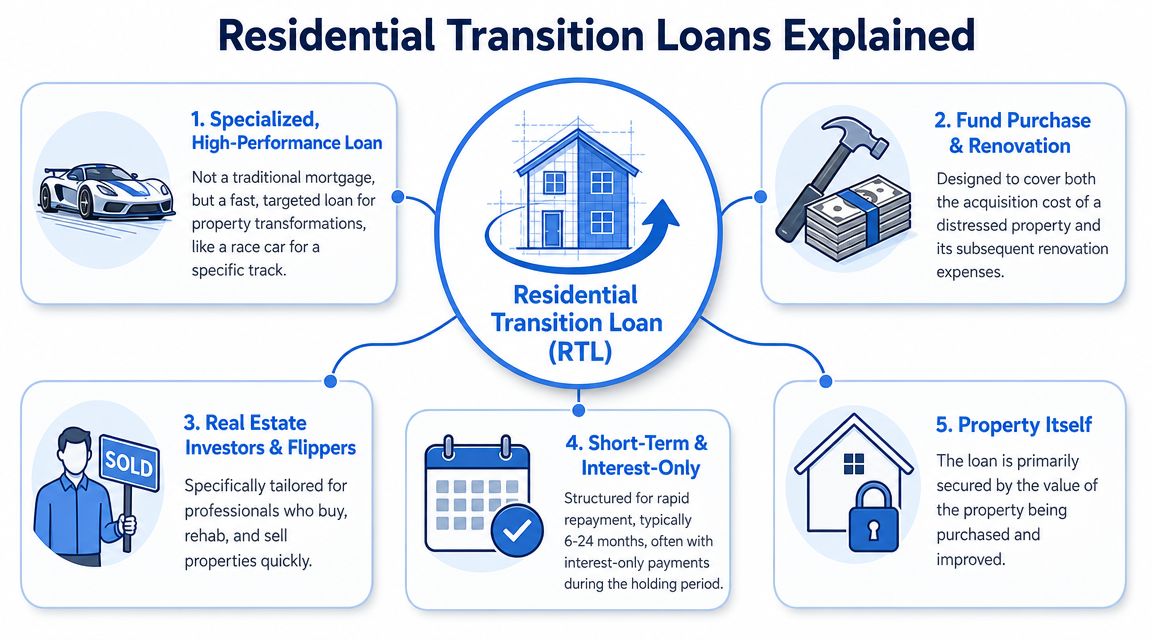
For a flipper, that usually creates a cleaner cash-flow profile than a long-term mortgage. You're not trying to force principal reduction during the rehab phase. You're preserving liquidity for labor, materials, carrying costs, and surprises.
Why underwriting feels different
With an RTL, the lender is usually looking first at the asset and the plan. That includes the property's after-repair value, or ARV, the scope of work, the timeline, and the exit strategy.
That's why these loans often work for houses a bank won't finance. If the property isn't in condition for agency lending today, an RTL can still make sense because the collateral is being evaluated based on where it should be after the rehab is completed.
A second structural difference is regulatory. Because these are business-purpose loans on non-owner-occupied property, they generally sit outside certain consumer mortgage rules such as TRID. That's one reason the process can move faster and stay more flexible than a conventional owner-occupied loan.
What interest-only and balloon payoff mean in practice
Here's the practical version.
- Interest-only payment: During the hold period, you're usually paying interest rather than principal. That keeps monthly outflow lower while the property is under construction.
- Balloon payoff: The full remaining balance gets paid off at the end through sale proceeds or a refinance.
- Short duration: The loan is meant to match the project, not your long-term housing plans.
The cleanest flips are financed with a loan structure that matches the business model. Short hold, focused rehab, clear exit.
If you're borrowing for a flip, don't treat the monthly payment as the only number that matters. A key question is whether the structure gives you enough room to finish the work and exit without a timing problem.
Key Loan Features Built for Flipping Success
The best thing about RTLs isn't the label. It's the way the loan is built around the actual friction points in a flip.
Most projects get squeezed in three places. First, you need to close before another investor steps in. Second, you need rehab cash without draining your own reserves. Third, you need underwriting that makes sense for a distressed asset. RTLs address all three when the lender knows how to structure them correctly.
Rehab draws protect your cash
One of the biggest mistakes newer investors make is assuming they need to front every construction dollar themselves. In many RTL structures, rehab funds are advanced through staged draws tied to completed work.
That matters because your capital stays available for deposits, overruns, utilities, insurance, and the next deal. According to Deephaven Mortgage's summary of RTL benefits, lenders may finance up to 100% of renovation costs via staged draws, and some can fund in as few as 3 to 7 days.
In practice, staged funding works well when the scope is clean and the budget is realistic. It works badly when the borrower submits a vague contractor estimate and expects the lender to fill in the gaps.
Speed changes what deals you can buy
A slow loan doesn't just feel inconvenient. It changes the deals you can win.
When the asset is distressed, speed has direct financial value. You may secure a better purchase because the seller wants certainty. You may avoid weeks of extra taxes, insurance, and interest carry while waiting on a conventional process. You may also keep a contractor schedule intact, which is often where flip timelines start slipping.
Field note: Fast money only helps if the file is clean. Experienced investors win more approvals because they hand over a complete package the first time.
That's why investors looking at fix and flip loan options should pay close attention to execution, draw administration, and how the lender reviews scope, ARV, and exit. A quote is easy. A smooth closing and usable rehab process are what matter.
Asset-based underwriting fits distressed property better
Traditional mortgage underwriting asks whether the borrower fits the bank's box. RTL underwriting asks whether the deal makes sense.
That doesn't mean the borrower doesn't matter. Experience, liquidity, and decision-making still matter a lot. But on a flip, the lender should also care about project scope, resale potential, timeline discipline, and the realism of your numbers.
Three things usually make an RTL file stronger:
- A precise scope of work with line-item costs that match the actual plan.
- A believable exit based on sale or refinance, not wishful pricing.
- A property with a clear value-add story once the rehab is complete.
If one of those pieces is weak, the financing strategy becomes harder to justify. If all three are strong, the loan becomes a tool instead of an obstacle.
RTLs vs Traditional Bridge and Hard Money Loans
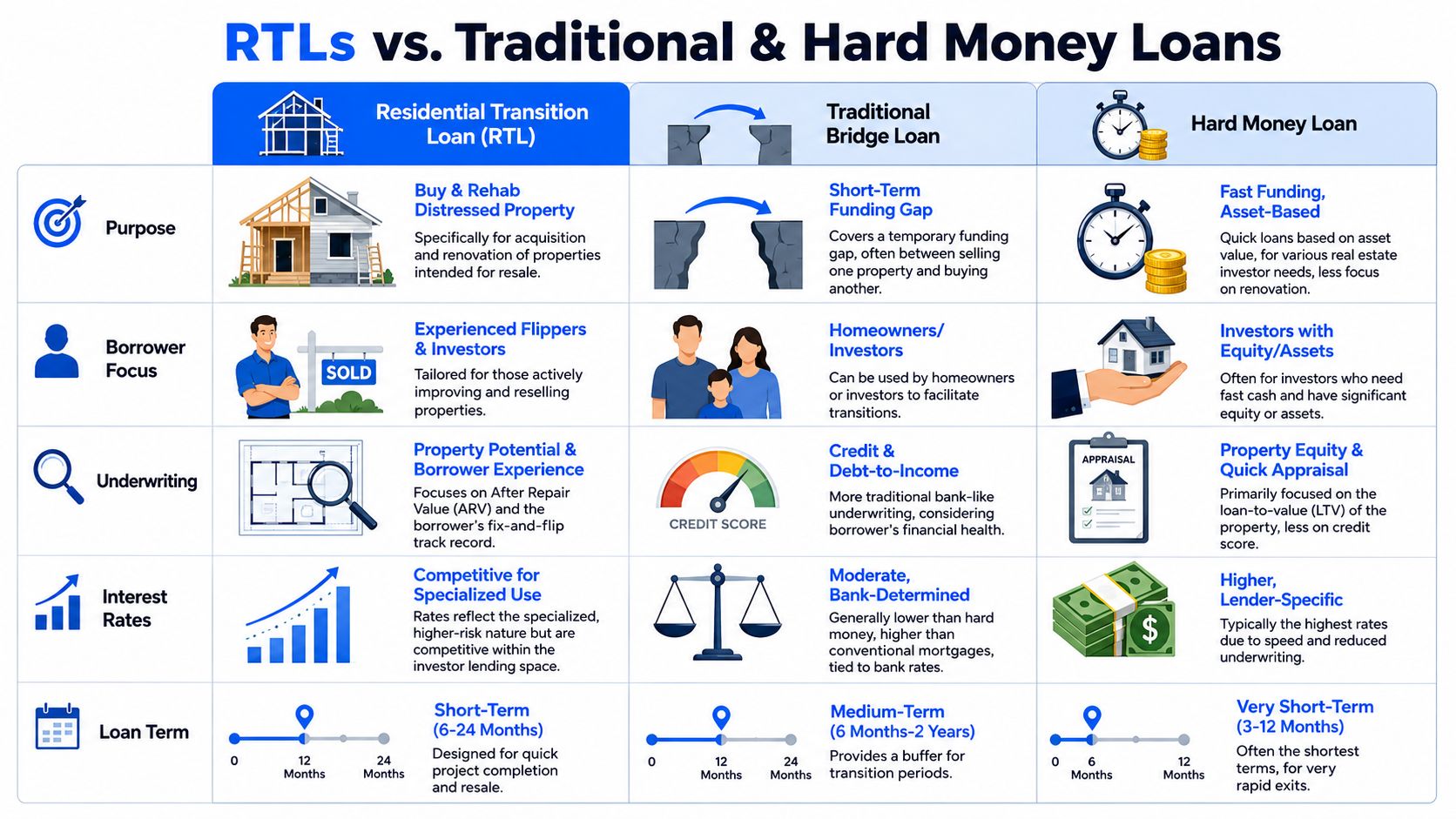
Investors use these terms interchangeably all the time, and that's where confusion starts. Not every bridge loan is built for rehab. Not every hard money loan has a reliable draw process. And not every product marketed as a fix-and-flip loan is underwritten with the same discipline.
The useful way to think about it is by job, not label.
When an RTL makes the most sense
An RTL is usually the strongest fit when the property needs meaningful work and the business plan depends on both acquisition financing and organized rehab funding. It's especially useful when the underwrite should center on ARV, scope, and exit rather than long-term borrower income.
A simple bridge loan can work when you already have the capital for repairs and mostly need short-term acquisition financing or a refinance bridge. Traditional hard money can still fill gaps, but the experience varies more from lender to lender. Some platforms are structured and predictable. Others are ad hoc, fee-heavy, or difficult on draws.
Investor loan comparison
| Feature | Residential Transition Loan (RTL) | Simple Bridge Loan | Conventional Loan |
|---|---|---|---|
| Main use | Buy and rehab an investment property | Short-term financing gap, often acquisition-focused | Long-term financing for stabilized property |
| Underwriting focus | Asset, ARV, scope, exit | Property and short-term exit | Income, credit, property condition |
| Rehab funding | Commonly built into the structure | Often limited or absent | Usually not built for distressed rehab projects |
| Speed | Faster, business-purpose process | Can be fast | Usually slower |
| Best fit | Flips and transitional residential assets | Transitional timing needs with less rehab complexity | Stabilized properties that fit bank guidelines |
The right questions to ask before choosing
If you're comparing products, ask the lender these questions directly:
- Does the loan include rehab funds? If yes, how are draws handled?
- What drives the underwrite? Current condition, ARV, borrower income, or some mix?
- What is the intended exit? Sale, refinance, or either?
- How standardized is the process? You want clarity, not moving targets.
For projects where timing is tight and the property is in transition, investors often compare RTLs with bridge loan structures for investment property to see whether the deal really needs rehab financing or just short-term acquisition capital. That distinction matters more than the label on the term sheet.
A Real-World Fix-and-Flip Case Study
The easiest way to understand residential transition loans for flippers is to follow a project from purchase to sale.
Take a dated single-family property in a neighborhood where updated homes sell cleanly. The house is livable enough to enter, but not financeable through a standard owner-occupied mortgage in its current shape. The investor's plan is straightforward. Buy below the value of renovated comps, complete a focused rehab, list quickly, and exit.
Here's a simplified example of how the financing mechanics can work.

The project setup
The investor locks up the property and submits a scope of work that covers cosmetic upgrades, deferred maintenance, and the items most likely to improve resale appeal. This isn't a luxury remodel. It's a disciplined value-add plan.
A practical scope often includes:
- Exterior cleanup and paint to improve first impression before the listing goes live.
- Kitchen and bath updates where buyers notice condition immediately.
- Flooring, lighting, and fixtures that tighten the look without overbuilding the neighborhood.
- Mechanical and safety corrections so the property can sell without obvious red flags.
When investors get this part wrong, it's usually because they renovate for personal taste instead of resale. If you're deciding where to spend, this guide to renovations that boost your sale price is a useful reminder that not every upgrade produces the same payoff.
How the loan helps the project move
The acquisition closes quickly because the lender is underwriting the property, the rehab plan, and the exit. Rehab funds are managed through draws, so the investor doesn't have to dump all project cash into construction on day one.
That changes the way the operator manages the deal. Instead of preserving capital by cutting scope, the investor can preserve capital by sequencing the project correctly, documenting work, and requesting draws as milestones are completed.
A short educational video can help if you want to see how investors think about deal execution and exits on transitional property:
Where flips actually go right or wrong
The clean case study isn't “buy ugly house, renovate, collect profit.” The underlying story is operational.
Keep the timeline tight, the scope boring, and the exit realistic. Most flip problems come from drift, not from the original idea.
A good RTL-supported flip usually has these traits:
- The investor buys with margin. There's room for mistakes because the deal wasn't won at a retail price.
- The rehab plan is specific. Contractors, materials, and sequencing are clear before closing.
- The resale strategy matches the neighborhood. The finished product fits local buyer expectations.
- The exit starts early. Listing prep, pricing, and refinance backup are thought through before the rehab is done.
What doesn't work is equally clear. Vague budgets. Over-improving the property. Assuming the sale price instead of proving it. Waiting too long to address change orders. Those are the habits that turn a short-term business-purpose loan into a stressful maturity problem.
How to Qualify and Apply with LendingXpress
Applying for an RTL should feel more like presenting a business plan than applying for a consumer mortgage. The strongest files are organized, direct, and easy to underwrite. If the lender has to guess what you're doing, expect delays.
That process has become more standardized as the asset class matured. Mayer Brown notes that the first large revolving RTL securitization was issued in 2018, a milestone that helped push the market toward more refined institutional processes for short-duration lending designed for fix-and-flips, bridge deals, and ground-up construction in its analysis of RTL securitization evolution.

What to have ready before you apply
A solid package usually includes the core items a lender needs to evaluate both the deal and your execution risk.
- Purchase contract or property details: The lender needs to understand what you're buying or refinancing.
- Scope of work and budget: Line items matter. “Full remodel” is not a budget.
- Property photos or video: Condition drives underwriting.
- Borrowing entity information: If you're closing in an LLC or other entity, have those documents ready.
- Exit plan: Sale or refinance. Either is fine if it's credible.
- Track record, if you have one: Past flips, before-and-after photos, settlement statements, and anything that shows you finish what you start.
What underwriters actually care about
A lot of borrowers assume qualification is mainly about personal income. On this kind of loan, underwriters usually care more about whether the project can be completed and exited as proposed.
That means the file gets stronger when the rehab budget matches the actual condition, the ARV story is grounded in the market, and your contractor plan is believable. Experience helps. So does liquidity. But clarity often matters just as much.
A lender can work with a first-time flipper who has a tight plan. It's much harder to work with an experienced borrower who sends a sloppy file.
How to make the process smoother
If you want speed, package the deal for speed.
Send the full scope early. Flag anything unusual about title, access, permits, or occupancy. Be honest about investor experience and reserves. If the property has quirks, explain them before the lender discovers them during review.
LendingXpress offers business-purpose financing for non-owner-occupied projects, including bridge and fix-and-flip structures with staged rehab draws and fast closings, so borrowers who need an efficient process can submit a project with those basics already organized. That kind of preparation is what gets files through underwriting cleanly.
Common Questions About Residential Transition Loans
Can a first-time flipper get an RTL
Yes, but the deal has to carry its weight.
A first-time investor won't usually get the same flexibility an experienced operator gets. That's normal. If you don't have a track record, the lender is going to look harder at the property, the scope of work, your contractor support, and whether the exit makes sense. A detailed budget and a realistic timeline do more for a new borrower than broad claims about future profit.
What are the common exit strategies
For most flippers, the primary exit is a sale. That's the cleanest outcome when the project was underwritten as a flip.
The second common path is refinancing into a longer-term investment loan if the property ends up being a better hold than a sale. That can work when the rehab is complete and the home is stabilized. The key is not to treat the refinance as a rescue plan from the start. It should be a valid backup, not the only reason the deal works.
How is ARV determined
ARV starts with the property's expected value after the planned work is complete. The lender typically reviews that through valuation and file analysis tied to the rehab scope and local comparable sales.
Borrowers get into trouble when they treat ARV like a target instead of an underwritten opinion. If your finished product won't match the comps you're using, the number isn't real. The best approach is to anchor the scope to what buyers in that submarket already pay for.
Are prepayment penalties common
It depends on the lender and the loan structure. Many fix-and-flip borrowers expect to exit early if the rehab and sale move quickly, so this is one of the first questions you should ask before signing a term sheet.
Don't just ask whether there's a prepayment penalty. Ask how interest is charged, whether there's a minimum interest period, and how payoff timing is handled. On a short project, small structural details can affect total cost more than borrowers expect.
What usually causes avoidable problems
Most issues come from execution, not from the concept of the loan.
- Weak scopes: If the budget is too loose, draws become harder to manage.
- Optimistic timelines: Contractors slip, permits stall, and listing prep takes longer than expected.
- Unclear exits: A flip should have a real selling plan, not just a hoped-for number.
- Poor communication: Delays multiply when the borrower, contractor, and lender aren't aligned.
Residential transition loans for flippers work very well when the investor treats the project like an operating business. They work poorly when the borrower treats the loan like easy money and the rehab like an improv exercise.
If you're financing a non-owner-occupied flip and need a lender who understands short-term investor deals, LendingXpress is one option to consider. Bring the address, purchase details, scope of work, and your exit plan. A clean file gives you the best shot at a fast, workable quote.