
You've found a non-owner-occupied house that needs work, and the seller wants a fast close. A bank is moving slowly, the property may not qualify in its current condition, and you're asking a simple question. If you buy it, fix it, and rent it, can you get your cash back through a refinance and use that same money again?
That's the promise behind the BRRRR method. It's not a guarantee, and it isn't a no-money-down shortcut. It's a sequence you underwrite in advance, where the purchase price, rehab budget, rent, appraisal, and loan terms all have to line up. When they don't, you don't lose the property automatically. You usually leave more cash in it than planned, and that changes what you can buy next.
The Five Stages of the BRRRR Method
Say you buy a dated rental below market value because the kitchen is worn, the roof is near the end of its life, and retail buyers can't easily finance it. You renovate it to a clean, durable rental standard, place a tenant, and then refinance based on the improved value. If the new loan is large enough, it repays your short-term financing and returns part or all of your cash for the next purchase.
Investor Brandon Turner has said he coined the acronym in a BiggerPockets blog post around 2013, after describing how he bought, renovated, rented, refinanced, and repeated the process on an earlier property. Landlords had used comparable capital-recycling practices for decades. The label stuck because the loop is easy to remember. Unlike a fix-and-flip, you keep the renovated asset. Your goal is rental income plus reusable equity, not a resale check.
The five BRRRR stages and the number that decides each
| Stage | What happens | Number to check |
|---|---|---|
| Buy | Purchase a non-owner-occupied property below market value | Purchase price plus rehab budget at or below 70% of after-repair value |
| Rehab | Renovate and document every improvement | Renovation budget with a contingency reserve |
| Rent | Place a tenant and establish operating income | Achievable market rent against comparable rentals |
| Refinance | Replace short-term debt with a longer-term loan on the new value | Loan-to-value applied to the appraised value after repairs |
| Repeat | Redeploy released capital into the next purchase | Cash flow still positive after debt service and reserves |
During rehab, controlling material costs matters, and some investors price durable finishes through suppliers such as Central Valley salvaged building supplies from Equity Building Materials, Inc. when the quality fits a rental scope. If you're new to renovation draws and inspections, a plain walkthrough of how a rehab loan works in practice helps you plan the order of work before money is released.
Five measurable conditions decide whether the loop works. They are purchase discount, renovation budget, post-repair value, achievable rent, and refinance terms. Miss one by a wide margin and the later stages can't fully repair it. Overpaying at purchase, for example, can't be solved by hoping for a generous appraisal.
The acronym is a label, the numbers are the method.
Refinance Rules That Decide How Much Cash Comes Back
The refinance is where capital returns, but it's capped three ways at once. A lender looks at loan-to-value against the new appraisal, your ability to carry the debt, and seasoning rules. Your maximum proceeds are the lesser of those three limits, not the highest number in your spreadsheet.
Seasoning is the limit many investors miss. Under Fannie Mae's cash-out refinance transactions guide, at least one borrower generally must have held title for six months before refinance disbursement, and an existing first mortgage being paid off must generally be at least 12 months old. That means your pro forma needs a liquidity period. You may be carrying short-term debt, insurance, taxes, and utilities for longer than the rehab itself takes.
The delayed-financing exception
If you bought entirely with cash, Fannie Mae's delayed-financing exception guidance says the new loan amount cannot exceed the documented initial investment in the purchase plus eligible closing costs, prepaid fees, and loan points. It remains subject to loan-to-value limits based on the current appraisal. You may refinance sooner, but you don't automatically monetize all the equity you created. Documented purchase funds matter as much as the finished value.
How the lender counts rent
Rent also gets haircut before it supports a loan. Fannie Mae's subject-property rental-income method uses 75% of gross monthly rent when calculating adjusted net rental income, then subtracts principal, interest, taxes, insurance, and applicable association charges. So $2,400 in rent becomes $1,800 of qualifying income before housing expenses. The 25% reduction accounts for vacancy and operating costs. A renovation that raises value but doesn't produce durable rent may not support the permanent loan you want.
Before you buy, run this test with real terms, including cash-out refinance loan-to-value limits for investment property. Multiply a conservative appraisal by the lender's LTV. Then subtract payoff, closing costs, and reserves. If what's left can't fund the next purchase, you have two honest choices. Leave cash in this deal, or use flexible private financing for the next acquisition while this rental seasons. Planning that gap early is cheaper than discovering it at maturity.
Running the Numbers on a Sample BRRRR Deal
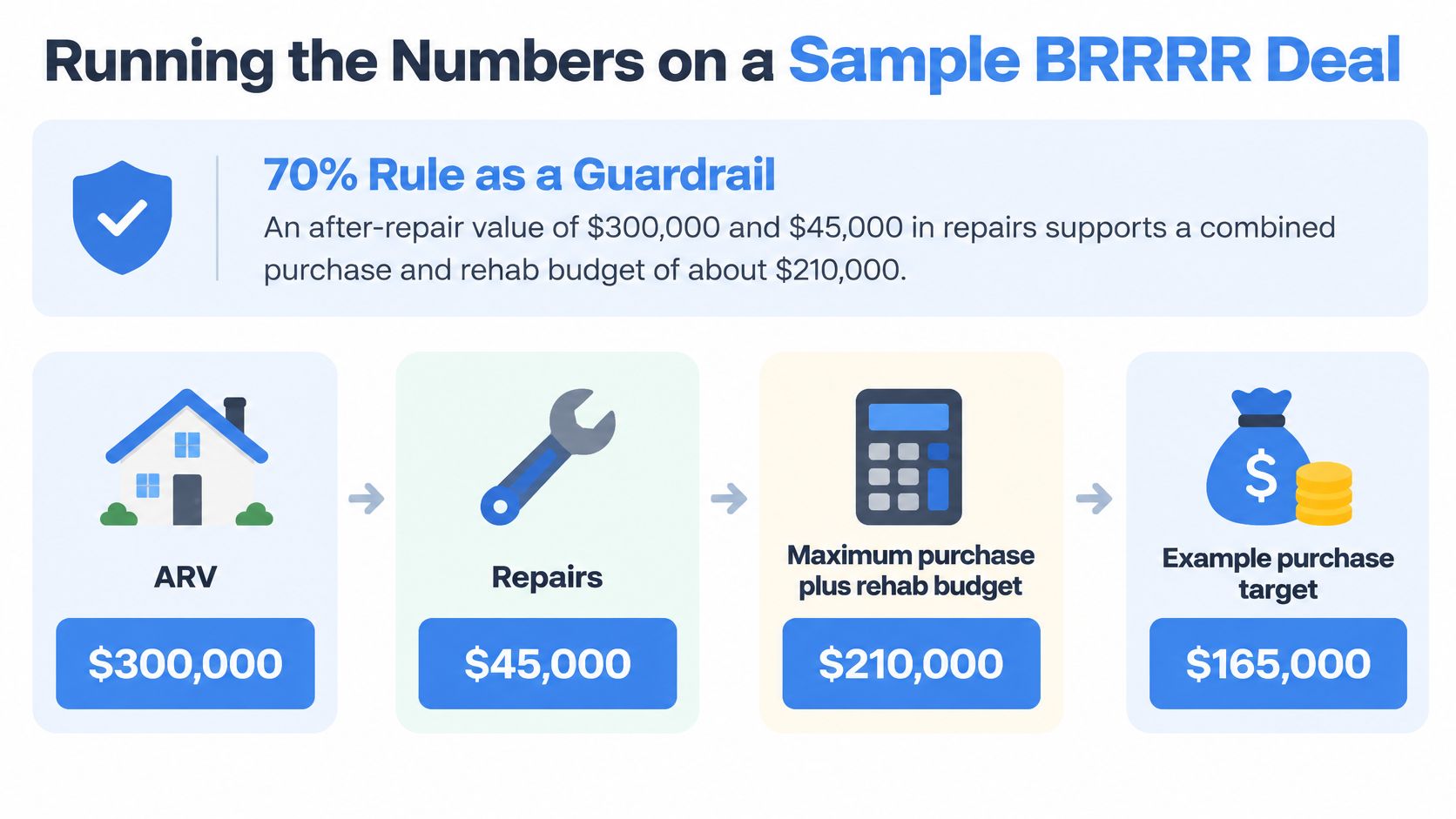
Start with a guardrail, not a hope. Inman's BRRRR investor strategy overview describes the commonly cited 70% rule, where purchase price plus renovation budget should generally remain at or below 70% of after-repair value. If a completed property is expected to appraise at $300,000 and repairs cost $45,000, the maximum combined purchase-and-rehab budget under that rule is about $210,000. A $165,000 purchase plus $45,000 in repairs fits exactly. The rule isn't a lender requirement. It leaves margin for closing costs, carrying expenses, surprises, and valuation risk.
Now test the refinance choice that most guides rush past. Assume rent is $2,400 per month. For the rate, a 2025 federal loan-level dataset cited in Crowdfunded Wealth's BRRRR method analysis recorded 99,035 investor cash-out refinances on one-to-four-unit rental properties, with a median note rate of 7.25% and median combined loan-to-value ratio of 70%. That tells you full capital recovery isn't automatic, even after value is created. We'll use that 7.25% rate in this illustrative example and compare two loan sizes on the same $300,000 appraisal.
Monthly cash flow at 70% and 75% refinance loan-to-value
| Line item (monthly) | At 70% LTV ($210,000 loan) | At 75% LTV ($225,000 loan) |
|---|---|---|
| Gross rent | $2,400 | $2,400 |
| Vacancy at 8% | -$192 | -$192 |
| Property management at 8% | -$192 | -$192 |
| Repairs and capital reserve at 5% | -$120 | -$120 |
| Taxes and insurance | -$450 | -$450 |
| Principal and interest at 7.25% | -$1,433 | -$1,535 |
| Monthly cash flow | $13 | -$89 |
Read the table line by line. Vacancy and management each take $192 because they're percentages of rent, not of the loan. Repairs and capital reserve take another $120, and taxes and insurance take $450, before debt is paid. That leaves $1,446 to cover principal and interest. At 70% LTV, the $210,000 loan costs about $1,433 per month in this example, so the property cash-flows about $13 per month and returns all $210,000 of purchase plus rehab capital, before closing and carrying costs.
At 75% LTV, you pull out $15,000 more cash. That's tempting. But the $225,000 loan raises principal and interest to about $1,535, so the same property now runs about $89 per month negative. A five-point LTV increase flipped the deal from barely positive to negative. You've funded the next purchase by making this rental subsidize it every month.
Extra cash-out only helps if the property still pays its own debt after realistic expenses.
These figures are illustrative assumptions, so replace every line with local taxes, insurance quotes, management fees, and rent from rented comparables, not asking listings. If your hold includes an added unit later, you'll also want clean records when you create an ADU depreciation schedule from CozyCube, since cost tracking starts during rehab, not at tax time. The chart above shows the same tension visually. More debt increases cash once, but it also raises the monthly payment every month after.
Choosing Financing for Each Stage
The BRRRR method usually needs three kinds of money in sequence. You need short-term capital to buy, funds to renovate, and a longer-term loan to hold. Trying to force one bank product to do all three jobs is where many non-owner-occupied deals stall, especially when the property is distressed or the borrower doesn't fit a traditional box.
Private and hard money bridge loans are built for speed and flexibility at purchase. They're short term and carry a balloon payment due at maturity, so your exit, sale, refinance, or extension plan, has to be clear before the loan closes. Lenders in this space can often look past issues like a recent foreclosure or thin credit history, but that doesn't mean anything goes. They'll still ask for a repayment plan and proof of cash reserves and monthly income, because the property and your liquidity both protect the loan.
Financing options compared by use, speed and rehab funding
| Financing option | Best used for | Typical speed | Rehab funding |
|---|---|---|---|
| Hard money bridge loan | Buying a non-owner-occupied property quickly | About one week | Sometimes included, confirm holdback terms |
| Rehab financing | Renovation costs released in staged draws | Tied to acquisition closing | Up to 100% of rehab costs |
| Conventional cash-out refinance | Long-term loan after the rental is stabilized | Slower, full underwriting and seasoning apply | No new rehab draws |
| LendingXpress bridge and rehab loans | Fast acquisitions and renovations on non-owner-occupied property | Closings in as little as three days | Up to 100% of rehab costs with staged draws |
A California private lender offering that structure can close quickly when a bank timeline would kill the purchase, and staged draws release renovation money as work is completed and inspected. That protects both sides. You aren't paying for unfinished work, and the lender can verify progress before the next draw. For a broader view of renovation funding choices beyond investor loans, Epic Remodeling's renovation financing guide from Epic Remodeling is a useful plain-language comparison.
Bring your numbers to a loan officer before you make an offer. Share purchase price, rehab scope, expected appraisal, comparable rent, and your reserve position. A good scenario review tests whether the refinance you need later is plausible with the debt you're taking now. Speed matters at acquisition, but it only helps if the exit still works.
Cash Flow Risks That Sink Deals
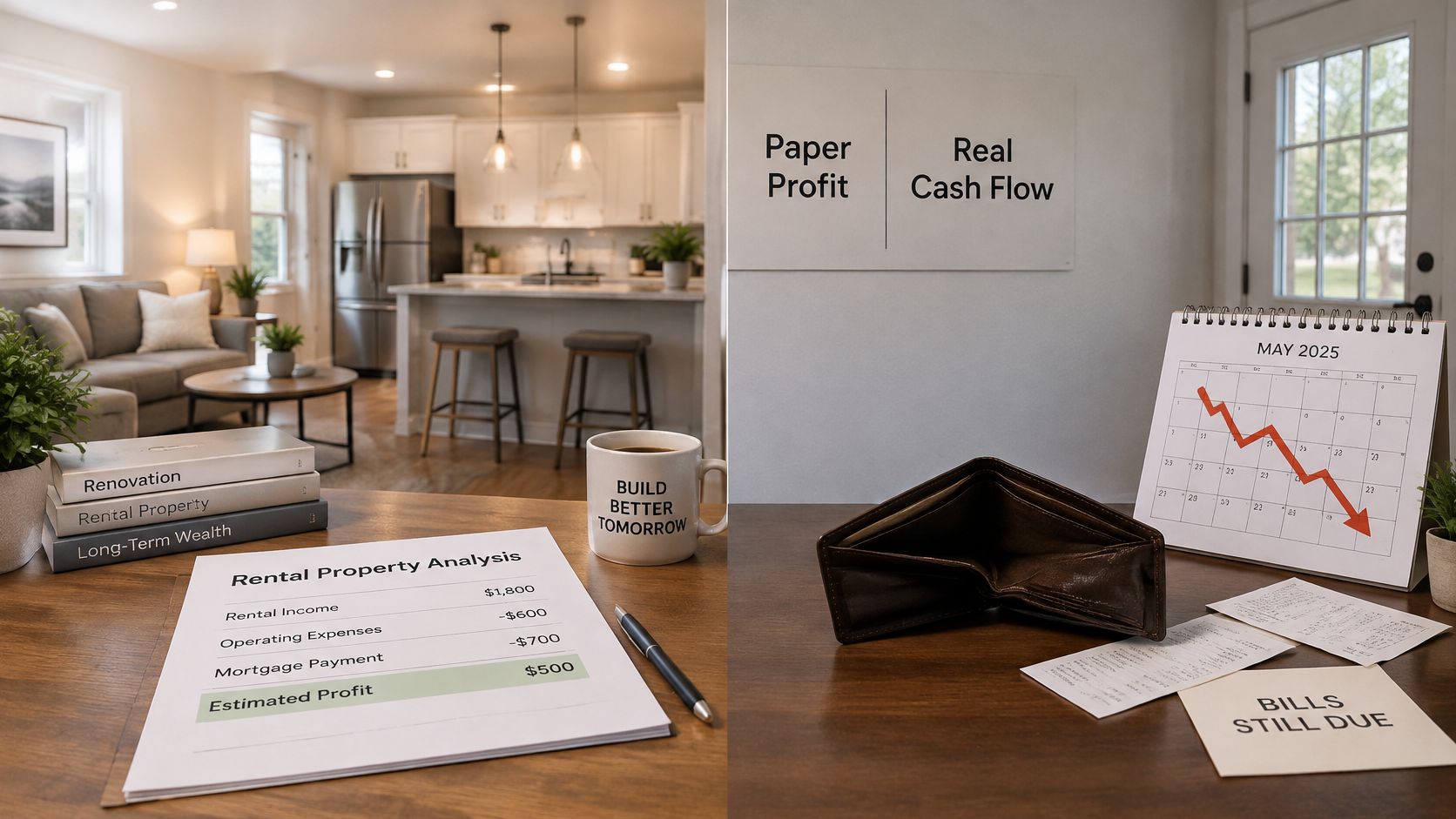
A deal can look strong on paper at purchase and still fail to return capital after renovation. That's the core risk. You're underwriting a future appraisal and a future lease, while interest, taxes, and insurance are due in the present.
This split between projected profit and real monthly pressure is worth seeing clearly before you commit capital.
Recent rental conditions make optimistic lease-up assumptions risky. Harvard Joint Center for Housing Studies State of the Nation's Housing 2025 reported national rental vacancy reached 7.1% in the first quarter of 2025, up from 6.6% a year earlier, while rent growth was only 0.8% annually in that quarter. Separate market reporting in that analysis found a 7.6% average rental vacancy rate across the largest 50 U.S. metros in 2025. Financing costs also reset higher, as Business Insider's 2023 BRRRR market reporting noted 30-year mortgage rates had reached approximately 7% by 2023. Higher rates raise debt service and reduce what a refinance can safely cover.
Four stress tests to run before you buy
- Appraisal 10% below projection: On a $300,000 projection, value falls to $270,000. A loan at 70% of the stressed appraisal is $189,000, not $210,000, leaving $21,000 in the deal. Don't confuse this refinance LTV with the 70% purchase-and-rehab rule.
- Rent 10% below projection: Test rent at the lower quartile of comparable properties and include two months of vacancy during lease-up.
- Refinance rate one point higher: Recalculate principal and interest and check whether rent still covers debt service, insurance, and operating costs.
- Three extra months of carrying cost: Add interest, taxes, insurance, and utilities for a slower rehab or lease-up, then check your reserves.
The walkthrough below reinforces why those downside cases belong in your first underwrite, not your refinance application.
If a property only works at the best rent on the best listing, it doesn't work yet. Underwrite to lower-quartile rent, keep reserves for concessions and repairs, and decide in advance how much capital you're willing to leave in the property. That decision protects the cash meant for your next acquisition.
Lender Checklist and Go or No-Go Test
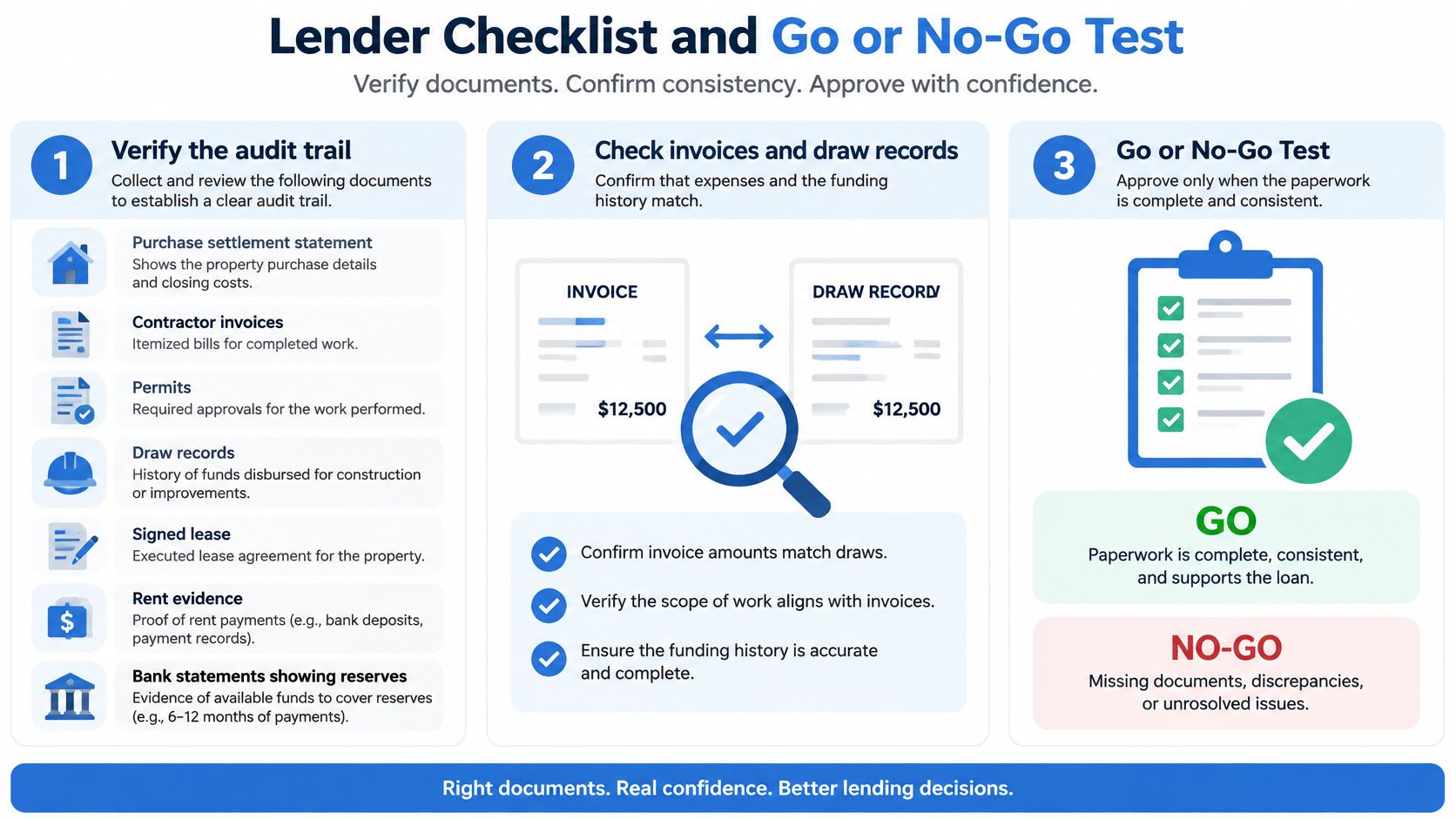
Lenders don't refinance your intentions. They refinance documents, value, rent, and reserves they can verify. Build the file during the project, not the week before you apply.
Verify the audit trail
Keep one organized folder with the purchase settlement statement, contractor invoices, permits, draw records, signed lease, rent evidence, and bank statements showing reserves. Each document proves a different thing, and a missing piece slows underwriting even when the property looks great in photos.
Invoices and draw records prove renovation value was created and paid for. Permits show work was done legally, which matters for appraisal and insurance. The lease and rent evidence support the rental income calculation, especially when deposits match the lease amount. Bank statements show liquidity for lease-up delays, debt payments, and the shortfall if the appraisal comes in low. Together, that trail helps a lender distinguish genuine value creation from unsupported assumptions.
Check the leverage limit
Borrowing needs its own check, separate from value. Fannie Mae's high-LTV refinance loan and borrower eligibility matrix lists a 75.01% minimum LTV threshold for one-to-four-unit investment-property high-LTV refinance transactions. Read that correctly. It's an eligibility floor for that framework, not a cap and not proof that heavier debt is safe for your property. A lender offering more doesn't mean the rent supports more.
Calculate maximum refinance proceeds as the lesser of three amounts. Use lender LTV capacity times appraised value, underwriting-based loan capacity from rent and borrower strength, and the amount permitted under seasoning rules. The smallest number controls. If you extract too much equity, the property can turn cash-flow negative when insurance renews higher, a tenant leaves, or a major repair lands in the same quarter.
Run the portfolio test
Before you repeat, test the finished property as a business. Start with gross rent at the lower quartile of comparables. Subtract vacancy, management, repairs, capital expenditures, taxes, insurance, utilities, and debt service. Only what's left is distributable cash flow. Don't count principal paydown as spendable income, and don't assume you'll self-manage forever at zero cost.
Then look beyond this one house. Each cycle adds debt, tenants, insurance renewals, and maintenance exposure. If two properties go vacant at once, can reserves cover both mortgages without forcing a sale? Cross-property borrowing can amplify a small problem because one weak rental starts pulling cash from stronger ones.
Repeat only when the refinanced property stays cash-flow positive after realistic expenses and the next purchase can be funded without exhausting reserves.
That's your go or no-go test. Go when paperwork is complete and consistent, rent is documented, the stressed cash flow is still positive, and reserves remain after closing. No-go when the deal needs a perfect appraisal, top-of-market rent, or every dollar of reserves to survive lease-up. Waiting is a valid decision.
Your next step is a scenario review, not an application guess. Bring the address, purchase price, itemized rehab budget, rent comparables, expected timeline, and reserve statements to a loan officer who works with non-owner-occupied property. Ask for the downside case in writing, including a lower appraisal and slower lease-up. If the numbers still hold, you have a BRRRR deal worth pursuing. If they don't, you've learned that before your capital is trapped.
If you're buying or renovating a non-owner-occupied property in California and a traditional bank is too slow or won't qualify the deal, LendingXpress offers bridge and rehab financing with closings in as little as three days and staged draws that can cover up to 100% of renovation costs. Bring your purchase price, rehab budget, expected rent, and projected value for a scenario review, and get a clear view of whether your BRRRR refinance can return capital without draining reserves.