
A hard money loan is a short-term, asset-based real estate loan, commonly carrying 9.5% to 13% annual interest, 1.5 to 3 origination points, and terms of roughly 6 to 24 months. It's secured primarily by the property, not by the borrower's income or credit profile.
You've found a non-owner-occupied investment property with strong potential, but the seller wants to close in ten days. Your bank still needs tax returns, income documentation, debt-service analysis, committee approval, and an appraisal review. By the time the bank finishes, another buyer may already own the deal.
That's where hard money fits. It isn't automatically a last resort for desperate borrowers. Used correctly, it's a strategic financing tool for investors who need to acquire, renovate, stabilize, refinance, or sell an investment property before conventional financing can respond.
When Opportunity Knocks Faster Than a Bank Can Answer
A real estate investor sees an underused property in a strong location. The purchase price works because the building needs repairs, the seller has a firm closing deadline, and the investor expects to create value through renovation. The investment thesis is sound, but the timeline is the problem.
A traditional bank usually evaluates the borrower first. It wants a complete financial profile, documented income, established debt obligations, and a property that already fits its lending standards. That process makes sense for a long-term mortgage, but it can be poorly suited to a transitional investment where the property's value will change after acquisition.
A private lender approaches the same opportunity differently. The lender examines the collateral, lien position, current value, projected value, purchase contract, renovation plan, borrower equity, and exit strategy. Credit and experience can still matter, but they typically don't carry the same weight they do in conventional underwriting.
Practical rule: Speed only creates value when the deal has a clear way to repay the loan.
Hard money is designed for that kind of mismatch between opportunity and institutional process. Market sources describe closings in roughly 3 to 14 days, with some offerings stating 5 to 10 business days and urgent transactions potentially closing faster, depending on the lender, property, documentation, and title work. This overview of hard money and bridge-loan timing explains why asset-focused underwriting can move more quickly than a conventional mortgage process.
The strategic question isn't, “Can I qualify?” It's, “Will faster access to capital produce enough value to justify the cost and risk?” If a quick close lets you secure a property, complete a renovation, and refinance into longer-term debt, hard money may be efficient. If the transaction has no urgency and conventional financing is available, paying for speed may weaken the investment.
How Hard Money Loans Actually Work
The simplest way to understand a hard money loan is to think of it as a property-first loan. A pawn shop cares primarily about the value and resale potential of the item pledged as security. A hard money lender applies a similar logic to real estate, while also evaluating title, marketability, construction risk, and the borrower's repayment plan.
The process generally follows a practical sequence:
- The borrower presents a deal. The lender reviews the purchase contract, property type, proposed use, requested loan amount, and intended exit.
- The lender evaluates the collateral. Current value, comparable sales, condition, location, and marketability help determine whether the asset supports the requested debt.
- The lender evaluates the financing capacity. Loan-to-value, loan-to-cost, or loan-to-after-repair value determines how much capital the property can support.
- The lender reviews the business plan. For a renovation, that may include contractor bids, a scope of work, a draw schedule, and the expected sale or refinance.
- The lender completes diligence. Title, insurance, entity documents, borrower information, and property reports must align before closing.
- The lender funds and monitors the loan. Renovation projects may use staged draws, while the borrower makes payments and works toward the planned exit.
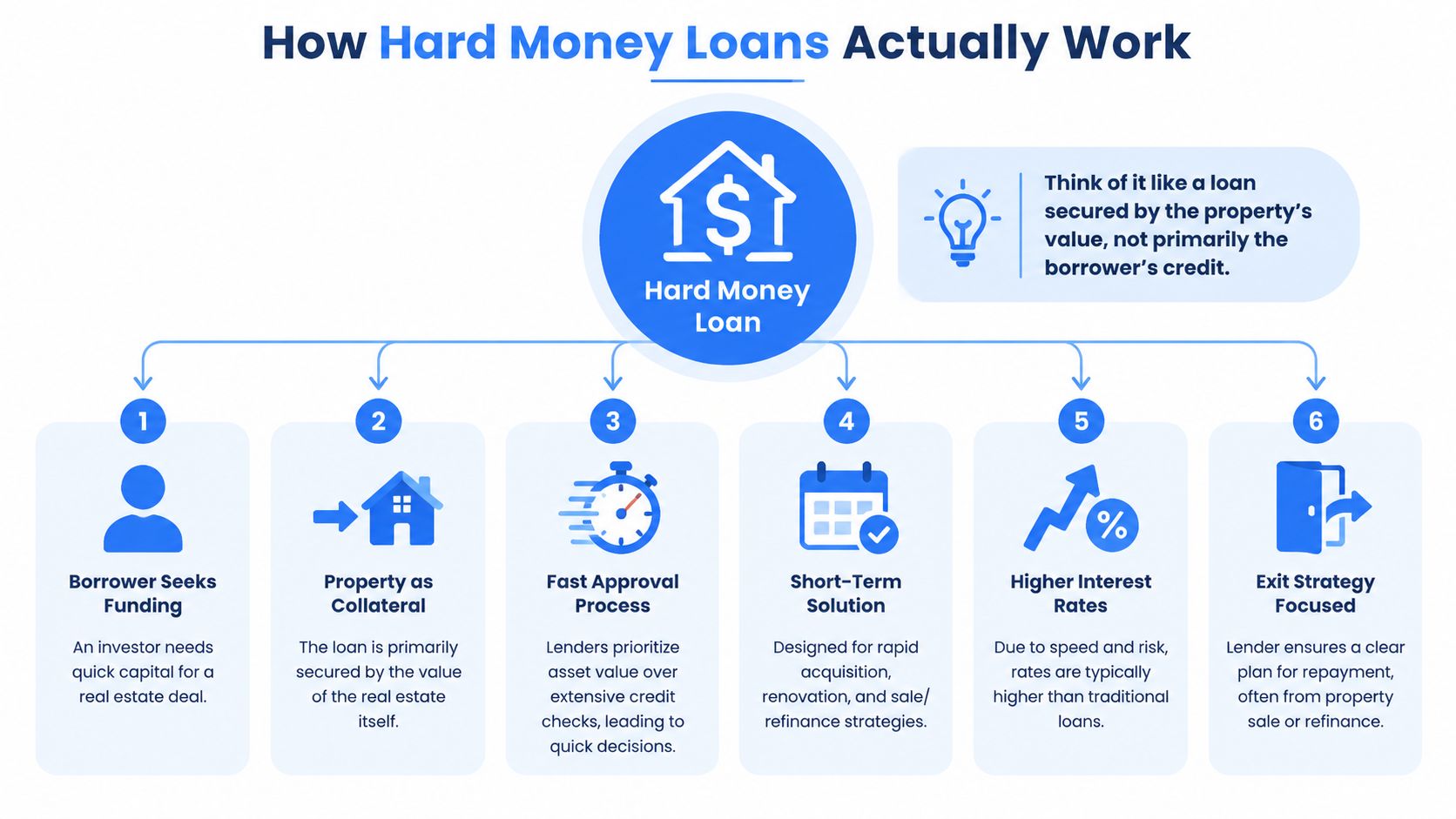
A borrower with imperfect credit may still receive serious consideration if the property provides sufficient collateral and the repayment plan is credible. That doesn't mean the lender ignores the borrower. A lender still needs confidence that the investor can manage the project, fund required equity, handle payments, and complete the exit.
Hard money loans for non-owner-occupied properties are commonly short-term, asset-based facilities lasting 6 to 36 months. Some lender guidance narrows non-owner-occupied first-position loans to 6 to 24 months, reinforcing that these loans support transitional financing rather than long-term amortization. Lantzman Lending's loan-term guidance provides that distinction.
The loan may cover acquisition, selected renovation costs, or both, depending on the lender's structure. The borrower must understand whether interest accrues on the full commitment or only funded amounts, how draws work, what happens if construction runs late, and whether an extension is available.
Hard Money Loans vs Traditional Bank Mortgages
A bank mortgage suits long-term ownership, stable income, and predictable repayment. A hard money loan suits a property in transition, where speed, collateral, or deal structure matters more than the lowest borrowing cost. For business-purpose investment property, the choice often depends on whether financing speed creates enough value to justify the premium.
| Feature | Hard Money Loan | Traditional Bank Loan |
|---|---|---|
| Closing speed | Often structured for fast acquisition, subject to diligence and title readiness | Usually follows a longer institutional approval process |
| Primary underwriting focus | Collateral value, LTV or ARV, lien position, project plan, and exit strategy | Borrower income, credit, debt obligations, documentation, and property suitability |
| Typical term | Commonly 6 to 24 months | Generally structured for long-term repayment |
| Interest and fees | Common market pricing is 9.5% to 13%, plus 1.5 to 3 points (market pricing reference) | Usually lower-cost when the borrower and property qualify |
| Flexibility | Can accommodate unusual assets, renovation plans, and time-sensitive acquisitions | Uses more standardized property and borrower requirements |
| Repayment | Often interest-only, with repayment through sale, refinance, or another planned exit | Usually based on scheduled long-term amortization |
| Best fit | Transitional investment properties where speed or flexibility has business value | Stable assets and borrowers who meet conventional underwriting |
The price difference requires a full calculation. On a $500,000 loan, 2 points equal a $10,000 upfront fee, separate from monthly interest payments. Points can make a short loan more expensive than its interest rate alone suggests.
Compare the total cost, not only the monthly payment. Include points, legal and closing costs, draw administration, applicable extension fees, carrying expenses, and the financial effect of a delayed exit. A lower rate can still produce the weaker result if the bank process causes the investor to miss the purchase, renovation, or refinancing deadline.
The legal purpose of the loan also matters. A business-purpose loan for a non-owner-occupied investment property is evaluated differently from a consumer mortgage for a borrower's home. Borrowers should confirm how the lender classifies the transaction and whether the use of proceeds, property occupancy, and documentation match that classification.
For a closer comparison, this comparison of private lenders and banks outlines differences in underwriting and deal structure. Use conventional financing when its process fits the transaction and the lower cost outweighs the waiting period. Consider hard money when it preserves a deadline, funds improvements, or bridges a temporary gap, and verify that the exit plan can absorb its fees and timing requirements.
Who Uses Hard Money Loans and For What Deals
A fix-and-flip investor may find a property that needs substantial work before it can compete with nearby homes. The investor wants to purchase quickly, complete the improvements, and sell after the property reaches its expected after-repair value, or ARV.
For this type of deal, the lender focuses on the relationship between the loan and the completed property. Fix-and-flip transactions commonly target 60% to 75% of ARV, while bridge loans are often limited to 60% to 70% of current as-is value, according to Herring Bank's explanation of LTV and ARV underwriting.
This equity requirement protects both sides. The investor contributes meaningful equity and has room to absorb some variation in the renovation or sale. The lender receives collateral coverage that doesn't depend entirely on the borrower's income history.
The renovation plan must be more than a hopeful budget. A lender will want a realistic scope of work, contractor information, cost estimates, draw requirements, insurance, and a timeline that matches the loan maturity. A polished kitchen may help a property sell, but the investor also needs to consider buyer expectations, finish quality, and the order in which work gets completed. For practical guidance on presentation and buyer appeal, review Soca Services Painting's staging insights.
A bridge borrower faces a different problem. The investor may want to purchase a new non-owner-occupied property before selling or refinancing another asset. The bridge loan provides temporary capital while the investor completes the sale, stabilizes the property, secures permanent financing, or resolves another timing issue.
The two strategies share a short-term structure, but their underwriting questions differ. A flip depends heavily on renovation execution and resale value. A bridge loan depends on the quality of the current collateral and the reliability of the planned payoff. Neither loan works well without a defensible exit.
Understanding the Benefits and Risks
The main benefit is control over timing. A private lender may be able to evaluate a property and structure a loan around its collateral and business plan without requiring the same process used for a conventional mortgage. That flexibility can help an investor compete for a property, begin work sooner, or solve a temporary capital gap.
The main risk is that speed comes with a higher financial burden and a shorter repayment window. The borrower must carry interest, satisfy payment obligations, complete the project, and execute the sale or refinance before the loan matures. If the exit fails, the investor may need an extension, additional capital, a sale at a lower price, or a different refinancing strategy.
The legal boundary matters
For non-owner-occupied investment properties, hard money is generally structured as business-purpose financing, but the label alone doesn't determine the legal treatment. The property's occupancy, the purpose of the loan, the lien position, and the applicable state jurisdiction all matter.
Business-purpose loans may be exempt from some requirements associated with consumer mortgage lending, including portions of TILA, Dodd-Frank ability-to-repay rules, RESPA, and other consumer protections. Owner-occupied or consumer-purpose transactions may trigger different federal and state rules, including licensing and usury requirements. This legal overview of private lending and regulatory considerations explains why the same basic loan structure can receive different treatment depending on use and occupancy.
That distinction isn't a shortcut around compliance. It's a reason to describe the transaction accurately and involve qualified legal counsel when the facts are unclear.
Test the downside before closing
Ask these questions before accepting terms:
- Exit: Can the loan be repaid through a realistic sale, refinance, or other source?
- Budget: Does the project still work after interest, points, carrying costs, closing expenses, and contingency needs?
- Timing: What happens if the sale or refinance takes longer than expected?
- Collateral: Could a value decline or construction problem leave too little equity?
- Documents: Are the rate, points, draw process, default provisions, extension terms, and payoff requirements clear?
A fast loan isn't a successful loan unless the borrower can carry it and repay it.
Finding the Right Lending Partner with LendingXpress
The lender you choose shapes execution, not only the interest rate. Look for a partner who explains collateral analysis, flags missing documents early, communicates conditions directly, and sets draw procedures around the renovation plan.
LendingXpress works with real estate investors seeking private and hard money financing for bridge, fix-and-flip, rental, residential, and commercial investment properties. Its process includes an efficient application, practical underwriting, direct communication with loan officers, and financing structured around the property and exit rather than a standard bank template.
For renovations, ask how the lender manages staged draws, contractor records, inspections, unused commitments, and scope changes. Clear procedures help prevent funding delays that can interrupt contractors and increase carrying costs.
Prepare the purchase contract, property details, renovation budget when applicable, ownership information, requested loan amount, available equity, and written exit strategy before applying. Investors can also review this hard money loan qualification checklist to organize the application.
A sound lender does not overlook risk to force an approval. It tests whether the collateral, financing structure, timeline, and repayment plan fit together. That discipline helps prevent the use of expensive short-term capital for a project that needs longer-term financing.
LendingXpress offers asset-backed bridge and fix-and-flip financing for non-owner-occupied real estate, with applications and structures that can support acquisition and renovation needs. Visit LendingXpress to discuss your property, timeline, and exit strategy with a lending partner before the opportunity passes.