
A lot of investors run into the same problem at exactly the wrong time.
You spot a non-owner-occupied property with upside. Maybe it's a fast flip. Maybe it's a rental that pencils out if you can move quickly. You already have equity in another investment property, so the obvious move is to refinance that asset and pull cash for the next deal. Then the lender or title company tells you there's an issue. You still have a second loan, private note, or HELOC on the property, and before the refinance can close, they need a subordination agreement.
That phrase sounds bigger than it is. In practice, it's a common legal tool that lets investors keep financing flexible without tearing apart an existing capital stack. It doesn't create new value in the property, and it doesn't wipe out any debt. What it does is settle a very practical question: which lender gets paid first if something goes wrong.
If you invest long enough, you'll see this document more than once. It shows up when you refinance, restructure debt, increase borrowing, or try to access trapped equity from one property to fund another. The investors who handle it well usually aren't the ones with the most complicated spreadsheets. They're the ones who understand lien priority early, ask the right lender for approval first, and build enough time into the closing calendar.
Your Next Investment Opportunity Is Waiting
An investor owns a rental free of any owner-occupant complications, but not free of debt. There's a first mortgage in place, plus a smaller second-position loan used for improvements. A new opportunity appears. To move on it, the investor wants to refinance the rental and pull cash out.
The refinance itself may be straightforward. The obstacle is the existing junior lien.
When the original first mortgage gets paid off through the refinance, lien priority doesn't just sort itself out the way borrowers expect. The new lender wants the replacement loan in first position. The junior lender has to agree, in writing, to remain behind that new loan. That written agreement is the subordination agreement.
For active investors, this is less a legal curiosity and more a recurring transaction tool. It often shows up in moments when speed matters most, such as a pending purchase contract, a maturing bridge loan, or a rehab timeline that can't wait for traditional bank pacing.
Why investors get tripped up
The issue usually isn't whether the deal makes sense. It's timing.
Many borrowers assume the refinance lender, title company, and junior lender will sort it out automatically. They won't. The junior lienholder has its own review process, its own risk concerns, and its own conditions for saying yes. If that lender drags its feet, the whole refinance can stall.
Practical rule: If your investment property has more than one recorded loan, check lien positions before you lock your closing plan.
A subordination agreement is best viewed as a way to keep momentum. It's the document that lets you replace one senior loan with another without forcing the second lender to be paid off in full. For investors building across multiple properties, that flexibility matters. It can preserve liquidity, keep reserves where they need to be, and open the door to the next acquisition instead of tying up capital in one asset.
Understanding Lien Priority in Real Estate Investing
Before you can answer what is a subordination agreement, you need a clear view of lien priority.
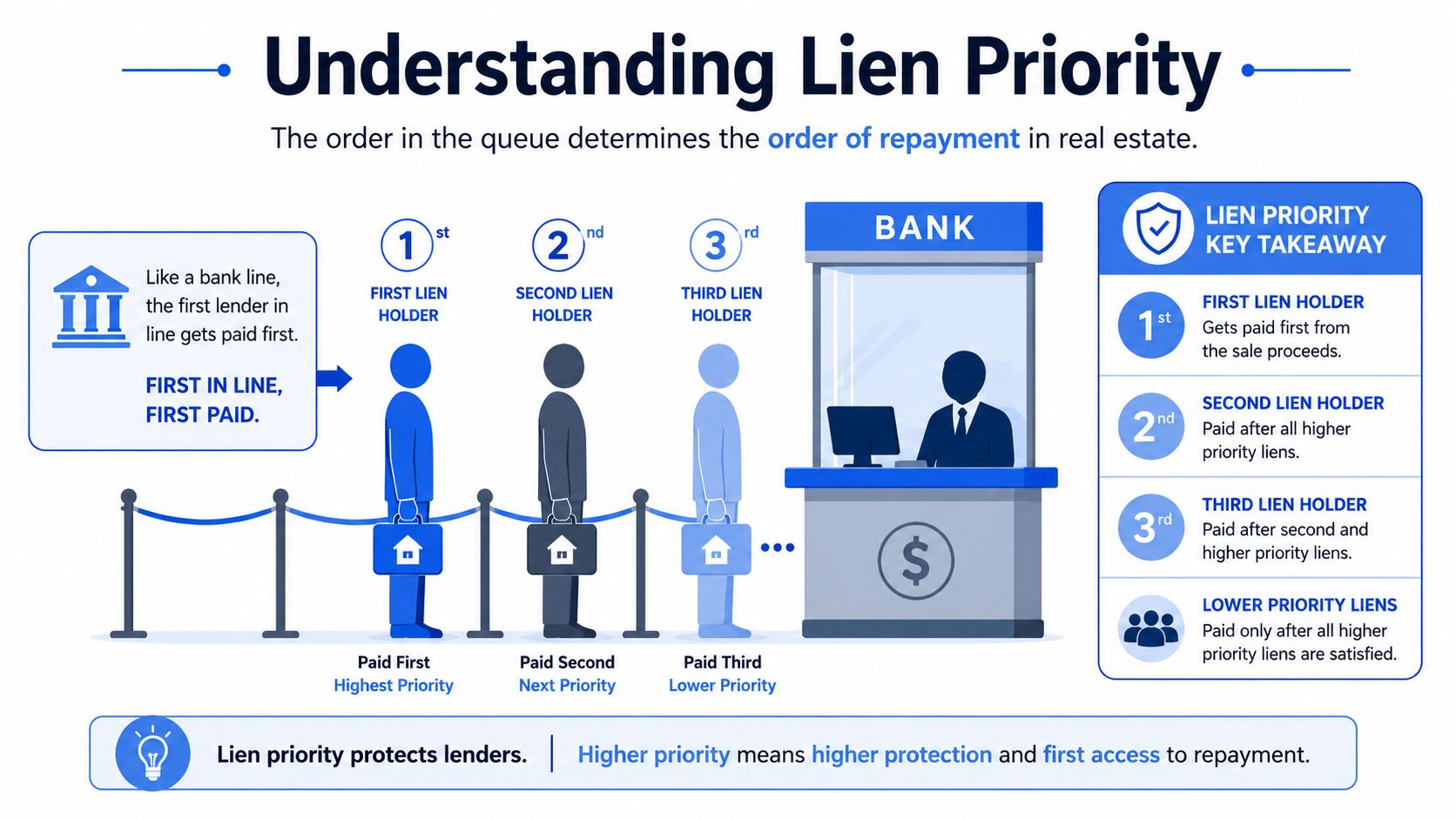
Think of repayment like a line at a teller window. The lender at the front of the line gets paid first from the property's value. The lender behind that one gets paid next, if there's anything left. If a third claim exists, it waits behind both of them.
First position and junior position
In most real estate transactions, the senior lien sits in first position. That lender has the strongest claim against the property. A junior lien sits behind it. This might be a second mortgage, a HELOC, or a private note secured by the same real estate.
That order matters most when the property is sold under pressure, liquidated, or foreclosed. Cornell Law School's Wex explains that a subordination agreement does not erase a junior debt; it only changes the priority of repayment, and the main issue is what happens when the collateral value isn't enough to cover every claim upon liquidation or foreclosure (Cornell Wex on subordination agreements).
If you review title often, it helps to use a document review workflow instead of scanning everything manually. An AI solution for legal documents can help investors or brokers flag title items, recorded liens, and language that deserves a closer look before closing.
Why the line matters to every lender
A lender in first position takes less risk than one in second. That difference shapes underwriting, pricing, and approval decisions. It also explains why a new refinance lender usually insists on being first in line.
Here's the practical version:
- First lien holder: Gets paid first from sale or foreclosure proceeds tied to the property.
- Second lien holder: Gets paid only after the first lien is satisfied.
- Borrower: Still owes both debts unless one is separately paid off or released.
Later in the process, this distinction can make or break a refinance. A lender replacing the old first mortgage typically won't fund a new senior loan unless its priority is clear and documented.
A quick explainer can help if you want a visual walkthrough before dealing with title and closing paperwork.
The Role of a Subordination Agreement
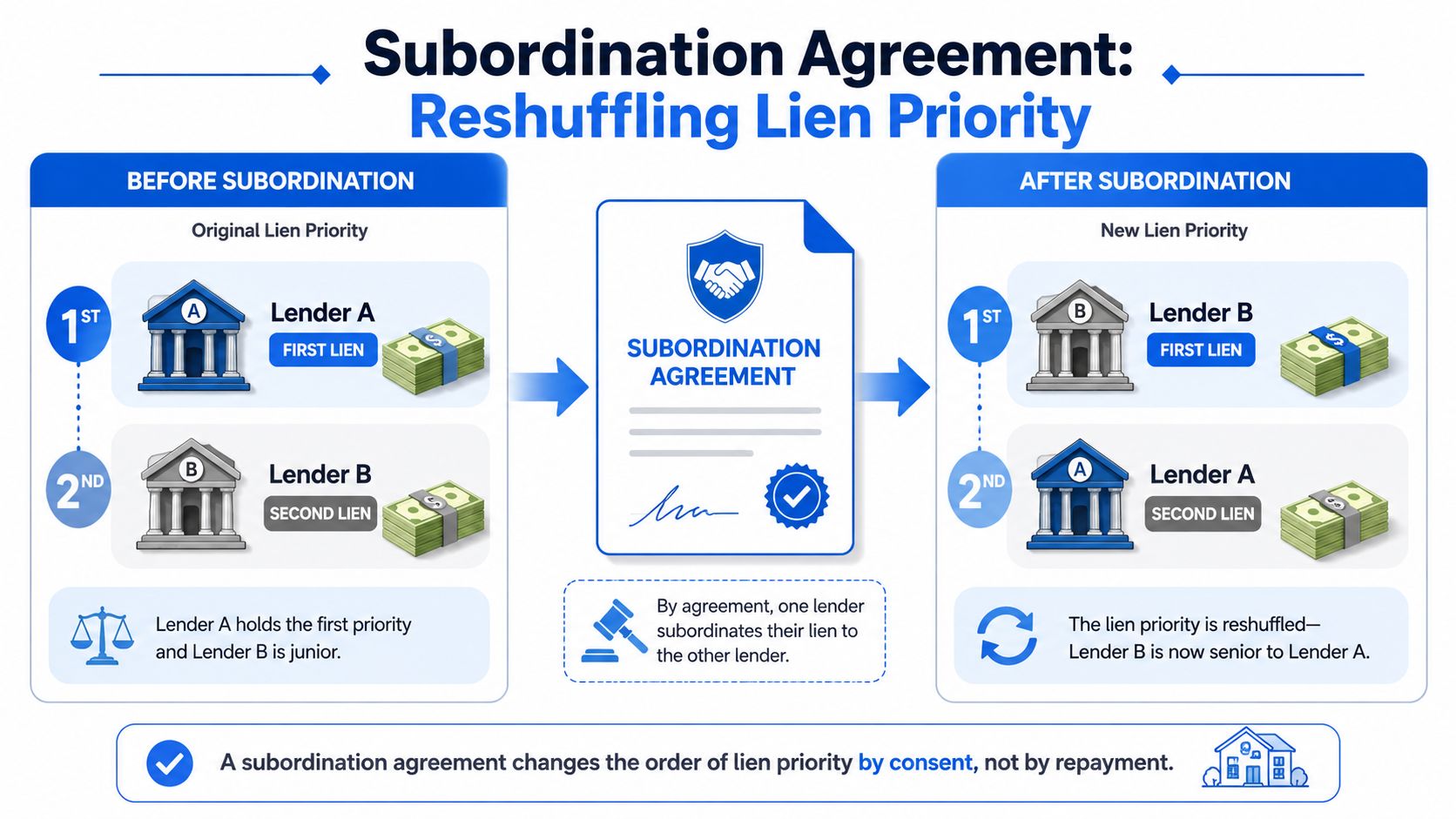
A subordination agreement is the document that changes the repayment order tied to a property. Corporate Finance Institute describes it as a contract that changes lien or debt priority so one creditor agrees to rank behind another, and in real estate refinancing it allows a new loan to step ahead of an existing lien and formally sets the hierarchy if there's a default or foreclosure (CFI on subordination agreements).
That sounds technical, but the day-to-day function is simple. It keeps a junior lender in junior position even after the old first loan is replaced.
What changes and what doesn't
The agreement changes priority, not the existence of the debt.
If you have a first mortgage and a smaller secured second loan on a rental property, both debts remain in place unless one is paid off. The subordination agreement confirms that the replacement first mortgage stays first, and the second lender stays second.
That distinction matters because some borrowers hear the term and assume it changes loan balances, wipes out the second lien, or rewrites all terms between the borrower and the junior lender. It doesn't. The note still exists. The monthly payment still exists. The lien still exists. The order of repayment is what moves.
Why refinances often need it
Here's the core problem. Once the original first mortgage is paid off, that lien disappears. If nothing else is done, the existing second lien may move into the top spot by default. The new lender funding your refinance won't like that outcome.
So the junior lender signs a subordination agreement, and the new refinance loan takes first position instead.
This comes up often on investor properties carrying layered debt. You might have purchase financing plus a rehab note, or a long-term rental loan plus a smaller line used for repairs and reserves. In those situations, the agreement is what keeps the stack workable instead of forcing a payoff of every smaller secured debt.
A subordination agreement is often the difference between “refinance approved” and “refinance ready to close.”
Investors using private lending structures or trust deed financing see this issue more often than borrowers with a single conventional mortgage. If you work in California structures involving recorded deeds of trust, understanding how lien position affects new funding is especially important. This overview of California trust deed lenders for investment property gives useful context on how those transactions are commonly structured.
When Real Estate Investors Need a Subordination Agreement
Most investors don't go looking for a subordination agreement. They discover they need one in the middle of a transaction that already has a deadline.
One common example is a rental refinance. You want to pull equity from a stabilized non-owner-occupied property and use that capital for another acquisition. There's an existing second-position debt on the rental, maybe from an earlier cash need, a private lender, or a credit line used during turnover. The refinance lender is ready, but closing can't happen until that junior lienholder agrees to stay behind the new first mortgage.
Quorum Federal Credit Union notes that subordination is frequently required when refinancing if an existing HELOC or second mortgage is also on the property, and the new lender will almost always require the junior lienholder to formally agree to remain in second position (Quorum on loan subordination agreements).
Typical investor scenarios
A few situations come up repeatedly in the investment world:
- Cash-out from a rental property: You're extracting equity from one asset to fund the down payment or rehab budget on another.
- Fix-and-flip with old debt still attached: A property already has a small secured note that wasn't paid off before the next financing step.
- Debt cleanup before stabilization: You're replacing shorter-term financing with a cleaner senior loan but keeping a secondary obligation in place.
- Portfolio reshuffling: One property supports the next deal, so you need the existing junior lender to cooperate rather than demand payoff.
Where deals slow down
The investor usually sees the transaction as logical. The junior lender doesn't always see it that way.
That lender asks different questions. Does the new senior loan increase overall risk? Is equity still strong enough to protect the junior position? Has the borrower stayed current? Are there any changes in terms that make the collateral weaker from the junior lender's point of view?
When those questions aren't answered early, everyone waits. Title waits for payoff and recording instructions. The new lender waits on final lien position. The borrower waits on a deal that may not stay available.
Borrowers tend to focus on approval from the new lender. The bottleneck is often consent from the old junior lender.
For real estate investors, that's why subordination should be treated as part of deal design, not end-stage paperwork. If the property already carries layered debt, the request belongs on the checklist as soon as the refinance strategy takes shape.
How to Navigate the Subordination Process
The cleanest subordination requests start early and stay organized. Delays usually come from missing documents, late outreach to the junior lender, or a borrower who assumes title will solve it without borrower involvement.
Yale-linked material included in the verified data explains that the process is time-sensitive, can be a gating item for the transaction, typically takes 2 to 6 weeks, and may cost the borrower $200 to $400 in processing fees from the second lien holder (Yale legal analysis reference). For an investor with a closing deadline, that's not background noise. It's part of the transaction timeline.

The practical sequence
Most deals follow a sequence close to this:
Confirm that subordination is needed. Review title and identify every recorded lien secured by the property.
Contact the junior lienholder early.
This is the party whose priority is staying behind the new senior loan. Its approval is the key approval.Submit the lender's package.
The junior lienholder may ask for the new loan terms, borrower information, title details, payoff information on the old first loan, and a draft of the proposed agreement.Wait for underwriting and conditions.
The junior lender may approve, deny, or request revisions based on risk.Review the final document carefully.
Make sure the legal names, property description, recording references, and lien positions are accurate.Sign and record through title or closing.
Execution and recording need to line up with the refinance closing so the new senior position is clear.
What helps and what doesn't
A few habits improve the odds of a smooth approval.
| Approach | Likely result |
|---|---|
| Asking for subordination at the start of the refinance | More room to solve lender conditions |
| Sending complete title and loan information | Fewer back-and-forth requests |
| Assuming the junior lender will “just sign” | Delay or outright friction |
| Reviewing the agreement only at closing | Last-minute corrections |
If you manage several properties, back-office organization matters more than most borrowers think. Tracking payoff statements, lien references, renewal dates, and required closing documents in one place can cut confusion. Some investors also use MyOfficeOps financial tools for investors to keep property-level records and financing details cleaner between transactions.
Documents and details worth checking
Don't skim the subordination agreement. Focus on the parts that affect enforceability and recording.
- Correct parties: The borrower, senior lender, and junior lender names should match the underlying loan documents.
- Property description: The legal description and address need to point to the correct collateral.
- Recording references: Existing deeds of trust or mortgages should be identified accurately.
- Priority language: The document should clearly state which lien will remain subordinate.
- Execution requirements: Some lenders require specific signatures, notarization, or title handling.
When borrowers want to get ahead of closing issues, it helps to review standard loan documentation requirements before the file reaches the finish line.
Closing advice: Treat the subordination package like an underwriting file, not a favor request. The more complete it is, the easier it is for the junior lender to say yes.
Investor Risks and Strategic Considerations
Subordination helps deals close, but it also shifts risk. Investors who understand that tend to get better results because they present requests in a way lenders can approve.
The junior lender takes the hardest hit in a downside scenario. By agreeing to remain behind the new senior debt, that lender accepts that repayment from the collateral comes later. If value drops or liquidation proceeds fall short, the junior position becomes more exposed.

How investors should think about the request
A strong request usually has three characteristics:
- The borrower has preserved equity. If the refinance creates an excessive debt burden, the junior lender may decide the remaining cushion isn't enough.
- The refinance improves the borrower's position. Cleaner terms, better cash flow, or a more stable structure can make the request easier to justify.
- The file is transparent. Hidden liens, stale title issues, or unexplained changes in loan structure make lenders defensive.
Why a lender might refuse
A lender can refuse to subordinate. That decision often comes down to risk, not personality.
Common reasons include weak collateral coverage, a payment history that makes the borrower look unstable, incomplete documentation, or a refinance structure that leaves the junior lender with less protection than before. Sometimes the lender prefers payoff over continued exposure in second position.
For the investor, the strategic question isn't just whether subordination is possible. It's whether the overall financing plan still leaves enough room for error. If every deal depends on maxing out equity and getting every lender to cooperate perfectly, the structure may be too tight.
The best borrowers look at the transaction from both sides of the table. They ask what the junior lender loses, what the new senior lender requires, and whether the property still carries enough margin if the market or timeline turns against them.
Frequently Asked Questions
Can a lender refuse to subordinate
Yes. A junior lender doesn't have to agree. If the new structure increases its risk or leaves too little equity in the property, it may deny the request or ask for conditions before signing.
What happens if the request is denied
Usually you have three options. Pay off the junior debt, change the refinance structure, or look for a different financing strategy that doesn't require the same lien position.
Does a subordination agreement remove the second loan
No. The second loan still exists. The agreement changes repayment priority tied to the property, not the underlying debt itself.
Should you rely on your lender or call an attorney
For routine transactions, your lender, escrow officer, and title team can often manage the process. If the title chain is messy, the language in the agreement is disputed, or multiple entities are involved, a real estate attorney is worth bringing in.
What's the practical takeaway for investors
If your non-owner-occupied property already has layered debt, check title and lien order before you commit to a refinance timeline. The subordination issue is manageable. It just isn't something to discover at the closing table.
If you're refinancing an investment property, pulling cash out for your next acquisition, or trying to close around an existing second lien, LendingXpress can help you move fast with practical financing for non-owner-occupied real estate. Reach out to discuss the property, the lien structure, and the timeline so you can choose a path that fits the deal instead of losing time to preventable delays.