
You're looking at two deals. One is a non-owner-occupied duplex with stable rent. The other is a small mixed-use building with a retail tenant and a couple of apartments upstairs. On paper, both are investment properties. In lending, they live in different worlds.
That difference shows up fast. It changes what documents you need, how the lender sizes the loan, whether personal income matters more than property income, and how much refinance risk you're taking on later. Most investors find out too late, usually after they've already tied up earnest money and the bank starts asking questions they didn't expect.
For non-owner-occupied real estate, the biggest mistake is treating financing like a detail. It isn't. It's part of the investment strategy. A rental loan on a 1 to 4 unit property follows one path. A 5+ unit or true commercial asset follows another. If you miss that line, you can waste weeks with the wrong lender, the wrong term sheet, and the wrong exit plan.
If you're financing an investment property and want a practical breakdown of options, this guide on how to finance investment property is a good place to start.
Introduction to Commercial vs Residential Loans for Investors
The dividing line in commercial vs residential loans isn't the word “investment.” It's unit count, occupancy, and how the lender expects repayment to work.
A non-owner-occupied property already gets more scrutiny than a primary residence. Industry definitions treat a non-owner-occupied mortgage as financing for a rental or investment property rather than a home the borrower lives in, and lenders generally apply stricter qualification standards and higher upfront equity requirements because of that under the non-owner-occupied mortgage definition.
The questions that matter first
Before you talk rates, ask these:
- How many units are on the property? That often decides whether you're in residential or commercial underwriting.
- Will repayment be based more on you or the asset? Smaller residential investment loans usually lean harder on personal credit, reserves, and debt ratios.
- What's the exit? A long hold, a rehab and refinance, and a bridge into stabilization all need different loan structures.
- Can you afford refinance risk? That matters more on commercial debt than most borrowers realize.
Here's the blunt version. If you're buying a duplex as a rental, you may still fit conventional residential investment financing. If you're buying a 6-unit, a small retail strip, or a mixed-use building, you're likely in commercial territory from day one. That means different underwriting, different structure, and often less patience from the lender if the property story doesn't make sense.
Most financing problems don't start with rate. They start with using the wrong loan category for the deal.
That's why smart investors and brokers sort out the financing lane before they negotiate hard on price. The loan type affects speed, closing certainty, and what happens when it's time to refinance.
What Counts as Commercial and Residential Financing
Most guides overcomplicate this. The classification is simple at the front end.
Residential financing usually covers 1 to 4 unit properties. That includes single-family rentals, condos, townhomes, duplexes, triplexes, and fourplexes. Commercial financing usually starts at 5+ units and includes office, retail, industrial, and many mixed-use properties. A neutral market explainer also notes that 1 to 4 units are typically treated as residential while 5+ units move into commercial lending, where balloon structures and personal guarantees are common in this breakdown of commercial vs residential financing.
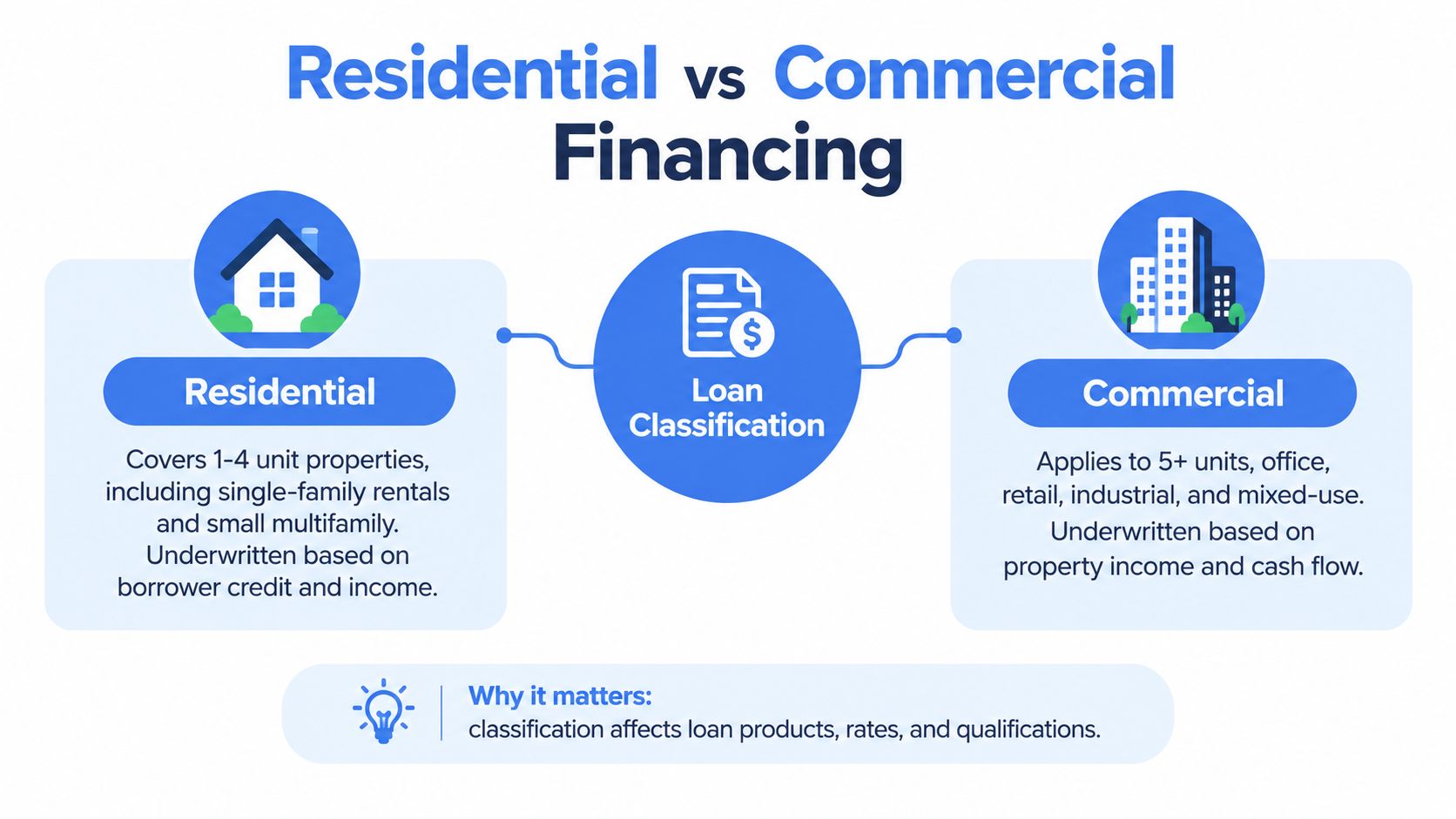
The 4-unit threshold changes the whole loan
That 4-unit versus 5-unit line isn't trivia. It often changes:
- Loan product options
- How the lender underwrites income
- Whether balloon risk shows up
- How common recourse and guarantees are
- What kind of lender can move fast enough for the deal
Critical cutoff: Four units or less is often a residential loan conversation. Five units or more is usually a commercial loan conversation.
Occupancy and property type are separate filters
A lot of borrowers miss this. Non-owner-occupied doesn't automatically mean commercial. It means the lender starts by treating the file as an investment property. Then the lender layers in the property type and unit count.
Regulatory and industry materials distinguish owner-occupied from non-owner-occupied nonresidential property in bank reporting, which shows that occupancy and property type are separate credit categories. In practice, commercial financing is usually judged through property cash flow, loan-to-value, and asset-specific risk, while residential investment loans still tie back to household credit and reserve metrics in this CFPB attachment discussing property categories.
A quick classification table
| Property scenario | Typical loan lane |
|---|---|
| Single-family rental | Residential investment |
| Duplex, triplex, fourplex held as rental | Residential investment |
| Five-unit apartment building | Commercial |
| Mixed-use with retail component | Commercial |
| Office, retail, industrial asset | Commercial |
If you're an investor or broker, don't gloss over this step. It determines who should quote the deal in the first place.
How Underwriting Really Differs Between Loan Types
You tie up a clean fourplex and expect a standard rental loan. Then the file gets tight because reserves are light, personal income is hard to document, or the property needs work. Buy a five-unit on the next block and the whole conversation changes. Now the lender cares more about the building's income, your exit plan, and whether you are signing full recourse on a short-term note with a balloon.
That 4-unit versus 5-unit line is the split. The other one is structure risk.

Residential investment underwriting
For 1 to 4 unit rentals, underwriting is still borrower-first. The lender wants to see that you can support the payment from your own file if the property underperforms. That puts your credit, documented income, debt load, cash reserves, and property condition at the center of the decision.
In practice, these files get stuck for familiar reasons:
- tax returns do not show enough income
- reserves are thin after the down payment
- the property condition does not fit agency or conventional standards
- the borrower already owns several financed properties
- appraisal rent support comes in weak
A fourplex can be a strong asset and still miss the box. That is the problem with treating small residential rentals like pure property plays. Conventional lenders usually do not.
Commercial underwriting
Once you cross into 5-plus units, mixed-use, or true commercial property, underwriting shifts to the asset and the loan structure. Lenders review net operating income, debt service coverage, vacancy, rent roll quality, deferred maintenance, sponsor liquidity, and the exit at maturity. If you want a closer look at that process, this guide to commercial real estate underwriting lays out the main credit tests.
Banks also set commercial credit standards around items like maximum loan size, maturity, loan-to-value, spread, debt service coverage, and take-out requirements, as documented in this analysis of commercial real estate underwriting standards.
Here is the part investors underestimate. Commercial underwriting is not just about whether the property cash flows today. It is also about what happens when the note comes due. Balloon risk matters. Recourse matters. A bank quote with a decent rate can still be the wrong loan if the maturity is short and the refinance path is shaky.
What experienced investors watch first
Start with the property type. Then check the structure risk before you chase rate.
For residential investment loans, the weak point is usually borrower documentation. For commercial loans, the weak point is often the combination of DSCR, property condition, lease quality, recourse, and balloon maturity. That is why a five-unit deal with decent rents can still stall at a bank, while a rough fourplex can get declined even with strong market demand.
My advice is simple. If the deal is stabilized, the borrower file is clean, and time is not tight, bank or conventional money usually makes sense. If the file has friction, the property needs repairs, the rents are in transition, or you need to close before a seller walks, private bridge or fix-and-flip capital is usually the better tool.
Speed wins deals. Flexibility saves deals. Use the loan type that matches the actual problem.
Terms Rates and Structures Compared Side by Side
A buyer is in contract on a fourplex in Long Beach and a five-unit in Oakland. On paper, the deals look close. In financing, they are not close at all.
That 4-unit versus 5-unit line changes the loan structure, the underwriting lane, and the risk you carry after closing. Issue is not just rate. It is whether you are stepping into a long-term residential note or a commercial loan with recourse, shorter maturity, and possible balloon pressure.
Commercial vs Residential Loan Terms at a Glance
| Feature | Residential Investment Loan | Commercial Loan |
|---|---|---|
| Typical property type | 1 to 4 unit non-owner-occupied residential | 5+ units, mixed-use, office, retail, industrial |
| Primary underwriting focus | Borrower credit, income, DTI, reserves | Property income, DSCR, loan-to-value, leases, exit risk |
| Down payment | Usually more standardized by property type and borrower profile, as noted earlier | Varies widely by lender, asset quality, business plan, and recourse |
| Reserves | Often set by agency or conventional investor guidelines, as noted earlier | Usually tied to property strength, borrower liquidity, and planned work |
| Recourse | Often closer to consumer mortgage structures | Common in bank commercial lending, especially on smaller balance deals |
| Loan size profile | Usually smaller investor loan amounts | Can range from small balance apartment loans to much larger income-property debt |
| Balloon risk | Usually lower on fully amortizing long-term structures | Often higher because many commercial loans mature before the amortization ends |
| Pricing framework | More standardized | More lender-specific, structure-specific, and sensitive to asset risk |
| Rate quote reliability | Quote usually holds together if the borrower file stays clean | Quote can change as the lender reviews leases, repairs, rollover, and exit plan |
The 5-unit line changes the risk
Investors get distracted by the note rate and miss the bigger problem. A five-unit building can bring a completely different maturity profile than a fourplex, even if the rent roll is only modestly larger.
Residential investment loans usually give you a simpler long-term hold structure. Commercial loans often give you a shorter runway and force a refinance later. If rents are still being raised, units are still turning, or the property needs cleanup, that future refinance can become the most expensive part of the deal.
Balloon risk is what trips up a lot of borrowers.
A low commercial rate does not help much if the loan comes due before the property is fully stabilized or before the market is ready to refinance it on favorable terms.
Why structure beats rate
Commercial lenders are judging whether the income, loan-to-value, maturity, and covenants make sense together. Residential lenders are usually judging whether the borrower fits a more standardized box.
That distinction matters in the world. A bank term sheet on a small apartment property may look fine at first glance, then stall over deferred maintenance, vacant units, old leases, or reserve requirements. A conventional investor loan on a duplex or fourplex may price well for a clean borrower, but it can also break down fast if the property condition is rough or the timeline is tight.
The better question is simple. What can go wrong before payoff?
If the answer is lease-up risk, rehab risk, title cleanup, tenant issues, or a rushed close, flexibility matters more than a slightly better rate.
Market conditions hit commercial borrowers faster
Commercial credit can tighten quickly because lenders react to refinance risk, property cash flow pressure, and overall lending volume. The Mortgage Bankers Association reported sharp swings in commercial and multifamily borrowing volume in recent years in its market update on commercial and multifamily borrowing and lending.
For borrowers, that means your takeout plan can look fine at acquisition and look much worse at maturity. That problem shows up more often on commercial structures than on plain-vanilla residential investment loans.
My recommendation
For a clean 1 to 4 unit rental you plan to hold, residential financing is usually the better long-term debt.
For a 5+ unit deal, or any non-owner-occupied property with rehab, vacancy, lease-up, or seller deadline pressure, look at the structure first. Check recourse. Check maturity. Check extension terms. Check prepay. Then decide if bank debt is the right tool.
If a bank cannot close on your timeline or the property is in transition, private bridge or fix-and-flip capital usually wins because it solves the core problem, speed and flexibility, without pretending the deal is already stabilized.
Real World Use Cases for Each Loan Type
The right loan depends on what you're trying to do with the property, not just what kind of property it is.

Buy-and-hold single-family rental
If an investor is buying a clean single-family rental with documented income and enough cash for down payment and reserves, a residential investment loan usually fits. The property falls inside the 1 to 4 unit lane, and the borrower gets a structure built more around personal qualification than lease complexity.
This works best when the borrower has a straightforward financial profile. If the investor is self-employed, moving fast, or buying a property that needs work before it qualifies for conventional financing, the bank route can drag.
Small multifamily value-add
A duplex or fourplex can still be residential financing, but borrowers often get tripped up. The property may be residential by unit count, yet the deal behaves more like a small business project if rents are under market, units are vacant, or rehab is needed.
That's where a lot of bank files start to wobble. The property doesn't fit cleanly into a stabilized box, and the borrower doesn't want a long closing timeline while contractors and sellers wait.
Transitional commercial acquisition or refinance
A 6-unit, a mixed-use building, or a retail property moves into commercial underwriting. In these deals, capital source matters because stress isn't spread evenly across the market.
MBA reported that as of Q1 2026, commercial and multifamily delinquency was 4.02% overall, with CMBS at 7.28% for loans 30+ days delinquent or in REO, while the national residential mortgage delinquency rate for one-to-four-unit properties was 4.37% in Q2 2026, including 2.21% at 30 days and 0.73% at 60 days past due in MBA's delinquency benchmark report.
That tells me something practical. Commercial stress is often more concentrated by capital source and property type, so borrowers should underwrite refinance takeout and DSCR cushion more conservatively on commercial deals, especially if the asset is transitional.
A short explainer may help if you're comparing strategies visually:
What I'd tell a broker or investor
- Stable small rental: Lean residential if the borrower qualifies and the property is already financeable.
- Messy 2 to 4 unit value-add: Don't force a bank execution if the timeline is tight or the asset needs work first.
- 5+ unit or mixed-use: Underwrite the refinance before you underwrite the purchase. If the exit doesn't pencil, the acquisition loan won't save you.
Documentation Timelines and Closing Speed
Borrowers often think residential is always faster and commercial is always slower. In clean files, that's often true. In real life, speed depends on how many questions the lender needs answered before funding.
Residential investment loans usually require a heavy borrower package. The lender wants income documents, asset statements, reserve verification, debt review, and explanations for anything unusual. Commercial files shift the weight to property-level items such as leases, rent rolls, operating history, and asset condition.

Why bank deals stall
Here's where banks tend to slow down:
- Borrower complexity: Self-employed income, layered entities, recent liquidity movement, or multiple financed properties.
- Property complexity: Vacancies, deferred maintenance, mixed-use layout, short lease term, or inconsistent operating history.
- Exit uncertainty: No clear takeout, thin DSCR, or renovation plans that aren't fully budgeted.
A private lender can move faster because the underwriting is usually more direct. The focus is on collateral, equity, deal logic, and a realistic exit instead of trying to force the file through a narrow agency-style box.
When speed matters more than rate
For non-owner-occupied deals, speed often protects the deal itself. A delayed close can cost the property, the discount, or the contractor schedule.
That's why some investors use bridge or fix-and-flip financing when banks hesitate. In California, LendingXpress structures bridge, rental, and rehab loans on residential and commercial investment properties, with typical loan sizes from $100,000 to $18 million+, closings in as little as three days, and rehab financing that can cover up to 100% of rehab costs with staged draws, based on its published company profile.
Fast money only helps if the terms fit the exit. Speed is valuable. Bad structure is expensive.
If the property is non-owner-occupied, needs work, or has to close before a conventional lender can get comfortable, common-sense private underwriting can be the practical answer.
How to Choose the Right Loan for Your Investment
Don't choose the loan by habit. Choose it by deal shape.
A simple decision checklist
Ask these five questions in order:
- How many units are there? If it's 1 to 4, check residential first. If it's 5+, start with commercial.
- Is the property stabilized? A clean, leased, rentable asset has more conventional options. A transitional asset usually doesn't.
- Can you document your income cleanly? If personal income is hard to present, commercial or private capital may be easier than conventional residential.
- What's your hold period? Long-term hold favors stable permanent debt. Short-term rehab or lease-up often calls for bridge financing.
- What's your exit if rates, rents, or timing move against you? If there's no refinance path, the initial loan isn't the problem. The business plan is.
My practical loan map
- Use a residential investment loan for a non-owner-occupied 1 to 4 unit property when the borrower has solid credit, enough cash, and time for full documentation.
- Use a commercial bank loan for stabilized 5+ unit or nonresidential assets when property income supports the request and the borrower can live with the structure.
- Use private bridge or rehab financing when the property needs work, the file is too complex for a bank, or the close has to happen quickly.
If you're working through cash requirements before you apply, this guide on down payment strategies for rental property is worth reading. It helps investors think through equity planning before they start collecting term sheets.
The recommendation I give most often
For non-owner-occupied deals, don't waste time chasing the cheapest quote first. Start with the financing lane that fits the asset, the timeline, and the exit.
If you're a broker, that means screening unit count, occupancy, and stabilization before you shop the file. If you're an investor, that means asking one hard question up front: is this a permanent loan deal, or a transition deal pretending to be one?
Get that answer right, and the rest gets easier.
If your deal is non-owner-occupied and the bank box isn't working, there's a practical middle ground. LendingXpress offers bridge, rental, and rehab financing for residential and commercial investment properties, including scenarios where speed, property condition, or borrower complexity make conventional lending a poor fit. If you want to pressure-test the loan structure before you commit, it's worth having that conversation early.