
You found a deal. The seller accepted your offer on a non-owner-occupied property in Los Angeles. Then the clock started.
Maybe it's a worn duplex in Silver Lake. Maybe it's a rental in Mid-City with messy leases, deferred maintenance, or title issues that make a bank underwriter uneasy. Either way, the problem feels the same. The seller wants certainty, another buyer is circling, and your conventional lender can't move fast enough.
That's where private money enters the picture. Not because it's cheap. Usually it isn't. Not because it replaces bank debt on every deal. It shouldn't. It exists for the moment when a good investment starts slipping away because timing, property condition, or loan structure don't fit the bank box.
For Los Angeles investors buying or refinancing non-owner-occupied property, private money is often less about rate shopping and more about preserving the deal. If you understand that, the rest of the loan terms make more sense.
What Private Money Means in Los Angeles
An investor loses a Silver Lake duplex to a faster buyer for one simple reason. The conventional lender needs more time than the seller is willing to give.
That gap is what private money fills.
In Los Angeles, private money usually means a loan backed by real estate and funded by individuals, family offices, or private funds, not a depository bank. The loan is typically secured by a deed of trust on the property. The lender looks first at the collateral, the exit plan, and how quickly the deal can close.
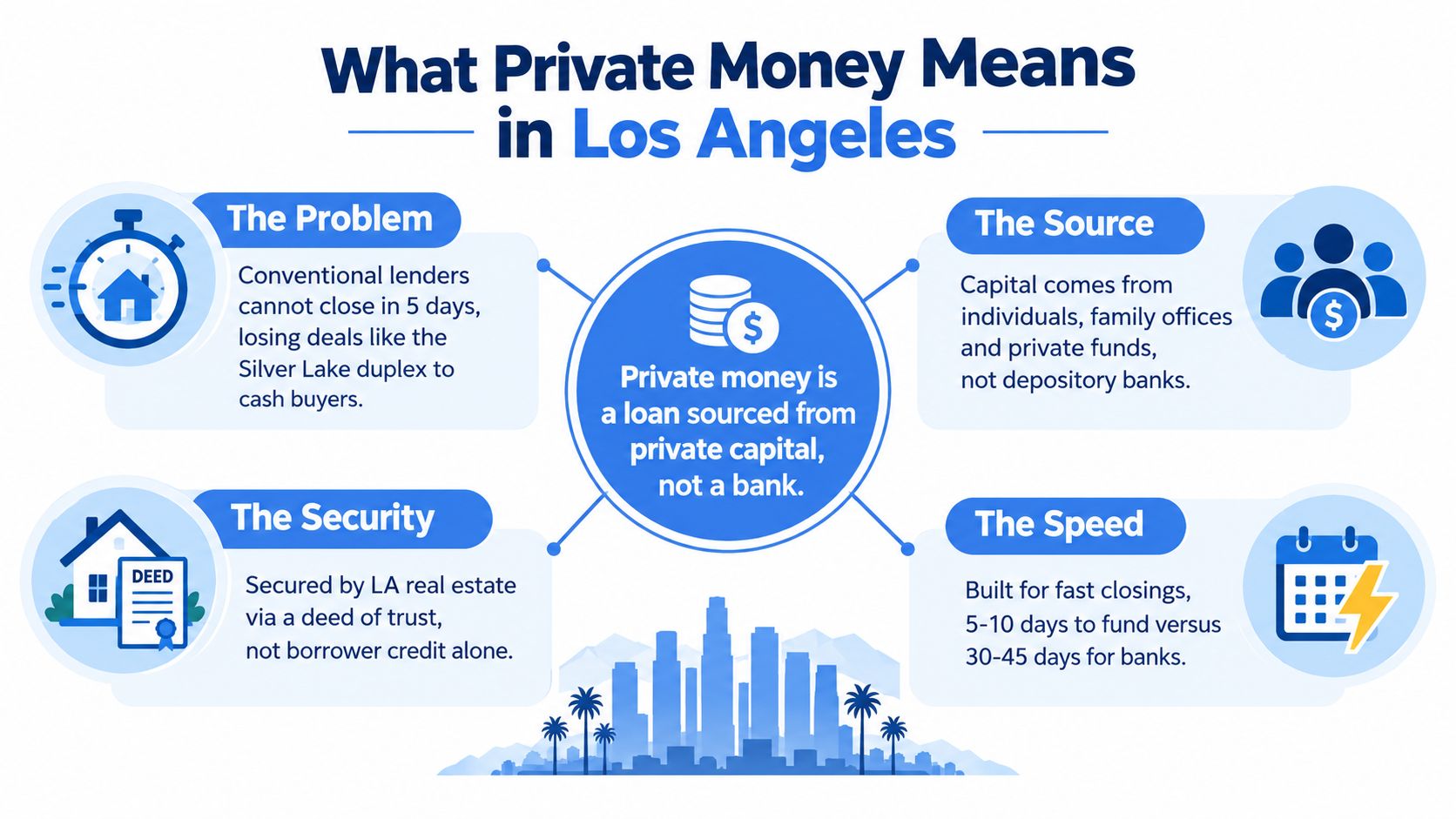
Why this market exists
Los Angeles is competitive enough that speed becomes a financing issue, not just a negotiation issue. A seller with multiple offers may prefer the buyer who can close quickly over the buyer with the lowest-cost debt. That's especially true when the property is non-owner-occupied, needs work, has vacancy, or doesn't fit clean agency rules.
Private money lenders make judgment calls that bank systems often can't. They can look at a property in Highland Park, a bridge refinance in Leimert Park, or a quick close on a small apartment building and decide whether the asset itself supports the loan.
Practical rule: If the property can carry the story and the exit makes sense, private money can often solve a deal that conventional financing slows down.
This isn't a tiny corner of the market. In Q2 2026, Los Angeles-area private lenders reported an average loan size of $1,018,098, an average interest rate of 10.38%, and 799 total loans across the Los Angeles region and nearby counties. Los Angeles County accounted for 520 of those loans, which shows how active the county remains in private real-estate credit (Los Angeles private money market data).
Why Los Angeles investors use it
Private money became more important in California after Proposition 2 in 1979 exempted loans made or arranged by real estate brokers from state usury limits. Legislative hearing testimony describes that change as highly significant because it opened the door to a broader investor base and helped expand hard money lending beyond its earlier, narrower form (California hard money lending hearing transcript).
Today, when investors talk about Private Money Los Angeles, they usually mean short-term capital built for urgency. It's often used for bridge purchases, renovation projects, and time-sensitive refinances where common-sense underwriting matters more than W-2 income. If you want to see how California lenders structure those deals in practice, review this overview of California private money lenders.
How Private Money Loans Actually Work
Private money looks simple from the outside. Borrower applies, lender funds, property secures the loan.
In practice, the loan offer comes from a chain of decisions. The asset drives financing capacity. That capacity affects rate. Rate and risk shape points, term, and prepayment language. If you understand that flow, the term sheet stops looking random.
The loan starts with the property
The first question isn't usually, “What's your salary?” It's, “What are you buying or refinancing, and what's the exit?”
A private lender typically reviews the purchase price, current value, and sometimes after-repair value if the business plan includes rehab. The lender wants to know what the property is worth today, what it may be worth after work is complete, and how you plan to pay the loan off. For a flip, that could mean sale proceeds. For a rental, it could mean a refinance into longer-term debt once the property is stabilized.
The underwriting is still about the borrower, just in a different order. Experience helps. Liquidity helps. Clean title helps. But the property usually does more of the heavy lifting than it would in a bank file.
Terms move together
Most first-time investors get tripped up here. They treat LTV, rate, points, term, and timeline like separate line items. They aren't.
A lower request generally gives the lender more protection. More protection can improve pricing and flexibility. A thinner equity cushion can push the loan the other direction, especially if the property is unusual, the borrower is new, or the exit depends on a fast resale.
Here's how those terms often connect in Los Angeles deals:
| Typical Private Money Loan Terms in Los Angeles | LTV | Rate | Points | Term | Typical Timeline |
|---|---|---|---|---|---|
| Bridge purchase | Depends on deal and asset quality | Commonly around 9% to 12% in LA hard money pricing | Often charged on top of interest | Short-term | Fast closings are a core use case |
| Fix and flip | Depends on purchase basis, rehab plan, and exit | Commonly around 9% to 12% in LA hard money pricing | Often charged on top of interest | Short-term | Designed for urgent acquisitions and rehab execution |
| Rental refinance | Depends on current value, rent story, and refinance path | Commonly around 9% to 12% in LA hard money pricing | Often charged on top of interest | Short-term bridge into longer debt | Useful when bank timing or structure is the blocker |
That's also why you should read every fee line carefully. Interest tells only part of the story. Origination points, extension fees, document fees, and prepayment language can change the cost more than many borrowers expect.
The cheapest-looking quote on page one isn't always the cheapest loan at payoff.
Why conventional borrowers still get pushed out
Even strong investors can get stuck when the permanent lender's rules don't fit the file. For a one-unit non-owner-occupied investment property, conventional conforming financing generally requires a 15% down payment, which means an 85% maximum LTV. For 2 to 4 unit investment properties, the minimum down payment rises to 25% (investment property down payment rules).
On refinance deals, the caps tighten. Fannie Mae guidance allows up to 75% LTV for a rate-and-term refinance on a single-unit investment property and 70% LTV for 2 to 4 unit investment properties, with cash-out refinances capped at the same levels (investment property refinance LTV guide).
There's also a process issue. Fannie Mae investment-property loans generally must be underwritten in DU and receive an Approve/Eligible recommendation, except for certain higher-LTV refinance paths (DU requirement for non-owner-occupied loans). If the file doesn't fit the automated box, the borrower may have a good deal and still miss the closing date.
For investors sorting through nonbank options, this plain-English LA Law Group seller financing guide is useful because it helps frame when alternative financing structures matter more than headline rate.
Private Money vs Conventional Financing for LA Investors
Investors usually compare these options the wrong way. They focus on interest rate first.
The better question is this: What happens if the property, the timeline, or the borrower profile doesn't fit agency lending? That's where the gap opens.
Side by side on what matters
| Private Money vs Conventional Financing | Private Money | Conventional / Agency |
|---|---|---|
| Underwriting focus | Property, equity, exit strategy, borrower liquidity | Income, credit, reserves, property condition, agency fit |
| Closing speed | Built for urgent closings | Often slower because of full underwriting and loan conditions |
| Property condition | Can work for distressed or transitional assets | Often limited when condition or occupancy profile creates risk |
| Documentation | Usually lighter and more practical | Often heavier and more standardized |
| Non-owner-occupied flexibility | Useful when the deal is outside the bank box | More rigid on occupancy, reserves, and property type |
| Cost | Higher-priced capital | Lower-priced capital when the file qualifies |
For non-owner-occupied property, conventional lending gets stricter fast. HUD guidance states that when there are two or more borrowers and one or more won't occupy the property as a principal residence, the maximum mortgage is limited to 75% LTV (HUD occupancy-based LTV summary). That's one example of how occupancy drives loan structure before a lender even gets to the rest of the file.
The trade-off you actually feel
If a rental purchase qualifies cleanly for agency debt, the property is in solid condition, your reserves are documented, and the seller can wait, conventional financing usually wins on cost.
If the closing window is tight, the building needs work, leases are messy, title needs cleanup, or the automated underwriting result doesn't cooperate, private money can become the only realistic path to preserve the deal.
Use bank debt when the deal fits the bank. Use private money when the deal is good but the timeline or structure breaks the bank process.
That's the honest trade-off. Private money is expensive capital. But in Los Angeles, expensive capital can still be cheaper than losing the asset, forfeiting a deposit, or missing a refinance window that protects your equity.
Real Use Cases for Private Money in Los Angeles
A lot of LA investors first meet private money at the worst possible moment. The property is under contract, the deposit is hard, and the seller wants to close fast. At that point, terms like LTV, rate, points, and loan term stop sounding technical. They become the math behind whether you keep the deal or lose it.
That urgency is what ties these use cases together. Private money is usually not the first choice on cost. It is often the choice that keeps control of the asset while you fix the part of the deal that a bank cannot solve on the seller's timeline.
Highland Park bridge acquisition
A Highland Park duplex goes under contract at $1.2 million. The seller wants a short close because they are also buying another property and do not want a long escrow. The buyer planned to use bank financing, but the file starts dragging over property condition items and documentation requests.
A bridge acquisition loan can step in here. Say the lender agrees to 65% LTV. That supports a $780,000 loan against the $1.2 million purchase price. If the loan carries a 12-month term and 2 points, the borrower is paying for speed and certainty, not for long-term hold economics.
That distinction matters.
If the investor's exit is a refinance, the lender will care about more than the purchase contract. They will want to see enough liquidity to close, enough monthly cash flow to carry the loan, and a believable path into cheaper debt after closing. In plain language, the lender is asking, “How do you get out of my loan before the clock runs out?”
Leimert Park fix and flip
A Leimert Park house needs heavy work before it can sell at full value or qualify for lower-cost refinance. The investor is not just buying the property. The investor is buying time to complete the business plan.
Here, the structure often includes an acquisition advance plus rehab draws. For example, a lender might size the loan around 70% of the purchase price and fund renovation money in stages as work is completed. The monthly payment is commonly interest-only, which keeps the payment lower during construction, but the trade-off is simple: the project has to move.
Draws can help or hurt depending on how they are set up. If inspections are slow, your contractor can end up waiting on reimbursement. If the scope changes halfway through the project, a tight budget can turn into a cash call from your own pocket. First-time borrowers often focus on the rate and miss the operational side. On a rehab loan, draw timing can matter just as much as coupon.
Mid-City rental refinance
A Mid-City triplex already has equity in it, but something is blocking a clean bank refinance. Leases may need cleanup. The borrower may be waiting out a seasoning issue. Financial statements may not be ready in the format a conventional lender wants.
Private money can buy that breathing room.
Suppose the property appraises at $1.5 million and the lender is comfortable at 60% LTV. That would support a $900,000 bridge refinance. If the term is 12 months, the question is not whether the rate is higher than agency debt. It is whether that 12-month window gives the owner enough time to stabilize leases, organize the file, and refinance into longer-term financing before maturity.
That is how to read the terms. LTV tells you how much room the lender is giving you. Points tell you what it costs to get the loan in place quickly. The term tells you how long you have to execute the exit.
A private loan works like a temporary scaffold. It holds the project up long enough for you to finish the part that creates a cleaner refinance or sale.
Here is what those scenarios can look like with concrete terms:
| LA scenario | Example structure | Illustrative terms | Why private money fits | Likely exit |
|---|---|---|---|---|
| Highland Park duplex purchase at $1.2M | Bridge acquisition loan | 65% LTV, about $780,000 loan amount, 12-month term, 2 points | Seller wants a fast close and the bank file cannot get there in time | Refinance into bank debt after closing |
| Leimert Park renovation project | Fix-and-flip loan with rehab draws | Purchase financing plus staged construction funds, interest-only payments, short term tied to rehab schedule | Property condition blocks cheaper financing today, and the investor needs capital in phases as work is completed | Sell after renovation or refinance based on improved condition |
| Mid-City triplex valued at $1.5M | Rental bridge refinance | 60% LTV, about $900,000 loan amount, 12-month term, points charged up front | Equity exists, but leases, seasoning, or documentation are not ready for a conventional refinance | Stabilize operations, then move into longer-term rental debt |
The pattern is practical. In Los Angeles, private money often shows up when a deal is slipping, not when everything is clean and easy. Used well, it buys time. Used carelessly, it buys expensive time with a hard deadline attached.
Borrower Due Diligence and What to Ask Before You Sign
Private money can save a deal. It can also become a problem if you sign the wrong paper with the wrong lender.
Before you commit a deposit, review the lender with the same care you'd use on the property itself.

Questions that deserve direct answers
Ask who is funding the loan. Some groups lend from their own balance sheet. Others broker the file out. That distinction matters because brokered capital can introduce delays, last-minute repricing, or moving approval standards.
Ask how rehab draws work if you're financing improvements. You need to know who inspects the work, what triggers a draw, how quickly reimbursement happens, and whether interest accrues on undisbursed funds.
Then ask the questions many borrowers avoid:
- What happens at maturity: Can you extend, and on what terms?
- How is prepayment handled: Is there a minimum interest period, extension fee, or other payoff friction?
- How are defaults handled: When is a late fee charged, and when does the lender move from collection to enforcement?
- Who services the loan: The originating lender, a third-party servicer, or a fund administrator?
Documents to prepare early
A serious borrower usually moves faster by being organized before the term sheet arrives.
- Purchase paperwork: Signed purchase contract, amendments, and escrow contact details.
- Property file: Preliminary title report, rent roll if applicable, insurance information, and any lease package.
- Rehab package: Scope of work, contractor bids, and timeline if the property needs improvements.
- Borrower file: Entity documents, personal financial statement, and recent tax returns.
You should also ask for sample loan documents before you're under deadline pressure. Review the promissory note, deed of trust, and loan agreement while you still have time to push back.
A short training video can help first-time borrowers spot issues before signing:
How to vet the legal side
California's usury framework matters here. Absent an exemption, consumer loans are capped at 10% annual interest, while non-consumer loans can charge the greater of 10% or the federal discount rate plus 5%. The California Constitution also excludes loans used primarily to purchase, construct, or improve real property from the personal, family, or household-purpose cap, which is one reason many real-estate private loans are structured around business purpose and collateral (California usury framework).
Verify licensing through the DFPI if the lender says it operates under a CFL framework. Then verify what will be recorded against the property.
If a lender won't explain fees, maturity options, or default remedies in plain language, keep looking.
The Trust Deed and Debt Fund Opportunity for Investors
Borrowers see private money as rescue capital. Investors see it as an income-producing asset class backed by California real estate.
Those two views meet at the trust deed.

What a trust deed investor is actually buying
In a direct trust deed structure, one or more investors fund a loan secured by a property. If there are multiple investors in one note, each investor may hold a fractional interest in the same lien position. The borrower makes payments. The servicer collects those payments and sends monthly interest to the investors according to the structure.
A debt fund works differently. Instead of owning exposure to one note, the investor owns an interest in a pool that may hold many loans. That can spread risk across multiple borrowers and properties, but it also means the investor depends heavily on the manager's underwriting, servicing, reserve practices, and workout discipline.
What first-position security does and doesn't do
A first-position lien gives the lender priority in the collateral chain. That matters. It does not eliminate risk.
If a borrower defaults, the lender still has to enforce the deed of trust, manage legal steps, protect the asset, and carry time risk. California's nonjudicial foreclosure process generally allows a Notice of Default only after 30 days of lender-borrower contact, then a 90-day cure period, followed by a Notice of Sale at least 21 days before auction. In practice, a defaulted deed-of-trust loan can move from formal default to sale in roughly 4 to 7 months (California nonjudicial foreclosure timeline).
That timeline is why disciplined financing matters more than a flashy coupon. Lower financing gives the lender more room if the property has to be sold under pressure.
What investors should evaluate
If you're evaluating trust deed or debt fund exposure, focus on the operator before the yield.
- Underwriting discipline: How does the manager decide and exit risk?
- Servicing capability: Who handles draws, collections, extensions, and defaults?
- Reserve policy: What capital is set aside for legal costs, taxes, insurance, or protective advances?
- Structure clarity: Are you investing in one note, a fractionalized note, or a managed fund?
For investors researching California note strategies, this page on California trust deed lenders for investment property gives a useful overview of how these structures are commonly framed.
Risks, Regulations, and When Private Money Is the Right Call
You have a signed purchase contract on a small Los Angeles fixer. The seller wants to close in 10 days. Your bank says the appraisal, repair review, and final credit sign-off will take longer. At that point, private money is no longer an abstract financing category. It is a clock.
That urgency is exactly why the risks matter.
Private money can save a deal that is slipping away. It can also trap a borrower who focuses on the closing date and ignores the exit. A fast loan only works when the numbers still make sense after you account for rate, points, fees, carrying costs, and enough time to sell or refinance.
Here is a simple way to frame it. Every private-money term is really a time term in disguise.
- LTV tells you how much room you have if the project goes sideways.
- Rate tells you what each extra month will cost if your timeline slips.
- Points and fees tell you how much profit disappears on day one.
- Loan term and extension terms tell you how expensive a delay becomes.
A first-time investor often looks at the monthly payment first. In this part of the market, that is only one piece of the picture. If you borrow $700,000 at 11% with 2 points, the interest is about $6,417 per month, and the points add $14,000 upfront. If your plan was a 4-month bridge but the project takes 7 months, that delay is not just annoying. It can wipe out margin quickly.
The risks borrowers usually feel first
Pricing comes first because it hits immediately. Los Angeles private money usually costs more than bank debt. That trade can be reasonable when speed preserves a discount, avoids a lost deposit, or gets control of a property a conventional lender will not touch. It becomes painful when the deal has no clear exit or very little profit cushion.
Structure is the second risk, and borrowers often miss it because they are focused on approval. Default interest, extension fees, broad guarantees, cross-collateral language, and loose rehab-draw terms matter just as much as the note rate. A loan that looks manageable at closing can become expensive fast if one contractor delay forces an extension.
Execution risk is the third piece. In Los Angeles, timelines slip for ordinary reasons. Permits take longer. Tenants do not leave on schedule. Insurance gets revised. A buyer backs out. A refinance lender asks for more seasoning or cleaner rent history. Private money gives you speed on the way in, but that same speed means the clock is always visible on the way out.
Stress shows up when exits get tight
As noted earlier, stress among smaller private-credit borrowers has risen in recent years. That is not a direct Los Angeles real-estate loan statistic, but the lesson carries over. Higher-yield lending can look safe at origination because the loan is short-term and collateral-backed. Trouble usually appears later, when the borrower needs more time, more cash, or a cleaner exit than the original plan allowed.
That is why a private loan should be underwritten backward. Start with the exit. Then ask whether the property, timeline, and budget support that exit under less-than-perfect conditions.
When the higher cost earns its keep
| Situation | Conventional financing outcome | Private money outcome | Practical read |
|---|---|---|---|
| Seller wants a very fast close on a non-owner-occupied purchase | File may miss the contract deadline | A bridge loan may keep the deal alive | Often reasonable if resale or refinance is clear |
| Property condition fails agency or bank standards | Lender may decline or delay | Asset-based lender may lend against current value and plan | Often the workable option |
| Borrower needs short-term refinance before rents, repairs, or records are stabilized | Conventional lender may want more seasoning | Bridge refinance can buy time to stabilize | Works if the next step is realistic |
| Property is clean, rents are documented, and borrower has time | Lower-cost debt is available | Higher-cost capital adds little value | Conventional usually makes more sense |
One legal point deserves attention. In California, who is brokering the loan, who is originating it, and who is charging which fees can carry different licensing and compliance consequences. When a deal is moving fast, borrowers should still verify who the parties are, what documents control the transaction, and how fees are being earned and disclosed.
So when is private money the right call?
Use it when the property is solid, the exit is believable, and the cost of missing the deal is greater than the cost of the loan. Pass on it when speed is being used to cover a weak purchase, a thin margin, or a refinance plan that only works if everything goes perfectly.
A practical example is LendingXpress, which offers California private loans for bridge, fix-and-flip, and rental property financing using asset-based underwriting for non-owner-occupied deals. The useful question is not whether a lender can close quickly. It is whether the deal still works after you pay for that speed.
If you're working on a non-owner-occupied purchase, bridge refinance, or rehab deal in Los Angeles and timing is getting tight, LendingXpress can review the property, the exit, and the structure in plain language. Visit LendingXpress to explore private loan options built for investors who need flexibility when conventional financing won't move fast enough.