
You're looking at a Florida duplex that seems to work on paper. The rent covers the proposed payment, the location has dependable tenant demand, and the seller has already accepted your offer. Then the insurance quote arrives. The premium is higher than expected, flood coverage is separate, and the projected DSCR drops below the lender's comfort level.
That's where many investment property FL deals break. Florida can offer appreciation, rental income, and strong resale liquidity, but only if you underwrite the property after taxes, insurance, flood exposure, vacancy, and financing costs. The right question isn't whether Florida is a good market. It's whether this specific asset still produces acceptable returns after expenses are loaded into the model.
Why Florida Keeps Drawing Real Estate Investors
A 1972 stucco duplex in Pinellas County can look like a straightforward value-add purchase. The investor walks the property with an insurance binder on the seat, an after-repair-value spreadsheet open on the phone, and a contractor waiting to confirm whether the roof and electrical systems can pass inspection. A third offer is due, but hurricane exposure and rising wind deductibles have turned a simple bidding decision into an underwriting problem.
That tension defines Florida. The state continues to attract capital because investors can pursue rental income, long-term appreciation, and tax efficiency in the same market. Florida has no state individual income tax, and rental demand is supported by tourism, healthcare, logistics, and continuing relocation into major metros and coastal counties. Landlord-friendly rules and a deep resale market add flexibility when an investor needs to refinance or sell.
International capital reinforces that depth. Foreign buyers purchased 16,401 existing homes in Florida between August 2024 and July 2025 and spent about $10.4 billion, making Florida the leading state for cross-border residential capital during that reporting cycle, according to the Florida property investment guide. The same source reports an average international purchase price of $635,164, a figure that reflects the state's appeal to higher-capital buyers.
The opportunity comes with a hard cost
The climate that draws residents also creates the state's most dangerous operating expense. Standard landlord policies generally exclude flood coverage, and coastal assets can face wind, roof, and deductible issues that a basic rent schedule won't reveal. Before making an offer, review what landlord insurance Florida covers and confirm which risks require separate policies.
My recommendation is simple. Don't buy Florida appreciation first and search for cash flow later. Get the insurance quote, tax estimate, flood determination, and realistic rent before you decide what the property is worth.
Where the Florida Market Stands Right Now
Florida's headline is strong, but the state isn't moving as one market. In 2026, luxury demand has remained more resilient than the broader mid-market. Luxury sales above $1 million increased 9.6% year over year and represented 11.4% of all Florida transactions, while total home sales declined 6.1% year over year, according to Realtor.com's Florida housing market analysis.
That split matters to investors. Prime-location assets and higher-end properties may retain buyer attention, while ordinary condos, aging coastal buildings, and commodity rentals can require sharper pricing. More inventory has also shifted power toward buyers, which creates room to negotiate, but only when the property's insurance and capital needs are understood.
The statewide data shows substantial transaction depth. Florida had 114,252 properties available for sale in early September 2026, with roughly 22,000 transactions in a recent 30-day period, a gross yield estimate of 6.55%, and median rent near $2,100, as reported in the Florida investment guide cited above. Those figures describe a large, active market. They don't prove that every metro or property type cash-flows.
What the snapshot can and can't tell you
The requested metro-level Q1 2026 median prices, days on market, months of supply, and year-over-year rent growth for Miami-Dade, Broward, Palm Beach, Tampa Bay, Orlando, Jacksonville, and Naples aren't included in the verified data. I won't manufacture a table of figures that can mislead you.
| Metro | Median Price | Days on Market | Months Supply | YoY Rent Growth |
|---|---|---|---|---|
| Miami-Dade | Verify locally | Verify locally | Verify locally | Verify locally |
| Broward | Verify locally | Verify locally | Verify locally | Verify locally |
| Palm Beach | Verify locally | Verify locally | Verify locally | Verify locally |
| Tampa Bay | Verify locally | Verify locally | Verify locally | Verify locally |
| Orlando | Verify locally | Verify locally | Verify locally | Verify locally |
| Jacksonville | Verify locally | Verify locally | Verify locally | Verify locally |
| Naples | Verify locally | Verify locally | Verify locally | Verify locally |
Investors should pair market data with operating execution. A strong leasing plan, accurate listing presentation, and disciplined tenant funnel matter, so review the AgentPulse guide to property management marketing when building the operating side of the investment.
My market view is direct: prime assets can still justify new capital, but ordinary assets need discount pricing. Don't pay a statewide premium for a property that competes with excess inventory or carries fragile insurance economics.
Running the Numbers on a Florida Deal
Start with the 1 percent rule, but treat it as a screening tool, not a buying rule. Monthly gross rent at or above 1 percent of purchase price can signal attractive income potential, yet Florida insurance, taxes, flood coverage, vacancy, and association costs can erase that apparent margin.
Then apply a conservative expense check. The familiar 50 percent rule uses roughly half of gross rent for operating expenses before debt service, including maintenance, management, taxes, insurance, utilities paid by the owner, and vacancy. It's not a substitute for actual bids, but it forces you to stop treating gross rent as spendable cash.
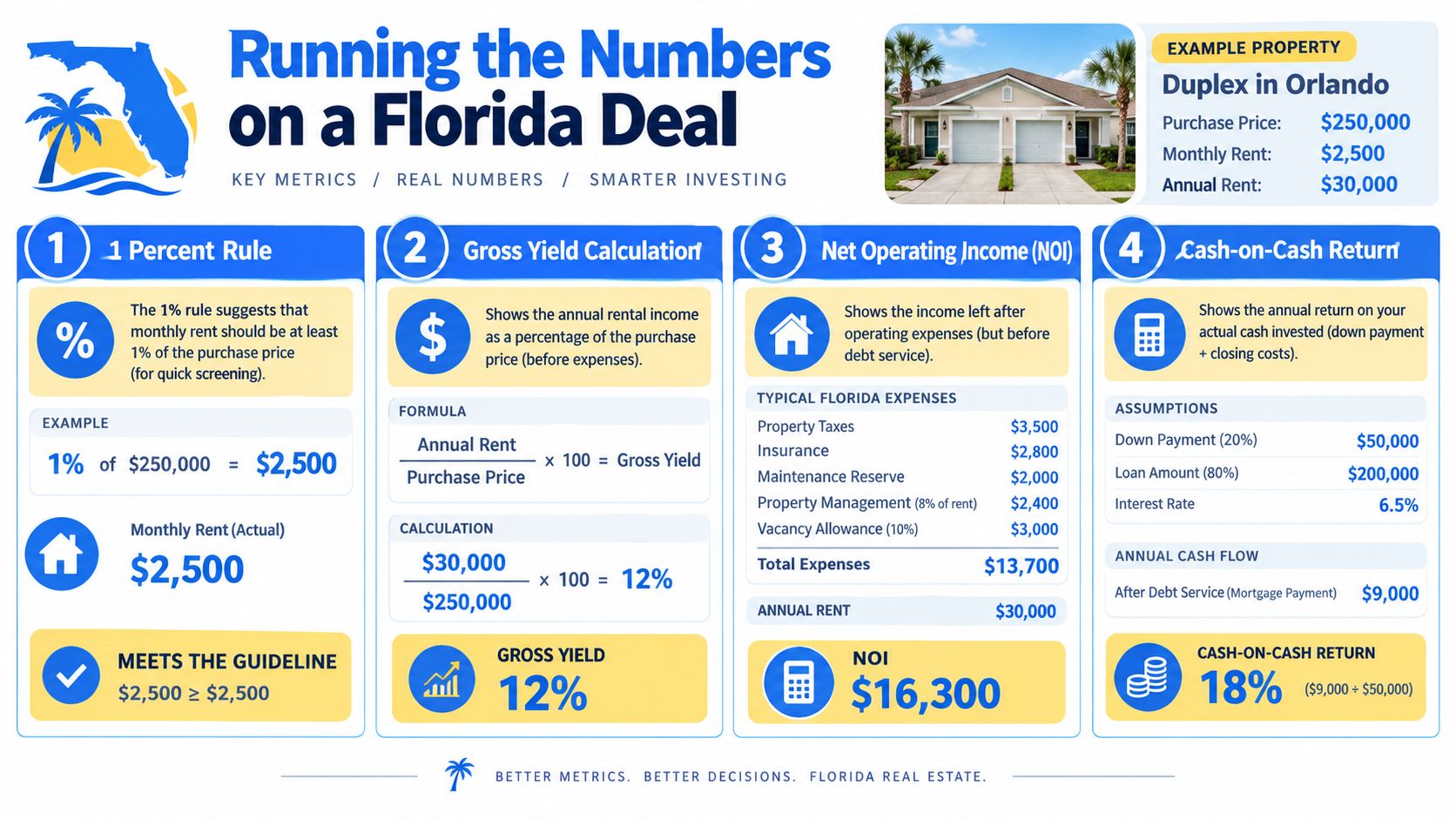
A Florida underwriting example
Consider the required Tampa duplex example. Purchase price is $375,000, with each side renting for $2,400 per month. The proposed PITI is $3,150 monthly, annual insurance is $1,100, flood coverage is $2,400 annually, and the vacancy allowance is $1,400 annually.
Using rental income against the stated housing and vacancy costs produces a DSCR of approximately 1.18. That may fail a conventional bank's required threshold even though the gross rent appears healthy. The lesson is important: lenders evaluate the income available for debt service after operating expenses, not just the rent printed in the listing.
For a full file, use a disciplined real estate underwriting process:
- Verify insurance: Get renewal assumptions, wind terms, deductibles, flood pricing, and inspection requirements.
- Rebuild taxes: Don't rely blindly on the seller's current bill, especially when the property's assessment may change after purchase.
- Reserve for vacancy: Use a defensible allowance rather than assuming continuous occupancy.
- Calculate cash-on-cash: Divide annual pre-tax cash flow by total cash invested, including 25 percent down, closing costs, and rehab funds.
- Stress the exit: For a flip, use the 70 percent rule as an initial ceiling, then subtract repairs, holding costs, selling costs, insurance, and remarketing expenses.
Rookie projections usually fail through optimistic renewals, missing flood exposure, four-point inspection problems, or unclaimed wind mitigation credits. If one insurance line changes, your NOI and borrowing capacity change with it.
Bank Loans vs Private and Hard Money
This isn't a debate about which lender is universally better. It's a question of execution risk, property condition, borrower profile, and exit timing.
A clean, stabilized rental with documented income and a borrower who can wait often belongs with a bank or DSCR lender. A property needing immediate work, a borrower using an entity structure, or a purchase with a narrow closing window may need private capital instead.
| Feature | Bank / DSCR Loan | Hard Money / Private |
|---|---|---|
| Down payment | Often 20 to 30 percent | Structured around collateral and deal risk |
| Amortization | Commonly 30-year amortization | Frequently interest-only |
| Rate profile | Sub-7 percent for qualified borrowers | Often 10 to 13 percent |
| Closing timeline | Commonly 30 to 45 days | Often 7 to 14 days |
| Term | Long-term financing | Commonly 6 to 24 months |
| Property condition | Prefers stabilized assets | More flexible for repairs and value-add work |
| Underwriting | Strict income, appraisal, and seasoning review | More emphasis on asset, equity, and exit |
| Best use | Long-term hold with clean documentation | Bridge, rehab, acquisition, or refinance |
Where banks win
Banks generally offer the lower cost of capital when the borrower qualifies and the property is financeable as it stands. Their process can become difficult when the appraisal depends on uncertain repairs, the property has a complicated insurance history, or the borrower's income doesn't fit traditional documentation.
Where private capital wins
Private and hard money lenders charge more because they solve a different problem. They can prioritize speed, collateral, renovation plans, and a credible exit when a conventional lender can't move quickly enough. That flexibility can protect an acquisition, but the borrower must budget interest, points, extension risk, and a refinance or sale that happens on time.
For Florida acquisitions where timing or condition creates the bottleneck, review Florida bridge loan options before submitting an offer. The strongest structure is often a bridge loan followed by bank takeout after the property is repaired, stabilized, and properly documented.
Florida Rules Every Investor Needs to Know
Florida investment ownership combines tax rules, landlord obligations, insurance requirements, and local enforcement. A mistake in any one category can reduce returns or delay a refinance.
Save Our Homes protects qualifying homesteaded properties with a 3 percent annual cap on assessed-value increases, and portability can transfer the benefit to another homestead within 2 years, up to $500,000, according to the supplied infographic brief. That protection generally doesn't apply to a non-owner-occupied investment property. Investors should also budget for the 10 percent annual assessment cap applicable to non-homestead properties, while remembering that local millage varies between counties such as Miami-Dade, Orange, and Duval.
Florida landlord obligations sit under Chapter 83 of the Florida Statutes. Use a written lease, document the security deposit handling, follow applicable notice requirements, and keep records of communications and repairs. Never copy a generic lease from another state and assume it fits Florida operations.
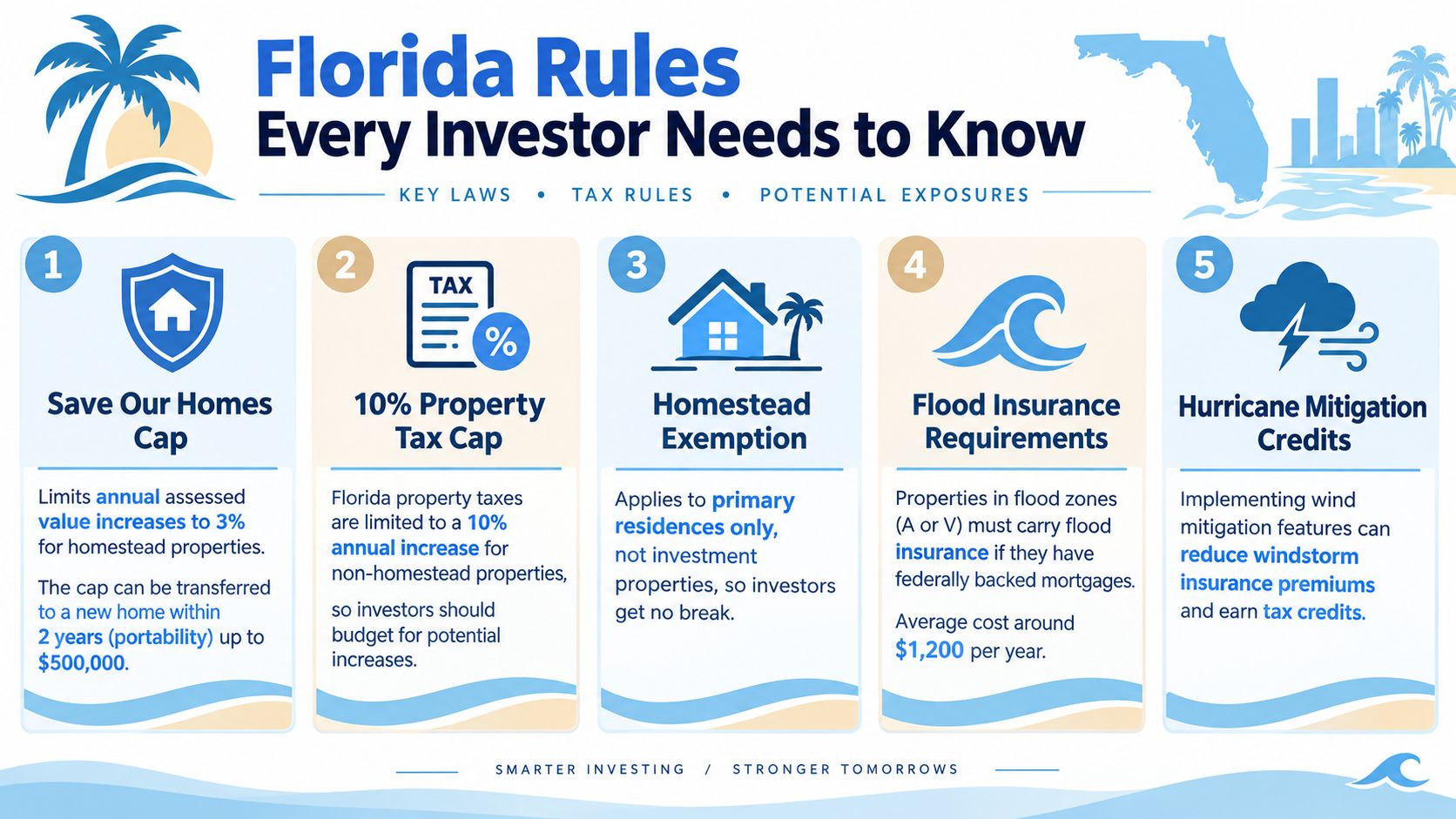
Insurance is an underwriting issue
Citizens Property Insurance, insurer depopulation efforts, wind mitigation credits, four-point inspections, flood zones, and elevation certificates can all affect whether coverage is available and what it costs. Hurricane and flood premiums can add $3,000 to $15,000 per year to holding costs, according to the supplied Florida rules brief.
That expense hits NOI directly. Lenders commonly compare rental income with PITIA for DSCR analysis, so higher taxes, insurance, and association dues reduce coverage even when rent remains unchanged. Flood insurance is usually separate from a standard landlord policy, and federally backed loans may require coverage in designated flood zones.
Practical rule: Bindable insurance must be part of the deal file before you trust the lender's DSCR result.
Matching Strategy to Market and Asset
Choose the strategy after you choose the asset. A flip, a long-term rental, and a short-term rental can all work in Florida, but they depend on different revenue assumptions, financing structures, and regulatory tolerances.
| Strategy | Best FL Markets | Typical Hold | Capital Required | Key Risk |
|---|---|---|---|---|
| Fix and flip | Tampa, Jacksonville, Orlando | Short term | Acquisition, rehab, carrying costs, resale costs | Insurance, repair overruns, resale timing |
| Buy and hold | Jacksonville, Gainesville, parts of Fort Myers | Long term | Down payment, closing costs, reserves, improvements | Insurance-driven DSCR compression |
| Short-term rental | Tampa, Destin, Key West | Seasonal or long term | Acquisition, furnishing, setup, operating reserves | Local rules and hurricane-season occupancy |
Fix and flip
Use the 70 percent rule as a ceiling for the purchase price before repairs and selling costs, not as proof of profit. Tampa, Jacksonville, and Orlando can offer workable value-add opportunities, but the deal needs enough spread to absorb inspection surprises, insurance remarketing, carrying costs, and a slower exit.
A flip's risk rises when the renovation schedule depends on permits, structural work, or a roof replacement. Private financing can help fund the acquisition and eligible rehab work, but the borrower needs a realistic completion plan and a dependable resale strategy.
Buy and hold
Long-term rentals work best where tenant demand remains durable after taxes and insurance. Jacksonville, Gainesville, and parts of Fort Myers may deserve attention when the property's net yield survives conservative insurance assumptions.
Don't chase a high gross cap rate in a flood-prone location if the premium makes the stabilized return ordinary. A less exciting property with dependable tenants and manageable insurance can outperform a glamorous coastal purchase.
Short-term rentals
Tampa, Destin, and Key West can attract short-term demand, but local ordinances decide whether the strategy is legal and workable. Verify city, county, zoning, licensing, HOA, and building restrictions before underwriting platform income.
The ceiling is clear for each playbook. Flips depend on spread and execution, holds depend on durable NOI, and short-term rentals depend on lawful operations and occupancy that can withstand seasonal disruption.
From Offer to Close to Operations
Florida transactions move more smoothly when the investor treats insurance and title work as early closing conditions, not final paperwork.
Draft the contract carefully. Include inspection and financing contingencies that reflect the property's age, condition, flood exposure, and intended use. A 1970s duplex should not have the same inspection assumptions as a newer rental.
Order inspections immediately. Request wind mitigation and four-point inspections early. Roof age, electrical panels, plumbing, HVAC systems, and mitigation features can determine whether an insurer will bind coverage.
Run title and lien searches. Ask the title company to investigate recorded liens and municipal liens, not just the basic ownership chain. Confirm that prior owners' exemptions or filings won't create confusion around the property's tax status.

Manage the appraisal. Hurricane-impacted neighborhoods can produce difficult comparable sales. Give the appraiser clear information about condition, improvements, flood exposure, and the relevant competing properties.
Coordinate closing funds. Follow the lender's wiring instructions exactly and confirm documentary stamp tax calculations on the deed and mortgage. Use verified phone numbers for wire confirmation because closing fraud can turn a successful approval into a permanent loss.
Operations begin on closing day
Activate landlord and HOA policies, transfer utilities, and confirm that the property insurance policy starts on the closing date. If a prior owner filed a homestead exemption, work with the county tax collector or property appraiser to correct the record and prevent future confusion.
Set a reserve equal to three months of PITI plus the insurance deductible, then schedule recurring roof and pest checks. For a flip, track contractor payments and required 1099 filings. For a rental, monitor lease compliance, rent collection, maintenance requests, and renewal pricing.
The best operators build the property file before the tenant arrives. Keep inspection reports, policies, invoices, leases, permits, and lender documents together so a refinance or claim doesn't become a scavenger hunt.
Moving Forward With the Right Lending Partner
Florida deals are won through structure and certainty, not optimism. A bank can be the right answer for a stabilized, well-documented rental when the borrower has time and the property clears every underwriting test. It's the wrong answer when a tight purchase window, non-conforming self-employed income, property-condition problem, or compressed DSCR makes approval uncertain.
Private or hard money financing has a specific role. It can bridge an acquisition on the MLS or at auction, fund a rehab before a bank takeout, support an entity-owned purchase, or provide a refinance path before an insurance renewal changes the operating model. The higher cost only makes sense when the capital solves a timing or qualification problem that cheaper financing cannot solve.
LendingXpress provides bridge, fix-and-flip, and rental-property financing for non-owner-occupied residential and commercial assets. Its lending model emphasizes applications, collateral-focused underwriting, rehab funding with staged draws, and closings that can move in days when the file is ready. Investors evaluating structure can review how to finance investment property before choosing between a bank loan, bridge facility, or refinance plan.
The Florida investors who stay solvent will underwrite insurance as a return driver, price taxes, and keep a lender ready before the next opportunity appears. Market conditions will keep changing, but disciplined math remains portable across Tampa, Orlando, Jacksonville, South Florida, and the Panhandle.
If your Florida investment property needs fast, flexible financing for acquisition, rehab, bridge funding, or refinance, LendingXpress can help structure a non-owner-occupied loan around the asset and exit plan. Visit LendingXpress with the purchase details, insurance assumptions, and funding timeline, and start the conversation before the deal reaches a lender deadline.