
You've found a non-owner-occupied property with solid potential, but the seller needs certainty and your bank is still requesting another document. The rent roll is under review, the appraisal hasn't cleared underwriting, and the committee meeting is too far away to protect the deal. The property may work, yet the financing process doesn't move at the speed of the opportunity.
That frustration is common among investors who meet the property's needs but not a bank's standardized checklist. Commercial real estate loan qualifications make more sense when you view them as a lender's language for measuring repayment, collateral protection, and execution risk. Once you understand that language, you can identify weaknesses early, present the deal more clearly, and choose a financing source that fits the asset.
Why Banks Turn Down Good Commercial Real Estate Deals
An investor finds a small income-producing property, reviews the leases, and sees a straightforward improvement plan. The seller accepts an offer with a tight closing window. The investor's bank initially sounds interested, then asks for historical statements, personal income documentation, additional entity records, and explanations for a temporary vacancy. The deal isn't necessarily bad. It doesn't fit a process designed to minimize exceptions.
Traditional banks serve an important role, but their underwriting is shaped by regulation, internal policy, and committee approval. That structure can make them cautious with non-owner-occupied properties that have changing occupancy, incomplete operating history, renovation needs, unusual property types, or a borrower whose income doesn't follow a standard pattern.
Practical rule: A bank's rejection often means the deal doesn't fit its risk box. It doesn't automatically mean the property can't support debt.
The useful response isn't to argue with the checklist. It's to diagnose what the checklist is trying to measure:
- Repayment capacity: Can the property's net operating income cover annual debt service with a cushion?
- Collateral protection: Is the loan amount conservative compared with the property's value?
- Execution risk: Can the borrower complete the business plan, stabilize the asset, and repay or refinance?
- Sponsor strength: Does the borrower understand the asset, market, leases, costs, and exit?
Private lenders often start with those same questions, but they can weigh the facts more contextually. A temporary vacancy may be manageable if the borrower has a credible lease-up plan. A renovation may be financeable if the scope, budget, and contractor are clear. A refinance may work if the sponsor can explain how the property reaches a sustainable capital structure.
The core metrics remain essential. Loan-to-value ratio, debt service coverage ratio, property value, and borrower quality create a common framework between the borrower and lender. The difference is how quickly and thoughtfully the lender interprets the full picture.
The Four Pillars of Commercial Loan Approval
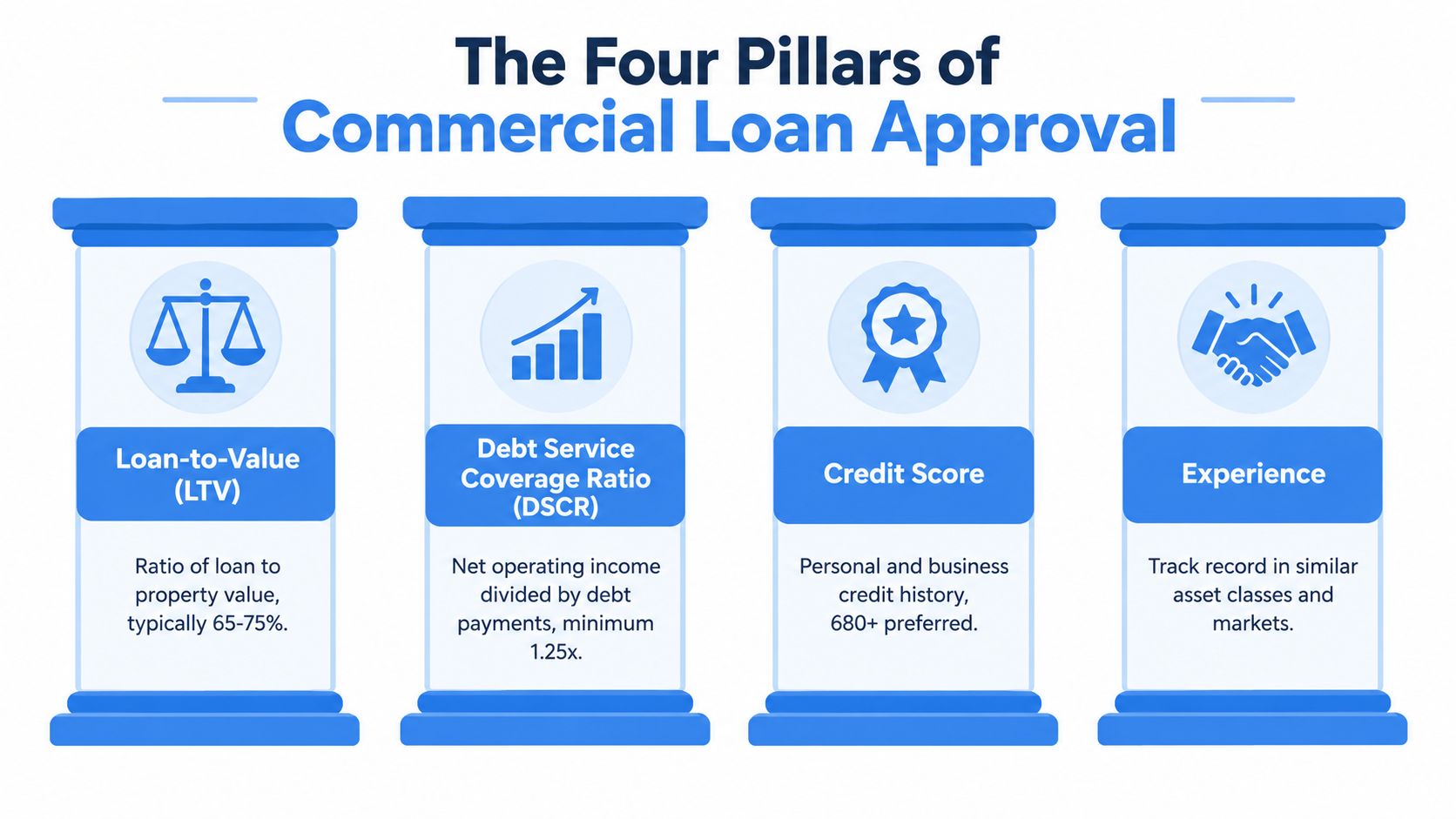
A lender usually views an investment property through four connected lenses. Think of them as a table. If one leg is weak, the others need to provide more support.
Loan-to-value protects the lender's downside
LTV compares the loan balance with the property's value. If a property is valued at $1 million and the loan is $700,000, the LTV is 70%. The remaining equity is the lender's first layer of protection if the asset must be sold.
Lenders commonly view 70% to 80% LTV as reasonable, while more conservative lenders often prefer 60% to 70%, according to the NAIC commercial mortgage primer. In practical terms, many borrowers need roughly 20% to 30% equity, and sometimes more depending on property type and risk.
For standard commercial assets, many lenders cap LTV between 65% and 75%, as described in this overview of common commercial real estate loan covenants. Lower debt levels can improve approval odds because they reduce the amount the property must repay or recover through a sale.
DSCR shows whether the property pays its bills
DSCR is the property's paycheck after operating expenses, measured against debt payments. A DSCR of 1.25 means the property generates $1.25 of net operating income for every $1 of annual debt service.
Many lenders look for DSCR above 1.0, with common targets around 1.20 to 1.35, according to the NAIC primer. For non-owner-occupied properties, PNC's commercial financing guidance also describes lender preferences in the 1.20 to 1.35 range. That cushion matters because collections, repairs, vacancies, and expenses can change.
A property with strong NOI may support more debt even when the borrower's personal income is less conventional. A property with weak NOI usually needs lower debt, stronger liquidity, a higher rate, or a clear stabilization plan.
Value and credit complete the picture
The appraisal isn't just a formality. It tests whether the proposed value is supported by comparable sales, income, condition, and market evidence. For a renovation or repositioning deal, distinguish between as-is value and the value expected after improvements. A lender needs to know which value supports the current loan and which depends on successful execution.
Credit history helps lenders understand payment behavior and unresolved obligations. It matters, but it isn't the entire decision for an investment loan. Entity structure, liquidity, net worth, property experience, and the quality of the operating plan can materially affect the final view.
Use the LendingXpress commercial real estate underwriting resource to organize the property and borrower information a lender will likely review. Investors comparing options can also learn more about commercial lending for investors when evaluating funding structures beyond a conventional bank loan.
Looking Beyond the Numbers The Borrower's Story
A spreadsheet tells a lender what the property produces today. The borrower's story explains why those results may improve, remain stable, or deteriorate. Private underwriting works best when the sponsor makes that story specific and testable.

Experience reduces execution risk
A borrower doesn't need to have owned every type of property, but relevant experience helps. Someone who has managed similar tenants, completed comparable renovations, or operated in the same market can identify problems earlier and budget more realistically.
That experience becomes especially important when occupancy is weak or the asset needs work. A lender may ask who will manage construction, how leasing will be handled, whether the borrower has reserves for overruns, and what happens if the original timeline slips. A clear answer can matter more than a polished biography.
In a difficult market, lender attention often shifts toward sponsor quality. A strong sponsor with a proven track record may still obtain financing for a property in a structurally weak sector such as office, while alternative and private-credit funds specialize in situations that require more specialized underwriting, as discussed in TowneBank's commercial real estate qualification guidance.
The plan must explain repayment
A bridge loan isn't approved because a property might become valuable someday. It's approved when the lender can understand the path from today's condition to repayment.
Your plan should answer:
- What changes first: Identify renovations, leasing actions, expense controls, or management improvements.
- Who executes it: Name the contractor, property manager, leasing team, and decision-makers where available.
- What could go wrong: Address vacancy, construction delays, cost increases, and slower leasing directly.
- How the loan ends: Explain whether repayment comes from a sale, permanent refinance, asset stabilization, or another documented source.
Temporary low occupancy doesn't always disqualify a property. It does make unsupported projections dangerous. A lender is more comfortable with conservative assumptions, evidence from the local market, and a sponsor who has already prepared for the downside.
A strong borrower doesn't hide the property's weakness. They show the lender how they'll control it.
The same principle applies to credit issues. Late payments, tax obligations, or a prior failed project need context and a solution. Private lending isn't risk-free lending. It's a process of matching the loan structure to the actual risk and requiring enough collateral, equity, liquidity, and execution capacity to manage it.
Bank Qualifications vs Private Lender Speed
The main difference between a bank and a private lender is not that one evaluates risk and the other doesn't. Both care about repayment and collateral. The difference is how each institution handles exceptions, timing, documentation, and transitional assets.
Federal supervisory guidance cited by the FDIC recommends maximum LTV levels of about 65% for raw land and 80% for commercial construction. These ceilings act as a first-loss buffer and make bank underwriting more restrictive for speculative or transitional properties, as explained in the FDIC examination policies manual.
| Qualification Factor | Traditional Bank | Private Lender (LendingXpress) |
|---|---|---|
| Primary focus | Standardized borrower and property criteria | Collateral, repayment plan, sponsor strength, and deal structure |
| Documentation | Extensive historical financial and personal documentation | Focused property, entity, borrower, and exit documentation |
| Transitional assets | Often difficult when income or occupancy is changing | Can be reviewed when the stabilization plan is credible |
| Decision process | Multiple departments and formal approval stages | Direct communication and case-by-case underwriting |
| Timing | Can be slow when exceptions or committee review arise | Designed for situations where a faster funding decision matters |
| Structure | More standardized loan terms | Greater flexibility around bridge, refinance, and investment scenarios |
A bank may prioritize verified historical income because its process needs consistency across many borrowers. A private lender can place more weight on current collateral, the proposed business plan, liquidity, and the exit. That doesn't eliminate documentation. It changes which documentation carries the most weight.
Investors should review the trade-off carefully. Private capital may offer speed and flexibility, but borrowers must understand the rate, fees, maturity, extension provisions, prepayment terms, draw process, and default remedies before signing. A fast closing only helps if the structure gives the project enough time and cash flow to reach its planned exit.
Read this practical comparison of private lender versus bank financing before deciding which route fits the transaction. The right question isn't just whether a bank is cheaper on paper. It's whether the loan can close in time, survive the property's actual transition, and support a realistic repayment strategy.
How to Strengthen Your Commercial Loan Application
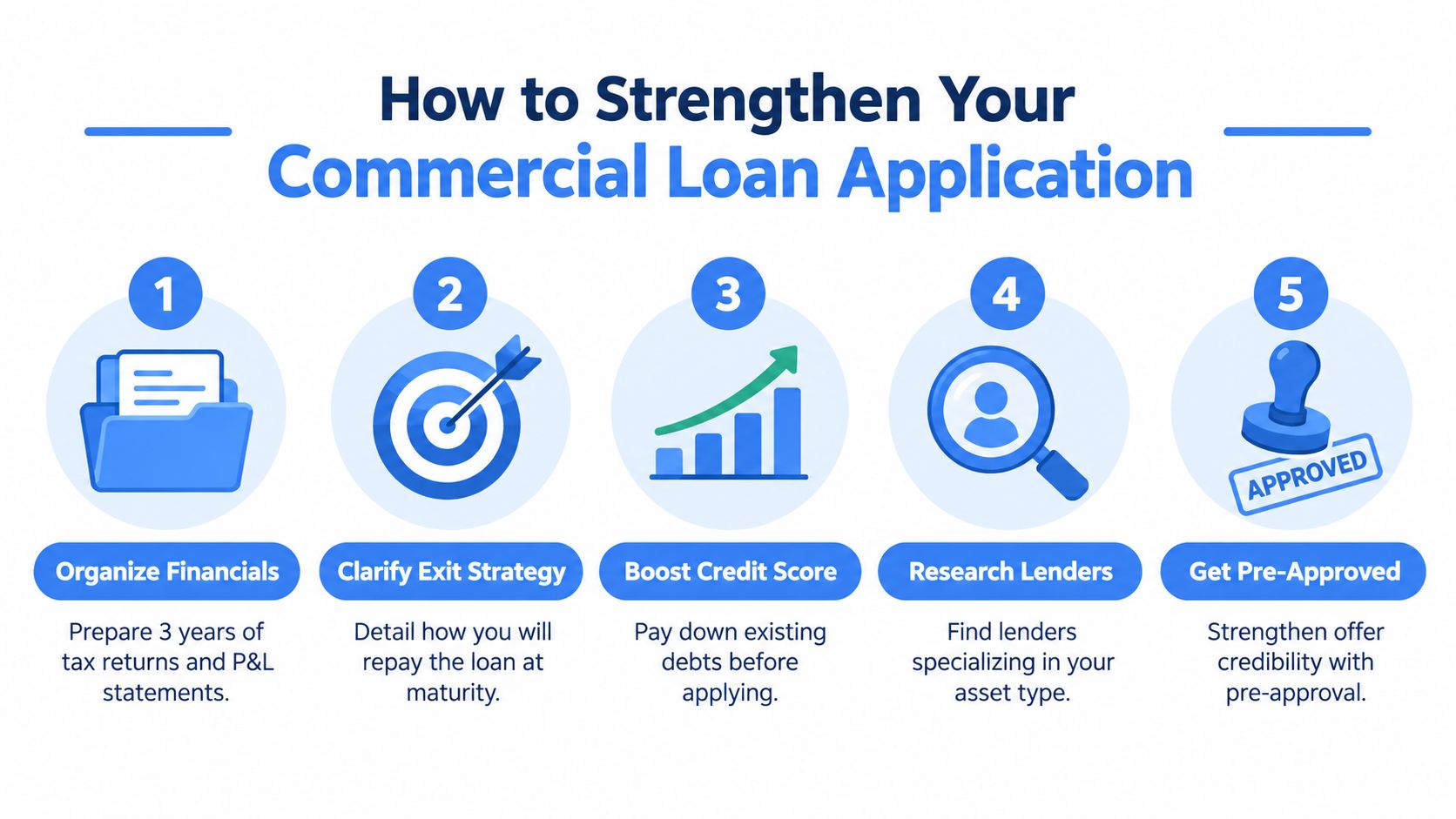
The strongest application makes the lender's work easier. Don't send a folder of disconnected files and expect the underwriter to assemble the deal. Present the property, borrower, risks, and repayment plan in a sequence that answers the lender's questions before they ask.
Start with a concise deal summary
Write a short executive summary covering the purchase or refinance purpose, property type, location, current occupancy, requested loan, estimated value, available equity, renovation scope, and exit. Include the issue that may concern a lender, then explain how you'll manage it.
Attach the core property file:
- Operating statements: Show income, expenses, debt obligations, and unusual items clearly.
- Rent roll and leases: Identify lease terms, arrears, vacancies, renewals, and tenant concentration.
- Valuation support: Separate the as-is value from any after-repair or stabilized value.
- Project budget: Match each improvement to a realistic cost and timeline.
- Insurance and taxes: Resolve gaps before they become closing conditions.
Accuracy matters more than optimistic presentation. If current NOI is weak, don't bury it in a projection. Explain the cause, provide supporting evidence, and show the point at which the property should support the proposed repayment structure.
Make liquidity and the exit visible
Cash reserves tell the lender who absorbs the first unexpected cost. Document the source of equity, post-closing liquidity, and any funds reserved for repairs, tenant improvements, or operating shortfalls. Keep bank statements and entity records organized so the lender can verify the capital without repeated requests.
The refinance wall makes this especially important. More than $1 trillion of commercial real estate loans were estimated to mature in 2025, and refinance activity became the fastest-growing loan category, according to Baker Tilly's commercial real estate debt insights. The underwriting question is increasingly whether the sponsor can bridge a maturity gap, not merely whether the property looks acceptable on the application date.
Write the exit as a sequence, not a slogan:
- Stabilize: State the leasing, renovation, or operating milestone.
- Measure: Identify the income or occupancy evidence that demonstrates progress.
- Refinance or sell: Name the likely lender type, buyer profile, or sale strategy.
- Protect the timeline: Explain what happens if the first exit takes longer.
Tax liens and title complications also deserve early attention. If an IRS lien affects a transaction, borrowers should understand the documentation and coordination involved in trying to sell property with an IRS lien before presenting a closing date as certain.
Application standard: Every major risk should have an owner, a timeline, and a fallback plan.
Finally, match the lender to the asset. A lender experienced with non-owner-occupied commercial property will usually understand rent rolls, bridge structures, rehabilitation draws, and stabilization risk more quickly than a lender focused on owner-occupied businesses. That fit can prevent wasted applications and help you negotiate a structure that reflects the property's actual needs.
Get Your Next Investment Property Funded with Confidence
Commercial real estate loan qualifications become manageable when you separate the lender's concerns into clear questions. Does the property generate enough income? Is the loan amount protected by sufficient equity? Is the value credible? Can the sponsor execute the plan and repay the debt?
Banks may be appropriate for stable, conventional properties and borrowers who fit their policies. They're less useful when a non-owner-occupied property needs a quick decision, has transitional income, or requires a lender to understand the opportunity behind the current numbers.
Private financing can solve that mismatch, but it should still be disciplined. A sensible loan structure protects both sides with conservative financing, documented assumptions, adequate liquidity, and a credible exit. Borrowers who improve their personal financial profile can also review practical resources on credit repair for borrowers, while keeping the property's cash flow and collateral at the center of the application.
LendingXpress works with real estate investors seeking bridge, refinance, fix and flip, and rental property financing secured by residential and commercial assets. For a specific deal, the best next step is a direct review of the property, requested capital, current income, borrower background, and repayment plan.
LendingXpress offers common-sense underwriting for non-owner-occupied residential and commercial properties when traditional bank financing moves too slowly or doesn't fit the deal. Share your property details and exit strategy through LendingXpress, and speak with a loan officer about a financing structure built around the asset and your investment plan.