
You've found a rental that pencils on paper, but your tax returns don't tell the same story. Maybe you're self-employed and write off a lot of income. Maybe you already own several properties and your personal debt load looks crowded to a bank. Or maybe the seller won't wait while a traditional lender picks through two years of paperwork.
That's the gap a DSCR loan for rental property is built to fill. It asks whether the property's rent can carry the payment, not whether your wages can. A passing ratio gets you in the door, but it isn't the whole test, and treating it as one is how a good-looking deal turns tight after closing.
What the DSCR Number Says About Your Rental
Think of the rent as the property's paycheck and the loan payment as its biggest bill. A DSCR loan for rental property asks whether that paycheck covers that bill with room to spare. Your personal job, your salary, and your other debts aren't the main event here. The building has to stand on its own.
Net operating income, or NOI, is the rent you collect minus the operating costs you pay as owner. That includes property taxes, insurance, repairs, utilities, management, and a vacancy allowance for the months a unit sits empty. The mortgage itself stays out of NOI. If you want the full breakdown before you run your own file, our guide to what net operating income includes and excludes walks through each line item.
One file, run in order
Say a rental brings in $3,000 a month in market rent, or $36,000 a year. An 8 percent vacancy allowance takes out $2,880, and other operating costs run $9,600, so NOI lands at $23,520. A $1,600 monthly payment is $19,200 a year in debt service. Divide $23,520 by $19,200 and you get 1.23.
The formula behind that example is the standard one, since a DSCR is calculated by dividing a rental property's net operating income by its annual debt service, as NASB's DSCR loan overview puts it. That same source sets the landmarks. A ratio of 1.0x means the property generates exactly enough income to cover scheduled loan payments, and a 1.20x ratio means NOI is 20% greater than annual debt service.
Below 1.00, the property needs outside cash from you every month just to make the payment. That property-level approach can help you qualify based on rental cash flow rather than relying solely on personal income documentation, although specific lender standards vary. This figure measures the property's coverage, not your taxable personal income, so don't confuse the two when you're planning.
Keeping clean records matters more than most investors expect, because your NOI is only as good as the expense numbers behind it. It's the same discipline behind keeping a diary for home office expenses, where a simple running log turns a guess into a number you can defend. Track repairs, utilities, and management costs the same way and your ratio stops being a hope.
| DSCR band | What the rent is doing | Typical lender stance |
|---|---|---|
| 1.00 | Covers the annual payment exactly | Borderline; often needs reserves or a larger down payment |
| 1.20 to 1.24 | About 20 percent above debt service | Widely used target for a standard rental DSCR loan |
| 1.25 and above | Strong coverage | Often the best pricing and a higher allowable LTV |
Bands below those get harder fast. Under 0.75 most private lenders won't engage, 0.75 to 0.99 usually means a lower loan amount and a higher rate if it works at all, and 1.10 to 1.19 sits in a gray zone where structure decides the outcome. Write down your own three numbers now, your NOI, your annual payment, and your ratio, before you read any further.
The File a DSCR Lender Still Wants
The ratio is the front door, not the whole house. A clean DSCR on a non-owner-occupied rental still sits inside a file that a lender has to underwrite, and files stall on the items around the ratio far more often than investors expect.
Credit gets reviewed, but it isn't the main qualifier. Many private programs start in the mid-600s, though a thin file or a recent housing event can still cut your borrowing power or raise your rate. On a purchase of a 1-to-4 unit rental, loan-to-value often lands around 70 to 80 percent, and condos, mixed-use properties, or short-term rentals are commonly held lower than that.
Here's the documentation picture at a glance before we walk through it.
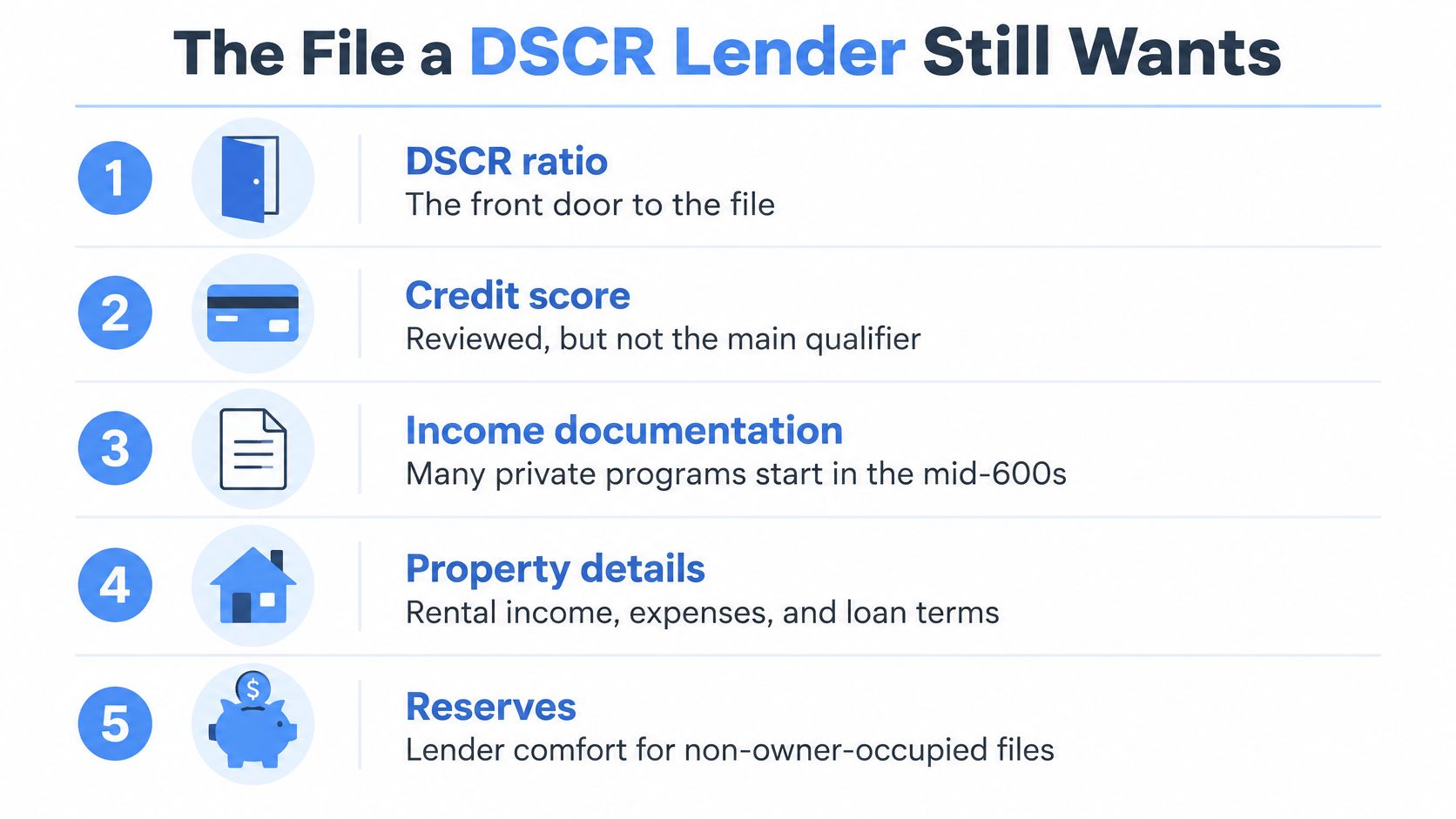
Rent, reserves, and the items beside the ratio
Rent comes from a signed lease or an appraiser's rent schedule, and many lenders haircut gross rent for vacancy rather than counting every dollar you hope to collect. That haircut is why a listing rent and a qualifying rent are often two different numbers. Send the lender the rent you can document, not the rent you're planning to ask for after a light rehab.
Reserves are separate from your down payment, and otherwise fine files can falter here. Several months of principal, interest, taxes, and insurance sitting in the bank after closing is a normal ask. Investment-property underwriting commonly requires additional review of reserves, rental-income calculations, monthly housing expenses, and rent-loss insurance, and Freddie Mac's investment property mortgage guidance identifies these as distinct requirements for investment-property mortgages. You may need more liquidity and documentation than an owner-occupant even when projected rent supports the payment.
A low bank balance after closing is the most common reason a clean ratio still stalls. The lender wants proof you can survive a vacant month without missing a payment.
Rent-loss insurance and the full monthly housing expense stack, meaning taxes, insurance, and any association dues, sit beside the DSCR in the file. Entity vesting in an LLC is often allowed, which is a practical reason investors leave a bank that wants the loan in a personal name. For a small rental, the test stays at the property level, which keeps the file focused.
Your payment choice also moves the ratio without adding a dollar of rent. An interest-only payment lowers debt service and can lift DSCR, but the balance doesn't shrink while you're paying interest only. Prepayment penalties are common on these loans too, so price one into your hold period before you sign, not after you decide to sell early.
Pack the file before you apply and you'll move faster than most borrowers.
- Lease or rent schedule: The signed lease if the property's occupied, or be ready for an appraiser's rent opinion.
- Insurance quote and tax bill: Real numbers, not the seller's old figures.
- Entity documents: Formation paperwork if you're vesting in an LLC.
- Reserve statements: Bank statements showing several months of payments after closing costs.
How Fast a Passing Ratio Can Break
Take that same 1.23 file and change one thing at a time. The base is $23,520 of NOI against $19,200 of debt service, and it looks comfortable. Now watch how quickly comfortable disappears.
A 5 percent rent decline, holding the same 8 percent vacancy rate and the same $9,600 of other costs, drops NOI to about $21,864 and DSCR to about 1.14. Push the rent decline to 10 percent and NOI falls to about $20,208, with DSCR near 1.05. Neither scenario requires a bad tenant or a market crash, just a renewal signed a little under your projection.
The chart below steps through those single changes one by one.

Vacancy and repairs hit harder
One extra vacant month, beyond the allowance already in the base case, removes about $3,000 and leaves DSCR near 1.07. Two extra vacant months remove about $6,000 and push the ratio to about 0.91, which means the property no longer covers its own payment. A $3,600 annual repair reserve, the kind of money a roof or an HVAC system eventually demands, cuts DSCR to about 1.04 on its own.
Debt service can move against you too. A refinance that raises debt service 15 percent, to $22,080, leaves the same NOI covering only about 1.07. If you want to test your own payment under a higher rate before you commit, you can estimate your mortgage repayments with a simple calculator and plug the result straight into your ratio.
| Shock | NOI | DSCR |
|---|---|---|
| Base case | $23,520 | 1.23 |
| 5 percent rent decline | $21,864 | 1.14 |
| 10 percent rent decline | $20,208 | 1.05 |
| One extra vacant month | $20,520 | 1.07 |
| Two extra vacant months | $17,520 | 0.91 |
These shocks aren't stacked. Each row changes one variable, and stacking a rent cut on top of a vacancy is harsher than anything in the table. That's the point worth sitting with. Qualification today isn't the same as survival, and a property can clear 1.20 and still fail if expenses were understated or you have no cash to cover a soft month.
Late-payment conditions also aren't identical across property types, since Freddie Mac's monthly volume summary reported single-family delinquency at 0.59% and multifamily delinquency at 0.44% in December 2025, using different delinquency definitions for each segment. A calm market average is no substitute for your property's own math. Property-level DSCR also isn't your whole portfolio, because other rentals can support your living expenses without automatically repairing this loan unless the lender allows reserves, an interest-only period, or verified outside income to bridge a weak case.
Before you rely on any DSCR loan, rerun your ratio at a 10 percent rent cut and at one vacant month. If both versions still work, you have a property. If they don't, you have a projection.
Two Rentals and the Ratios They Produce
Numbers get clearer when they're attached to an actual decision. These two scenarios show how the same product produces opposite answers depending on what the property earns.
The first borrower is self-employed, reviewing tax returns that don't reflect what the business brings in.

The near miss that structure can fix
Say a self-employed buyer's tax returns show about $70,000 after write-offs. The rental she's buying supports $42,000 of NOI, and the proposed loan needs $36,000 of annual debt service, so DSCR comes out to 1.17. A lender with a 1.20 minimum won't approve that loan as written, full stop on that structure.
She has three levers. She can shrink the loan, raise the down payment, or choose an interest-only payment that lowers debt service until the ratio clears, while still showing reserves after closing. A bank, by contrast, would decide on the taxable income, and $70,000 on paper is too low to support the loan regardless of what the property earns. The DSCR path at least gives her a structure problem instead of a dead end.
This short walkthrough shows how a lender reads a file like hers.
The portfolio borrower a bank can't read
Now take a landlord who already holds four rentals and wants cash out of a fifth that's leased and stable. His personal debt-to-income is crowded by the other four mortgages, so a wage-based refinance stalls before anyone looks at the property itself. But this property's NOI of $30,000 covers $24,000 of debt service at 1.25.
A DSCR lender can look at that property alone, which is exactly why portfolio borrowers use this product to keep buying after banks stop counting. His decision isn't about structure at all. It's about whether the cash-out terms, the prepayment penalty, and the reserve requirement fit his next purchase.
In both stories the number forces a specific move, change the loan size, show reserves, or walk away. The first file is a near miss that structure can fix. The second clears a common 1.25 band and depends on the lender reviewing the property rather than the borrower's full personal debt.
When a DSCR Loan Beats a Bank
Both loans can buy the same rental, but they qualify different things. A DSCR loan qualifies the property's rent against the payment. A bank loan qualifies your wages, tax returns, and debt-to-income. Everything else in the comparison flows from that one difference.
| Question | DSCR rental loan | Traditional bank loan |
|---|---|---|
| What qualifies the loan | Property rent versus the payment | Borrower wages, tax returns, and debt-to-income |
| Typical speed | Often days once value and rent are documented | Often several weeks of income review |
| Title | LLC vesting commonly allowed | Often expects a personal borrower |
| Weak personal income or credit | Possible if the property and reserves carry the loan | Often a decline |
| Cash-out on a rental | Often available, still limited by LTV and DSCR | Available only if personal ratios pass |
| Rate and term | Usually higher rate, prepayment penalty common | Usually lower rate and a long fixed term |
| Best fit | Strong rent, weak or slow personal docs | Clean income and time to underwrite |
The same comparison in chart form makes the trade-off easy to scan.
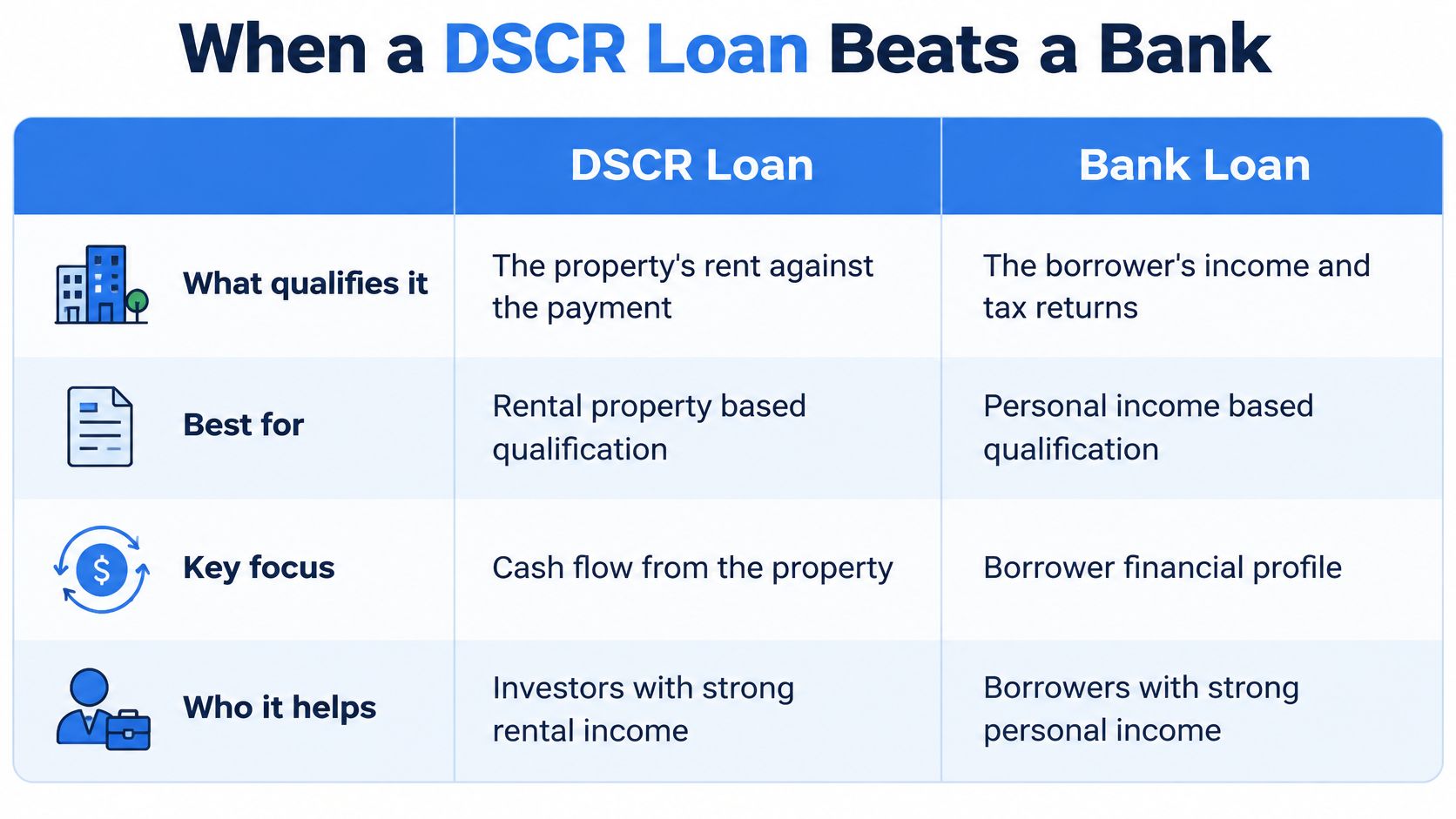
Where each path actually wins
Private DSCR files are designed for non-owner-occupied property and often close in days once rent, value, and reserves are documented. That speed matters when a seller won't wait on a full income package or when you're competing against cash. Banks are slower and stricter on personal income, and they often resist entity titles, but the rate and the long fixed term are usually better when you qualify. I won't pretend otherwise, because if a bank will fund you cleanly, the bank is usually the cheaper path.
There's also a line where the property stops being a small rental in a lender's eyes. Federal Reserve commercial real estate guidance treats a loan as rental-income-driven when at least 50% of the repayment source comes from third-party, nonaffiliated rental income or from the property's sale, refinancing, or permanent financing. For larger multifamily or commercial rentals, lenders may therefore evaluate the property's income and the broader financial position of the borrowing group, not just the single building.
Demand for the product is part of why it's easier to find than it used to be. In 2024, DSCR loan volume increased 52% year over year across 33 private-lending users tracked by the American Association of Private Lenders' Lightning Docs data. That growth tells you the product is available, not that it's cheaper.
Choose DSCR when rent coverage is at least around 1.20, your tax returns understate your cash flow, you need an LLC, or the purchase falls through if funding takes a month. Choose the bank when you have clean W-2 income, want the lowest rate, and can live with the paperwork. The trade is simple. Flexibility and speed cost more than a clean conventional loan, and that's a fair price only when the conventional loan isn't available to you.
The Exit Test After You Close
Approval is the entry test. The exit is the second test, and nobody runs it for you. A DSCR loan can be a long-term rental loan or a shorter bridge into a later refinance, and approval now doesn't lock the next lender's value, rate, or minimum ratio.
The maturity checklist
Work through these six items before you close, not in the final year of the loan.
- Projected balance: Write down what you'll owe at the balloon or first refinance date, especially if payments are interest only and the balance never falls.
- Stabilized value: Use a value the property can defend in a flat market, not the peak price you paid.
- Next lender's DSCR: Apply a stricter minimum ratio to rent you can prove, not to today's optimistic lease.
- Seasoning rules: Confirm how long you must hold before a cash-out is even available.
- Prepayment penalty: Price the cost of exiting early into your hold period.
- Sale fallback: Know whether a sale clears the payoff if refinance proceeds come up short.
Our breakdown of how to build an exit strategy for a real estate investment goes deeper on sequencing those fallback options. The core habit is refusing to treat any single exit as guaranteed.
Value risk is the part investors underestimate most. Freddie Mac's 2025 annual housing activities report reported that multifamily property prices declined 1.3% during 2025 and remained nearly 20% below their mid-2022 peak. A borrower can have perfectly adequate rent coverage and still face insufficient refinance proceeds if the valuation falls, amortization is limited, or the next lender applies a stricter DSCR and loan-to-value requirement.
Hold-period question: If neither a refinance at a stricter ratio nor a sale at a lower value would pay the loan off, the entry DSCR wasn't enough.
Rising insurance, taxes, and maintenance can outrun rent in the same quiet way, shrinking NOI while the payment stays fixed. Don't spend assumed cash-out equity before a new appraisal and a new DSCR test exist, because that equity is a guess until a lender verifies it. Use the multifamily price record as a warning for any rental, then check local comparable sales for your specific property, since a single-family or small rental value can move differently from the national multifamily picture.
Run Your Numbers Then Talk to a Lender
You don't need a spreadsheet with forty tabs. You need three numbers, and all three have to hold at the same time.
First, the property DSCR from your own NOI and annual payment, with a target around 1.20 or better. If your ratio sits between 1.00 and 1.20, you need a known plan, a smaller loan, a bigger down payment, or an interest-only structure you have priced. Second, cash reserves of several months of the full housing payment still in the bank after closing. Third, an exit that still works if value comes in lower and the next rate comes in higher.
The go or no-go call
If all three hold and a bank will stall on your tax returns, your LLC, or your portfolio debt, a DSCR loan is the practical path for a rental you won't occupy. If the ratio only works with perfect rent and no reserves, wait or bring a larger down payment. Forcing a thin file through doesn't make the property stronger, it just moves the problem past closing where it's more expensive.
Borrowers outside our market sometimes ask how investors elsewhere line up financing contacts before they shop, and resources covering mortgage connections for Vancouver home buyers show the same pattern, get the lending relationship sorted before the offer, not after. That sequencing matters everywhere. We'd rather read your scenario before you've committed to a purchase than rescue one after.
When you're ready, our Rental Property Loans are long-term financing for income-producing properties, designed for portfolio growth, which is exactly the job a DSCR structure does for buy-and-hold investors. The path is simple. You send the scenario with rent, expenses, and target loan amount through our online portal, we review the application and provide a pre-approval and terms in as little as an hour, and most loan approvals are handled in just 24 hours. Once the file is reviewed, you move to closing with the ratio already checked.
Submit those numbers before you write an offer, so the DSCR gets tested while you can still walk away. That's the whole discipline this product rewards. A passing ratio opens the door, and a stressed ratio with reserves and an exit is what keeps the property yours.
If your rental's numbers hold up under a rent cut and a vacant month, LendingXpress can structure DSCR financing around the property's income instead of your tax returns, with a fast pre-approval read on your scenario. Send us the rent, expenses, and loan amount you're targeting and we'll tell you plainly whether the ratio works before you commit to the purchase.