
You find a property that looks right. The purchase price works, the rehab looks manageable, and the upside feels obvious. Then the key question shows up: how are you getting your money out?
That's where a lot of otherwise solid non-owner-occupied deals start to break. The investor has a clear Plan A, usually sell or refinance, but no funded Plan B if the market slows, the rehab drifts, or the buyer pool changes. The problem usually isn't the asset alone. It's the mismatch between the exit and the loan attached to it.
An effective exit strategy real estate plan starts before you close. It shapes your offer, your timeline, your reserve planning, and the kind of lender you should use. If your financing only works for one narrow outcome, you're not underwriting a deal. You're betting on one.
Why Every Deal Needs an Exit From Day One
A borrower buys a non-owner-occupied property to flip. The budget looks clean on paper. The renovation starts, permits drag, the listing goes live later than expected, and the home doesn't move as fast as planned. Suddenly the original short-term loan is still running, the sale hasn't happened, and the investor starts asking whether the property can convert to a rental.
That's a normal situation. What's not normal is treating that pivot like an afterthought.
Many investors are told to model backup exits, but the financing side often gets skipped. As Proplab's exit strategy planning guidance notes, many investment guides advise modeling 2–3 exits but ignore the financing mismatch where a short-term fix-and-flip loan may not support a long-term hold or rental conversion. That's a major blind spot in non-owner-occupied investing.
The first question isn't profit
The first question is whether the deal still works if your preferred outcome doesn't.
If you plan to sell, ask what happens if the sale timeline stretches. If you plan to refinance, ask whether the property will be financeable in its stabilized condition. If you think you may wholesale, ask whether the spread is wide enough for the end buyer to execute after their costs.
Practical rule: Before you buy, know your primary exit, your backup exit, and whether your loan allows both.
What disciplined investors do differently
They underwrite from the exit backward.
- They define the outcome first: Sell, refinance, hold, exchange, or assign.
- They match the debt to the path: A short bridge for a fast cleanup is different from financing a longer stabilization.
- They reserve for friction: Delays, carry, and buyer hesitation can wreck a thin-margin deal.
- They avoid one-path thinking: If the property needs a pivot, they already know what that pivot looks like.
The investors who survive rough patches aren't always the ones who bought the cheapest or renovated the fastest. They're the ones who made sure the loan, reserves, and timeline all supported more than one workable exit.
Core Real Estate Exit Strategies Explained
Most non-owner-occupied deals end one of a few ways. You sell. You refinance. You hold. Or you move equity into another investment property through an exchange. Each option can work. Each also creates a different set of financing demands.

Sell
This is the classic exit for a flip or value-add reposition. You improve the property, list it, close, and recycle capital.
Selling is best for investors who want quick liquidity and a clean break. It can also make sense when the property no longer fits the portfolio or when local demand is still strong enough to support a premium listing strategy.
The trade-off is timing risk. If the sale stalls, the carry keeps running. Investors often underestimate the hidden bleed from debt service, taxes, and utilities when a primary exit like a flip fails, and that extended carry period is often a bigger deal-killer than the exit choice itself, as explained in Team 912's discussion of investor carry risk.
Refinance
Refinancing lets you keep the asset while replacing short-term debt with a longer-term loan. This path works well when the property has improved enough to support a stronger valuation or more stable income profile.
For many investors, refinance is the bridge between forced appreciation and longer-term wealth building. The catch is simple: the property has to qualify. On commercial and income-producing non-owner-occupied assets, lenders typically look for a Debt Service Coverage Ratio of at least 1.25, meaning the property must generate 25% more income than needed to cover debt obligations, according to Ascend Bank's DSCR overview.
Hold as a rental
A hold strategy works when the asset can produce stable income and you want optionality instead of a fast sale. Some borrowers buy with this in mind from day one. Others arrive here after a flip no longer makes sense.
The financing side matters more than many people expect. Conventional lenders for non-owner-occupied properties typically require a down payment between 15% and 30%, with jumbo investment property loans often requiring 20% to 50% depending on loan amount, as outlined by Rocket Mortgage's guide to non-owner-occupied financing. That can change your reserve needs quickly if your original loan was built around a short-term sale.
1031 exchange
A 1031 exchange is for investors who want to sell one investment property and move proceeds into another like-kind investment property while deferring taxes. It's useful when the current asset has appreciated, but the investor wants a different asset type, market, or management profile.
If you want a plain-English breakdown, this overview of how a 1031 exchange works is a helpful reference.
Comparing Real Estate Exit Strategies
| Strategy | Best For | Speed to Cash Out | Profit Potential | Complexity |
|---|---|---|---|---|
| Sell | Flips, value-add projects, capital recycling | Fast if buyer demand is strong | Strong when bought and managed well | Moderate |
| Refinance | Stabilized assets with improved value or income | Slower than a sale | Moderate to strong over time | Moderate to high |
| Hold (Rental) | Investors focused on ongoing income | Slowest immediate cash-out | Depends on operations and long-term appreciation | Moderate |
| 1031 Exchange | Investors repositioning into another asset | Moderate | Strong for portfolio growth and tax deferral | High |
A good exit isn't just the one with the highest upside. It's the one you can execute with the loan, reserves, and timeline you actually have.
Choosing the Right Exit for Your Project
The right exit depends on the property in front of you, not the strategy that sounds best in a podcast clip. A clean cosmetic flip needs a different playbook than a distressed asset with title issues or a rental stabilization project that won't be financeable right away.

Fix and flip
Discipline is paramount. For fix-and-flip deals, the Max Allowable Offer uses a 70%–75% target of the After Repair Value as a baseline to preserve room for costs, carrying, and profit, especially when hard money is involved, according to Evernest's guide to real estate exit strategies.
If you're buying a flip, the primary exit is usually resale. The secondary exit might be refinance into a rental if the home doesn't move. A tertiary exit could be a wholesale assignment before major work begins if new information changes the numbers.
What works:
- Buying with margin: If the MAO is thin, the exit gets fragile fast.
- Writing a real rehab scope: Vague scopes lead to vague budgets and bad offers.
- Choosing debt that won't trap you: You need enough runway to complete work and market the asset.
What doesn't:
- Using best-case ARV logic: That's how people overpay.
- Assuming sale speed: The property still has to compete.
- Ignoring backup financing: A flip-to-rent pivot only helps if you can finance the hold.
Rental stabilization
This path fits small multifamily or mixed-use assets that need operational cleanup, tenant improvement, or rent normalization before they're financeable at better terms.
Your primary exit may be refinance after stabilization. Your secondary exit could be a sale once the books, occupancy, and condition support investor demand. The tertiary path may be a structured recap with a new partner if you want partial liquidity without losing the asset.
A rental stabilization deal usually rewards patience more than speed. The key is whether the property can become lender-friendly after the work is done.
Consider these questions:
- Can the asset support durable occupancy?
- Will the trailing numbers tell a clean story to the next lender?
- Are you improving the property in ways buyers or lenders value?
If your plan depends on “someone will see the upside,” that's not a plan. The numbers have to become obvious to the next buyer or lender.
Distressed property
Distressed deals can create strong outcomes, but they demand the widest exit map. These are the properties where title defects, severe deferred maintenance, access issues, or bad tenant situations can drag the timeline.
For a distressed acquisition, your first exit might still be rehab and sale. But in practice, you should also think through who would buy it unfinished, who would finance it once partly improved, and whether it could be sold as an investor-special asset if your original scope proves unrealistic.
A practical framework looks like this:
- Primary path: Full execution and sale if repairs, permits, and marketability line up.
- Secondary path: Partial improvement and refinance if the asset can produce enough income or appraised support later.
- Tertiary path: Fast assignment or as-is sale if hidden issues multiply.
The strongest deals aren't the ones with the prettiest spreadsheet. They're the ones where all three exits are believable before closing.
When to Exit The Metrics That Matter
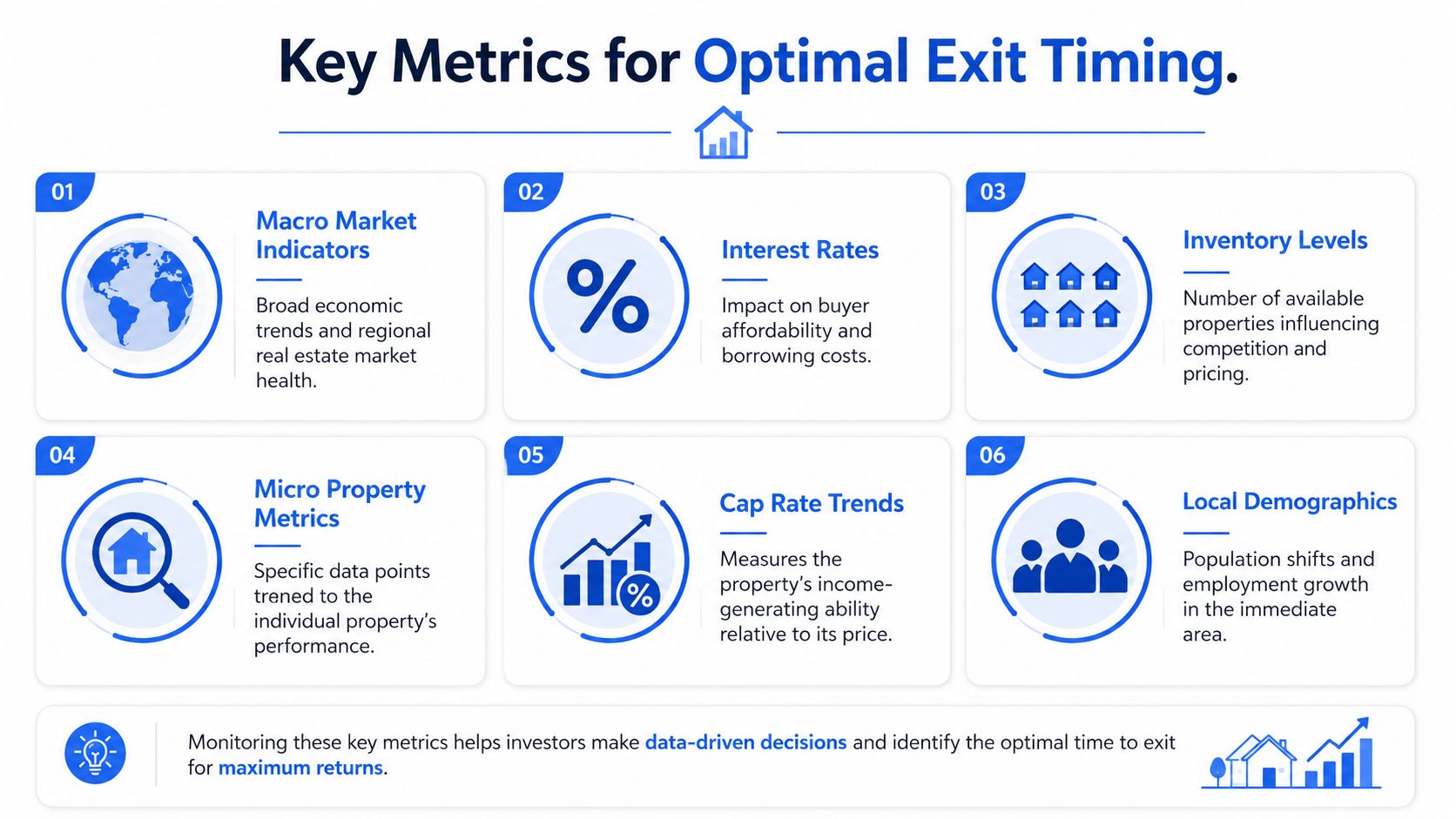
A solid plan can still fail if you execute it late. Timing drives exit quality just as much as property selection.
Investors should begin exit planning 12–18 months before a planned sale because declining building permits and employment data often signal a market peak with that same 12–18 month lead time, according to LoopNet's multifamily exit strategy analysis. That matters because non-owner-occupied properties don't usually punish you all at once. Conditions soften first, then buyers get choosier, then terms get harder.
Watch the market before it shows up in your listing
Three macro signals deserve attention:
- Building permits: A sustained decline can warn that the market is approaching a peak well before prices visibly soften.
- Employment data: Weakening local employment often shows up later in leasing and buyer confidence.
- Population movement: If residents are leaving a submarket, demand can fade faster than sellers expect.
These indicators don't tell you the exact week to sell. They help you avoid being late.
Watch the property like a lender would
At the asset level, timing comes down to whether the property is ready for the next step.
LoopNet's exit-planning guidance also notes that investors preparing for sale should stabilize occupancy above 90% and address deferred maintenance so the property can command stronger market value during favorable conditions. That's practical advice because buyers and lenders both discount uncertainty.
A simple checklist:
- Occupancy stability: If tenants are churning, your pricing power weakens.
- Deferred maintenance: Buyers will price it in, often more harshly than you would.
- Debt coverage: If a refinance is part of the exit, the property has to support debt comfortably.
- Selling costs: Before you list, run realistic property commission calculations so your net proceeds estimate isn't inflated.
Strong exits usually happen before owners feel forced. If you're waiting for obvious weakness, you're probably already behind.
Use a portfolio lens when you own multiple assets
For investors with several properties, timing gets easier when you sort assets by role. Real Estate Financial Planner's exit strategy framework breaks portfolios into Core, Transition, and Disposition assets, with action timelines of 12 months for core holdings, 6 months for transition assets, and 90 days for disposition properties. That kind of sorting keeps emotion out of the process and makes capital decisions cleaner.
Funding Your Exit How LendingXpress Unlocks Your Plan
Most exit problems are financing problems in disguise. The property may be workable, the market may still be there, and the borrower may have experience. But if the debt only supports one narrow timeline, the whole project gets brittle.

Traditional banks can be a poor fit for non-owner-occupied properties that need speed, rehab, lease-up, title cleanup, or a quick pivot. Their credit boxes are tighter, timelines are slower, and they often want the asset to look finished before they'll fund the deal that would make it finishable.
Private lending solves a different problem. It gives investors a way to move on opportunities that won't wait for a conventional process.
Why flexibility matters more than rate shopping
A borrower with a fix-and-flip plan may need a bridge if the rehab scope changes. A borrower intending to sell may need a rental loan if the property cash flows better than expected. Frequently, deals become stuck under these circumstances. The loan was priced around one idea, and real life produced another.
Private money lenders often fund projects for borrowers with FICO scores below 600, qualifying the loan based on the property's value and potential rather than personal credit history or verified income, as described in West Forest Capital's explanation of private money lending. For investors who don't fit a bank's box, that flexibility can be the difference between pivoting and defaulting.
Match the loan to the likely exits
A practical financing structure for non-owner-occupied property usually falls into one of these lanes:
- Fix and flip loan: Best when the property has a defined rehab plan and a likely resale path.
- Bridge loan: Useful when you need to close quickly, stabilize the asset, or buy time before a sale or refinance.
- Rental loan: Better when the property will be held for income and needs longer-term debt.
The right move is rarely just “get the cheapest money.” It's “get money that still works if Plan A slips.”
If you're comparing structures for acquisitions, rehab, or long-term holds, this guide on how to finance investment property lays out the main loan paths clearly.
What experienced borrowers ask before they borrow
They don't just ask about rate and term. They ask operational questions.
- Can the loan close fast enough for the seller's timeline?
- Does the structure support rehab draws if work is needed?
- If the sale misses, can the property transition into a refinanceable rental?
- Will the lender stay practical if the business plan needs to change?
Those questions matter because hidden carry is what turns pressure into loss. Team 912's analysis of failed exits points to the bleed from debt service, taxes, and utilities when a sale stalls, and that's exactly why financing flexibility matters most before trouble starts.
A quick walkthrough can help frame the issue:
Where private lending fits best
Private financing is strongest when the deal is good but the timing, condition, or borrower profile doesn't fit conventional underwriting.
That includes:
- Time-sensitive purchases
- Properties with deferred maintenance
- Bridge-to-sale situations
- Bridge-to-refi situations
- Borrowers who need asset-based underwriting
- Projects where backup exits need to stay open
For non-owner-occupied investors, the financing decision is part of the exit strategy. If the debt supports your primary, secondary, and tertiary paths, you're in control. If it only supports one, the property controls you.
Your Action Plan for a Profitable Exit
Before you buy your next non-owner-occupied property, pressure-test the exit the same way you pressure-test the rehab and valuation.
Pre-acquisition checklist
- Define three exits. Set a primary exit, a backup, and a last-resort option before you close.
- Model the carry realistically. If the project runs long or the sale stalls, include debt service, taxes, utilities, and other holding costs in your downside view.
- Underwrite the buy from the exit backward. If it's a flip, base your offer on disciplined ARV logic and a real scope of work.
- Check refinance viability early. If a hold is your fallback, ask whether the finished property could qualify for stable long-term debt.
- Watch timing indicators. Track local permits, employment, occupancy stability, and property condition instead of waiting for obvious distress.
- Sort assets by role. If you own multiple properties, decide which are core holds, which need transition work, and which should be sold.
- Choose financing that allows a pivot. A deal with one narrow debt path is more fragile than it looks.
The best exit strategy in real estate isn't the most creative one. It's the one that stays executable when the deal stops behaving the way you hoped.
If you treat exit planning as part of acquisition, your decisions get cleaner. You'll know what to pay, how long you can hold, and when to change course before a manageable problem turns expensive.
If you need fast, practical financing for a non-owner-occupied deal, LendingXpress is built for investors who need speed, flexible structures, and common-sense underwriting when traditional banks fall short. Whether you're planning a flip, a bridge-to-refi, or a rental hold with backup exits in mind, their team can help you structure capital around the practical aspects of the deal.