
You're under contract on a building that looks better every time you review the deal. Retail on the ground floor. Apartments above. Solid location. Real upside if you can close on time and clean up the tenancy.
Then the bank says no.
Not because the property is vacant junk. Not because the rents make no sense. Not because you don't know what you're doing. The file stalls because mixed-use sits in an awkward middle ground. It isn't clean multifamily, and it isn't simple commercial. That's where good deals start dying in committee.
The Investor's Dilemma with Mixed-Use Properties
A common version of this deal looks like this. You find a three-story property with a storefront at street level and rental units above. The residential units are leased. The retail space may be leased, dark, or nearing rollover. On paper, it's the kind of asset many investors want because it spreads income across more than one use.
The problem starts when the lender tries to fit the building into a standard box.
Many guides miss the issue that matters most at the front end. Borrowers with commercial space exceeding 40% of the building often hit a "no-finance zone" where traditional lenders reject the asset and the borrower gets pushed toward private capital, as noted in WHYY's coverage of the federal rule holding back neighborhood-scale mixed-use buildings. That threshold catches a lot of otherwise good investment properties.
Why a good deal still gets declined
The bank may like your experience. It may like the neighborhood. It may even like the rent roll. But if the commercial portion crosses the wrong line, the conversation changes from pricing the loan to declining the property type.
That's frustrating because the physical building can still perform well.
Practical rule: A bank decline on a mixed-use deal often means the property falls outside policy, not outside logic.
Many investors find themselves losing time. They keep shopping the same file to lenders who use the same rules, hoping for a different answer. That rarely works. If the property sits in the no-finance zone, the path forward usually comes from a lender willing to underwrite the asset as it exists, not as a simplified category.
What actually helps
Three things move these deals:
- Clear commercial analysis: Show what the retail or office component is doing today and what it can do after stabilization.
- Fast document delivery: Delays usually come from missing leases, incomplete rent rolls, or unclear ownership structure.
- The right lending channel: If the property doesn't fit bank policy, private capital is often the practical route, not the backup route.
Mixed-use properties can be excellent non-owner-occupied investments. But they require a lender that understands why a slightly more complex building isn't automatically a bad one.
What Makes a Mixed-Use Property Loan Different
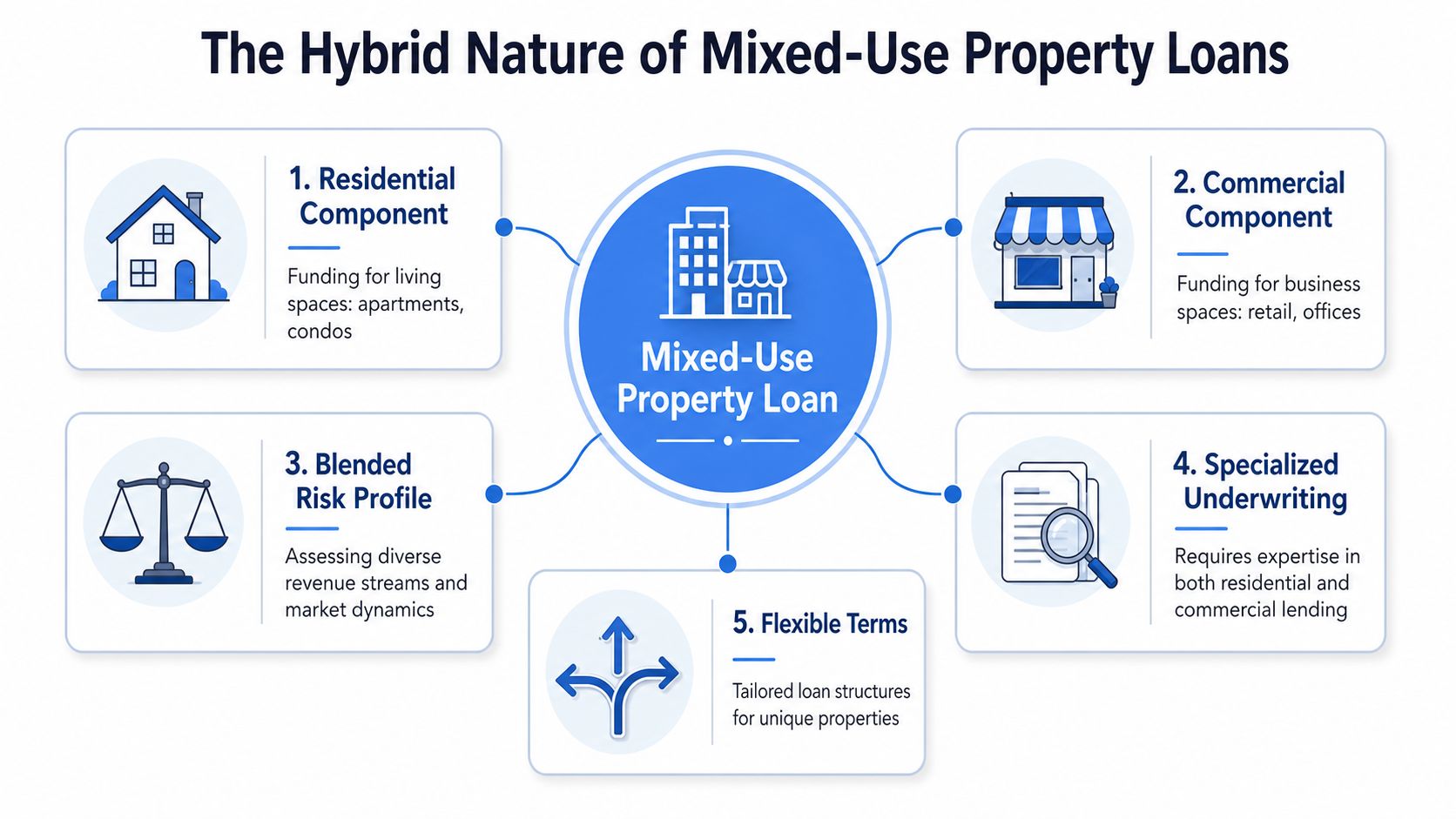
You can have a building with four solid apartments, one occupied storefront, and a clean operating history, and it still gets treated like a harder loan than a plain multifamily deal. That is the mixed-use reality. The property produces income, but the income comes from two tenant types, two lease structures, and often two very different risk profiles.
That difference matters because lenders do not underwrite a mixed-use asset the way they underwrite a standard rental property. They are not just asking whether rent covers the payment. They are asking how stable the commercial rent is, how much of the total income comes from that space, and whether the building still works if one side weakens.
The income test is more layered
On a mixed-use deal, income is usually reviewed as one property-level cash flow, but the lender rarely gives equal weight to every dollar. Apartment rent is often seen as easier to replace. Commercial rent can be stronger on paper, but it carries more questions. What kind of business is in the space? How long is the lease? Who pays taxes, insurance, and maintenance? How hard would it be to release the unit if that tenant leaves?
That is why debt service coverage ratio, or DSCR, matters so much. The Consumer Financial Protection Bureau defines DSCR as a property's annual net operating income divided by its annual debt obligations in commercial lending context, which is the core idea lenders use to measure whether the asset can support the loan (CFPB glossary).
In practice, mixed-use underwriting is rarely just a math exercise. A property can show enough income on a spreadsheet and still get reduced proceeds if the commercial side looks thin, volatile, or too large for the lender's box.
The terms that change the deal
Three terms drive most mixed-use loan decisions:
- DSCR: Measures whether property income supports the debt payment with room for error.
- Loan-to-Value: Sets how much a lender is willing to advance against the appraised value. The more complexity in the building, the more conservative this usually gets.
- Rent roll and lease review: Shows who occupies the property, what they pay, when leases expire, and how dependable that income is.
A storefront vacancy does not stay isolated. It can reduce cash flow, weaken appraised value, and push the whole loan into a category many banks avoid.
Why mixed-use loans fall into a different lending lane
The issue is not that mixed-use properties are bad collateral. The issue is that conventional lending rules often treat them as exceptions. Once the commercial component gets too prominent, or the lease profile gets too uneven, the deal can drift into the no-finance zone where bank policy overrides property performance.
Private lenders often step in there because they can underwrite the actual deal instead of forcing it into a residential-only template. They still care about coverage, value, and tenant quality. They are just more willing to work through a property that has a strong business case but does not fit a conventional credit box.
For investors, that is the key difference. A mixed-use loan is not only about borrowing against a building. It is about finding a lender that understands how the residential and commercial pieces work together, and what risks are real versus outside bank policy.
Decoding the Underwriting Process for Your Deal
When a lender underwrites a mixed-use deal, the first question usually isn't rate. It's fit. Before anyone gets deep into pricing, the lender wants to know what bucket the building lands in and whether that bucket matches an available program.

The first screen is leverage and coverage
For conventional mixed-use financing, lenders typically want a stabilized DSCR of at least 1.25x, and conventional LTVs are strictly between 65% and 75%, based on Crestmont Capital's guide to business loans for mixed-use developments. Some deals get tested even harder in riskier situations, but that baseline alone knocks out plenty of files.
That standard matters for two reasons. First, it tells you why a marginally cash-flowing property may not get traction with a bank. Second, it shows why mixed-use borrowers often need more equity than they expected.
The commercial share can change the whole file
Small changes in the building mix can push the property into a different lending lane. A residential-heavy asset may get looked at more like a rental property. A more commercial-heavy asset may move into a full commercial review with tighter reserves and more scrutiny on tenant quality.
That's where investors get blindsided. They focus on total rent and total value, but underwriting cares about composition too.
What lenders stress-test
Lenders usually pressure-test the weak points in the income. That often includes:
- Commercial lease term: A short remaining term raises renewal risk.
- Tenant quality: A stronger tenant usually gives the lender more comfort than a fragile local operator with thin history.
- Vacancy exposure: A dark storefront can reduce proceeds fast because the lender knows it may take time and money to refill.
- Below-market or inflated rents: If the numbers don't look durable, the lender may underwrite to a lower figure.
Here's a useful walkthrough on financing structure and lender expectations before you go too far with a file:
What borrowers can control
You can't change every fact in the property, but you can control presentation. A sloppy file tells the lender there may be more problems hiding behind it.
Bring these items early:
| Underwriting item | Why it matters |
|---|---|
| Current rent roll | Shows actual income and vacancy exposure |
| Leases and amendments | Confirms term, rent, options, and reimbursements |
| Operating history | Helps the lender judge whether income is stable |
| Property photos and layout | Clarifies how the building is really used |
| Borrower plan | Explains lease-up, rehab, or exit strategy |
The best mixed-use files answer the second question before the lender has to ask it.
When a bank says the deal is too complicated, that usually means one of two things. The property doesn't fit policy, or the file doesn't clearly prove stability. Those are very different problems. One requires a different lender. The other requires better packaging.
Your Guide to Mixed-Use Loan Products
You find a corner building with strong apartments upstairs, a decent basis, and a seller who wants a quick close. Then the financing issue shows up. The storefront takes too much of the square footage for a bank, one lease is short, and your tax returns do not tell a clean W-2 story. That is the no-finance zone for a lot of mixed-use deals.
The product you choose has to match the core problem in the file. Sometimes the issue is speed. Sometimes it is property mix. Sometimes it is borrower complexity. Mixed-use financing gets easier once you stop sorting loans by label and start sorting them by what each lender can tolerate.

Mixed-Use Loan Product Comparison
| Loan Type | Typical leverage and terms | Closing speed | Best For |
|---|---|---|---|
| Conventional bank loan | Often strongest pricing, with leverage tied to occupancy, commercial mix, and borrower strength. Fannie Mae notes mixed-use properties generally need a majority residential use to fit standard multifamily treatment in its mixed-use property eligibility guidance. | Usually the slowest option because underwriting, appraisal, and committee review take time | Stabilized properties that fit bank policy and do not raise use or documentation issues |
| SBA 504 | High leverage can be available for owner-occupied business properties under the SBA 504 structure, as explained by the U.S. Small Business Administration 504 loan program overview | Slower, with more documentation and program rules | Owner-users buying a building for their own operating business |
| DSCR loan | Terms are driven by rent coverage, property type, and lender appetite. In practice, mixed-use DSCR sizing is often more conservative than 1 to 4 unit residential DSCR programs | Faster than a bank if the leases, rent roll, and insurance are in order | Non-owner-occupied deals where the property income matters more than personal tax return complexity |
| Bridge loan | Short-term debt priced for speed and transition. The Mortgage Bankers Association describes bridge lending as an interim solution used to acquire, reposition, or refinance before permanent debt is available in its commercial real estate finance glossary | Often the fastest path to a closing | Acquisitions with deadline pressure, vacancy, lease-up, rehab, or payoff risk |
| Fix-and-flip or rehab-focused private loan | Structure depends on scope, budget, and after-repair plan. Some lenders will fund purchase plus rehab draws if the business plan is clear | Fast if the scope of work and exit are credible | Distressed mixed-use buildings that are not ready for permanent financing |
Which product works when
Conventional debt works when the property is already behaving like a financeable asset. Stable rents, a commercial component that stays inside policy, and a borrower file that does not need explaining. If the deal slips outside those lines, banks often pass without saying why. The property may be good. It just does not fit the box.
SBA 504 belongs in a narrower lane. It can be an excellent tool if you are buying a building your own business will occupy. It is rarely the answer for a pure investor buying a mixed-use asset for rental income.
For investors, DSCR and private bridge loans usually carry the conversation. DSCR can work when the income is documented and reasonably stable, even if your personal returns are messy from depreciation, multiple entities, or uneven write-offs. Bridge debt is better when the property needs time before it deserves long-term financing. If you want a broader look at how these structures compare, review these commercial real estate financing options.
Private rehab money fills another gap. It is useful when the building has the right story but the wrong current condition. A vacant retail bay, deferred maintenance, or incomplete renovations can push a good asset out of bank territory. A private lender can underwrite the plan instead of judging only the property as it sits today.
Down payment and speed trade-offs
Here is the practical trade-off. The more a lender has to explain to a credit committee, the more likely the loan amount decreases and timing stretches.
For non-owner-occupied mixed-use deals, private and DSCR lenders usually want meaningful borrower cash in the deal. Constitution Lending notes that mixed-use structures often require larger equity contributions than standard residential financing in its overview of commercial loans for mixed-use properties. That is normal. Complexity gets priced through rate, the debt component, or both.
Use that to choose the right product.
- Pick bank debt when the property is stabilized, the commercial percentage is within policy, and you have time.
- Pick DSCR when the rents support the loan but your personal income documentation is the weak point.
- Pick bridge money when speed matters or the building needs lease-up, cleanup, or repositioning before takeout financing.
- Pick a rehab-focused private loan when the value will come from execution, not from the current rent roll.
Cheap debt only helps if it closes. In mixed-use lending, the best loan is usually the one that matches the problem that is blocking the deal.
When to Choose a Private Lender Over a Bank
A bank is a good option when the deal is clean, the timeline is forgiving, and both the property and borrower fit standard policy. That's not most mixed-use investment deals.
Private lenders become the better choice when the problem isn't asset quality. It's fit.
The situations where private lending makes sense
If you need to close fast to win the property, a bank timeline can become a significant risk. Sellers don't care that your lender committee meets next week. They care whether you can perform.
If the commercial portion is too high for conventional comfort, shopping the deal from one bank to another usually burns time. The same is true when the retail space is vacant, the lease is short, or the building needs stabilization before it deserves long-term debt.
Borrower issues that banks don't handle well
Banks also struggle when the borrower doesn't fit a standard income story. Maybe you're self-employed. Maybe your returns are complex. Maybe your debt picture looks messy on paper even though your properties perform.
A key advantage of portfolio and hard money lenders is their flexibility for borrowers with complex finances or credit scores in the 600s, because they focus on the property's income potential rather than personal debt-to-income ratios and W-2 income, as explained in Crestmont Capital's mixed-use property loan overview.
That difference matters more than many investors realize.
- Complex tax returns: Private lenders may care less about how your accountant structured deductions if the property can support the debt.
- High personal debt: Banks may freeze on global debt. Asset-focused lenders may spend more time on the deal itself.
- Transitional properties: A bank often wants the building after the story is fixed. A private lender may fund the story while you fix it.
For investors weighing short-term options, this overview of non-bank bridge loans for investment property is a useful reference point.
What private lenders still need to see
Flexibility doesn't mean loose lending. Good private lenders still want a credible path.
They want to know:
- What the property is today
- What changes after closing
- How the loan gets repaid
- Why the rents, lease-up, or exit are realistic
A bank no isn't always a deal no. Sometimes it's just a sign you're using the wrong capital source.
The strongest borrowers in private lending are often not the borrowers with the prettiest personal file. They're the investors who understand their property, know their timeline, and can explain the plan without hand-waving.
A Step-by-Step Roadmap to Securing Your Loan
Mixed-use financing gets easier when you stop treating it like a generic loan request. The lender needs a clear deal package, a clear strategy, and a clear reason the asset works despite its complexity.
That starts before you submit anything.
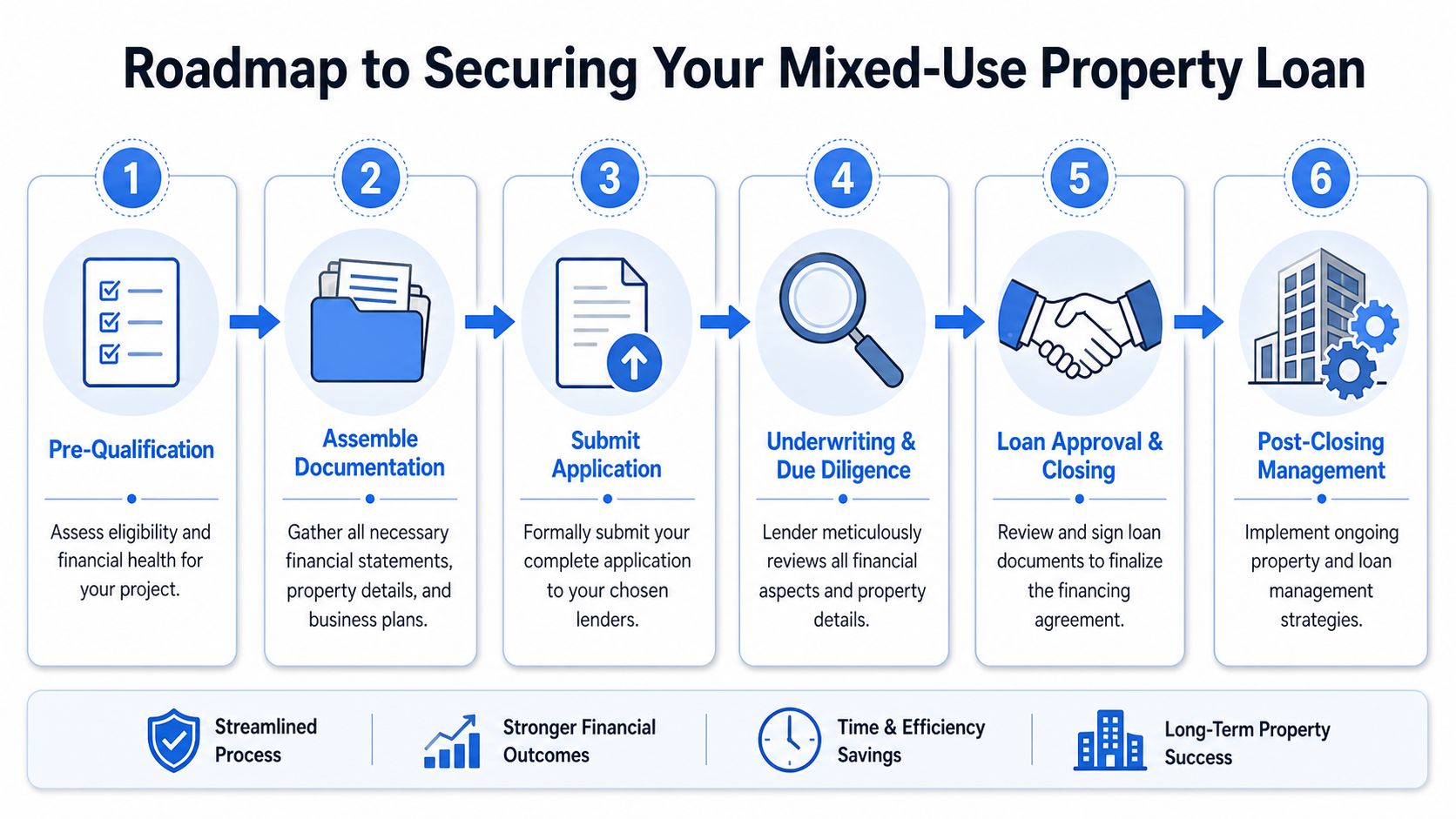
Step one through three
Pre-qualify the property, not just yourself
Look at the building mix, current occupancy, commercial lease terms, and whether the property belongs in a bank, DSCR, or bridge lane. If the commercial share is high or the retail unit is unstable, assume you need a lender with more flexibility.Assemble a real package
Bring the current rent roll, all leases, trailing operating history, entity documents, purchase contract, and a short summary of the business plan. If there's rehab, include scope, budget, and timeline.Submit the story with the numbers
Numbers alone don't carry mixed-use files. The lender needs context. Explain what's leased, what's vacant, what's month-to-month, and what you'll do after closing.
Step four through six
Stay ahead of underwriting
Expect questions about tenant strength, lease rollover, and whether any commercial income is weak or temporary. Answer quickly. A delayed response often gets read as uncertainty.Review approval terms carefully
Don't focus only on rate. Look at reserves, holdbacks, prepayment structure, extension options, and any conditions tied to the commercial space.Manage the property with the refinance in mind
If you closed with bridge or private capital, your next job is to create a cleaner refinance profile. Signed leases, better occupancy, and cleaner operating statements improve your next set of options.
A closing checklist that saves time
Use this before you send the file out:
- Property documents ready: Rent roll, leases, estoppels if available, and operating statements.
- Ownership structure clear: Borrowing entity, guarantors, and vesting should be settled early.
- Business plan written down: Lease-up, rehab, stabilization, or payoff strategy should fit on one page.
- Commercial story explained: Tenant type, lease term, and vacancy plan should be obvious.
- Timeline defined: State when you need to close and whether seller pressure, payoff deadlines, or construction milestones apply.
Strong execution in mixed-use lending usually comes from preparation, not persuasion.
A lot of deals that look difficult are just poorly organized. When the file is complete and the strategy is credible, lenders can move much faster.
Funding Your Next Mixed-Use Investment with Confidence
Mixed-use properties reward investors who can see value where standard lenders see friction. The building may have good bones, multiple income streams, and a strong location, but that doesn't matter if the financing plan starts with the wrong lender.
A fundamental takeaway concerning mixed-use property loans is this: This asset class isn't impossible to finance. It just doesn't fit cleanly inside every bank box. When the commercial component is too heavy, the property is in transition, or your personal finances don't read like a simple W-2 file, you need a lending strategy built around the existing deal.
The practical approach is simple. Match the property to the right capital source early. Package the file tightly. Be honest about the commercial risk, the lease-up plan, and the exit. That saves time, protects earnest money, and gives you a better shot at closing without surprises.
Investors who do this well don't waste weeks trying to force a bank approval that was never likely. They pivot quickly, secure control of the asset, and then improve the property into better long-term financing later.
If you're looking at a mixed-use acquisition, refinance, or bridge scenario, the key isn't chasing every lender. It's choosing one that understands how these deals really work.
If your bank won't fund a mixed-use investment property, LendingXpress can help you explore practical options for bridge, DSCR, and asset-based financing built for speed, flexibility, and real-world deal complexity.