
California hard money quotes typically run in the low double digits, around 10% interest with roughly 1 to 2 points. That headline number alone is misleading because points, minimum interest, extensions, and draw terms can make a lower rate cost more over your real holding period.
If you're looking at a non-owner-occupied property that a bank won't touch, or won't touch fast enough, you're probably not shopping for the cheapest money in the abstract. You're shopping for capital that closes, funds the work, and still leaves a margin when you sell or refinance. That's the right frame for hard money loan rates in California. Don't ask only what the rate is. Ask what the loan costs if the project takes six, twelve, or eighteen months.
Two Quotes, Same Property, Different Reality
You've got a California investment property under contract and two term sheets on your desk. Both lenders say they can close. Both quotes sit within a point of each other on rate. Your eye goes straight to the lower interest number, because that's how most borrowers have been trained to shop a mortgage.
Then you read the fine print. One quote carries more points paid at closing. The other asks for minimum interest, so a fast payoff doesn't save as much as you expected. One assumes you'll finish inside the initial term. The other prices the extension you'll need if permits, a contractor, or a buyer runs late.
I've built quotes like these from the lender side. Every line exists because something on the deal can go sideways, and the coupon is the last number worth arguing over.
Why the Lower Coupon Can Lose
Points are paid upfront, while interest accrues over time. Sell quickly and you've spread that upfront charge over a handful of monthly payments, so it weighs far more on your realized cost. Hold longer and the rate carries more weight, until an extension fee changes the math again.
This structure reflects how short-term, asset-based money gets priced. A private lender charges for speed, flexibility, property risk, and a short window to earn a return. For non-owner-occupied deals that don't fit a bank box, that trade-off can be worth paying for, but only if you price the whole package.
Run the same property through both quotes at a six-month exit, then a twelve-month exit, then with one extension. The quote that looks cheaper on day one can flip well before payoff. I've watched borrowers take the lower coupon and pay more because the exit slipped one quarter.
Compare offers on total dollars over your expected hold, then stress that hold. A quote that wins at twelve months can lose badly at six.
So don't expect one statewide rate to tell you if a deal works. Read any quote the way the lender built it, line by line, with your exit timing in the middle of the page.
Why California Pricing Has Its Own Rules
California doesn't work like a conventional mortgage rate sheet, and the reason starts with state law. Most rate articles skip this part. You shouldn't, because it explains why lenders structure fees and broker involvement the way they do, and why two loans with the same stated rate aren't treated the same.
The diagram below maps the legal cap, the state framework, and market forces that sit behind a California quote.

Article XV and the Full Economic Package
For nonpersonal loans, California Constitution Article XV generally limits interest to the greater of 10% per year or 5 percentage points above the applicable Federal Reserve Bank of San Francisco rate. Courts don't look only at the coupon on the note. Required bonuses or fees are evaluated together with interest, so mandatory charges can push the effective return into a legal issue even when the advertised rate looks modest.
That's practical, not academic. If a lender loads a deal with required upfront charges, you have to analyze the entire economic package, including points, bonuses, and extensions. Comparing coupon rates alone misses the very things California courts examine.
The Proposition 2 Broker Exemption
A major exception changes the picture for many real-estate-secured loans. Proposition 2, approved in 1979, created an exemption for loans made or arranged by a California-licensed real-estate broker and secured wholly or partly by a lien on real property. When its requirements are satisfied, that exemption can remove the constitutional ceiling.
California courts have applied that principle broadly, including a decision describing a broker-arranged loan at an extreme rate as exempt. You don't need to memorize case law. You do need to know that the borrower's purpose, the lender's licensing status, the security for the loan, who arranged it, and how the file is documented can materially affect whether a cap applies.
This is why California hard money pricing is individualized rather than published as one statewide number. The legal structure, the property, your equity position, your execution risk, and your exit all feed the same quote. A lender who can't explain how the loan is structured under California rules is giving you a number without the foundation under it.
Anatomy of a Typical California Hard Money Quote
You have a purchase closing in two weeks, a rehab budget to fund, and a term sheet quoting a rate plus points. The coupon tells you only part of the cost. Compare each charge against the time you expect to hold the loan, including a realistic delay.
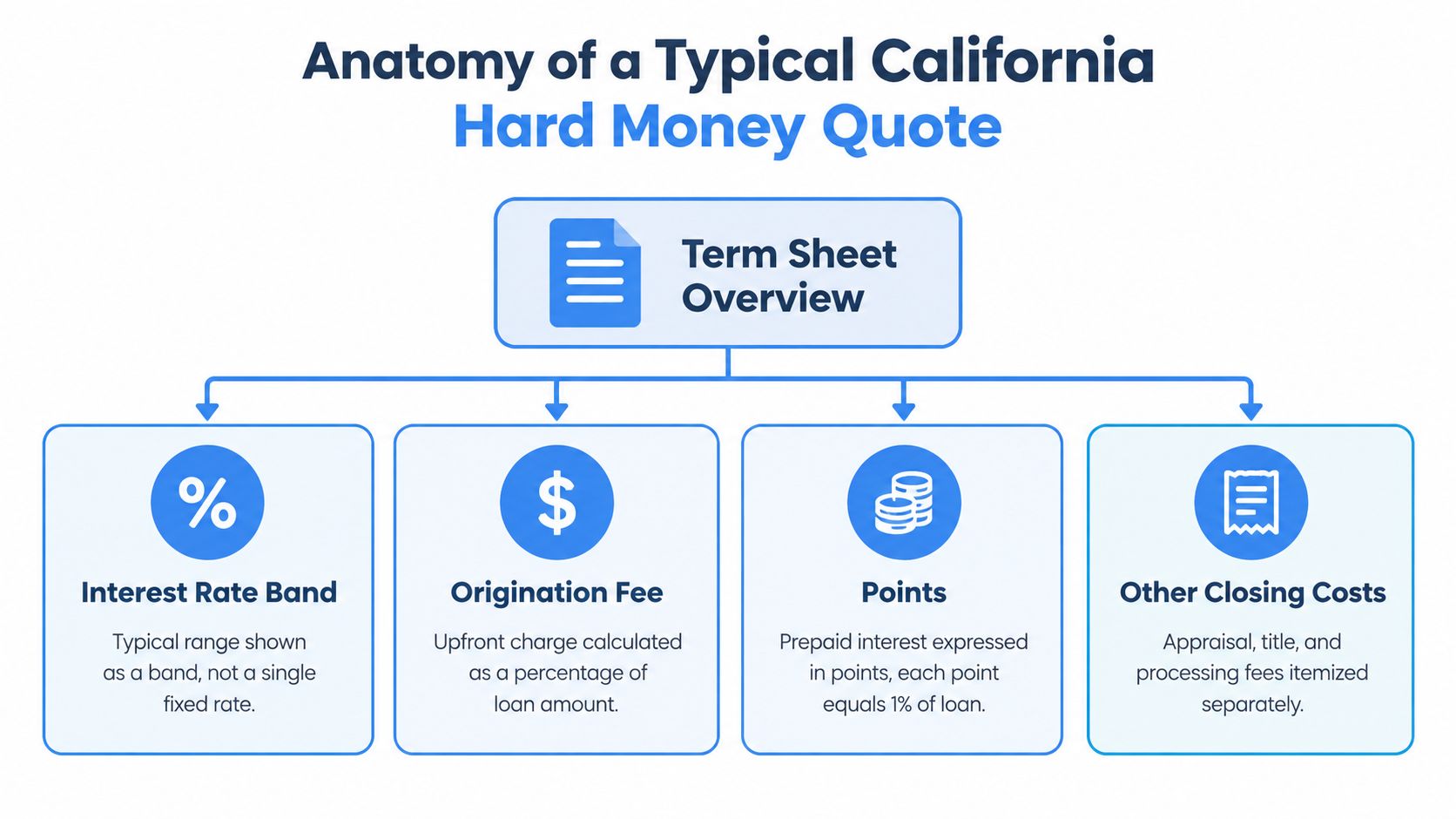
Rate, Points, and Monthly Carry
Consider a hypothetical 12-month, $1,000,000 interest-only loan at 10.0% with 2.3 points. Interest over the year is $100,000, and the points add $23,000, for $123,000 in interest and origination charges before closing, servicing, or other costs. At 10.0% interest-only on $1,000,000, monthly debt service runs about $8,333.
Points are generally paid at closing, reducing the cash available for the purchase and initial work. The holding period changes the comparison: if the loan pays off after six months, points still count in full, while interest accrues only for the time the balance remains outstanding. Check the payoff language and any minimum-interest provision before treating an early exit as a savings.
The Lines Borrowers Underprice
- Minimum interest: Ask whether a set amount is owed even if you pay off early.
- Extension pricing: Confirm the fee and conditions before closing.
- Draw terms: Find out whether rehab funds arrive in stages and whether interest applies to the full commitment or only amounts drawn.
- Default pricing: Review the rate and fees that apply if repayment is delayed.
- Third-party costs: Appraisal, legal, escrow, title, and recording charges sit outside the rate and points, but still reduce your margin.
Rebuild the quote in dollars for your expected hold and for a plausible delay: interest, points, extension costs, and other fees. Then compare the totals. A lower coupon can cost more if the loan has higher points, expensive extensions, or a minimum-interest charge.
The Four Levers That Move Your Rate
Two lenders can review the same California property and quote different rates because they assess different risks. The main drivers are the amount financed relative to the property's value, the collateral's condition and resale market, the borrower's experience, and the repayment plan.
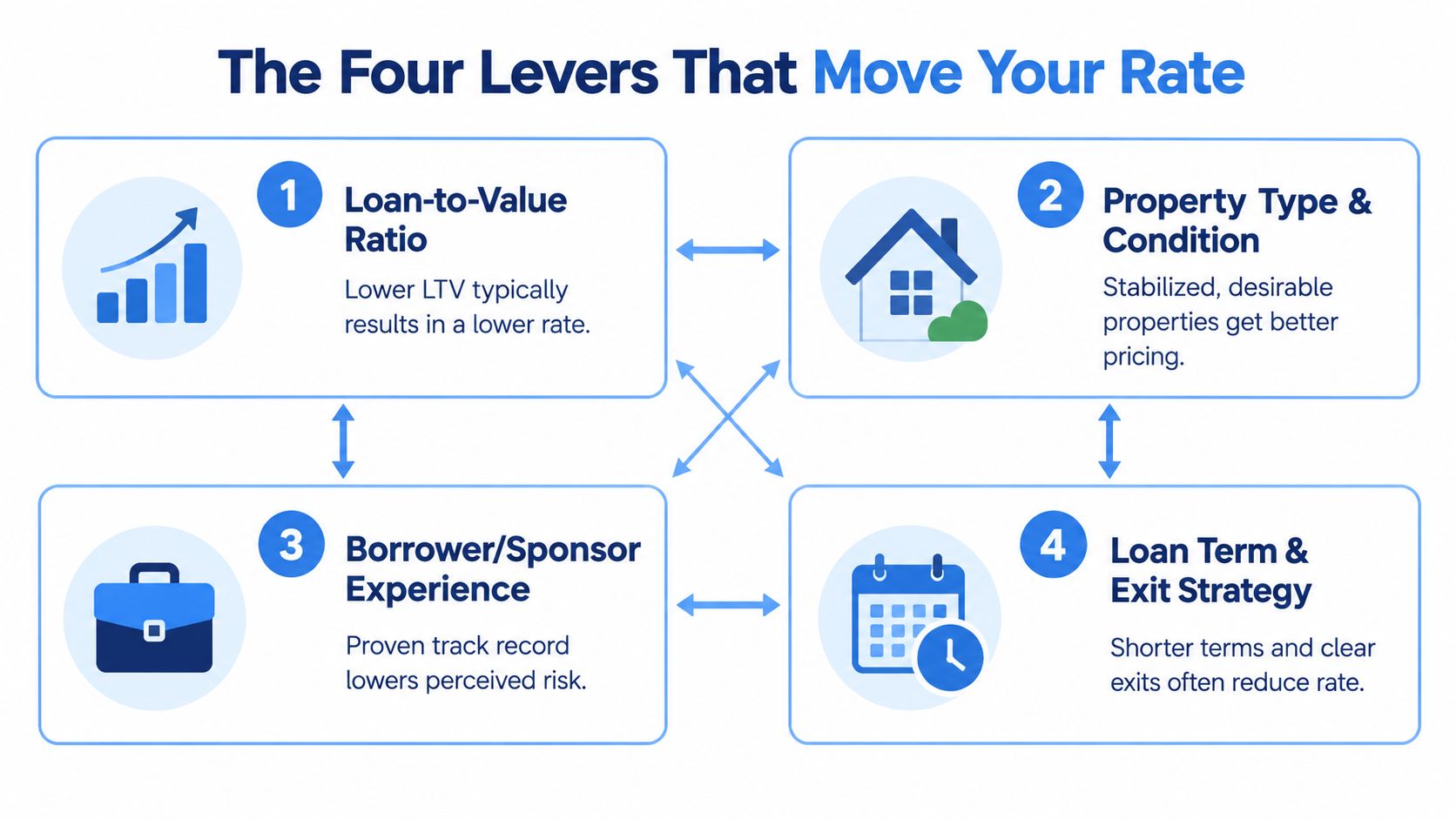
Loan-to-Value and Property
Loan-to-value ratio (LTV) measures the loan against the property's value. A lower LTV gives the lender more protection if the value falls, which can support a lower rate. A request for maximum financing on a worn property does the opposite. Review how loan-to-value ratio is calculated and what it measures before comparing offers.
Condition and resale demand matter alongside LTV. A clean residential flip in an active market presents a different recovery prospect than a half-leased commercial property or a building with deferred repairs and few likely buyers. More marketable collateral can support tighter pricing because a lender has a clearer path to repayment if the project stalls.
Sponsor and Exit
A borrower's experience affects the lender's view of execution risk. Completed projects of a similar type, a realistic budget, and a qualified contractor can strengthen an application. First-time investors may still qualify, but lenders may account for the added uncertainty in the rate or loan structure.
For income property, operating cash flow also shapes the exit. Permanent commercial lenders commonly look for a DSCR of approximately 1.20x to 1.25x or higher. A property below that range may still suit bridge financing while the borrower raises occupancy, increases rents, or completes renovations before refinancing.
Finally, the loan term needs to match the repayment plan. A quick resale, a refinance into permanent debt, and a staged lease-up carry different timelines and risks, even when the quoted rates look similar. A specific, workable exit gives the lender more confidence in repayment.
Real Rate Scenarios Across California Markets
Hold period is where good underwriting separates from hopeful underwriting. A fix-and-flip borrower who plans for a short hold and gets a long one doesn't just pay more interest. The entire ranking of competing offers can flip.
Recent California data gives you a realistic starting band for the exercise. Q1 2025 data covering 1,501 California private loans reports average rates ranging from 9.83% to 10.67% with average origination charges of 1.3 points.
What $1 Million Looks Like Over Time
Using that source's illustration, a $1 million, 12-month loan at 10.22% with 1.3 points would cost approximately $115,200 in interest and origination charges before escrow, title, recording, appraisal, legal, extension, draw, or default-related costs. That's the honest baseline. It already shows that the all-in cost is higher than the headline rate suggests.
Now stretch or compress the timeline. At six months, points don't shrink just because you worked faster, so they consume a larger share of the total and push the annualized cost up. At eighteen months, you've paid another block of interest and may have triggered an extension charge, so the extension assumption starts to dominate the actual rate.
California Hard Money Total Cost at Different Hold Periods
| Hold Period | Nominal Rate | Points | First-Year Cost (USD) | Effective Cost |
|---|---|---|---|---|
| 6 months | Around 10% | Higher points hurt most | Interest for the hold plus full points | Highest annualized cost if points are heavy |
| 12 months | Around 10% | Balanced against a full year of interest | About $115,200 on the $1 million, 10.22%, 1.3-point illustration noted above | Rate and points trade off more evenly |
| 18 months | Around 10% before extension terms | Points spread over a longer hold | Twelve months of cost plus added interest and any extension fee | Extension assumptions drive the realized rate |
The table is deliberately not a promise of pricing in Los Angeles, Orange County, the Inland Empire, or anywhere else. Local liquidity and property type affect financing and rate, but the math of time works the same in every California market. Points punish a short hold. Extensions punish a long one.
Ask every lender the same question. What does this loan cost in total dollars if I exit in six, twelve, or eighteen months?
If a lender can't answer that cleanly, you don't have a quote yet. You have a headline.
Getting Competitive Terms on Your Next Deal
You don't get better terms by telling a lender another shop quoted less. You get them by removing uncertainty from the file and by shopping the same deal, on the same assumptions, with lenders who are authorized and able to perform.
The review below is the unglamorous part that moves pricing, packaging the deal so an underwriter can say yes without guessing.

Package the File Before You Shop It
Bring a clear exit strategy, comparable sales that support value, a rehab scope that matches the budget, and a record of relevant completed projects. Explain how the property gets from purchase to sale or refinance, and where the timeline could slip. Lenders price vague files defensively because they have to assume the missing pieces break against them.
Know what a competitive starting point can look like on the commercial side. Published California guidance places commercial bridge and hard-money rates roughly in the 9.49% to 12.99% range with example maximum leverage around 70% LTV, giving a $1,000,000 property a $700,000 loan before the borrower funds roughly $300,000 of purchase equity plus closing costs and reserves in that example.
Verify, Compare, and Negotiate the Right Trade
Check licensing before you share sensitive documents or pay upfront fees. California's framework for mortgage-loan activity and broker licensing gives you a way to verify that the party arranging a real-property-secured loan is authorized to do that work, and starting with a roster of California private money lenders helps you shop within that regulated market.
Then compare at least a few offers on identical hold assumptions. If you expect a quick resale, trading a slightly higher rate for fewer points can be the smarter bargain. If you expect a longer hold, the reverse may win.
- Draw structure: Push for interest on funded rehab balances where the program allows it, rather than paying on money you haven't drawn.
- Extension language: Negotiate the option and its price while you still have negotiating power, before closing.
- Net proceeds: Confirm what points and closing costs do to cash at the table, not just to rate.
A relationship-driven lender should be willing to tailor that structure to a specific investment goal. Speed and flexibility are the point of this capital, but they only help if the terms match how your project will unfold.
Putting It All Together for Your Next California Deal
Carry one framework into your next quote comparison. California pricing is structured deal by deal, shaped by the state's usury rules and the broker exemption, and the headline rate is only one input. Points, minimum interest, extensions, draw mechanics, borrow amount, and your exit assumptions decide what you really pay.
Start with the market band, then rebuild each offer in total dollars at a short, expected, and extended hold. That single habit will save you from choosing the cheapest-looking loan that becomes the most expensive one on your actual timeline. It also tells you which term to negotiate, because the right trade depends on whether time or upfront cost is your bigger risk.
For borrowers who want that conversation with a California lender rather than a rate sheet, LendingXpress structures bridge, fix-and-flip, and rental property loans for non-owner-occupied residential and commercial assets, with typical loan sizes from $100,000 to $18 million+, closings possible in as little as three days, and up to 100% rehab financing with staged draws. The fit isn't automatic for every deal, and terms still turn on collateral and exit. The value is in getting terms structured around a specific project instead of forcing your project into a generic quote.
Bring the property, the budget, and a realistic exit. Then make every lender, including anyone you already like, prove the cost over the hold you'll probably have, not just the one you hope for.
If you've got a California acquisition, flip, or bridge deal that needs a clear all-in cost breakdown before you commit, LendingXpress can walk through rate, points, draws, and exit timing for your specific property. Visit the site to start a conversation about structuring financing around your timeline, capital, and resale or refinance plan.